Year of the Snake
February 21, 2013 § 4 Comments
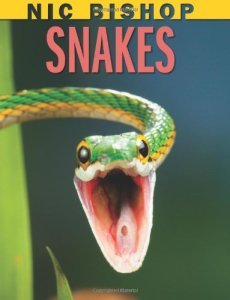 Let me be clear: I am not a snake person. Just ask my husband about the time our former neighbor’s grandson misplaced his yellow and black striped rubber snake in our driveway. My hysteria, combined with the Internet, had half the street convinced that a rare and deadly species of snake (I believe we had landed on the Eastern King Snake) had invaded our DC suburb. My husband finds this an enlightening story about my disposition to overreact (I prefer to think of it as strong survival instincts).
All this is to say that if I am telling you that Nic Bishop’s Snakes (Ages 5-12) is not only A-MA-ZING but that I have been volunteering to read this book to my son, then you should take me very, very seriously. You should march straight out to your local bookstore and buy this book (actually, you should buy all the books in Bishop’s series, even those about tamer animals like butterflies and frogs).
Eyes on Abraham Lincoln
February 12, 2013 Comments Off on Eyes on Abraham Lincoln
 You might expect that my children, living so close to Washington DC, have many opportunities to learn about our nation’s history. But mere proximity does not a future scholar make. The Lincoln Memorial, for example, is consistently celebrated by my five year old as “the place where we picnic in the summer!” If you ask him the name of the president that sits in stone behind him during said picnics, he is likely to throw you a disinterested look and recommence staring out the car window, pointing out other landmarks whose names he boasts correctly but whose significance he understands not. Which begs the question: How do we get our kids to care about the past presidents that have shaped our country?
The biographies we read as kids were filled with dry facts and black-and-white photographs that made their content feel all too disconnected from our daily lives; too often we were encouraged to memorize names and dates for tests, only to forget them a week later. Thankfully, our own kids have access to a whole new generation of fresh reading material, including picture books that breathe colorful new life into historic periods and events.
Thinking Outside the Box This Valentine’s Day
February 5, 2013 § 4 Comments
 Is there a better way to shower our children with love this Valentine’s Day than by snuggling under a blanket with them and sharing a new story? And yet, I’m never thrilled with the list of books that the media typically puts forth as gift ideas for V-Day. Chances are you already have your fair share of books about parental affection (the Guess How Much I love You? sort). If I’m being totally honest, I feel a tad exploited by these lovey-dovey books about hugging and kissing and eternal love; too often they’re lacking in imagination and art and feel instead like a cheap move by publishers to go after our vulnerability as parents (I’ll get off my soapbox now). There are some wonderful classics, like Judith Viorst’s Rosie and Michael and Sandal Stoddard Warbug’s I Like You, but their content is arguably more appropriate for grown-ups to give one another.
So when it comes to Valentine’s Day, I like to think outside the box. In the past, I’ve given my son the glorious Red Sings from the Treetops (hey, there’s red in the title) and The Jolly Postman (Valentines are like letters, right?). But this year, I have an especially good one pegged for my two-year-old daughter; I’ve been hiding it under my bed since it came out last fall and biding my time to spring it on her.
Snow Days
January 24, 2013 Comments Off on Snow Days
 Last night, as I was falling asleep, I wished for snow. Not for the parent in me (who dreads school closures); not for the adult in me (who has never been terribly coordinated at navigating icy pathways); but for my children. In the two and a half years since our family moved to Virginia from the Midwest (land of bountiful blizzards), snow has been something that my kids talk about, dream about, but rarely, if ever, experience. I must admit I find it a bit alarming that my son, so nostalgic for the snow of his earliest years, has taken to listing shoveling among his top five favorite activities. It just doesn’t seem fair that my kids have to go through the daily chore of putting on puffy coats and woolen hats and fleece mittens—without the reward of some billowy white stuff to play in.
So last night, oddly without even realizing snow was in the forecast, I wished for it. And when I woke up this morning, the quiet hush outside (where was the garbage truck?) and a flurry of school emails on my phone sent me flying to my window, where I could hardly wait to broadcast my discovery.
As Cynthia Rylant’s beautiful and celebratory Snow (ages 3-8) begins, “The best snow is the snow that comes softly in the night, like a shy friend, afraid to knock, so she thinks she’ll just wait in the yard until you see her.”
“Use Your Words” (MLK Jr. Style)
January 17, 2013 § 1 Comment
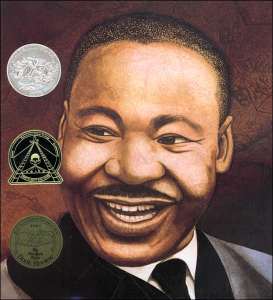 In a few days, our country will celebrate Martin Luther King, Jr.’s birthday and a presidential inauguration. Whatever our political views, whatever our race or gender or religion or socioeconomic background, we can do our children a great service by talking to them about Dr. King’s vision of justice and peace, his commitment to respecting the dignity of every human being.
I’ve found that parents, especially us white Americans, are reluctant to broach the subject of race relations with preschoolers or even young elementary students. Ashamed of our country’s past afflictions, it’s as if we can pretend they never existed if we don’t talk about them. But child development specialists and sociologists (like Po Bronson and Ashley Merryman, authors of NurtureShock) have pointed out that children naturally notice differences in appearances, and that if we don’t have these conversations with them from an early age, they will begin to draw their own conclusions—and, even worse, begin to view the subject as taboo—which does nothing to advance our nation’s long and still arduous progression toward equality. And, let’s be honest, have you ever met a five or seven or ten year old that isn’t obsessed with the notion of fairness? For that matter, how many times a day do we as parents plead with our children, “Use your words!” (say, when said children yank something out of their sibling’s hands or push a peer on the school playground)?
January’s Birthday Pick
January 8, 2013 § 1 Comment
 For this month’s birthday pick, I’m doing something a little different: 1) I’m focusing on the youngest ages for a change; 2) I’ve chosen not one but two books (which make a perfect pairing); and 3) I’m encouraging you to throw caution to the wind and take a chance on books that aren’t brand new but are commonly unknown.
In short, the next time you are headed to a birthday party for a one or two year old, you’re in luck. I Took the Moon for a Walk (Ages 1-4) and Listen, Listen (Ages 1-4) are both illustrated by the supremely talented Alison Jay, whose praises I have sung here before. With their over-sized 9” by 9” format, these hefty board books mirror another favorite by Jay, her ABC: A Child’s First Alphabet Book (which tends to be well known and for good reason: it may just be the best alphabet book ever illustrated).
Alison Jay’s books are the ultimate gift. Packed with hidden surprises, layered with detail, and shimmering in vivid colors underneath a “crackle” finish, Jay’s paintings beg to be poured over again and again.
The Year That Lies Ahead
January 3, 2013 § 2 Comments
On the morning of January 1, my five year old crawled into our bed and asked with great solemnity, “Is the year of Christmas over?” I’m not entirely sure what he was getting at; did he mean to say month? or season? or was he actually inquiring as to whether the Year of the Great Christmas of 2012 had ended? I’ll never know exactly what was ruminating in his little head, but it was a sweet reminder of how bewildering the concept of time is to children—even to a five year old who has plenty of memories of past years.
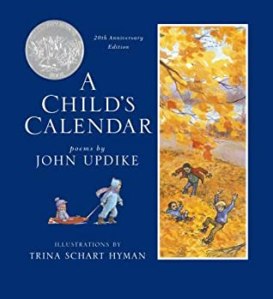
We as adults take for granted our assurance about the cyclical nature of time: that all seasons, all holidays, all of nature’s dramatic transformations, will occur again and again with each passing year. It will probably come as no surprise that my instinctual reaction to JP’s question on New Year’s morning was to send him downstairs to fetch some relevant reading material. One of my all-time favorite children’s books (a book so precious to me that it actually resides on the “adult” shelves of our living room library) is A Child’s Calendar (Ages 5-10), a 1965 treasure of poems by John Updike that was later given a ’90s makeover with the addition of award-winning illustrations by Trina Schart Hyman.
« Read the rest of this entry »Holiday Gift Guide 2012 (No. 4): Books For the Hero Within
December 18, 2012 § 1 Comment
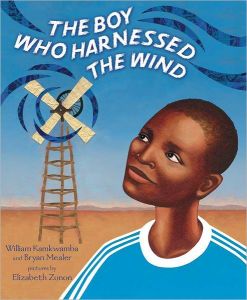 Benjamin Franklin once penned: “If you would not be forgotten/ As soon as you are dead and rotten,/ Either write things worth reading,/ Or do things worth the writing.” OK, that might not be a quote we need to read aloud to our young children, but its sentiment can and should inform the books we choose to share with them.
The genre of biographies written for children is taking off like never before; it seems not only are parents and educators seizing the chance to inspire our young ones with tales of historical figures, but kids themselves are embracing these literary opportunities to inform their own choices, to pave their own paths worth living. And it’s no accident that many of this past year’s biographies are picture books: against a backdrop of beautiful art and poetic text, stories about scientists, writers, inventors, artists, and peacemakers become that much more gripping. The books listed at the end of this post are treasures worth giving and owning; their artistic caliber alone makes them a far cry from the dry, fact-filled paperbacks that we once suffered through for school reports.
Holiday Gift Guide 2012 (No. 3): Books for Future Zoologists
December 13, 2012 § 1 Comment
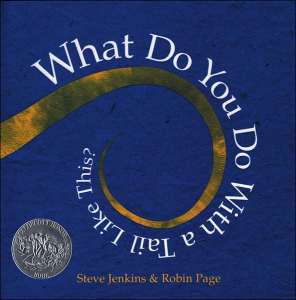 If you have an animal lover in your life, allow me to introduce you to the amazing Steve Jenkins, whose stunning paper collages are the basis for highly engaging and informative books about animals. Why do these books make great gifts? For starters, most parents don’t know about them! Jenkins’ books are more likely to end up on the non-fiction shelves of bookstores and libraries than in places where parents would be likely to bump into them; and while they are technically non-fiction, these gems read like picture books.
The other reason they make great gifts is because they play directly into children’s inherent curiosity about the world around them. Jenkins uses the animal kingdom as a vehicle through which to introduce all kinds of scientific topics—and he does so while keeping kids as absorbed as if they were listening to stories featuring animal characters. He tackles all the obvious themes, like anatomy, food chains, adaptations, symbiotic relationships, and basic survival. But he also tackles more abstract concepts, like time, proportion, and scale—all through gorgeous spreads of animals and fascinating tidbits (see my complete list of favorite Jenkins titles below, including some for younger and older audiences).
Holiday Gift Guide 2012 (No. 2): Books Cleared for Take Off
December 10, 2012 § 1 Comment
 There are days, OK months, OK years, when it feels like everything is about airplanes and rockets in our house. Last year, JP chose a space-themed birthday party; this year he chose an airplane-themed one. We’ve been to air shows. I chop vegetables in the kitchen while large LEGO creations go whizzing by on little pattering feet. I have even been known to spend rainy days hanging out at Reagan National Airport, just so my kids can watch airplanes take off and land (a.k.a. Richard Scarry’s A Day at the Airport, minus the bratwurst balloon). For my five year old, it seems, life above ground is infinitely more fascinating than terra firma. And his enthusiasm is contagious: even my two-year-old daughter can’t resist squealing when she spots an airplane in the sky. Children’s bookstores aren’t lacking in books about air or space travel, but the trick is to choose ones that don’t compromise on art or narrative. At the end of this post, I’ve listed some fantastic fiction and non-fiction picture books guaranteed to wow any young aviator.
This fall, Brian Biggs came out with Everything Goes: In the Air (Ages 3-6), a follow-up to last year’s successful Everything Goes: On Land (which we also have at our house, for when we get tired of reading about planes). This is young non-fiction at its best, a perfect combo of action and information. Blending a kind of comic book layout with bright cartoon-like illustrations (think Schoolhouse Rock), the simple storyline of a father and son navigating a busy airport is jazzed up by zillions of sub-plots, from the mom of quintuplets whose babies have escaped (lots of seek-and-find opportunities here) to the pirate who’s trying to take his sword through security.
My Favorite Christmas Books
December 7, 2012 § 4 Comments
 I was recently approached by the wonderful local parenting blog Del Ray Baby about doing a guest post on children’s books. After considering a bunch of thematic possibilities, I kept coming back to one: Christmas books! When I worked at my old store, the boxes and boxes of holiday books that I’d ordered would start arriving as early as October. We had to wait until at least Thanksgiving to put them out, so we’d sit at our desks in the stockroom with towers of Christmas titles all around us. Those were wonderful weeks for me, filled with anticipation at ushering in another holiday season and the chance to get these magic-filled treasures into people’s hands.
Yes, I have a weakness for Christmas books. Read all about my favorites here, and I’m betting you’ll love them as much as I do. And a heartfelt thanks to Del Ray Baby for the opportunity to share my musings with a new audience!
Holiday Gift Guide 2012 (No. 1): Books Worth Their Weight
December 6, 2012 § 3 Comments
 When it comes to picking gifts this holiday season, it’s no surprise I vote books all the way (and I’ll have posts all month long with recommendations for everyone on your list). But I thought I’d kick off my Holiday Gift Guide with a more unusual approach.
What about making an impact through sheer weight? I’m talking about reference books: those meaty treasures filled with mind-blowing facts, stunning photography, and encyclopedia-rich knowledge. We normally associate these books with schools, while we focus on stocking our shelves at home with storybooks (why clutter up our houses with reference books when we have the Internet?). But there’s a reason that educational philosophies like Montessori and Waldorf advocate strongly for encouraging children to find answers the old-fashioned way (after all, you learn nothing about alphabetization when you look up a definition on dictionary.com).
A good dictionary or atlas or encyclopedia can grow with your child for years and years. It will make your child a better student, and it will make you a better teacher (come on, we can’t let our children get smarter than us!).
The “Perfect” Christmas Tree
December 3, 2012 § 4 Comments
 This past weekend, we partook in one of our favorite family traditions: chopping down our Christmas tree and driving it home to trim. We started this tradition five years ago, when JP was one year old. I like the idea of my children understanding where their Christmas tree comes from; plus I enjoy supporting the family-owned tree farms in our area; plus, well, we all know that I love any excuse to unleash my urban children on a farm.
By now, the excursion has become fairy predictable. JP (eager to get his hands on a saw) begins by pointing to the first tree he sees and announcing, “This is the perfect one!” I meander deep into the fields, weaving in and out of the rows, sizing up each possibility and muttering oohs and ahhs. And my husband (who has carefully measured our nook at home and tried to set appropriate expectations before we left the house) rushes after me, chastising, “That one is too big! It won’t fit! You promised this year you’d be reasonable!” He has a point, my husband, but I can’t help myself. Something overcomes me out there in the crisp open air, beautifully manicured trees stretching out on all sides of me, and I WANT BIG.
I guess in this way I’m a lot like Mr. Willowby, the mustached tycoon in one of my favorite Christmas stories to read aloud to my kids (or, in the case of last week, to my son’s preschool class). Originally published in 1963, Robert Barry’s Mr. Willowby’s Christmas Tree (Ages 3-8) was reissued last year with newly colorized pen-and-ink sketches that brim with delight. Mr. Willowby’s Christmas tree comes straight off the hills—“full and fresh and glistening green—/The biggest tree he had ever seen.”
Now Please Go to Sleep
November 29, 2012 § 1 Comment
 The best parenting advice I ever received—and didn’t listen to—came when I was in the throes of sleep training my six month old. The advice was: “Make sure you pick a short bedtime ritual, because you’ll be doing it for a long time.” Of course, when you’re knee-deep in sleep deprivation, it’s not easy to see into the future and predict that five years later, your son will still expect a book, water, two songs (one being a made-up “Curious George” song, don’t ask), a hug, a kiss, and a very involved tucking in of the covers every single night.
We all get wiser the second time around; and consequently, I have a five year old who takes 45 minutes to put to bed, and a two year old who takes 45 seconds. But one thing remains the same: I love a good bedtime story.
The best bedtime stories are filled with gentle, lulling rhymes; jewel-toned illustrations; and ample opportunities for whispers and kisses (see my full list at the end of this post). The witching hours of dinner and bath time behind us, pajamas donned and teeth brushed, our collective bodies relax as the first words are read. No matter what madness has just transpired in the moments leading up to this one, peace is now restored; those big juicy bonds of love can flow freely once more (because, let’s face it, it’s almost over).
“Mommy, you know what? You know what? You know what?”
November 20, 2012 § 1 Comment
 My five year old loves to tell stories. Most of the time, his stories are a blend of autobiographical truth and nonsensical make-believe, and most of the time they are his way of working through whatever he’s trying to make sense of in the world (“There was this hurricane, and the winds were swirling around outside like a tornado, and then the roofs of the houses blasted off to Outerspace, and then…). As a parent, I know that I’m supposed to dedicate my ears to him when he’s narrating life’s inexplicable phenomena, but golly if his stories don’t always seem to come at a time when I’m desperately trying to corral him into putting on his coat or swallowing a few bites of food (the fork goes up, then stops, millimeters from the mouth, then comes down again: “Mommy, you know what?”). But I get it. I do. We all want to narrate our lives, and we all want an appreciative audience.
That’s why I’m not surprised that JP’s sister, now a full-fledged two year old, has decided that she too has verbal musings of her own to share. Suddenly, our family dinners are filled with Emily’s terrorizing screams—“I talking here!”—followed by JP’s despairing moans, “Emil-ee, I haven’t finished my story yet!”
Alas, tonight seemed like a good time to introduce my clan to the latest treasure from Philip and Erin Stead, the husband and wife duo that wrote and illustrated two of my all-time favorites, A Sick Day for Amos McGee and And Then It’s Spring. Their newest gem, Bear Has a Story to Tell (Ages 2-6), has all of the subtle charm, all of the understated quietness, of their earlier works, and this makes it perfectly suited for the subject at hand: hibernation.
My Good Pal Mo (I Like to Pretend We’re On a First Name Basis)
November 10, 2012 § 1 Comment
 No one gets straight to the heart of kids like Mo Willems. It seems almost criminal that I’ve been at this blog for several months now and have yet to sing the praises of one of the most original author-illustrators of all time. While he’s best known for the Don’t Let the Pigeon Drive the Bus series (which, despite its popularity, is not my or my children’s favorite), Mo is at his best with one-off masterpieces, like Edwina, the Dinosaur Who Didn’t Know She Was Extinct and Leonardo the Terrible Monster (see my complete list at the end). And now we get to add his newest creation, Goldilocks and the Three Dinosaurs (Ages 4-8), in which three scheming dinosaurs lure Goldilocks into the wrong fairy tale in an effort to make “chocolate-filled-little-girl-bonbons” out of her.
During the 46 times that I’ve been asked by my son to read this book in the past month, I’ve started to put my finger on what it is that unites Mo’s seemingly disparate stories. Mo gives children A LOT of credit (probably more than us parents do). He doesn’t employ traditional literary devices (in fact, in Goldilocks he actually turns them on their head), and he offers few explanations; instead, he writes with the expectation that kids will pick up on the subtlety, the irony, the little side jokes, and the sophisticated vocabulary through their repeated readings. Over the years, I’ve had more than one person ask me whether Mo’s multi-layered storytelling is accessible enough to children or simply intended to amuse the parent who’s reading it. In response, let me give you an account of how my five year old experienced Goldilocks and the Three Dinosaurs:
In the Driver’s Seat
November 2, 2012 § 2 Comments
 If there’s something all kids can agree on, it’s the thrill of being in the driver’s seat. Getting their choice—heck, coming up with the choices in the first place—seeds the adrenaline that drives our little ones forward in their quest for independence and control. Perhaps no author-illustrator understands this better than Chris Van Dusen, who has a knack for knowing what kids (especially boys) want and serving it up in rollicking rhyme and neo-futuristic illustrations. Years ago, when If I Built a Car was published, it instantly became my shop’s “go to” book for anyone headed to a four or five year old’s birthday party; we only stopped stocking it when virtually every family in a 15-mile radius owned the book.
The good news is that Van Dusen has now written an equally captivating follow-up—and one with an arguably broader appeal (girls will dig this, too). In If I Built a House (Ages 3-6), a young boy named Jack describes with contagious enthusiasm his dream house. I challenge any child to come up with a TV show or video game with more allure than a house containing an anti-gravity room, an underwater chamber, an art room with walls made of drawing paper, a bedroom atop a high tower with the world’s longest spiraling tunnel slide for descent, and a jet-powered Plexiglass Playroom that detaches to fly around the neighborhood.
The Leaves, They Are a-Falling
October 24, 2012 Comments Off on The Leaves, They Are a-Falling
 To young children, fall can be a time of bewilderment (what is happening to the leaves on my trees?!). As they get older and can remember previous falls, some of that mystery transforms into magic: soon fall becomes a season to embrace for the very changeability that was once so puzzling.
My two children are on opposite ends of this spectrum of discovery. On the one hand, there’s two-year-old Emily, who at times can’t refrain from picking up and examining every leaf she comes across. On our walks to school, I’ll point out a magnificent crimson maple leaf lying on the ground, freshly fallen and perfectly preserved in its flatness and shape: “Look at that huge red leaf—let’s grab it!” I’ll encourage. But she’ll stop short and pick up part of a shriveled brown leaf, holey from bugs and tinged with black spots. She’ll gaze at it with a furrowed brow before proudly handing it to me and demanding that I put it in her backpack. On the other hand, there’s five-year-old JP, whose seasoned eye searches out only the most unusual spectacles: “Whoa, that tree is totally orange! It looks like fire exploding out of a rocket ship!”
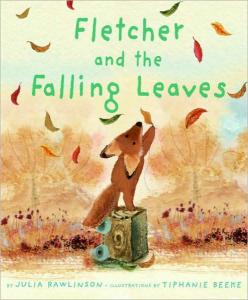
Regardless of where they fall on the spectrum, their excitement about fall is contagious. Tonight, the kids and I curled up together in our jammies to read my all-time favorite picture book about fall: Fletcher and the Falling Leaves (Ages 2.5-6), with text by Julia Rawlinson and watercolors by Tiphanie Beeke (side note: if you fall deeply in love with this book, as I know you will, make sure to get your hands on the sequels, Fletcher and the Snowflake Christmas and Fletcher and the Springtime Blossoms, which are equally captivating).
Monsters With Manners
October 11, 2012 Comments Off on Monsters With Manners
 I recently asked my five-year-old son: “What do you think monsters are like?” His answer: “They have big teeth and sharp claws and they eat little kids.” Oh. Well, the good news is that there’s a new(ish) genre afoot in children’s literature: not-too-scary scary stories (my recent posts on Creepy Carrots and Vampirina Ballerina are great examples). There are also some fantastic monster-themed books, featuring a new generation of what I will call Funny Monsters.
What makes kids find the monsters in these books so funny? Precisely because our little ones, occasionally monstrous themselves, can identify with these monsters’ unpredictable bursts of rage and destruction. On some level, they recognize a shared vulnerability, a shared quest to fit in and make sense of a complex world.
Author and illustrator Patrick McDonnell (best known for his Mutts comic strip) has a knack for creating deceptively simple picture books that get right to the heart of what it means to be human. In the beginning of his brand new The Monsters’ Monster (Ages 3-7), we are introduced to three tiny nay-saying monsters, named Grouch, Grump, and little Gloom ‘n’ Doom (how can you not immediately love this book?). The trio relishes their job of being monsters: they have tantrums, their favorite word is “NO,” and they love crashing, smashing, and bashing (sound familiar yet?).
Anyone Can Learn to Dance
October 3, 2012 Comments Off on Anyone Can Learn to Dance
 Calling all wannabe ballerinas! If you’re headed to a girl’s birthday party this month, you must give this irresistibly charming (and seasonally appropriate) new book, Vampirina Ballerina (Ages 3-7), by Anne Marie Pace, with pictures by LeUyen Pham. This book has everything ballerinas-in-the-making (and their supportive parents) would want in a book: tutus, pirouettes, a Swan Lake-inspired recital, encouragements about practice and effort (as opposed to perfection), and a subtle but poignant message about accepting someone who looks different.
In addition, this book has something most people don’t associate with ballet: a family of vampires. That’s right, Pace’s text reads like a “how to succeed in ballet” handbook, only it’s directed at a young vampire girl, who is eager and nervous to begin her ballet education alongside a troupe of human girls and their instructing Madame. Along with some predictable directives about form and style (“a true ballerina is always on pointe” and “always move with your head held high”), our young Vampirina is given some important life lessons: “Whatever happens, don’t be discouraged. The road to ballerinadom can be bumpy.”


