The Lure of the Balloon
June 3, 2012 Comments Off on The Lure of the Balloon
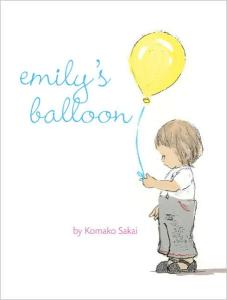 At 20 months, my daughter is starting to move away from board books and into short, simple picture books; consequently, she (and I) have fallen in love with Emily’s Balloon (Ages 18 mos-3 yrs), by Japanese author-artist Komako Sakai. I know, I know, you’re thinking that we’re partial to this book because my daughter’s name also happens to be Emily. But before I even had kids, I used to sell gobs of this book when it first came out in 2006; customers would only have to page through the gorgeous charcoal-and-wash pages to fall in love.
Some of my favorite children’s books have been imported from Japan; their illustrative style so beautifully transports us back to the carefree days of our own youth, when making dandelion crowns for a balloon might easily occupy an afternoon. What is it with toddlers and balloons? Balloons have a buoyancy that seems fascinating in its unpredictability, yet non-threatening in its softness; but, most significantly, its perfect sphere-like shape is just the right size for little eyes to track.
Food: Not Just for Eating
June 1, 2012 Comments Off on Food: Not Just for Eating
 What do you get the kid who has everything (including an extensive library filled with storybooks)? How about a brand new book that’s unlike any other, a rhyme-filled romp through magical lands made entirely out of—wait for it—FOOD! Carol Warner, a London-based still-life photographer, has created a clever and engaging picture book, titled A World of Food (Ages 2.5-8).
I like food. My kids like food. Really now, who doesn’t like looking at gorgeous photographs of food? Organized by color, each double-page spread reveals a fantastical scene where watermelons become boats (with asparagus as masts), dried cornflakes resemble falling foliage, chocolate KitKat bars stand in for train tracks, and pork ribs morph into jagged mountains (OK, you might want to pass this up for your vegetarian friends).
Getting Up the Giggles
May 22, 2012 § 2 Comments
 Let’s face it: being a parent can sometimes feel like a thankless job (does he realize I’m missing precious minutes of “American Idol” while I’m washing his uniform for tomorrow, composing a creative note for his lunchbox, and picking crumbs off the floor so it will stop looking like the inside of a barn—all while he is hollering from upstairs about “one last drink of water”?).
Suffice it to say that we parents will take an Ego Boost where we can get one. And that’s why I love reading books like A Visitor for Bear (Ages 3-6), the first of the delightful Bear and Mouse books by Bonny Becker, with illustrations by Kady MacDonald Denton. Now, I could love this book because of the witty banter between the two strangers-turned-friends, or because Mouse speaks in a decidedly British accent, or because a bear dressed in an apron is just so darn cute. But, on those rare occasions when JP allows me to choose his bedtime book, the reason I run to grab this gem off the shelf, is because it makes him LAUGH OUT LOUD.
A Chomp Through Berryland
May 20, 2012 § 1 Comment
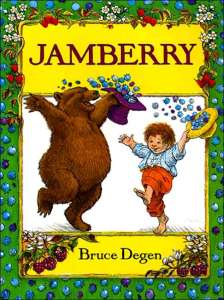 Today’s excursion to pick strawberries at Shlagel Farm in Maryland was the perfect excuse to break out an old favorite: Jamberry (Ages 1-3), by Bruce Degen. Not that we need an excuse to read this rollicking rhyme of a boy and a bear romping through fields and down streams on a quest for every kind of berry. But as the kids and I were filling our buckets with the plumpest, juiciest strawberries I’ve ever tasted, our fingers and shirts and mouths stained red, I couldn’t help but hear in my head: “Three berry/ Four berry/ Hayberry/ Strawberry/ Finger and pawberry/ My berry, your berry/ Strawberry ponies/ Strawberry lambs/ Dancing in meadows/ Of strawberry jam.”
We didn’t encounter any strawberry lambs (although there were goats and some very vocal chickens), and my children are likely to eat all the strawberries before I get a chance to make them into jam, but the spirit of the book was very much alive as we chomped our way through the farm. Our excitement continued to build, as we got deeper into the patch, launching ourselves into uncharted territory wherein (as we imagined it) lay the biggest berries.
How do I get my squirmy-wormy baby to love books?
May 17, 2012 § 1 Comment
 I’ve been fortunate that my kids have loved books from the very beginning. I’ll admit that part of my design was purely selfish: I’d rather read to my children than do almost anything else with them (read: sitting for hours on the floor making train sounds). So they quickly learned that Quality Time With Mom meant listening to stories.
During the years that I worked in retail, I was always surprised when a customer, shopping for a baby gift, would say, “I’m not going to buy a book for someone who can’t even talk! How would they understand it?” Who said anything about understanding?! In the beginning, books are simply stimuli: things to touch, to feel, to explore, to eat. They present an opportunity for little ones to listen uninterrupted to a parent’s voice, a sound babies are born loving. And they make for the best snuggle time EVER.
But don’t be fooled: the past decade of child development research tells us that, even while they’re hanging out of drooling mouths, books are wielding their magic on babies’ brains, laying the groundwork for early language development and, yes, even lifelong intelligence. So how do you get your squirmy-wormy baby to love books?
Rain, Rain, Here for a Day (Or Two…)
May 14, 2012 § 1 Comment
 As a mom of young children, I will admit to feeling a little dread, even a touch of panic, when I wake up and it’s raining. Trapped inside with my kids? Anything but that! Naturally, my kids think it is a treat, since they have activities reserved for rainy days (“Pillows off the couch! Pillows off the couch!”). Over time, I’ve discovered that if I can live in the moment and give in to the calm and quiet of a rainy day (and, yes, the subsequent moments of cooped-up mania), then there is much to be gained for me as well.
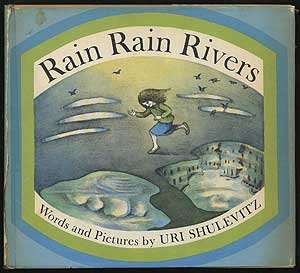
And if not, well, there are always rainy day books to read inside our blanket forts! A good rain book should make you feel wet and cozy at the same time. Uri Shulevitz does this to perfection in his 1969 gem Rain Rain Rivers (Ages 2-6), where pen and ink drawings mix with watercolors in an almost haunting monochromatic exhibit of rain, first falling outside a little girl’s bedroom window, then (as she imagines it) trailing through the city streets, out into the countryside, and into the open, swelling oceans.
You Thought You Could Talk on the Phone?
May 10, 2012 § 1 Comment
 It’s a situation we moms know all too well: The kids are playing nicely together; it’s quiet, even harmonious. You tiptoe to the other end of the house to make a “quick phone call.” As soon as the person on the other end answers the phone, there’s a tug on your leg. Suddenly, someone needs milk. Another someone is stepping over you trying to pull the scissors down to open a Zappos box (didn’t you leave that package on the porch)? Another someone has decided now is an opportune time to start poking his sister’s eyes. Another someone (or is it the same someone?) would like dinner and would like dinner NOW but not broccoli no way not eating that and why can’t we have mac ‘n cheese like so-and-so does every night and blah blah blah.
So, it’s no surprise that we sympathize with the mom in While Mama Had a Quick Little Chat (Ages 3-6), by newcomers Amy Reichert and Alexandra Boiger (pub. 2012). Bedtime is approaching, so Mama asks her daughter (think Eloise with red hair): “Rose, dear, please get ready for bed while I have a quick chat with your Uncle Fred. Brush your teeth. Wash your face. It’s getting late! I want you in bed by half past eight.” Naturally, Rose is well intentioned and would go straight to bed (truly), but what’s one to do when the doorbell rings and your mom doesn’t hear it and so you open the door and in bursts a team of men with party supplies for a party you didn’t know you were throwing?
Send-Off for Sendak
May 8, 2012 Comments Off on Send-Off for Sendak
 Today we remember Maurice Sendak (1928-2012), arguably the most game-changing children’s author and illustrator of the 20th century; he took age-old storytelling conventions and turned them on their head (or, rather, sent them on a wild rumpus through the forest). His beloved Where the Wild Things Are has topped more recommended book lists than any other children’s book in history—as much for its glorious depiction of a boy’s uninhibited reign over his imagination as for its foray into previously shushed subjects like parental abandonment and night terrors. Sendak’s later books took even more risks, got simultaneously darker and more brilliant (and not without their fair share of controversy).
But for me and my family, Sendak’s “sweet spot” lies in his earliest works–no less memorable, even if they didn’t upset the status quo at the time. Before his characters were banished to their rooms without supper or left to wander the streets of New York without clothes, there were the deliciously sweet, make-me-want-to-read-to-my-children-all-day-long moments between a little bear, his parents, and a quirky ensemble of friends. I’m referring, of course, to the Little Bear books (Ages 3-7) by Else Holmelund Minarik, which Sendak illustrated in his 30s.
Curious George: Every Story Has a Beginning (Part 2)
May 7, 2012 Comments Off on Curious George: Every Story Has a Beginning (Part 2)
 A continuation of yesterday’s post…
H.A. Rey, the German-born creator of Curious George more than 100 years ago, was a master of episodic storytelling, and his original books possess a level of wit, ingenuity, and “meatiness” that the derivative stories published in the last 10 years don’t quite match, even if the illustrations give them a very close look and feel (I’m referring to the stories included in such newer anthologies as A Treasury of Curious George).
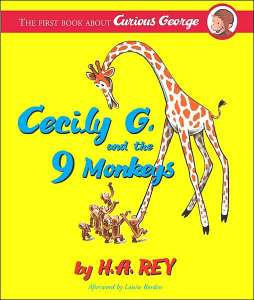
Every story has a beginning, and many don’t know that H.A. Rey’s very first book about Curious George was titled Cecily G. and the 9 Monkeys (Ages 2.5-5). It’s a story about how George, still living in Africa with his brothers and sisters, came to live with (and befriend) a lonely giraffe named Cecily G. (who, incidentally, bears a striking similarity to the “Sophie the Giraffe” rattle that’s become something of a fashion accessory to today’s urban baby set). It turns out that when you’re a monkey, playing with a giraffe affords all kinds of unusual delights: you can ski down her neck, parachute off her head with an umbrella, and even sail on her back.
Curious George, Alter Ego (Part 1)
May 6, 2012 § 1 Comment
 When JP was two, I read him his first Curious George book (Curious George Goes to the Hospital, by Margret & H.A. Rey). Two and a half years later, still not a day goes by that we’re not reading about him, watching him on TV, or singing about him (Oh, you’re not familiar with the Curious George songs, the ones my husband and I are forced to make up EVERY SINGLE NIGHT before JP will go to sleep?).
My mother-in-law is a bit troubled that my son has chosen as his hero in life a monkey who spends a lot of time getting into a lot of trouble; she seems to think perhaps there are better role models than ones who can manage to knock over a bottle of ink, flood the house, release a herd of pigs, and knock over an entire dinosaur exhibit at a museum—all in a single day (Curious George Gets a Medal). But children are rarely that literal, and I like to think that it’s not George’s actions that inspire JP (though he laughs hysterically at them) but rather the motivation behind those actions: his insatiable, uncontainable curiosity. I might even claim that Curious George is a kind of Alter Ego for my son–and for scores of other boys and girls as well (I too was obsessed with him as a little girl).
Chapter-a-Night Adventure
May 4, 2012 § 2 Comments
 How do chewing gum, hair ribbons, and six magnifying glasses help a little boy rescue an enslaved baby dragon on a wild island of ferocious talking animals? There are few early chapter books written with as much wit, cleverness, and heart as Ruth Stiles Gannett’s beloved trilogy, first published over 60 years ago: My Father’s Dragon, Elmer and the Dragon, & The Dragons of Blueland (Ages 4-9). With short digestible chapters, about 200 words per page, and enchanting black-and-white sketches peppered throughout, they are perfect for reading aloud.
JP and I started these books on a recent train ride to New York and finished them a few days later, only to start them over again. At the heart of the stories is the relationship between Elmer and his dragon, an evolving friendship that brings out the best in both parties. But the real draw for kids is the adventure (no shortage of “close-calls”) and the magic (who doesn’t love thinking about riding on the back of a flying dragon?).
Dump It In, Smash It Down
April 30, 2012 Comments Off on Dump It In, Smash It Down
 Hooray for Garbage Day! Until two years ago, when we relocated from Chicago to Alexandria, VA, if you’d asked me what day of the week was garbage day, I would have looked at you blankly. But all that has changed. Every Thursday morning, when the sound of the garbage truck is heard turning the corner onto our street, giddiness erupts in our household. Breakfast spoons are laid down, the front door is thrown open, and we stand in PJs waving at the orange-clad workers as they dump our trash into their giant steel crushers. And the best part is that they wave back with enthusiasm (and make funny faces at Emily and beep their horn for JP).
Mr. Giddy, the central character in Andrea Zimmerman and David Clemesha’s Trashy Town (Ages 18 mos-4) is just this kind of “trashman,” the kind who tips his hat at schoolkids, who pauses to pet the dalmatian at the fire station. But it’s the rhyming refrain that makes this book a contagious, bring-down-the-house read-aloud: “Dump it in, smash it down, drive around the Trashy Town!”
Your Budding Naturalist
April 28, 2012 Comments Off on Your Budding Naturalist
 Right now in preschools across the country, little eyes are glued to screened containers perched on shelves, waiting to behold one of nature’s most wondrous life cycles: the caterpillar’s transformation into a butterfly. (“Mommy, when the chrysalis shakes, that’s how you know there’s a lot of action going on inside!”)
I grew up reading Eric Carle’s The Very Hungry Caterpillar (and really, who doesn’t love a book with holes for sticking tiny fingers through?); but in my opinion, Ten Little Caterpillars (Ages 2-6), written by Bill Martin Jr. and illustrated by the great collage artist Lois Ehlert, has topped this subject matter.
Apart from its stunning visual feast for the eyes, the book speaks to children on a multitude of levels. First, there’s the simple rhyme, each double-page spread focusing on a single caterpillar’s unique journey: “The first little caterpillar crawled into a bower./ The second little caterpillar wriggled up a flower.” A few of the caterpillars don’t fare so well (it’s a dog-eat-dog world, after all): one meets with a “hungry wren,” another is “frightened by a hen.” It’s the tenth caterpillar that we get to watch hang patiently among the apple blossoms for three pages, until her chrysalis hatches to reveal a stunning orange-and-black “tiger swallowtail.”
Alison Jay, Cloud Creator
April 25, 2012 § 3 Comments
 If you haven’t discovered the amazing British children’s artist Alison Jay, you’re in for a real treat. Or, if you’re as obsessed with her as I am, you’ll love her latest masterpiece, a fairy tale of sorts titled The Cloud Spinner (Ages 3-6), by Michael Catchpool (a fellow Brit).
The Brits have an unparalleled knack for creating books that feel Quintessentially Childlike, seamlessly blending fantasy with realism, and sprinkling on a quirkiness that makes these stories memorable for a lifetime. Alison Jay’s artistic signature, which she employs in all her work, is a “crackle finish” layered over her paintings, a technique which gives them a vintage look. In contrast, her animals, landscapes, and people feel anything but old-fashioned (here’s where that endearing quirkiness comes into play).
It seems that Jay’s artistic style has not gone unnoticed by JP, my four year old. Our favorite alphabet book is Jay’s ABC: A Child’s First Alphabet Book, which I’ve been reading to him since he was a baby (and which is jam packed with hidden surprises), along with a handful of her other storybooks (see my list at the end). A few months ago, while perusing the shelves at our local library, JP stumbled upon an Alison Jay book he’d never seen before (William and the Night Train), and he called out, “Look Mommy, it’s one of those books with the crazy clouds!” I had never thought of it that way before, but he was right: Alison Jay does have a very specific way of painting clouds.
Ce N’est Pas Un Box
April 23, 2012 § 2 Comments
 For adults, the worst part about moving is cardboard boxes. For kids, the best part about moving is cardboard boxes! We managed to save a giant wardrobe box from our last move, and we bring it out on rainy days. It’s the Mother of All Boxes. Don’t get me wrong: they also love playing with diaper boxes, amazon.com boxes, and wine boxes (that these seem to be the predominant boxes around our house at any given time probably says much about our priorities). Our “house rule,” when a new box shows up, is that the kids get it for one week—and then (because Mom can’t take it any longer) it’s dumped in the recycling bin, regardless of how beautifully decorated it is by then. But that wardrobe box is still kicking around some 18 months later, because, well, it’s just THAT AWESOME.
One of the more originally executed children’s books of the past decade is Not a Box (Ages 3-5), by Antoinette Portis. The book deceives: at first glance, its sparse text and simple graphics appear to be designed for a very young child. In fact, the perfect audience for this book is the precocious preschooler, who’s just beginning to forage into Imaginary Play.
Leaving the World a Little Bit Greener
April 22, 2012 § 3 Comments
 Happy Earth Day (or, as my very astute 4-year-old pointed out this morning, “Aren’t we supposed to care about the earth every day?”)! Oh right, yes.
Ironically, with all the increased mobilization around Going Green in the last several decades, the member of our family who actually most fully embodies and preaches a love for the planet is my 94-year-old grandmother, referred to affectionately by her grandchildren and great-grandchildren as Noni. As a child, I spent my summers at my grandparents’ farm house, on the shores of Lake Erie, getting lessons on the value of spiders (you never kill a spider, we were told, even if it is sitting on your toothbrush), the conservation of water (why shower when you can swim in the lake?), and that sometimes leaving trees and wildflowers right where they are makes the best kind of landscaping.
Today, one of the highlights of my son’s summers is the week he spends with Noni up at this same spot, where the house has been modernized but the land has not. These days, Noni’s mostly sedentary, but by golly if she doesn’t still go out with her hose to water her garden, and JP loves to trail behind her, occasionally earning a turn with the hose, but mostly getting an earful on “dead heading” flowers, which weeds are “not worth your time,” and how to grow the oldest and biggest Hibiscus plant in the history of time.
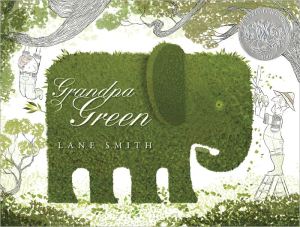
Perhaps this is why he (and I) respond so wholeheartedly to Grandpa Green (Ages 4-8), by the supremely talented (and deliciously quirky) Lane Smith. Through the simple and admiring words of a little boy (armed with his own watering can), we learn about his great-grandpa, a masterful hedge trimmer, who transforms ordinary garden hedges into dragons, elephants, wedding cakes–even the cast of “The Wizard of Oz” and “The Little Engine That Could.” As the boy explores his great-grandpa’s garden, we realize that every “milestone” of the latter’s life has been remembered in one of these stunning green creations.
Spring is Here!
April 21, 2012 § 1 Comment
 Perhaps at no other time in our lives than when we are parenting young children are we more attuned to the changing of the seasons. Seen through our children’s eyes, it’s positively magical, nature unfolding in all sorts of surprising ways. Regardless of our “mild” winter, on March 1 our family had a March into Spring around our living room, started giddily discussing planting vegetables and riding bikes to school without jackets–and started reading Spring Books. In my opinion, a picture book about spring should capture the anticipation, the wonder, the thrill, and the hope we feel at the beginning of the season.
Get ready to open your hearts to And Then It’s Spring (Ages 3-6), a 2012 picture book by newcomer poet Julie Fogliano and one of my favorite contemporary illustrators Erin E. Stead (side note: if you don’t already own her zoo-animal masterpiece A Sick Day for Amos McGee, do not delay a second longer). And Then It’s Spring is one of those perfect marriages of words and pictures, where the end result is more than the sum of its parts. Without any illustrations, it’s simply a lovely free verse poem about “first you have brown/ all around you have brown/ then there are seeds/ and a wish for rain” and more waiting and “you worry about those seeds” but it’s still brown—until you wake up one morning and suddenly “it’s green/all around you have green.” Now add to this verse subtly stunning pencil and woodblock illustrations, and suddenly you have a little boy, his dog, a bunny, a bird, and a turtle (sporting a red wool cap)—all moving around a backyard that gets a little less brown every day.


