Expressing Love in Extraordinary Times
February 18, 2022 § 2 Comments

This past Monday was Valentine’s Day, and when my daughter got home from school, I read a picture book to her while she had her snack, as we do most afternoons. (One more time for the back row: older kids continue to enjoy a litany of benefits from picture books!) For the simple reason that “love” was in the title, I grabbed Love in the Library (Ages 6-10) off a pile of book mail I’d just received. I had done such a cursory scan of the cover that I assumed it would be a sweet story about two people falling in love in a library. Or falling in love with books. In any case, a story that had been told before, in one way or another.
Had I looked more closely at the cover, I would have noticed that the view through the window behind the central figures—an armed guard in a tower above a barbed wire fence—starkly juxtaposes the smiles, expressive body language, and colorful book covers of the interior setting.
By the time I finished reading the book, I had tears in my eyes. By the time I finished the Author’s Note, I had chills across my entire body. My daughter echoed aloud what I was feeling: “WOW.” This may be a story of love in a library, but it is not one that has been told before. This is an incredible, largely true story of how the author’s maternal grandparents fell in love, against all odds, during their time at the Minidoka incarceration camp, where they were unjustly imprisoned during World War Two for being Japanese American. It’s a story told with tremendous power and tenderness, both in Maggie Tokuda-Hall’s words and in Yas Imamura’s gouache and watercolor art. And it’s a story that underscores the humanity we all share.
As I was getting ready for bed Monday night, I reflected on the casual Valentine’s celebration we’d had over dinner. I thought about how each of us has our own love language. For my son, it was the ginger cookies he’d baked. For my husband, it was the heart-shaped pizzas he hurried home from the dentist to make. For my daughter, it was craft-paper hearts, decorated with personal messages of love and gratitude for each of us. For me, it was the books I wrapped and placed at my kids’ spots on the dinner table, new titles in beloved graphic novel series that I knew they weren’t expecting. (The second book in the Katie the Catsitter series for my daughter; the fourth book in the Heartstopper series for my son.) Baking. Cooking. Crafting. Reading. Each of us expressing love in our own way.
In as much as the language of love is influenced by our own personalities, it’s also influenced by our surroundings. In Love in the Library, the protagonists’ love language is actually crafted in defiance of those surroundings. Loving each other becomes a way of setting their hearts free, of holding onto hope amidst the literal imprisonment of the camp and the figurative imprisonment of injustice.
« Read the rest of this entry »Making Room for Joy in Black History Month
February 10, 2022 § 4 Comments
During Black History Month, I typically highlight a recent picture book that introduces young readers to an essential part of African American history in a particularly compelling and inventive way. (Last year’s post was on the picture book biography of basketball legend, Elgin Baylor, which apart from being a fascinating story about one Black man also doubles as a mini primer on the Civil Rights Movement.) But since I so recently sung the praises of Born on the Water, one of the most comprehensive and gorgeous picture books to take on the subject of Black history, I thought I’d use today’s post to remind us that, as parents and educators, we must see to it that our children are reading just as many—if not more—stories about Black joy and achievement, as they are about Black pain and oppression.
This means reading When Langston Dances, a joyous new celebration of dance, starring a Black boy who aspires to take ballet. It means reading The Old Truck, a deceptively simple multi-generational story about a family of Black farmers. Or Milo Imagines the World, where a Black boy makes sense of the world in a sketchbook. Or the ebullient picture book biography of writer Zora Neale Hurston, titled Jump at the Sun. Are these books on our shelves alongside those about slavery and segregation? Have we deemed them important in our children’s eyes by giving them a seat at our (literary) table?
It also means reading about the people making Black history as I’m writing this post. The superstars of today. The people pointing us forward.
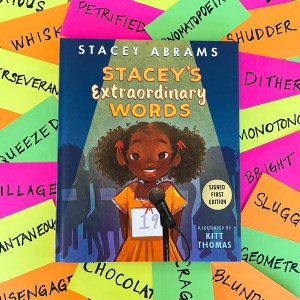
You’ll rarely see a book by a politician or celebrity plugged here. For one, these books come by publicity naturally; two, they’re usually mediocre at best. They can be dry or heavy-handed, come off like they’re trying too hard, or feel self-aggrandizing. So, while I find Stacey Abrams all kinds of dynamic and inspirational and vital in real life—and though our signed copies at the bookshop have been flying off the shelves—I put off reading her debut picture book. I figured it would be “meh.”
I stand corrected. I’m pleasantly surprised to report that Stacey’s Extraordinary Words (Ages 4-8), written by Abrams and illustrated by Kitt Thomas, is wonderful. In this story drawn from a childhood memory about a spelling bee competition, young Stacey emerges as inquisitive, bright, determined, and sensitive; and the effusively colored illustrations will endear young readers to her. But what would have appealed to me most as a young bookworm is that this is a story about a girl falling in love with the richness of language. A girl learning to wield the power of language to give voice to herself, to secure her seat at the table.
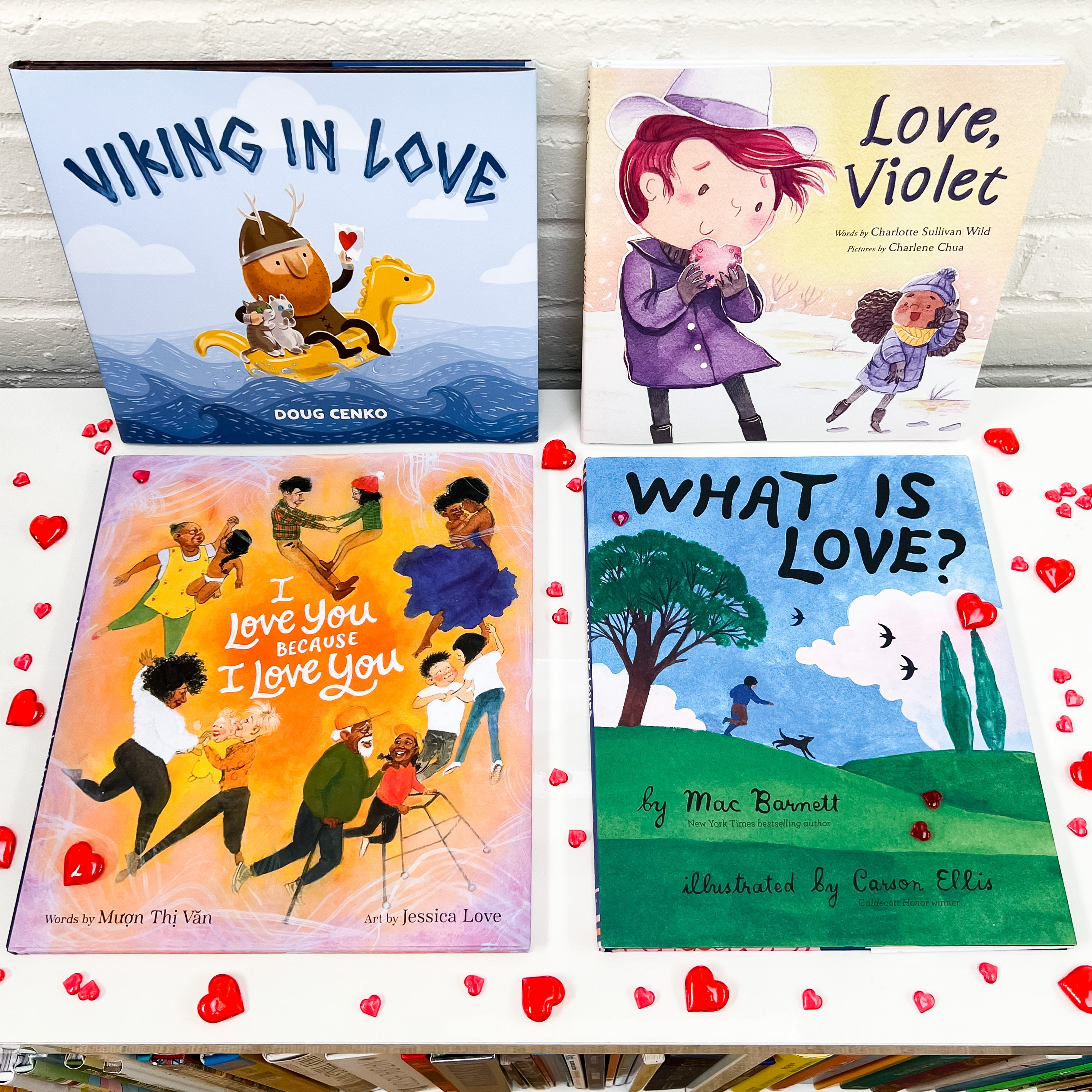
« Read the rest of this entry »Choosing Love: Four Favs for Valentine’s Day
February 3, 2022 § 9 Comments
I sat sleep-deprived in the dim winter light of early morning, stealing myself to break it to my children that their dad and I had decided we should return the puppy we’d picked up less than 24 hours earlier.
The previous day, we had driven three hours to pick up an almost five-month-old Goldendoodle. Upon entering the breeder’s house, it became apparent that the dog was nothing like what we’d been promised. Was nothing like our last puppy, either. We had expected a rambunctious, mouthy, high-energy, playful puppy.
What we left with was a dog that had never been socialized. Never seen a man or a child, not to mention a car, leash, crate, or bath. The dog was terrified of us. Of everything. After the car ride home, where we held his trembling body on our laps, he wouldn’t let us near him. We couldn’t pet him. We couldn’t handle him. When my husband tried to pick him up to bring him inside, he got his hand bitten.
The dog wouldn’t eat. He wouldn’t drink. We couldn’t get him outside to use the potty and, if we did, we couldn’t get him back inside. He was terrified of our stairs, so my husband slept next to him on the living room sofa, while I stayed up all night reading everything on the Internet about fearful, traumatized dogs.
What I determined over the course of that long night wasn’t just that this was not the puppy we had envisioned for our family, but that we were in over our heads. A dog who passed the four month mark without being socialized was, the Internet assured me, beyond hope of a normal life, even with professional training.
Earlier that morning, I told my husband that I thought we needed to take him back to the breeder. He reluctantly agreed. So there I sat, waiting for my kids to wake up so we could get it over with.
My son was the first to come down the stairs. His eyes immediately scanned the room, finding the dog—we hadn’t agreed on a name—cowering in the corner. My son stood for a few moments, looking at this terrified ball of fluff, and then he curled up next to me. I braced myself to say the words, but he spoke first, with no suspicion that there was anything amiss.
“Oh, Mommy,” he sighed, his eyes twinkling, a smile breaking across his face like it was Christmas morning. “I’m so happy. I just love him so much.”
This dog, who was nothing like the dog he had wanted, who wouldn’t even let him come near him…he loved him?
I began to speak about what I’d read, about the long road ahead of us. Yes, he said, he had thought as much. He’d start reading things, too. He was excited to help. “I know what it’s like to have anxiety, so I can do this. He’s going to be so happy here. I know it.”
And though part of me wanted to cry, to scream, to run from the loss of control I felt over the entirety of this situation, I thought, What if I chose love? What if we all chose love?
What if we didn’t get the puppy we wanted, but we got the one we needed? Or maybe the one who needed us.
« Read the rest of this entry »Party Time! (Or Not)
January 27, 2022 § 3 Comments
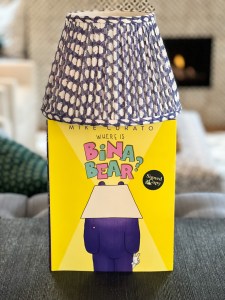
With so many posts devoted to serious books lately (not to mention all the awards excitement), I decided we were overdue for a recommendation high on the fun(ny) meter. As it turns out, 2022 has given us a delightful one right out of the gate, as perceptive as it is entertaining. (Plus, if you order from Old Town Books, you’ll get a copy that’s signed by the author-illustrator in the most fitting way. Just wait until you see it!)
Apart from being a total hoot, this story is going to resonate deeply with anyone out of practice at social gatherings. That would be all of us, in case your math skills have also gotten fuzzy.
Our family will attend a dear friend’s bar mitzvah in a few weeks, and as much fun as I know I’ll have, I’m already fretting about how I’m going to wedge my feet into heels, my out-of-shape body into an old cocktail dress, and do I even have lipstick anymore? And then I wonder, how am I going to be vertical at 8pm? What are we going to talk about? Are we going to discuss the pandemic, or will we remember other topics of conversation? And if I’ve got all these worries, what about my kids?
Those of us who were a tiny bit reserved two years ago are now completely overwhelmed by the prospect of hanging out with more than one or two friends at the same time. We’ve lost ground, our social muscles have atrophied. And yet, society’s expectations haven’t adjusted. We’re supposed to want to go back to attending birthday parties and backyard parties and weddings and fundraisers. And we do…but maybe only sort of?
I remember when my dad threw a surprise party for my mom’s 40th birthday. She had an inkling moments before she opened the door that our apartment was full of people, and she shot my dad a look. There was actual menace in that look, and while I don’t remember her exact words, they were something along the lines of, “You’re a dead man.” As soon as she opened the door, she was all smiles and laughter and grace—the hostess with the mostest, as she says—but I’d had a peek into something else. She wasn’t entirely comfortable surrounded by all these people, despite her obvious affection for them. Parties can be a complicated thing, is what I’m saying.
Enter Bina Bear, the large, purple, slightly stiff, certainly awkward protagonist of Mike Curato’s new picture book, Where is Bina Bear? (Ages 3-8, though my 11 year old is obsessed with it). Bina is attending a party thrown by her best bunny friend, Tiny. There are balloons! Cake! Punch! Lots of friendly faces! Bina Bear loves Tiny, so she has come to the party. But Bina Bear doesn’t like parties. She doesn’t do crowds.
« Read the rest of this entry »My Favorite Holiday Book of the Year
December 2, 2021 Comments Off on My Favorite Holiday Book of the Year
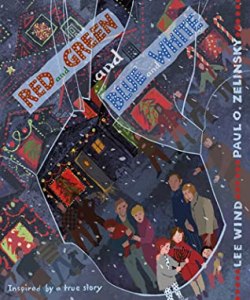
With two posts remaining, I’m once again hitting pause on my Gift Guide, this time to tell you about my favorite holiday book of the year. It’s rare to find a December holiday-themed book that speaks to Christians and Jews, much less one inspired by true events. Trust me: you do not want to miss this. You might not get through it without shedding a tear. You definitely won’t get through it without getting chills. If there was ever a story to conjure up the true spirit of the holiday season—while also reminding us of the meaning of community—this is it.
With words by Lee Wind and art by the esteemed Paul O. Zelinsky (don’t forget this holiday gem), Red and Green and Blue and White (Ages 5-10; affiliate link) is a nod to the real events of December 1993 in Billings, Montana. It’s the story of two best friends, who live across the street from one another—one in a house decked out in red and green, the other in a house lit up in blue and white—and an anti-Semitic act that threatens to diminish the latter. It’s as much about what happens when we won’t be silenced, as what happens when we stand beside our friends and rally support from an entire community.
It’s about what it looks like when love wins.
« Read the rest of this entry »2021 Gift Guide Kicks Off: Favorite Picture Book of the Year
October 28, 2021 § 2 Comments
It’s getting to be the most wonderful time of year: Gift Guide season! Over the next few weeks, you’ll be treated to round ups of picture books, graphic novels, middle-grade books, young adult books, and specialty books with a gifty flair. This year, I’m especially excited to be partnering with Old Town Books, a fantastic indie here in Alexandria, VA, where I’ll be presenting my full Gift Guide LIVE and IN PERSON at 7pm on November 12 and 13, with a chance to shop with me afterwards (get your tickets here!).
Traditionally, I kick off every Gift Guide with my favorite picture book of the year. (Some past picks are here, here, here, and here.) I recognize that choosing books for loved ones is immensely personal, but sometimes a book comes along that checks all the boxes. It’s beautiful. It’s original. It’s hefty, packed with details that demand repeat readings. It’s got a nostalgic charm that appeals to us oldies doing the gifting. To hold it feels inherently special.
Towering toadstools! All I’m saying is that there aren’t many books you want to clutch to your chest and carry around with you, so when you find one, you just want everyone to have it, OK?
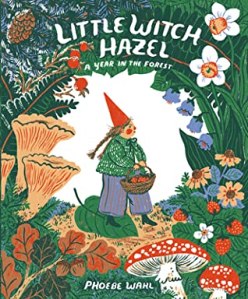
Little Witch Hazel: A Year in the Forest (Ages 4-8), by the extraordinary Phoebe Wahl—I blinked and missed her 2020 picture book for last year’s Gift Guide, and I’ll not make that mistake again—is an anthology of four stories, one for each season. It stars a cheery, capable, caring little witch with a pointed red cap and a fondness for messy braids and fair isle sweaters. Little Witch Hazel lives alone at the base of a tree in the enchanting Mosswood forest, surrounded by trees and waterfalls and a community of gnomes, elves, goblins, trolls, dryads, anthropomorphic amphibians, and tiny talking mammals. He days are spent divided between work and play, between helping others and tending to herself.
It has been a long two years, and I feel like we all deserve to spend some time in a place where tea cakes and twinkling lights are always in fashion, where coziness and cocoa reign supreme, and where the wonders of the wilderness are just an acorn’s throw away. A place where we can dip our tired toes in crystal clear water one minute and ride on an owl’s back the next. A place where creatures watch out for one another, repay favors, and are always happy for an impromptu dance party.
« Read the rest of this entry »Hiding in Plain Sight: A Halloween Post
October 7, 2021 § 1 Comment
After hitting the snooze button on Halloween last year while in temporary housing, we were extra-enthused to unbox our spooky decorations last weekend—especially our Halloween books! (Do you pack up your Halloween books with the decorations so you can re-discover them every year? Trust me on this.) As my kids have gotten older, we’ve offloaded many seasonal picture books, and those left are the ones we can’t bear to give up. This includes old favorites like Creepy Carrots, Old Black Witch, The Monsters’ Monster, I am a Witch’s Cat, In a Dark, Dark Room…along with more recent favorites, like The Little Ghost Who Was a Quilt and Gustavo the Shy Ghost (for the love of all cuteness, please add this book to your collection…I recently Instagrammed about it here).
Then there are the spooky chapter books we’ve loved reading aloud in past Octobers—by candlelight, of course—like James and Deborah Howe’s classic, Bunnicula, and Adam Gidwitz’s A Tale Dark and Grimm. (I recently did an Instagram video with these and many more, including the books my kids claim are too scary for me to attempt, but darned if we will get to them someday. Also, let’s compare witchy cackles, shall we?)
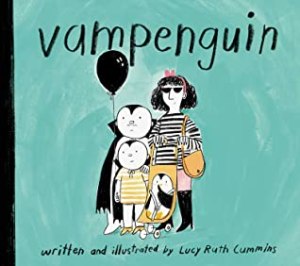
Which brings us to 2021, where I’ve combed through dozens of Halloween-ish new releases to tell you my favorite. The story I’ve chosen is about vampires—of the modern, hip, urban variety—though it has nothing to do with the actual holiday of Halloween. Which means you get to decide whether you pack it up on November 1st or let it stay out all year round. Who am I kidding? There’s not a chance your kiddos are going to let you pack up this one. In Vampenguin (Ages 3-6), Lucy Ruth Cummins—no stranger to the Halloween market ever since she wrote the darling Stumpkin—has created a story that abounds with visual gags and makes perfect use of that irresistible trope of storytelling, where the reader is in on the joke long before the characters themselves are.
Have you ever considered how a baby vampire and a baby penguin could be mistaken for one another? Nope, me neither. That’s where the fun (and the funny) begins. And, lest you think Vampenguin sounds big on antics and short on artistry, I assure you that Cummins’ expressive line work and limited color palette, awash in turquoise, orange, and pink, elevate the story in both whimsy and wonder.
« Read the rest of this entry »An Anthem to the “And”
September 9, 2021 § 5 Comments
It has taken me a lot of growing up to realize how quickly the world demands that we put labels on ourselves, and how tempting it then becomes as parents to fit our own children into the same tidy little boxes. Even the questions we routinely ask of our children and their peers—Is she shy? Is he artistic? Is she kind?—assume two fixed outcomes: yes or no. Sides are chosen, identities are constructed; and then, inevitably, confusion sets in when the data points don’t consistently match up.
A few years out of college, when I was working in advertising, I attended a retreat designed around improving problem-solving skills. As part of it, we had to take the Myers-Brigg personality test. What was revolutionary to me wasn’t that I received at the end a set of letters to represent my dominant personality traits, but that each of those letters was plotted on a spectrum. I expected, for example, that I would score as extroverted (E)—I’ve always been social, albeit preferring intimate groups—but what surprised me was that I was quite close to the midway mark between extroverted (E) and introverted (I). This seems incredibly obvious to me now, but I had never previously considered that someone could be both things at the same time. That I could derive equal energy from social interactions and from being by myself. That I didn’t have to choose. That my identity might run on a spectrum, rather than conforming to a binary system.
When we fall into the trap of thinking of ourselves as one way or another, it’s not only limiting, it’s fundamentally inaccurate. We, all of us, are walking contradictions. It’s what makes us interesting. It’s what makes us human. Maybe we get nervous walking into a new classroom, but we can belt out a solo on stage. Maybe we can’t draw the likeness of anything, but we love moving paint around on canvas. Maybe we have a hard time sharing crayons at school, but we’ll sit and read to our baby sister at home when she’s sad. What if there was a way to encourage our children to take these “but”s and turn them into an “and”s? What if instead of contradicting one another, they are just two true things?
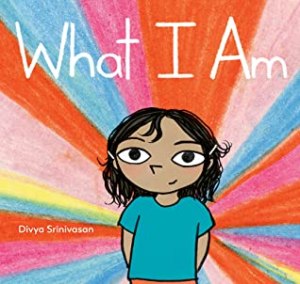
When I first opened Divya Srinivasan’s triumphant new picture book, What I Am (Ages 3-7), I thought it was going to be a book about a Brown girl responding to a microaggression that’s all too familiar to those whose non-whiteness doesn’t fit the idea of American that some people insist on holding onto, even though all evidence points to the contrary. It’s the “What are you?” question.
And it is a book about that. A beautiful, validating mirror for an Indian American reader.
AND it’s something more. Because, as our young narrator reflects on this question, she realizes that she is a whole lot more than her race or her ethnic heritage. And that many of these things might seem like contradictions—only they aren’t. They’re just her.
What this book is—and why I hope every child gets a chance to read it—is a testament to the complexities, to the nuance, within each and every one of us. It’s a kind of roadmap to how we might think about our own identities—and how we might express them to a world bent on incessantly inquiring.
« Read the rest of this entry »Summer’s Sweetness
July 22, 2021 Comments Off on Summer’s Sweetness
I’ve been caught in the hot, sticky, delicious embrace of summer (OK, but a little less heat, please), and it has kept me from showing up here as much as I would like. When I’m silent here, I’m usually still active on Instagram, so you can get lots of book recommendations there, but I do hope to get a few blog posts penned in the next few weeks (I’ve got a big graphic novel round-up planned, so stay tuned!).
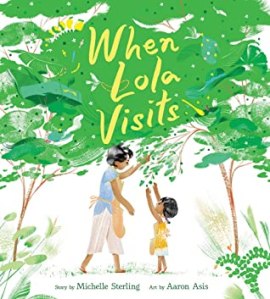
But today, let’s talk about one of my favorite picture books of the year, an especially fitting one for this mid-summer sweet spot we find ourselves in. We’re perfectly poised to reflect on summer’s arc, having traded the tentative newness of June for the wild abandon of July, with a creeping awareness that the final days of August will bring it all to a bittersweet end. When Lola Visits (Ages 4-8), lyrically penned by Michelle Sterling (fellow kid lit reviewer) and evocatively illustrated by Aaron Asis, perfectly expresses this arc by capturing the smells, tastes, and sensations of summer, as experienced by a young girl alongside her visiting Filipino grandmother.
When Lola Visits does something that isn’t easy to do in a picture book. It imparts a culturally specific experience while simultaneously invoking the universal wonder of this special season. It’s a book that asks us to reflect on the way we experience summer, to give language to our own observations, and to honor the richness of our memories from one year to the next.
For my children, at least right now, summer is the smell of chlorine, the tight hug of a swim cap, and the taste of glazed doughnuts, cherry popsicles, and concessions burgers with American cheese. In a few weeks, that will shift to the squish of pine needles beneath flip-flopped feet, the sharp bang of a cabin door, and a Styrofoam cup of steaming hot chocolate on a cool Maine morning where fog sits heavy on the lake.
For me, much like the young protagonist in When Lola Visits, summer will always conjure memories of my grandmothers, both of whom I would visit every year. Summer was the taste of warm popovers with melting pads of butter, enjoyed under an umbrella with my one grandmother, after a morning spent pouring over sawdusty cases of pinned bugs at the science museum, where she volunteered in the entomology department. Summer was make-your-own sundaes before Bingo night with my other grandmother, the excitement of watching the pot of money overflow with American and Canadian dollars outdone only by the anticipation of going to the water slide park the following day. Summer was a sticky tin straight from the fridge with chocolate-peanut-butter-Rice-Krispies cookies. The smoky smoothness of blue beach glass. The experience of hugging an older body, with its faint smell of talcum powder, soft, spidery-veined skin, and the security of a love that knows no bounds.
« Read the rest of this entry »Taking Our Cue from Them
June 17, 2021 Comments Off on Taking Our Cue from Them

Is that a naked boy on the cover? Why, yes. Are you mostly just posting about books with neon pink themes this year? Um, maybe.
For me, the biggest challenge of parenting continues to be taking the lead from my kids—and not the other way around. It’s seems simple enough—to guide, not instruct; to support, not push; to listen more and talk less—but it becomes intensely complicated when my own biases, fears, and failures get in the way of seeing my kids for who they are in the moment. Labels are comforting; they help us feel like we’re making sense of the chaos and uncertainty that is our children’s becoming. Look, he’s good at swimming—yes, swimming is his sport! He’s got brains, but she’s got compassion. He’ll never agree to that—he hated it last year. Wait, you want to wear a dress? I thought you hated dresses!
Being a parent can feel a lot like being tied to the end of a yo-yo that someone else is operating, and the whiplash isn’t always pleasant. But when we manage to extricate ourselves from that emotional tether, when we take a step back and observe the messy evolution unfold, we make space for wonder, joy, and acceptance—on both sides.
Upholding traditional gender roles is a trap most of us parents fall into at one time or another (regardless of how many feminist classes we took in college). It starts when our babes are in utero, as we fantasize about the mother-daughter shopping trips or decorate the nursery in a baseball theme, and it continues each time we measure our child against others of the same gender. Shyness in girls is sweet, but shyness in boys might be a sign of weakness. A boy who shows an interest in math confirms what everyone expected, but a girl who shows an interest in math is intriguing—as long as she’s not a dork, because then she’ll struggle socially. It’s OK for her to pick dance as a sport, but he needs a “real” workout. And so the dialogue goes, even if we never utter the words aloud.
And a boy who likes pink? Who wears make-up? What does that imply? What does that signal about the future?
Must it mean anything?
I’m thirteen years into this parenting gig, and the only thing I know for certain is that kids change. They change their minds, their habits, their styles. Sometimes it’s awesome, and sometimes it’s nerve-wracking. Sometimes, it’s along traditional gender lines, and sometimes it’s not. Sometimes it’s a signal of what’s to come, but just as often, it’s not. Most of the time, it has nothing to do with us, though how we react can be everything.
The supremely talented Peter Brown—creator of picture book favorites like Mr. Tiger Goes Wild, My Teacher is a Monster (No, I Am Not), and Creepy Carrots, and author of the equally brilliant chapter series The Wild Robot —has a new picture book out, and it brings the biggest smile to my face every time I read it. It’s also his most personal book to date, based on an incident when Brown was five years old and got into his mother’s make-up drawer. In many ways, it’s a tribute to his mother, whom he credits as being ahead of her time in her ability to validate who he was at every changing moment.
Fred Gets Dressed (Ages 2-6) may be a simple story about self-expression, but its execution is anything but ordinary. Design reigns, characters glow, and nakedness abounds. There’s the supportive mother, joined by a father who plays a small but mighty role. There’s a warm, inviting home, with books, dog, plants, and oversized throw pillows. But at the center of the story, stealing the show, is Fred. Fred is pure exuberance. Fred is that kid whose unbridled enthusiasm you want to bottle. Fred is that kid who prefers to air-dry au naturel (and who doesn’t, really?).
Fred is a boy who, on a whim, dresses up in his mom’s clothes and make-up. And because of his parents’ reaction, there’s no labeling, there’s no foreshadowing, there’s no shame. He’s simply allowed the freedom that comes with non-traditional gender roles. And his beaming smile says it all.
« Read the rest of this entry »Cicada Frenzy (A Father’s Day Post)
June 10, 2021 § 1 Comment

(Past years’ Father’s Day ideas can be found here, here, here, and here.)
The list of things my kids will someday recount to their wide-eyed grandchildren has gotten a lot longer in the past year. First, there was the pandemic. Then, the election (including an insurrection). And now, here in Virginia, we can add the seventeen-year cicada, a rare breed of cicada that hibernates deep underground for seventeen years and then emerges by the billions, filling the air with an incessant, high-pitched siren that could be (if you’re me) initially mistaken for an air raid. These cicadas, living and dead, now line our front steps and cover our shrubs and trees. When they’re not pelting our car windshields or dive-bombing into our hair, their orange-veined wings, protruding red eyes, and undeniable resiliency do inspire something resembling awe.
At least, if you’re my daughter. My teenage son isn’t having any of it. I still shriek every time one lands on me. But my ten-year-old daughter fancies herself something of a Cicada Whisperer. She rescues them from puddles (and my hair). She invites them to crawl on her finger, holds up their two-inch body to her eyes, and examines them closely, reassuring them that she won’t do them harm. As far as I can tell, she spent the last two weeks of the school year setting up hospital wings for cicadas on school grounds and presiding over funerals for the unfortunate ones who didn’t make it.
Not only do I have the perfect new picture book for the budding entomologist in your life, but with Father’s Day around the corner, Ben Brashares and Elizabeth Bergeland’s The Great Whipplethorp Bug Collection (Ages 5-9) does double duty, celebrating a boy, his stay-at-home father, and the globe-trotting grandfathers who came before. It’s a story about summer boredom, the transports of imagination, and the inspiration of backyard bugs. But it’s also a story about a boy questioning his place in a long line of achievers, a boy weighing his own idea of masculinity against that set by traditional gender roles. The writing is pitch perfect, and the art is awesome: quirky and unexpected, a visually enticing combination of tiny pen lines and washes of color that sits somewhere between real life and imagination. Children will love pouring over these pages, and they’ll grow in their understanding of the story’s broader messages with every reading.
« Read the rest of this entry »A Tribute to Those Behind the Scenes
May 20, 2021 § 1 Comment

After thirteen months, tomorrow we will begin the process of moving back into our renovated house. It’s not completely finished—the punch list is long—but we are more than ready to bid goodbye to our temporary digs and move more easily around one another in fresh, open spaces. It feels like we are reuniting with a dear old friend, while at the same time embarking on a new chapter.
Nearly every expectation we had going into the renovation process—the good and the bad—was exceeded. It was more expensive. It was more stressful. It was infinitely more fun.
What we vastly underestimated was how many hands would go into creating our dream home. Our core team of superstars—two architects, two carpenters, a project manager, and an interior designer—will draw most of the well-deserved recognition from our community. But their vision would never have been possible without the hard work of many, many others—some of whom I know by name and many of whom I never will.
We had a crew who showed up the first week for demolition—and returned months later to frame out the addition. We had arborists who took down trees and fought to save others. We had electricians, plumbers, house painters, and heating and cooling teams. A mason and his son poured the foundation, then came back to do the stone work for our patio. We had glass specialists and specialty painters, a shop of carpenters who built our kitchen cabinetry, and another who built bookcases and window seats. We had wizards who carved intricate backsplashes out of marble and others who created a beautiful bar top from a single tree in Maryland. We had a magician of a wallpaper installer and another who installed handmade, irregular tile so seamlessly around a new fireplace that you’d think it had been there all along.
We had graders and drainage trench diggers and even a guy who, according to our contractor, is the most adept person at installing front door hardware that he has ever seen.
And then there were folks we never saw. The ones who went into dilapidated barns and pulled down the hundred-year-old hemlock beams that now grace the ceiling of our family room. The ones who made our gorgeous windows and doors, or worked in the factories that made our appliances, our faucets, our decorative lights. The ones who packed boxes, loaded them onto trucks, and loaded them off.
There was no shortage of things that went wrong. But there were many, many more that went right, including all the creativity channeled into course correction. When new built-in bookcases in the old part of the house didn’t sit flush with the plaster wall, our contractor brought in a plaster expert, who feathered the wall to close the gap seamlessly. When the kitchen cabinets were delivered wrong…and then wrong again…our contractor stopped waiting for a new batch and reconfigured them himself, even though everyone said it couldn’t be done.
As the house nears completion, people stop by to congratulate my husband and me. It feels strange, honestly, and not a little bit disingenuous, to accept praise for something we largely didn’t do. We wrote checks. We worried over people. We made lists and sent emails like it was going to alter the fate of the universe when, in actuality, things would have probably gone along just fine without them. At the end of the day, we are indescribably grateful for the end product. But while we had the initial vision, it wasn’t our sweat equity that built it. The real credit goes to all the folks behind the scenes.
In their new picture book collaboration, Someone Builds the Dream (Ages 3-8), Lisa Wheeler and Loren Long have created an ode to the teams of people who toil behind the scenes to bring about the buildings, bridges, and books that enrich our lives—including and especially folks who are often invisible in the final product. It’s a book that showcases sweat equity. That celebrates trades and crafts. That values hard work and collaboration. It’s a book with perfect read-aloud rhyme, sweeping acrylic paintings, and a whole lotta tools and trucks.
« Read the rest of this entry »An Interview with Shawn Harris
May 6, 2021 Comments Off on An Interview with Shawn Harris

Earlier this week, I talked about how much I adore the new picture book, Have You Ever Seen a Flower? Today, I’m back with an interview I did with its creator, Shawn Harris, in which we talk about his inspiration for the book, his musical past, what neon pink says to him, why he loves school visits, and the super exciting new projects he’s working on. I hope you enjoy it as much as I did!
Me: Welcome, Shawn! Thank you so much for dropping in today. I am delighted to have the chance to chat with you about your authorial debut picture book, Have You Ever Seen a Flower?, one of my very favorites of the year. I’ve been a fan of your art for years—both Her Right Foot (written by Dave Eggers) and A Polar Bear in the Snow (written by your good pal, Mac Barnett) have been the subject of previous blog posts—so I was excited to see you trying your hand at writing, too. What made you decide to take the plunge? And where did the idea for this special picture book come from?
Shawn: In my former life, I was a touring songwriter, so I’ve been writing since I was a kid penning lyrics. This was the first time my authorial tone conjured images since I’ve been working in the picture book world, so I set out to illustrate the words. It’s almost a song in book form, really. There’s a theme and an arc to the narration, but I hop around my subject really loosely, and dip in and out of different meters, which is the way I like to approach writing music.
« Read the rest of this entry »The Tree in Me: An Interview with Corinna Luyken
March 18, 2021 § 5 Comments

I am thrilled to welcome picture book creator, Corinna Luyken, to the blog today! I have long dreamed of hosting authors and illustrators in these pages, but I want to do it in a way that ties into my mission of creating lifelong readers by nurturing a culture of reading aloud in the home—even after kids are reading by themselves. Corinna isn’t just one of our family’s favorite author-illustrators; as a mother, she’s also deeply invested in reading to her tween daughter. What I hope will feel different and inspiring about this interview is that, in addition to talking about her creative process and her newest book, I ask about the ways in which she has nurtured her own daughter’s reading journey—and even what some of their favorite read alouds have been. (As a result, I now have an even bigger #tbr pile.)
Earlier this week, I did a deep dive into Corinna’s exquisite new picture book, The Tree in Me (you can find my post here), and that’s what we’ll predominantly be talking about today. But I wanted to mention some of our previous favorites as well. I believe Corinna has the distinct honor of appearing on this blog more than any other creator! Her debut picture book, The Book of Mistakes, is still one of my children’s all-time favorites. It gave us language for framing our mistakes as beginnings, not endings. She followed that up by illustrating Adrian Simcox Does Not Have a Horse, written by Marcy Campbell, which I chose for my Favorite Picture Book of the Year post in 2018, and I still tear up every time I read it. My Heart was the next book she both wrote and illustrated, and for its metaphorical musing on empathy and connection, it is a kind of companion book to The Tree in Me.
My children have always been drawn to Corinna’s art—in particular, her bold, expressive use of color. (I especially love what she says about color in our interview—specifically, her answer to a question my daughter wanted me to ask: “What is your favorite color?”) But, increasingly, I also find myself appreciating her touch with the written word. She doesn’t simply choose her words carefully, she gives them a rhythm that translates beautifully into reading aloud. In sum, she does what many strive to do and few succeed: she invites reflection. In a fresh, unexpected, and pared-back way, her books speak to something essential about the human experience; we can’t help but be a tiny little bit changed when we come to the last page.
« Read the rest of this entry »For the Youngest Polar Bear Lovers
January 14, 2021 § 4 Comments

My children are as different as siblings can be, but one thing they have always shared is a love of polar bears. In his first grade Montessori classroom, my son spent months researching polar bears for a year-end presentation with a classmate, an endeavor that had us adding numerous non-fiction picture books (gorgeous ones, like this, this, and this) to our permanent collection. Years later, my daughter would do the same. In fact, her adoration of polar bears is now so legendary that on her last birthday, nearly every email, card, or voicemail mentioned polar bears. She even has a polar bear jacket. Two, actually.
I think we can assume, if for no other reason than their prevalence in kid lit, that polar bears have a special residence in the hearts of many children. Who can blame them? Polar bears are undeniably adorable (that black nose! those big paws!). They inhabit an Arctic wonderland that rivals any snow day. And their endangerment has only lent them more mystique.
There’s also something in the polar bear’s personality that invites a certain kinship with the young. Despite being some of the animal kingdom’s most ferocious predators, despite facing down harsh temperatures and bleak landscapes, polar bears are surprisingly playful. They tumble in the snow, they somersault in the water, and they fall asleep right where they are when they can’t keep their eyes open. They are kindred spirits.
It might seem rather mean of me to wait until after the holidays to tell you about one of my favorite picture books of 2020, but if there is a month to talk polar bears, it’s January (even if, here in Virginia, the weather forecast is disappointingly lacking in white stuff). In A Polar Bear in the Snow (Ages 2-6), beloved picture book creator Mac Barnett teams up with paper artist Shawn Harris to spark the imagination of the youngest polar bear lovers. The language is clever, wry, repetitive, and—as Barnett is fond of doing—asks direct questions of its reader. But it’s Harris’ stunning cut-paper collages, invoking countless shades of white alongside a piercing, crystalline blue, that make this a stand-out title, lending its subject matter the very awe it deserves.
« Read the rest of this entry »The Promise of Calm After the Storm
January 8, 2021 § 2 Comments
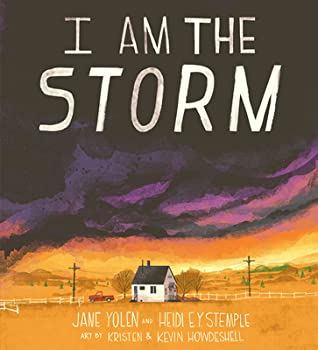
In the wake of Wednesday’s egregious attack on the US Capitol, I decided to postpone the post I’d initially planned for this week (cute polar bears can wait) and talk instead about a new picture book brimming with reassurance. Technically, it’s about weathering a literal storm—a tornado, a blizzard, a hurricane, and a wildfire—but its message feels deeply relevant to the place of uncertainty and fear in which we increasingly find ourselves: that in times of crises, we pull through with the help of family and community, with hope and heart and hard work. That Nature is powerful, but so are we. That, following every storm, there is always a return to calm.
Compared to most families, we spend a disproportionate amount of time obsessing about discussing the weather, owing to a fear of storms my eldest has had since he was two and a half and watched a microburst uproot a tree and send it spiraling down onto a power line, where it ignited. Previously, I’ve blogged about You’re Safe With Me, an animal-themed, folktale-like story offering a mother’s embrace as a panacea for stormy winds. Today’s book is more literal and larger in scope, showcasing scenarios that will feel familiar to children growing up at a time when weather events are larger, louder, and more frequent. It is about fear, but it’s also about a myriad of possibilities—some of them surprisingly wonderful—that can accompany that fear and pave the way for resilience.
Co-authored by mother-daughter team, Jane Yolen and Heidi E. Y. Stemple, with glorious spreads by husband-and-wife team, Kristen and Kevin Howdeshell, I am the Storm (Ages 3-7) is about the moments when Nature rears its ugly head and threatens to overpower us—and what happens next. With equal parts candor and lyricism, four different children describe their family’s response to an incidence of extreme weather and the unexpected ways they find empowerment.
« Read the rest of this entry »An Inclusive Take on a Christmas Classic
December 17, 2020 § 1 Comment

Traditionally on Christmas Eve, I channel my father and do a stirring rendition of Clement C. Moore’s poem “The Night Before Christmas,” before the kids head up to bed and pretend to sleep. First published in 1823, Moore’s description of St. Nicholas and his eight flying reindeer, landing on rooftops and sliding down chimneys, has shaped our Western portrait of Santa Claus for the past 200 years. And yet, in almost every case, Moore’s words have been illustrated to center a white, upper middle-class family in a small New England town.
When we first moved to Virginia, we didn’t have a fireplace. A preschool classmate asked my son how Santa would get into our home to deliver presents. My son was dumbstruck; nothing I said assuaged his anxiety. When, a few weeks later, I took my kids on our local “Santa Train” (thank you, Virginia Railway Express) to spend an afternoon with the Big Man, my son queued up to ask that most important question: “What if someone doesn’t have a chimney?” To which the white-bearded man pointed to an oversized silver key hanging from his belt. “This magical key opens every door in the world, so if I can’t enter by chimney, I simply go through the front door.” And that was that.
There is a myriad of ways that adults have revised (or eschewed completely) the Santa myth to suit diverse living situations. Addressing economic disparity is tougher. There were years when my son would ask, as we shopped for our local toy drive, “But won’t Santa bring toys to these children?” Those of us who talk to our children of Santa Claus find ourselves perpetuating a myth as privileged and problematic as it is enticing.
Children’s illustrator Loren Long—already beloved in our house for his picture books starring Otis the tractor—has breathed new life into Clement C. Moore’s The Night Before Christmas (Ages 3-10), setting the original poem to illustrations featuring four diverse families. As we page through the book, the warm, atmospheric, cleverly detailed paintings tell their own stories about what Santa’s arrival looks like for a family on a rural farm, in a mobile home, a city apartment, and an island bungalow. (Even before the poem starts, the endpapers show the different children engaged in Christmassy pursuits, like cookie making and letter writing.) The result is a fresh, if idealized, take on a Christmas classic—which, even as it doesn’t address all the paradoxes of the Santa myth, suggests that the magic of the holiday touches everyone who believes.
« Read the rest of this entry »2020 Gift Guide: Picture Book Round-Up
October 29, 2020 Comments Off on 2020 Gift Guide: Picture Book Round-Up
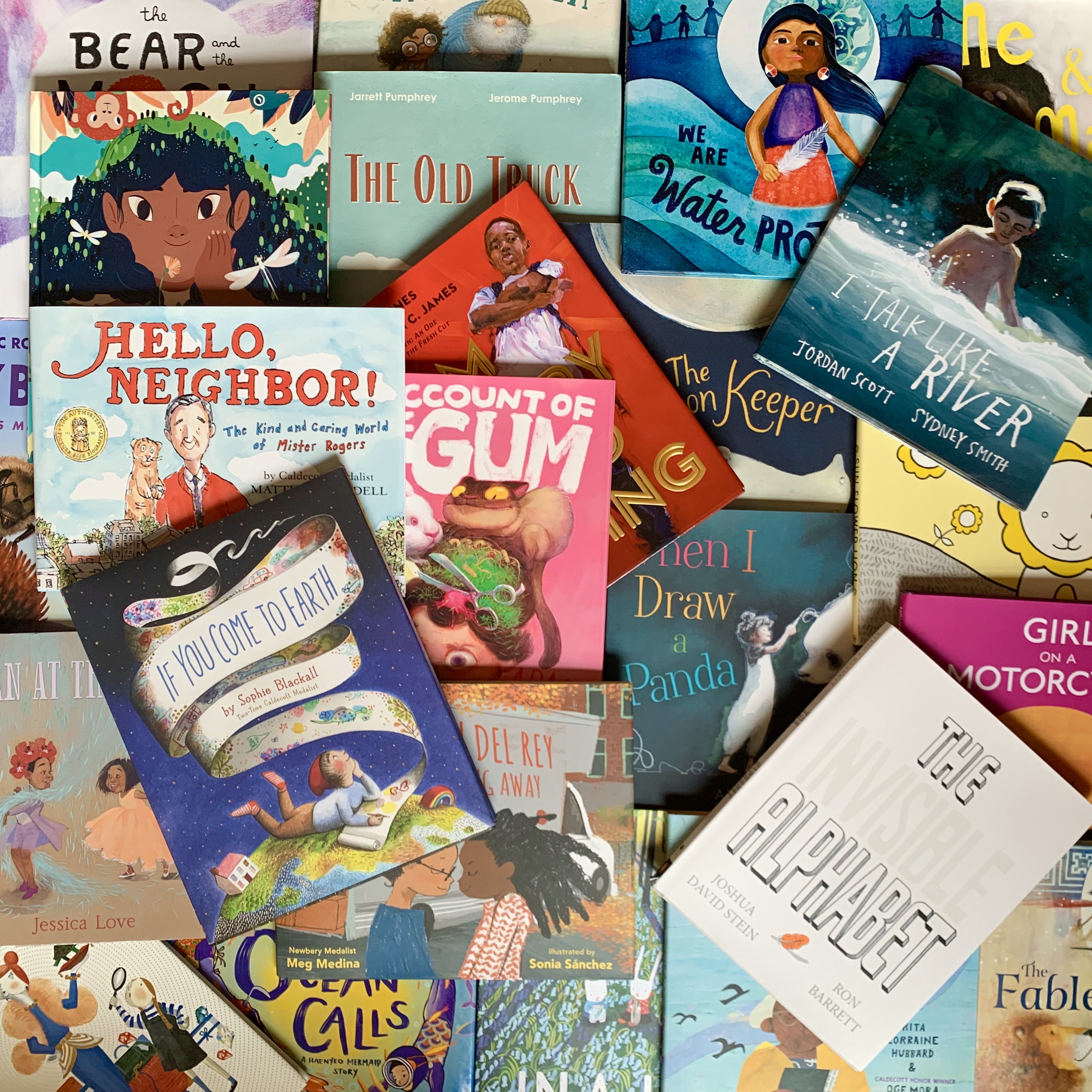
Last week, I told you about my two verrrrry favorite picture books of the year: The Bear and the Moon (Ages 2-6) and Girl on a Motorcycle (Ages 5-9). Today, I’m telling you about others I like a whole heck of a lot. I’ve selected titles, both fiction and non-fiction, for a range of ages, from two to ten years old. Some of them are jaw-droppingly beautiful; others elicit laughter; many invite wonder and compassion. All of them are deserving of a permanent home, where they can be enjoyed again and again and again.
Before we start, there are several I’ve already blogged about this year. Rather than repeating myself, I’m going to link to my original posts. The ones with mega gift potential from earlier in the year are Me and Mama (Ages 2-6), The Ocean Calls (Ages 4-8), Madame Bedobedah (Ages 5-9), Swashby and the Sea (Ages 3-7), The Fabled Life of Aesop (Ages 5-9), In a Jar (Ages 4-8), and The Oldest Student (Ages 6-10).
And now, here are ones new to these pages:
« Read the rest of this entry »2020 Gift Guide: My Favorite Picture Book for Preschoolers
October 20, 2020 § 5 Comments
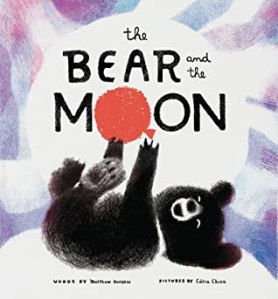
Similar to last year (when I picked this and this), I find myself unable to choose between two picture books for my very favorite of 2020. Still, the two I’ve chosen play to slightly different audiences, so I’m using that as an excuse to bring you two picture book posts this week. I’ll begin with my favorite for the littles.
It seems to me that what we should really gift our youngest children this year is what we wish for ourselves: the literary equivalent of a giant bear hug. In a year dominated by disconnection and uncertainty, we have had to work harder to love both one another and ourselves. If we are to fill the void that 2020 has left on our hearts, it will be through care and compassion, including and especially self-compassion. And that’s where The Bear and the Moon delivers beautifully.
Written by Matthew Burgess and illustrated by Cátia Chien, The Bear and the Moon (Ages 2-6) is a playful, poetic story about a bear and a balloon. But it’s also a visceral meditation on life’s impermanence—and on the forgiveness and self-love required to weather these moments of loneliness and sorrow. I’ve always believed that the best picture books should offer a little something to the adults called upon to read them again and again, and The Bear and the Moon provides comfort and reassurance to both reader and listener alike.
And then, of course, there are the mixed-media illustrations, which are in a class by themselves. Smudgy and sublime, they wash over us with a gorgeous palette of purples and blues, accented by the velvety black of the bear and the clean paper cut-out of the red balloon. And that expressive bear face? A thousand times yes.
« Read the rest of this entry »Emily Dickinson: Perfect Reading for a Pandemic?
September 24, 2020 § 2 Comments
 Not many people know this, but my daughter is named after Emily Dickinson. (Well, and the heroine of L.M. Montgomery’s Emily of New Moon.) I didn’t fall for Emily Dickinson’s poetry until I got to college, when I fell hard and fast and ended up featuring her poems in no fewer than seven essays, including my Senior Thesis. I had never been a big poetry lover, but there was something about the compactness of her poems which fascinated me. So much meaning was packed into such few words. And even then, the meaning was like an ever-shifting target, evolving with every reading.
To read Emily Dickinson is to contemplate universal truths.
Apart from reading Michael Bedard and Barbara Cooney’s 1992 picture book, Emily, I hadn’t had much occasion talk to my own Emily about her namesake. But that changed last spring, when my Emily started writing poetry of her own. Nothing about virtual learning was working for her, until her teachers started leading her and her classmates in poetry writing. Suddenly, my daughter couldn’t jot down poems fast enough, filling loose sheets of paper before designating an orange journal for the occasion. She wrote poems for school, for fun, and for birthday cards. It didn’t matter that they weren’t going to win awards for originality; what mattered was that she had found a means of self-expression during a stressful, beguiling time.
Jennifer Berne’s On Wings of Words: The Extraordinary Life of Emily Dickinson (Ages 7-10), stunningly illustrated by Becca Stadtlander, could not have entered the world at a more perfect time. It opens a dialogue, not only about Dickinson’s unconventional life, but about her poems themselves. At a time when a pandemic has prompted many of us and our children to turn inward, this picture book is less a traditional biography than an homage to the rich interior life developed by this extraordinary poet and showcased in her poetry.
 What to Read to Your Kids