When the Sea Works its Magic
August 6, 2020 § 3 Comments
 The value of a change of scenery during this pandemic cannot be overstated. Last week, we spent five nights in a rental on the Chesapeake Bay, our front door just steps to a tiny slice of sand, a bank of beautiful rocks, two kayaks, and a half mile of clear shallow water for wading, before dropping off to deeper water and stunning sunrises beyond.
The entire trip felt like a brief return to normalcy (look, we’re a family who vacations!). It was also a gift which arrived at precisely the right time. In the weeks leading up to our departure, I felt a heaviness descend on our family, the sum total of weariness from the past five months and the grinding uncertainty of the new school year.
The sea knew what we needed. For a few magical days, it drew us out of our heads and into our bodies, then engulfed us in a delicious weightlessness. It gave us expanses of space—so much space—at which to marvel, after staring at the inside of four walls for too long.
The sea didn’t get everything right (we didn’t need the jellyfish), but it reminded us that there is beauty in the world, that it hasn’t gone anywhere, and that in connecting to this beauty we can connect to the best in ourselves. We can be a little looser. A little messier. Smile a little more.
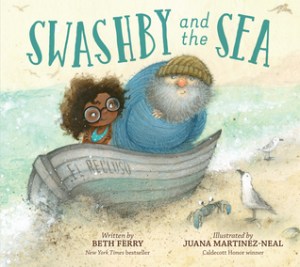
As it turns out, one of my favorite picture books of the year also features some welcome meddling by the sea. It has been awhile since I hailed a beachy picture book (last were here and here), and this one proves well worth the wait. Swashby and the Sea (Ages 3-7), written by Beth Ferry and illustrated by Juana Martinez-Neal (quickly becoming one of my favorite contemporary illustrators), reminds us that sometimes the sea knows what we need even before we do.
Moving Past Color-Blindness
June 25, 2020 § 2 Comments
 I have been drafting this post in my head for two weeks, terrified to put pen to paper for the dozens of ways I will certainly mis-step. Raising children dedicated to equity and justice has always been important to me—if you’ve been following my blog, you’ll recognize it as a frequent theme here—but only lately have I pushed myself to consider the ways my own privilege, upbringing, and anxiety have stood in the way of that. It is clear that I cannot raise my children to be antiracist if I am not prepared to do the work myself.
When my daughter was three, I brought her to the pediatrician’s office for a rash. As we sat in the waiting room, watching and remarking on the colorful fish swimming in the aquarium, my daughter suddenly turned to me. “Mommy, is the nurse going to be black-skinned?”
Embarrassment rose in my cheeks. “Oh honey, I’m sure any nurse here is a good nurse. Let’s not—”
Her interrupting voice rose about ten decimals. “Because I am not taking off my clothes for anyone with black skin!”
Just typing this, my hands are shaking. I am back, seven years ago, in that waiting room, aware of all eyes upon us. Aware of the brown-skinned couple with their newborn baby sitting directly across from us. This can’t be happening, I thought. This can’t be my child. She goes to a preschool with a multicultural curriculum. We read books with racially diverse characters. She plays with children who look different than her. Shock, outrage, and humiliation flooded every inch of my being.
Caught off guard and determined to rid myself of my own shame, I fell into a trap familiar to many white parents. For starters, I came down hard on her. I took my shame and put it squarely onto her. I was going to stop this talk immediately. I was going to prove to everyone listening that this was unacceptable behavior in our family. I was going to make it…all about me.
“Stop it!” I said firmly. “We do not say things like that.” Then, I started rambling about how we shouldn’t judge people by how they look, how underneath skin color we’re all the same, how we’re all one big human family, and so on. You know: the speech. The color-blind speech. The one where white parents tell their children to look past skin tone to the person underneath. The one where we imply that because skin color is something we’re born with, something “accidental,” we shouldn’t draw attention to it. The one where we try and push on our children a version of the world we’d like to inhabit, as opposed to the one we actually do.
My three year old was observing—albeit not kindly or subtly—that not everyone looked the way she did. And she wasn’t sure if that was OK. She was scared. She was uncomfortable. Because we weren’t talking about skin tone or race with her at home, because our conversations (however well-intentioned) steered mainly towards platitudes of kindness and acceptance, she had begun to internalize the racial assumptions around her. She had used the descriptor “black-skinned,” I later realized, whereas if she had simply been observing skin tone, she would have said brown skin or dark skin. The word she chose was a reference to race. A loaded word. Something she had heard. Something she didn’t understand. Something she was beginning to associate with something less than.
We don’t want our children to use race to make judgments about people, so we’d rather them dismiss race completely. Except, in a society where race is embedded into nearly every policy and practice, it is impossible not to see race. So instead, what we are really communicating to our young children is, I know you notice these differences, but I don’t want you to admit it. (Including to yourself). Good white liberal children don’t talk about their black and brown friends as being different from them. Even more problematic, good white liberal children love their black and brown friends in spite of these differences.
Sharing a Love of Travel (A Father’s Day Post)
June 11, 2020 § 1 Comment
 This Father’s Day, my own father will have been gone for twenty-six years. Twenty-six years. One of the most devastating things about losing a parent when you’re eighteen is that you never get to know that parent through an adult lens. I knew my father intimately, from his scratchy mustache to his eye-rolling wisecracks to his endless patience as I described every painstaking detail of my day. But I knew him as a child knows a parent. How I wish I could have known him as an adult.
In times of great upheaval and unrest, I feel my father’s absence most keenly. Every seismic shift in our world puts that much more space between him and me. How would he be participating in this national conversation about race? Would he be marching with a Black Lives Matter sign? What candidate would he have supported in the last Democratic primary? How would social distancing have impacted his life in retirement—or would he still be practicing law? What kinds of things would he enjoy doing with his grandchildren?
I can’t pretend to know the answers to these questions, though I ask them quietly to myself all the time.
What I do know is that there are certain things which always bring him back to me. And one of them is travel. My father’s love of travel was legendary. When I was very young and he would travel internationally for work, he’d always bring me souvenirs—usually dolls—from places like Brazil, Mexico, and Germany. I loved gazing at the tiny porcelain faces or printed fabric clothes and imagining where they had been. Our house was full of black-and-white photographs from before my time: my father on a camel in the Sahara, my father on a motorcycle in Greece. When I decided to spend a gap year in Vietnam after high school, he jumped at the chance to accompany me across the ocean. When, weeks later, it came time for him to return to the States, his parting words were, “It looks like you’ve got the travel bug now, too.” I beamed with pride.
It seems fated that I would fall deeply in love with Jenny Sue Kostecki-Shaw’s new picture book, Papa Brings Me the World (Ages 3-7), in which a young girl describes her affection for a father who travels the world and brings pieces of it back to her. I’ve long been a fan of Kostecki-Shaw’s (my daughter still pulls out Luna & Me), but this book positively transported me. Maybe because it’s inspired by the author-illustrator’s own father; maybe it’s because the theme of found objects lends itself beautifully to mixed-media collage; or maybe it’s because the voice of the little girl reminds me of my young self, brimming with tenderness and curiosity and admiration and longing for my father’s stories of adventure.
Adventures in Siblinghood, Quarantine Edition
May 28, 2020 § 7 Comments
 It was the best of times, it was the worst of times…it was the sibling relationship during quarantine. My daughter spent last Saturday night at her aunt’s house, and while my husband and I enjoyed a peaceful night with our son, it dawned on me: it’s not my children who have been sucking up all the oxygen in our house, it’s their relationship.
I’m grateful my children have each other at a time when they have no one else. But because they have no one else, they’ve pinned all their hopes and dreams and frustrations and jealousies on one another. Everything they’ve always done is now executed with a new level of intensity. They tear into each other over the smallest offenses (“Stop whistling!” “Stop looking at me!” “I can’t sit hit here because your feet smell!”), only it escalates into poking and clawing and just-plain-mean yelling, like they haven’t done since they were much younger. If I separate them (“This house may be small, but there is enough room for you to spread out”), they’re back together again before I can get down the stairs. Only, suddenly, they’re curled up in a teeny tiny fort of their own design, a tangle of limbs impossible to tell where one stops and the other begins, giggling and scheming and reveling in the giant mess they’ve strewn across the upstairs.
Four whole hours before my daughter was scheduled to come home from her sleepover last weekend, my son was already watching for her from the window.
The only thing that could make this current state of affairs any more intense would be an elevator button. If there is one small consolation to not being able to go places right now, it’s that we can at least avoid the universal sibling fight over who gets to push the elevator button. There has never been a harmonious moment of siblinghood that wasn’t ruined by a gosh darn elevator button.
Lest we forget about life with elevator buttons, Minh Lê and Dan Santat have teamed up to create a comics-inspired picture book to remind us. And yet, Lift (Ages 4-8) isn’t about ordinary elevator buttons. Well, at first it is. But then that button becomes something magical. Something illuminating and insightful and spectacularly fun. Something which drives siblings apart—but then brings them back together, united in a common purpose. All without leaving the house.
Bringing Down the House
April 16, 2020 § 2 Comments
 My kids love hearing stories about when they were babies. They especially love stories that involve crying. Inexplicable crying. Endless crying. Crying that brought down the house.
When our eldest was a newborn, he screamed bloody murder whenever we bathed him. It didn’t matter what we tried. We sang to him. We playfully splashed him. We made funny faces at him. Aren’t babies supposed to love bath time? we asked ourselves. Does he hate water? Does he hate us? Night after night, he’d scream, his face turning purple, his fists tightly clenched, his tiny legs kicking furiously.
A few weeks later, a friend gave us a baby gift. Tied to the top was a yellow rubber ducky. A duck, a duck! Surely a toy would be the golden ticket. That night, after we’d filled the oblong plastic tub from the kitchen tap, we tossed in the duck—and watched with horror as it turned from yellow to fire-engine red. Apparently, the duck had a sensor designed to gauge the proper temperature for itty bitty newborns unaccustomed to bathing outside utero. We thought we were running a nice, soothing, warm bath for our baby boy every night. Instead, we were scalding him. We turned on the cold for a few minutes, slowly lowered JP into the tub, and he smiled like he had never smiled before.
Well, dang.
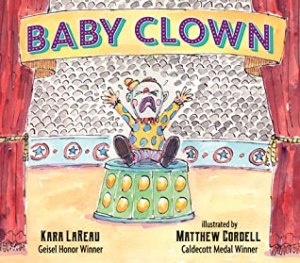
Earlier this week, a delightful picture book was birthed into the world by Kara LaReau and Matthew Cordell. Baby Clown (Ages 3-6) is about a newborn circus clown who wails and wails and wails, despite the attempts of his adults to hush, soothe, distract, or entertain him. It got me thinking: maybe the reason children relish hearing stories about babies crying is because they seem to defy the natural order of things. How is it possible that these tiny, helpless, innocent beings can wield so much power over their wise, capable, fully-grown adults?
Bees: To Fear or Not to Fear
April 2, 2020 § 2 Comments
 Remember last week when I talked about returning our children to nature during this pandemic vis-á-vis secret gardens and long hikes in the woods? Well, there’s just one teeny tiny problem. While we were hiking a few days ago, my son spotted a bee.
Let me back up.
When JP was almost three, during a family reunion in rural Rhode Island, he climbed a ladder to reach an aged treehouse and stood up into a nest of wasps. He was stung twenty-seven times. I know this because the pediatrician, whom I panic dialed, asked me to count the stings. JP was just shy of the number where the poison level would have necessitated getting into the car and trying to find a hospital. Instead, we sat him on the second step of my uncle’s swimming pool, where, immersed in cold water, the screams and swelling eventually subsided.
Perhaps owing to this traumatic event or perhaps just because of the way he’s wired, JP has moved through the past nine years immensely fearful of stinging insects. His fear doesn’t differentiate between wasps and bees. He has read countless books on the subject; he has taken field trips to bee farms; he can rattle off the statistical improbabilities of being stung. No matter. If he hears buzzing, his body goes rigid; if he spots a bee, he flails and shrieks and spends the rest of his outdoor time willing it to be over. He is a hostage to this fear. While I know that with enough exposure and time, he will someday share the outdoors more easily with these creatures, I also know that right now, even more than being afraid of them, he is afraid he will never stop being afraid.
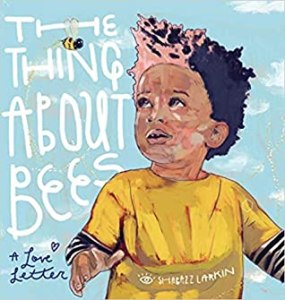
If I could go back in time, short of stopping JP from climbing that ladder, I would take this 2019 picture book with me. It’s what I wish I had read to him in the wake of the wasp event. It’s what I wish I had read to him a hundred times since. In The Thing About Bees: A Love Letter (Ages 3-7), author-illustrator Shabazz Larkin shares his steadfast love for his two young sons alongside an evolving love for bees (not to be confused with wasps), the great pollinators of everyone’s favorite fruits and vegetables. It’s a refreshingly original treatment of a popular subject—why bees matter—because it acknowledges front and center that bees are not easy to love. Indeed, this deeply personal book grew out of the author’s desire not to pass on his own fear of bees to his children. (Quick shout out to Capitol Choices, the children’s literary group of which I’m a part and where I learned of this book last year. Find other treasures on our 2020 list, published here.)
Friendship is Not Wasted on the Young
March 12, 2020 § 1 Comment
 My daughter has had the same best friend for nine years. She met her when she was just beginning to run and climb, when I used to swing by our local playground—what we called the “Tot Lot”—after dropping her brother off at preschool. It was an instant connection, the likes of which I had never experienced with my son, and it stopped me in my tracks. Child development literature would have placed my daughter squarely in the realm of “parallel play.” So how to explain that she never let fall the hand of this other little girl, that they climbed and descended the small slide, crawled through plastic boulders, and scampered up and down artificial hills as one?
After spending nearly every day together for years, the girls don’t see each other as often now; they live about an hour apart. Still, when they get together, they pick up like no time has passed. They disappear into their own world: talking in whispers, inventing elaborate games, often so wrapped in each other’s arms that it’s hard to tell where one stops and the other begins. To witness their togetherness feels like being in the presence of something magical, something almost miraculous.
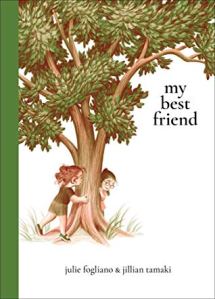
Julie Fogliano and Jillian Tamaki’s my best friend (Ages 3-7) came out only a week ago, but so enthusiastic has the response been from the kid lit world, I feel like the last person to sing its praises. (Still, wild horses couldn’t keep me from joining in the fun.) An homage to the giddy abandon exhibited in early childhood friendships—particularly those born on the playground—the book has all the makings of a classic. Fogliano’s free verse sings and soars with the stream of consciousness of a child tasting the deliciousness of friendship for the first time. (i have a new friend/ and her hair is black/ and it shines/ and it shines/ and she always laughs at everything) Tamaki’s muted palette of rusty pink and olive green lends the book a timeless, vintage feel, while the figures themselves spill and explode off the page, their excitement literally uncontainable.
Concluding Black History Month on the Train
February 27, 2020 Comments Off on Concluding Black History Month on the Train
 Every year, once in the fall and once in the spring, I take each of my children on a mommy-and-me trip to New York City for a long weekend in the city where I grew up. We board the train in Alexandria, Virginia and make stops in Washington, D.C.; Baltimore, Maryland; Newark, Delaware; Philadelphia, Pennsylvania; and, finally, New York City, Penn Station. My kids have come to enjoy the train ride almost as much as the destination itself, glancing up from their books to watch the changing scenery speeding by—there is something innately lolling and contemplative about train travel—and anticipating the stops to come.
These same train stops come to life against an important and fascinating historical backdrop in Overground Railroad (Ages 4-9), a new picture book by superstar husband-and-wife team Lesa Cline-Ransome and James Ransome, whose Before She Was Harriet I praised around this same time last year. “Isn’t it supposed to be “Underground Railroad?” my daughter asked, when I picked up the book to read it to her. Admittedly, I was equally stumped. As the Author’s Note explains, most people are familiar with the covert network known as the Underground Railroad, which assisted runaway slaves on their journey to the North, usually on foot. Lesser known but often equally secretive, the Overground Railroad refers to the train and bus routes traveled by millions of black Americans during the Great Migration, a time when former slaves opted to free themselves from the limitations and injustices of sharecropping to seek out better employment and educational opportunities in the North. Faced with the threat of violence from the owners of these tenant farms, who relied on the exploitation of sharecroppers for their livelihood, those who escaped often had to do so under cover of night.
Curating Memories
February 20, 2020 § 4 Comments
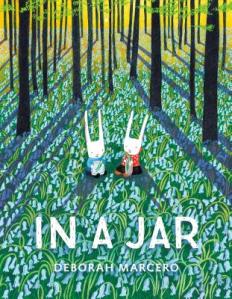 Since losing my grandmother two weeks ago, I haven’t been able to shake my sadness at the realization that my memories with her are now finite. For nearly 45 years, I have been collecting memories with her, savoring them on shelves in my heart. Memories of orange-red sunsets on the beach; of her impossibly large hibiscus plant; of earth-shattering thunder claps which sent me flying out of bed, always to find her calmly watching the electrical show from the screened porch (“Have you ever seen anything so beautiful, Meliss?”). There were jigsaw puzzles which kept us up late into the night, always after vowing she wouldn’t “get involved”; prank calls she encouraged me to make to her friends; Thursday night Bingo games at her golf club, where to be seated next to her felt like basking in the presence of a celebrity. I can still hear her voice like it was yesterday, those giddy eruptions of “Goody goody goody!”
If the right book, read at the right time, can cradle you in its embrace, then Deborah Marcero’s new picture book, In a Jar (Ages 4-8), is doing that for me. (My kids are pretty smitten, too.) It is the most exquisite, childlike, visual depiction of memory-making I’ve encountered, as well as a reminder that the process of collecting memories can be as beautiful as the memories themselves. While it’s not about death, it is a story of loss—the loss of a friend who moves away—and how we re-frame the world in light of departure. It’s affirming and hopeful and the kind of lovely that surrenders you to its pages.
Better Together (Maybe for the Apocalypse, Too?)
February 6, 2020 § 1 Comment
 A year or so ago, I was at a summer garden party, all twinkling lights and umbrella drinks, when the conversation took a dark turn. Several folks, none of whom I knew terribly well, began to discuss and debate the provisions they had stored away in the event of an apocalypse. I sat quietly, picturing my own basement with its boxed wedding dress, foosball table, and toys I’d stashed hoping my kids wouldn’t notice so I could gradually move them to the donation bin, and realized how far a cry this was from the scene being described. No crates of non-perishable food, no industrial sized jugs of water, no iodine pills in the event of a nuclear attack, no walkie talkies, no axes, definitely no guns to take down squirrels that could comprise my protein quota.
“Don’t you worry about how you’re going to protect your family?” someone said to me, after I tried to make a joke about my foosball table. I conjured up an image of myself, defending my children against other crazed survivors—all of us presumably reduced to looters or murderers—and I said, only half joking, “In the case of an apocalyptic event, I think it would be best for the future of humanity if my family made a quick exit.” To put it mildly, living off the land in the dark and cold for an extended period of time isn’t really in our wheelhouse.
Last month brought a fresh wave of worry for those of us working hard not to picture End of the World scenarios. We were on the brink of a war with the Middle East. The continent of Australia was burning. A mysterious and deadly virus was (is) rapidly spreading out of China. If we believe apocalyptic-themed fiction, it’s not long until we will be wandering alone in the dark and cold, assuming we are unlucky enough to survive.
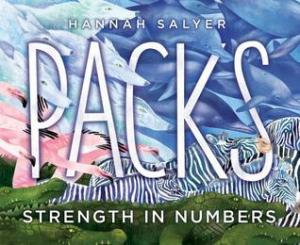
And yet, at a time when the news threatens to send us into an ethos of fear and anxiety—to fathom ways of constructing safe houses around our loved ones—children’s literature is there, reliably, with a hefty dose of optimism, a welcome respite from the dark and cold. Especially where gems like Hannah Salyer’s debut picture book, Packs: Strength in Numbers (Ages 5-9), are concerned, we would do well to remember that the animal kingdom has always survived when it turns towards, not away, from one another.
And Now, We Wait
January 16, 2020 § 4 Comments
 Happy New Year! Has anyone else noticed that the New Year always brings a mounting, restless anticipation about things to come? Maybe it’s because January is so much slower-paced than December (thank goodness); our minds naturally begin to leap ahead, craving that next fun event, that next milestone, even when we know we’d do better to slow down and allow ourselves to sink into the calm (dark mornings and grey afternoons included).
In any case, we’ve been doing our fair share of waiting lately. Waiting for snow days. Waiting to get braces off. Waiting for renovations to begin on our house. Waiting for our trip to Disney. Waiting for long summer days. And I’m feeling it as much as my kids. Waiting is hard.
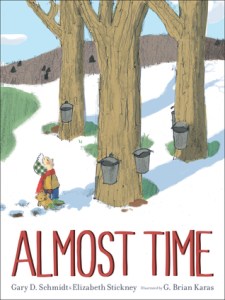
Fortunately, we don’t have to wait any longer for Almost Time (Ages 4-7), a new picture book by Gary D. Schmidt and his late wife, Elizabeth Stickney (pseudonym), with art by G. Brian Karas. I don’t think the sensation of waiting has ever been so astutely served up for young children as in this sweet winter story about a boy eagerly anticipating, not one, but two exciting events.
2019 Gift Guide: For The Littlest Ones
December 3, 2019 § 2 Comments
 The three and under set doesn’t get a lot of love on the blog these days, probably because my own kids are aging so darn quickly. But that’s no excuse. These early years are where we plant the seeds in our children for a love of stories. Plus, if you’re anything like me, these early years are when books sometimes feel like our only lifeline to sanity: no matter how much we’ve been spit up on or yelled at, falling under the spell of a story alongside our little one makes us feel like all is right with the world. If you do have a toddler, be sure to follow me on Instagram; that’s where I first reviewed many of these and where you’ll see more.
2019 Gift Guide: Picture Books for Ages 3-7
December 1, 2019 Comments Off on 2019 Gift Guide: Picture Books for Ages 3-7
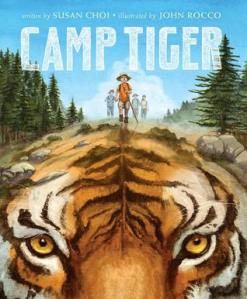
 Today is part recap, part intro. To kick off the picture book portion of my Gift Guide, I’ve already told you about my mad love for Home in the Woods and Pokko and the Drum. Earlier in the year in these pages, I sang the praises of Crab Cake, Lubna and Pebble, I am Hermes!, Camp Tiger, A Stone Sat Still, The Scarecrow, and Who Wet My Pants?—all of which would also make fantastic holiday gifts. But if you haven’t kept up with my reviews on Instagram all year long, I thought it was high time I shared some of them here. Because one or two (or all) of these might be perfect for someone on your list.
2019 Gift Guide: My Favorite Read-Aloud of the Year (Finding Your Own Rhythm)
November 27, 2019 § 3 Comments
 Last week, I told you about My Favorite Picture Book of the Year. I also told that you that, this year, I had two favorites. In fact, this second may be one of my favorite read-alouds ever. Seriously. Want me to swing by right now and read this to your kids? I’m in. Though I think they’d probably have more fun if you did it.
On the surface, Matthew Forsythe’s Pokko and the Drum (Ages 3-7) has a straightforward premise: girl gets drum; girl finds a way of expressing herself; girl wins over her skeptical parents. The originality lies entirely in Forsythe’s execution: a color palette at once earthy and whimsical; strategic use of white space to control pacing; expressive animal figures; subversive humor; and page turns perfectly timed for dramatic impact.
Forsythe’s dry humor kicks off in the story’s opening sentence: “The biggest mistake Pokko’s parents ever made was giving her a drum.” Proving that her parents know a thing or two about mistakes, we get a quick visual look at some of their previous ill-conceived gifts: “the slingshot” (launches Pokko), “the balloon” (up, up, and away), and—my personal favorite—“the llama” (destroys the house). « Read the rest of this entry »
2019 Gift Guide: Favorite Picture Book of the Year (and How Family Should Be)
November 21, 2019 § 6 Comments
 How it’s almost Thanksgiving I’ll never know, but the season of giving will soon be upon us. Seeing as I’ve read more this year than any other, I think it’s fair to say my 2019 Gift Guide won’t disappoint. I’m aiming to include something for every child and teen on your list. As has become tradition on this blog, I begin with my favorite picture book of the year (although spoiler: this year I have TWO, so stay tuned). Past years have seen this, this, and this. It has been hard keeping this one a secret…although timing for today’s reveal feels especially fitting.
Growing up, I always preferred Thanksgiving to Christmas. I would never have admitted this; it seemed odd as a child to prefer a holiday of sitting around, eating off formal china, and making conversation with grown-ups—over one with presents and candy and caroling. But there was something about the warmth and coziness of Thanksgiving which seduced me: returning home frozen after the Macy’s Thanksgiving Day Parade to an apartment abounding with hissing radiators and the smell of roasting turkey. There was the comfort of looking around the room and seeing the people I loved and not having the distraction of which gifts might be under the tree and which, disappointingly, might not.
It’s not lost on me that the timing of Thanksgiving plays a role in its appeal. After all, Thanksgiving kicks off the Holiday Season. It’s a time of anticipation, and there’s nothing more alluring to a young child than possibility. It may not be the holiday of presents, but it’s a road sign pointing towards the presents. Pointing towards the twinkling lights and crackling fires and colorful wrappings.
Still, there can be a kind of magic in and of itself created by family—and, if we’re lucky, it becomes almost tangible on Thanksgiving Day. For a few short hours, the world outside falls away, and the inside jokes and knowing glances and lingering hugs take center stage. Dishes are prepared with love and displayed in beautiful ways, and we relish the bounty of this precious togetherness.
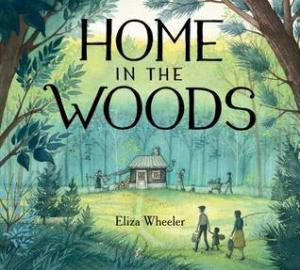
In her exquisite new picture book, Home in the Woods (Ages 4-8)—one of the finest examples of bookmaking I’ve ever encountered—Eliza Wheeler invokes her grandmother’s childhood to tell the story of a family who manages to make magic for themselves, even in the toughest of times. (You might remember Wheeler from this long ago favorite. Since then, she has mostly illustrated others’ texts. So happy to see her back in the seat of author and illustrator, because her writing is every bit as evocative as her art.)
Pointing the Finger (Who Me? Not Me.)
November 14, 2019 § 3 Comments
 “You are a thief AND a liar!” Stomping. Bedroom door slamming. Welcome to life in our happy little home.
My son is convinced that he cannot find his tin of Hypercolor Twilight Thinking Putty because his sister snatched it for herself. As it turns out, this same flavor of putty is in a drawer in her room. And yet, she claims she bought this putty with her own money at a gift shop over a year ago. He says she bought a different flavor. Neither can understand why I don’t reserve a part of my brain for keeping track of their fidget purchases. (Never mind that they both have numerous tins in numerous flavors, and is Hypercolor Twilight really that much more satisfying than Emerald Sky?!)
It has been weeks—weeks!—and still the accusations fly from the mouth of my eldest. The interrogations. The investigations (which aren’t really investigations so much as relentless demanding that we agree with him). Here’s the thing: from where I’m standing (hands over my ears), it is entirely probable that this tiny tin of putty was left lying around the house (GASP!) and some adult picked it up and put it in my daughter’s room and no one was the wiser for months. You know what Mr. Finger Pointer doesn’t want to acknowledge in all this? The possibility that if he had taken better care of his putty, it would still be in his room.
Assuming personal responsibility—be it for our carelessness or mistakes or misunderstandings—is one of the toughest things our kids have to learn. Heck, many of us adults still struggle with this. (My hand’s certainly in the air.) Why turn towards our own regret, remorse, embarrassment, or shame when we can don the more tantalizing cloak of anger and go all Grizzly on someone else? Fortunately, in their new picture book, Who Wet My Pants? (Ages 4-8), Bob Shea and Zachariah Ohoro have given us a clever, quirky, and hysterically funny way to broach the subject of personal accountability with our kids. (This is not a potty book.)
Mindfulness: Start ‘Em Young
October 17, 2019 § 2 Comments
 “A well-known teacher was asked to describe the modern world. He answered: Lost in thought.” I’m currently taking a 30-day online mindfulness course from Jack Kornfield and Tara Brach—a series of short guided meditations—and this was how the third session began. Lost in thought: a modern epidemic. I’ve thought about this observation multiple times since, always with sadness and identification. How much of my daily life is spent worrying, planning, remembering, regretting, being somewhere other than where I am?
When we’re lost in thought, Kornfield notes, we’re missing out on what’s in front of us, perhaps on the very parts of life we cherish most. He quotes from the great poet Khalil Gibran: “…and forget not that the earth delights to feel your bare feet and the winds long to play with your hair.”
This is my third attempt in the last eighteen months at developing a regular mindfulness practice. I’ve never lasted more than ten consecutive days. This month has been a mixed bag, too. October has thrown me a number of curve balls, and the pull to become lost in thought—mourning, stewing, deliberating—often eschews the discipline of sitting for a guided meditation.
I want to be better at this. To be more present in my senses, to more fully embrace the adventure of life. To feel the warm sun on the back of my neck, the hard earth beneath my feet. To smell the crispness in the air. To notice my daughter singing in the bathroom.
I want to be better at this for my kids. The ones watching me model being lost in thought as if my life depends on it. When my son experiences an emotion, I wish for him to notice how it manifests in his body, instead of ruminating on it or wishing it away. When my daughter walks home from her violin lesson, I wish for her to notice the shifting beauty around her, even while she plans which games she’s going to play with her waiting friend.
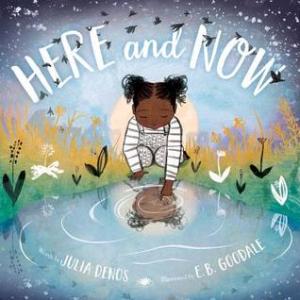
Author Julia Denos has teamed up with illustrator E.B. Goodale to produce another beautiful picture book (I regret not making time on this blog for their first, Windows) which is itself a kind of guided meditation for kids. Here and Now (Ages 4-8) gently and effectively brings children’s attention to the present moment. It grounds the reader in her own bodily sensations, while also connecting her to the wider world. It prompts parent and child alike to think about what might happen if we turn towards, instead of away from, the present moment, with all its beauty and mystery and wonder.
The Push-Pull of October
October 3, 2019 § 1 Comment
 “I’m so glad I live in a world where there are Octobers,” said Anne of Green Gables. And so am I. No month is more bountiful. It smells fresh. It crunches beneath your feet. It’s resplendent with a beauty so striking it almost hurts.
But, even with all its treasures, October is a time of loss. Loss of light. Loss of color. Loss of those long, lazy days of summer which (thank you, September) suddenly seem like a lifetime ago. Right now in our family, this October feels riper than usual with loss, as I prepare to say goodbye to my grandmother, a woman I have loved since she first touched her nose to mine.
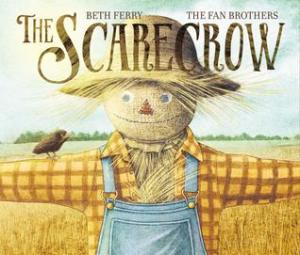
So, while I love books whose pages celebrate fall’s wonders (like this, this, this, and this), I also have a soft spot for books that speak to the shadows cast by fall. Beth Ferry’s quiet new picture book, The Scarecrow, gorgeously illustrated by The Fan Brothers (we would expect nothing less after this), plants the reader squarely in the push-pull of fall. Although, in fact, fall plays only a small role in the story.
When is a Stone a Story?
September 12, 2019 § 5 Comments
 If we want our children to entertain different perspectives when they get to middle or high school—to become critical thinkers and contributors—then they should have opportunities from an early age to consider that there is more than one way to see the world.
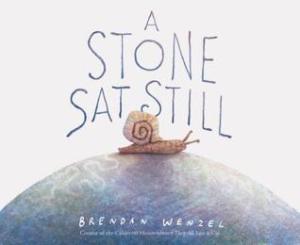
Picture book author-illustrator Brendan Wenzel is making something of a name for himself when it comes to creating books for young children about perspective and perception (his groundbreaking debut, They All Saw a Cat, received a Caldecott honor). His newest, A Stone Sat Still (Ages 4-7), similarly rendered with richly textured, mixed-media art and spare, poetic language, stole my heart from the moment I opened it (do yourself a favor and remove the jacket cover, because WOW). Even my children, well outside the target age, were captivated. This is visual storytelling at its best, where every page asks the reader to engage: to wonder, question, and understand. « Read the rest of this entry »
What’s Left When Summer Ends
August 29, 2019 § 9 Comments
 At no time more than summer do our children grow up. Camps, camping, gloriously long stretches of daylight, ample opportunities at exploration and courage and boredom…all of this combines to ensure that the children we send back to school in the fall are not quite the ones we ushered in summer with.
I was ill prepared for the onslaught of emotions I would feel upon picking up my oldest from his first sleepaway camp experience in Maine. As we slowed along the gravel road though the camp entrance, my excitement of the past 24 hours turned to butterflies. How would he seem? Would he look different? Would he have made friends? Would he burst into angry tears and declare he was never coming back?
We didn’t have to wait long: he was standing alone not far from the entrance. I waved frantically, shouting at my husband to stop the car so I could jump out. JP smiled broadly as I threw my arms around him, but something was immediately apparent. He was quiet. More upright than I’d remembered. More reserved than I’d expected. « Read the rest of this entry »
 What to Read to Your Kids