2020 Gift Guide: Middle-Grade Fiction for Ages 8-14, Part Two
November 13, 2020 § 2 Comments
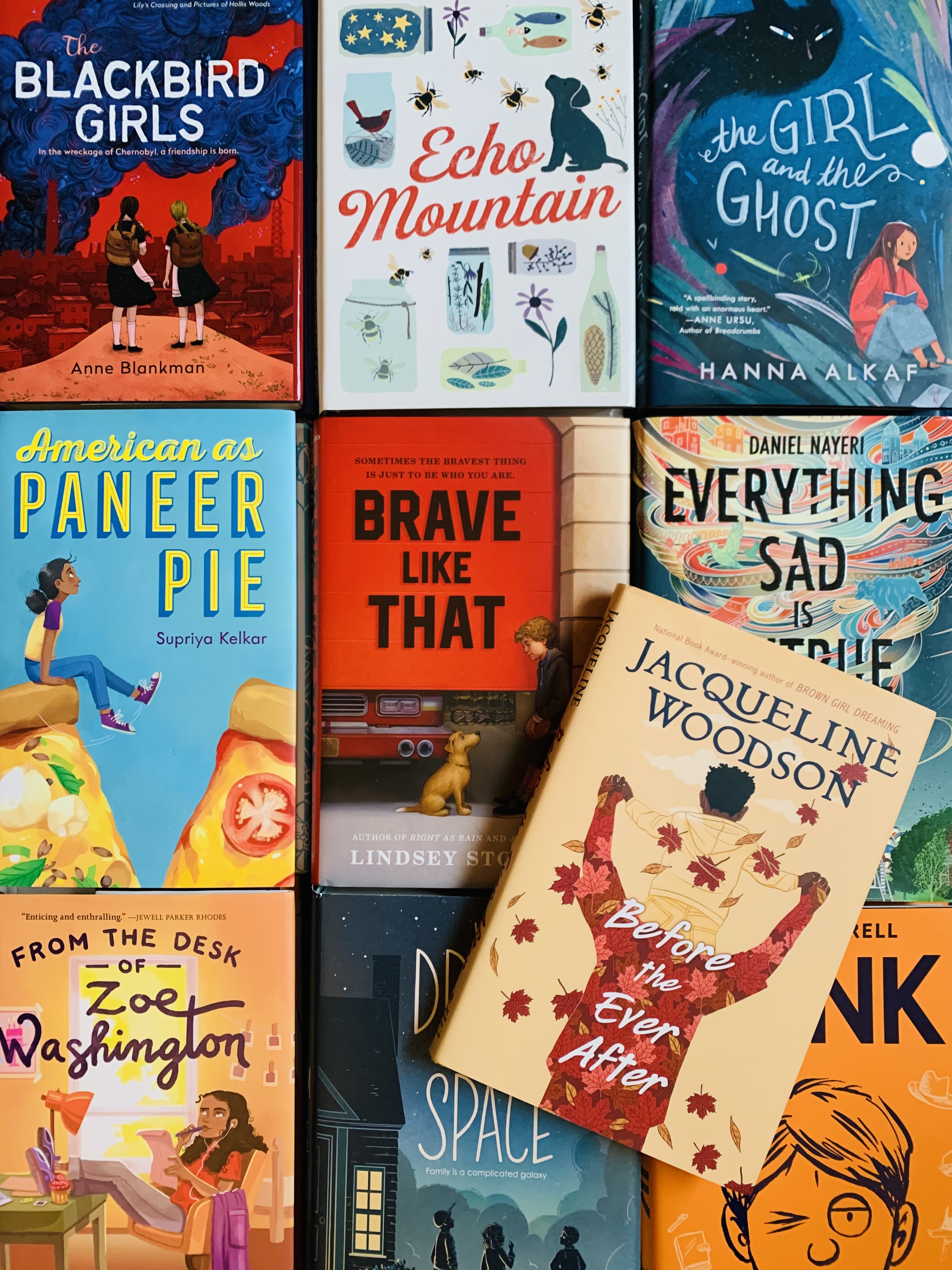
Today, I’m back with my other ten 2020 favorites for the middle-grade audience. As with part one, I’ve taken care to hit a range of interests, styles, and reading levels, while never sacrificing beautiful writing or complex character development (my motto remains: childhood’s too short for mediocre books).
This year’s middle-grade list was compiled with the intimate involvement of my daughter (10) and son (13). While you can always count on my having read any book I review on this blog, nearly every one of the books in today’s and yesterday’s post was also read and loved by one or both my kids. While we’re in that glorious window of sharing books, I’m milking it.
Another friendly reminder that you won’t find graphic novels here, because they got their own post earlier. And if the twenty titles between today and yesterday aren’t enough, check out 2019’s Middle-Grade Gift Guide post, filled with other treasures (many of which are now out in paperback), or my Summer Reading Round Up from earlier this year. And, of course, as soon as I publish this, the fates guarantee I’ll read something I wish I’d included here, so keep your eyes peeled on Instagram, where I’m regularly posting middle-grade updates.
« Read the rest of this entry »2020 Gift Guide: Picture Book Round-Up
October 29, 2020 Comments Off on 2020 Gift Guide: Picture Book Round-Up
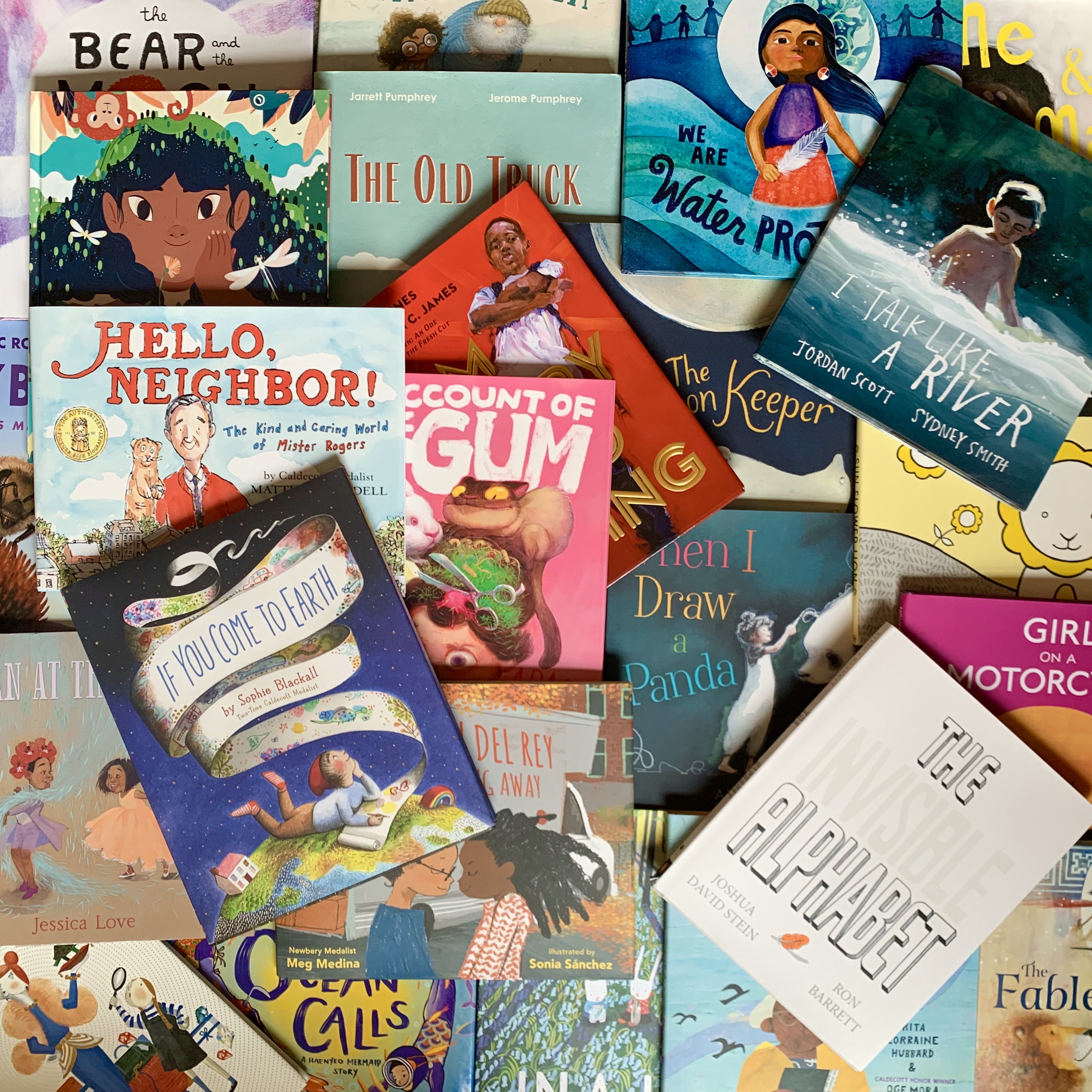
Last week, I told you about my two verrrrry favorite picture books of the year: The Bear and the Moon (Ages 2-6) and Girl on a Motorcycle (Ages 5-9). Today, I’m telling you about others I like a whole heck of a lot. I’ve selected titles, both fiction and non-fiction, for a range of ages, from two to ten years old. Some of them are jaw-droppingly beautiful; others elicit laughter; many invite wonder and compassion. All of them are deserving of a permanent home, where they can be enjoyed again and again and again.
Before we start, there are several I’ve already blogged about this year. Rather than repeating myself, I’m going to link to my original posts. The ones with mega gift potential from earlier in the year are Me and Mama (Ages 2-6), The Ocean Calls (Ages 4-8), Madame Bedobedah (Ages 5-9), Swashby and the Sea (Ages 3-7), The Fabled Life of Aesop (Ages 5-9), In a Jar (Ages 4-8), and The Oldest Student (Ages 6-10).
And now, here are ones new to these pages:
« Read the rest of this entry »2020 Gift Guide Kicks Off: My Favorite Chapter Book
October 15, 2020 § 2 Comments

Yes, it’s time! With supply chain challenges predicted towards the end of the year, and reading one of the few escapes we’re allowed these days, I’m kicking off this year’s Gift Guide a few weeks early, and you can expect weekly posts through Thanksgiving. There will be lots of round-ups with lists for all ages, littles through teens. (And yes, there will be one exclusively on graphic novels.) But I’m beginning today by highlighting one verrrrrry special book that came out this week. Usually, I kick off my Gift Guide with my favorite picture book of the year (and we’ll get to that, I promise), but I’m turning tradition on its head (it’s 2020, after all) and we’re going to start with a book for older readers and listeners. If you keep your eyes on my Instagram this week, you could even win a copy!
Let me start by saying that I am not, by nature, a nonfiction fan. Let me add that I don’t think my ten-year-old daughter has ever picked up a nonfiction book of her own volition. (She rarely lets me read the Author’s Note in a picture book!) Then there’s the fact that this book chronicles a story whose ending most of us already know. In fact, it’s one our family has already encountered in two previous kids’ books. So, how on earth did this nonfiction book—229 pages before the additional 40 pages of footnotes—end up a favorite 2020 read of our entire family?
I remember like it’s yesterday: picking up my son at camp the first week of July, 2018, and having him greet me every afternoon with, “Are they out yet?” Since June 23, our family—like millions around the world—had been glued to the news coverage of the twelve young soccer players and their coach, trapped inside a rapidly flooding cave in Northern Thailand after a field trip went wrong. The successful seventeen-day rescue mission that followed, where thousands of rescuers from around the world tackled one seemingly impossible obstacle after another, captivated people not only because of its tremendous scope and scale, but because at the center was a group of sweet, soccer-loving kids.
As it turns out, Thai-American children’s author Christina Soontornvat was visiting family in Thailand at the time, her plane touching down the same day the children went missing. We may have been riveted by the story on our other side of the globe, but the Thai people were consumed by it. Life as they knew it was temporarily suspended. Schools were closed; vigils were held. Farmers voluntarily sacrificed their land to the drainage operation, while others led drillers through the wild jungles surrounding the cave, and still others cooked food for volunteers. The experience for Soontornvat was such that, a few months later, she returned to Northern Thailand to spend time with the rescued boys and their coach, paving the way for an exhaustive undertaking of interviews with nearly all the key figures in the rescue.
In All Thirteen: The Incredible Cave Rescue of the Thai Boys Soccer Team (Ages 10-16), Soontornvat has written a chapter book that reads like fiction while telling the most textured, suspenseful, holistic version of this incredible true story to date. If there was ever a year when we needed a story that showcases the very best of humanity—the strength, ingenuity, and kindness exhibited when we come together as helpers—it is 2020.
Give this book to the tweens and teens in your life. If they won’t pick it up, read it to them, because there’s a particular power in hearing Soontornvat’s words spoken aloud. My teenage son inhaled this book on his own, but I read it aloud to my daughter, and it was she who kept exclaiming, “I know what’s going to happen, and I’m still on the edge of my seat!” I’ve often heralded how fun it is to learn alongside our children, and All Thirteen is a brilliant example of a book that has something to teach us—about Thai culture, about science and engineering, about the nail-biting niche of cave diving, and about the nature of teamwork and the human capacity for survival—on every single page.
« Read the rest of this entry »A Light in the Dark: Three New Read-Aloud Chapter Books
May 14, 2020 § 3 Comments
 It has been said that the only two certainties in life are death and taxes, but—at least, while quarantined—I can now add a third. Every morning for the past two months, the same conversation has transpired as soon as the breakfast dishes are cleared, around 8:15am.
Me: “OK, kids, head to the couch for read-aloud time.”
My son: “What? No! I need to get upstairs to get ready for school!” (“Getting ready for school” means opening up his Chromebook, clicking on a Zoom link, and waiting for the administrator to let him into the meeting…45 minutes before said meeting actually starts.)
Me: “Your class doesn’t start until 9am.”
Him: “But sometimes they come on early!”
Me: “You don’t need to stare at a screen any more than is necessary. Park your tush next to your sister.”
Every morning, we have this same exchange. Every single morning. For the record, I always win. I only insist on one tiny little fragment of consistency during corna-time and it’s that the kids and I spend forty minutes every morning reading aloud. It’s how we connect before dispersing into our own “virtual” agendas. It’s how we remind ourselves that the world still exists outside our doors, that it waits patiently for us to return, that it invites us to visit in our imaginations until we can come in person. It’s how we remind ourselves that we don’t have to leave the house to get our minds blown.
Quite simply, reading aloud is the one light in these dark days that we can always count on.
As soon as my fidgety, eager-for-that-screen-fix tween sits down on that couch and tunes into my voice, he doesn’t want to be anywhere else. I know this because he gasps the loudest, laughs the hardest, leans in the closest. Reading aloud to tweens and teens can initially seem like an uphill battle, but it’s almost always worth the struggle. In our family, it’s non-negotiable. And it always, always leaves them begging for more…even if just a few minutes earlier they were all too happy to skip it.
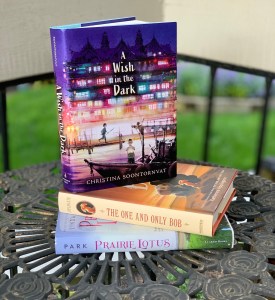
In the upcoming weeks, I’ll be doing a gargantuan middle-grade round up with favorite new books to put in front of your kiddos for independent reading. Today, though, I want to share three new middle-grade novels which lend themselves especially well to reading aloud, as evidenced by our own experience. Their genres—fantasy, comedy, and historical fiction—couldn’t be more different, but their characters, prose, and stories are similarly unforgettable.
Attention Deficit Corona: Graphic Novels for Tweens and Teens
April 30, 2020 § 1 Comment
 Of all the complaints I’ve heard during Quarantine, one of the most common is an inability to focus. If your former bookworms are having trouble losing themselves in literature (hey, Zoom zombification is real), look no further than these new graphic novels. Take it from me.
We moved last week. Moving is challenging in the best of times much less during a pandemic. So, you can bet I threw a bunch of graphic novels at my kids, and you can bet they were more than happy to stay out of everyone’s way. And the best news? You already know that graphic novels are the type of books your kids like to read again and again, so you can feel good about investing in them and supporting your local Indie bookstore at the same time.
Truly, 2020 is shaping up to be a STELLAR year for graphic novels. This list builds from young to older, with selections all the way up to high schoolers. (If you’re new to my site, you might check out my last graphic novel round-up here.)
Read Alouds Inspired by the Pandemic
April 9, 2020 Comments Off on Read Alouds Inspired by the Pandemic
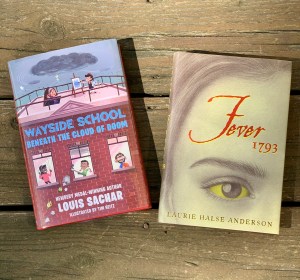 You need only consider the two chapter books I’ve just finished reading to my children to glean the wild fluctuations in mood characteristic of Home Life During the Pandemic. The first, Laurie Halse Anderson’s Fever 1793—a historical novel set during the Yellow Fever epidemic in Philadelphia—is dark, gripping, macabre, and mind-blowing. The second, Louis Sachar’s Wayside School: Beneath the Cloud of Doom—thirty interconnected stories about the students at the quirkiest school in literary history—is silly, preposterous, dry-witted, and a rip-roaring good time…while still being a tad apocalyptic, because I can’t resist a theme. If we’re doomed to spend all day, every day, in each other’s presence, while the pendulum of the wider world swings dramatically between fear and hope, heartbreak and grace, serious headlines and funny memes, it seems only appropriate that our read alouds should follow suit.
Bees: To Fear or Not to Fear
April 2, 2020 § 2 Comments
 Remember last week when I talked about returning our children to nature during this pandemic vis-á-vis secret gardens and long hikes in the woods? Well, there’s just one teeny tiny problem. While we were hiking a few days ago, my son spotted a bee.
Let me back up.
When JP was almost three, during a family reunion in rural Rhode Island, he climbed a ladder to reach an aged treehouse and stood up into a nest of wasps. He was stung twenty-seven times. I know this because the pediatrician, whom I panic dialed, asked me to count the stings. JP was just shy of the number where the poison level would have necessitated getting into the car and trying to find a hospital. Instead, we sat him on the second step of my uncle’s swimming pool, where, immersed in cold water, the screams and swelling eventually subsided.
Perhaps owing to this traumatic event or perhaps just because of the way he’s wired, JP has moved through the past nine years immensely fearful of stinging insects. His fear doesn’t differentiate between wasps and bees. He has read countless books on the subject; he has taken field trips to bee farms; he can rattle off the statistical improbabilities of being stung. No matter. If he hears buzzing, his body goes rigid; if he spots a bee, he flails and shrieks and spends the rest of his outdoor time willing it to be over. He is a hostage to this fear. While I know that with enough exposure and time, he will someday share the outdoors more easily with these creatures, I also know that right now, even more than being afraid of them, he is afraid he will never stop being afraid.
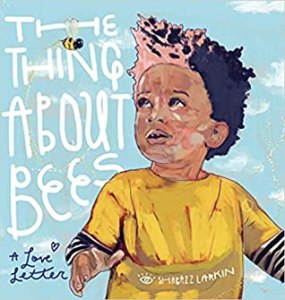
If I could go back in time, short of stopping JP from climbing that ladder, I would take this 2019 picture book with me. It’s what I wish I had read to him in the wake of the wasp event. It’s what I wish I had read to him a hundred times since. In The Thing About Bees: A Love Letter (Ages 3-7), author-illustrator Shabazz Larkin shares his steadfast love for his two young sons alongside an evolving love for bees (not to be confused with wasps), the great pollinators of everyone’s favorite fruits and vegetables. It’s a refreshingly original treatment of a popular subject—why bees matter—because it acknowledges front and center that bees are not easy to love. Indeed, this deeply personal book grew out of the author’s desire not to pass on his own fear of bees to his children. (Quick shout out to Capitol Choices, the children’s literary group of which I’m a part and where I learned of this book last year. Find other treasures on our 2020 list, published here.)
Moving the Classroom to the Woods
March 27, 2020 § 2 Comments
 (Friends, these are rough times. I feel you all. And I promise to keep showing up for you with book ideas for all ages. In addition to these weekly posts, I have (almost) daily recommendations on Instagram, so follow me there. We’ll get through this pandemic with the help of fictional worlds and gripping history and funny comics. Worst comes to worst, we can always use the pages to wipe our bottoms.)
It was only the second morning of #pandemicparenting, and the kids and I were already on the verge of strangling one another. My husband needed a quiet house for conference calls, so I threw out our daily schedule (just one day old) and drove the kids to the woods…where we stayed for four hours. It was cold and drizzly when we arrived, and I found myself willing it to be over. We walked and walked, saw no one, walked some more, and eventually settled into our own rhythms. My daughter ran off trail to climb on logs and rocks. My son stopped talking about his stress level and moved through the world quietly. We got lost, had to scramble up rocky ledges to find the trail again, discovered deserted outcroppings of beaches. The sun came out. I sat and listened to the water, while the kids skipped stones. Later, my son threw his arms around a tree, and I laughed out loud.
We’ve had our fair share of highs and lows these first two weeks of social distancing, but I am endlessly grateful that the trees still welcome our closeness. If there are silver linings amidst this collective heartbreak, one is an opportunity to return our children to nature. I never wanted to homeschool my kids; I knew I’d be rubbish at it. (I knew my kids would be equally rubbish at it.) Thankfully, they still have their wonderful teachers, even if they can only see them on a screen right now. I figure, for as long as we’re packed in together like sardines, I can give my kids two blessings: I can read them books; and I can gently push them towards the trees.
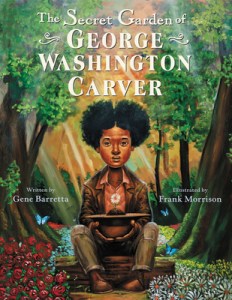
You know what social distancing is good for? Secret gardens. If your children need convincing to let nature step in as teacher, read them the extraordinary new picture book biography, The Secret Garden of George Washington Carver (Ages 7-10). My kids were riveted. Evocatively written by Gene Barretta and accented with richly expressive oil paintings by Frank Morrison, the story demonstrates how young George Washington Carver’s intimate relationship with nature as a child grew into a passionate career as a botanist, inventor, and activist.
Concluding Black History Month on the Train
February 27, 2020 Comments Off on Concluding Black History Month on the Train
 Every year, once in the fall and once in the spring, I take each of my children on a mommy-and-me trip to New York City for a long weekend in the city where I grew up. We board the train in Alexandria, Virginia and make stops in Washington, D.C.; Baltimore, Maryland; Newark, Delaware; Philadelphia, Pennsylvania; and, finally, New York City, Penn Station. My kids have come to enjoy the train ride almost as much as the destination itself, glancing up from their books to watch the changing scenery speeding by—there is something innately lolling and contemplative about train travel—and anticipating the stops to come.
These same train stops come to life against an important and fascinating historical backdrop in Overground Railroad (Ages 4-9), a new picture book by superstar husband-and-wife team Lesa Cline-Ransome and James Ransome, whose Before She Was Harriet I praised around this same time last year. “Isn’t it supposed to be “Underground Railroad?” my daughter asked, when I picked up the book to read it to her. Admittedly, I was equally stumped. As the Author’s Note explains, most people are familiar with the covert network known as the Underground Railroad, which assisted runaway slaves on their journey to the North, usually on foot. Lesser known but often equally secretive, the Overground Railroad refers to the train and bus routes traveled by millions of black Americans during the Great Migration, a time when former slaves opted to free themselves from the limitations and injustices of sharecropping to seek out better employment and educational opportunities in the North. Faced with the threat of violence from the owners of these tenant farms, who relied on the exploitation of sharecroppers for their livelihood, those who escaped often had to do so under cover of night.
Better Together (Maybe for the Apocalypse, Too?)
February 6, 2020 § 1 Comment
 A year or so ago, I was at a summer garden party, all twinkling lights and umbrella drinks, when the conversation took a dark turn. Several folks, none of whom I knew terribly well, began to discuss and debate the provisions they had stored away in the event of an apocalypse. I sat quietly, picturing my own basement with its boxed wedding dress, foosball table, and toys I’d stashed hoping my kids wouldn’t notice so I could gradually move them to the donation bin, and realized how far a cry this was from the scene being described. No crates of non-perishable food, no industrial sized jugs of water, no iodine pills in the event of a nuclear attack, no walkie talkies, no axes, definitely no guns to take down squirrels that could comprise my protein quota.
“Don’t you worry about how you’re going to protect your family?” someone said to me, after I tried to make a joke about my foosball table. I conjured up an image of myself, defending my children against other crazed survivors—all of us presumably reduced to looters or murderers—and I said, only half joking, “In the case of an apocalyptic event, I think it would be best for the future of humanity if my family made a quick exit.” To put it mildly, living off the land in the dark and cold for an extended period of time isn’t really in our wheelhouse.
Last month brought a fresh wave of worry for those of us working hard not to picture End of the World scenarios. We were on the brink of a war with the Middle East. The continent of Australia was burning. A mysterious and deadly virus was (is) rapidly spreading out of China. If we believe apocalyptic-themed fiction, it’s not long until we will be wandering alone in the dark and cold, assuming we are unlucky enough to survive.
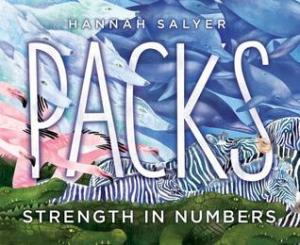
And yet, at a time when the news threatens to send us into an ethos of fear and anxiety—to fathom ways of constructing safe houses around our loved ones—children’s literature is there, reliably, with a hefty dose of optimism, a welcome respite from the dark and cold. Especially where gems like Hannah Salyer’s debut picture book, Packs: Strength in Numbers (Ages 5-9), are concerned, we would do well to remember that the animal kingdom has always survived when it turns towards, not away, from one another.
Never Too Old to Learn
January 30, 2020 § 6 Comments
 Last week, I flew to Boston to see my 101-year-old grandmother for what will likely be the last time. Her lucidity came and went throughout our few hours together, and at times she seemed to look at me and see a much younger version of her granddaughter. “What are your studying in school?” she asked.
“I’m not in school anymore,” I answered. “I’m all grown up! I have kids in school now.”
“That’s no excuse!” she exclaimed, in a playful but insistent tone I recognized all too well.
Perhaps she was simply covering up her mistake. But perhaps not. My paternal grandmother may have attended college for only two years, but she spent much of her adult and geriatric life chasing down knowledge wherever she could. She read biographies voraciously. She traveled the world. She referred to herself as a “news junkie” when you came upon her studying a newspaper. When she moved into her retirement home at 88, she signed up for every class they offered, from Buddhism to World War Two. “I’m taking a fascinating class about the decision to drop the atomic bomb,” she reported on the phone one day. “It has me quite disturbed, actually.”
On another call: “I’m reading E.O. Wilson’s new book. He’s an absolutely brilliant biologist. I’m not sure I’m understanding a word of it, but I suppose some of it might be sneaking in!”
Learning as something to be seized and cherished is a value I will always credit to my grandmother. Still, learning is a luxury not afforded to all, and nowhere is this more painfully evident than in the stories of American slaves. Rita Lorraine Hubbard’s new picture book biography, The Oldest Student: How Mary Walker Learned to Read (Ages 6-10), movingly illustrated by collage artist Oge Mora, tells the incredible true story of a former slave who achieved her lifelong dream of learning to read at the astounding age of 116.
2019 Gift Guide: Graphic Novels to Rock Their World (Ages 8-16)
December 11, 2019 § 1 Comment
 It’s what I hear most often from parents: “I can’t get my kid to read anything but graphic novels.” The assumption is one of concern: perhaps said kiddo is dabbling in literature less worthy than the meaty prose novels many of us devoured in our own childhoods. The question of whether to purchase graphic novels also stumps parents: is it worth buying books our kids will tear through so quickly? After all, a graphic novel that takes an entire year to create can often be finished by an avid young reader in a single sitting.
AND YET. I would argue that graphic novels are some of the greatest (material) gifts we can bestow on our children. Today’s kids are growing up in a more visual culture than we ever did. Couple that with the exploding innovation coming out of the comics market right now, and is it any wonder these books are so alluring to young readers? I’ve watched my own children fall in love with reading through these books. I’ve watched them return to favorite comics in times of stress or change. I’ve watched them bend over graphic novels in the backseat during carpool, with friends on either side leaning in.
Good graphic novels are clever and layered and poignant and often shockingly beautiful. Their vocabulary is rich. To read them is never a passive experience; rather, kids need to work to extract the complete narrative, to find the innuendos and deeper meanings hidden in the cross-section between picture and text. Herein lies the best case for owning graphic novels: the reason your kids return to them again and again isn’t just because they enjoy them; it’s because they get more out of every reading.
Best of all, today’s graphic novels are tackling a range of subjects and genres, including science, history, biography, and immensely valuable socio-emotional learning. 2019 was a banner year for graphic novels. Below are some of the stand-outs (including what my own kids are getting for the holidays!).
2019 Gift Guide: Nonfiction Favs for Ages 4-14
December 5, 2019 § 8 Comments
 Our children are blessed to be growing up at a time when kids’ nonfiction is being published almost as rapidly as fiction—and with as much originality! On this comprehensive list you’ll find new books for a range of ages on a range of subjects, including geology, biology, astronomy, art, World War Two, American History, survival, current events…and even firefighting. (Psst, I’m saving nonfiction graphic novels for the next post, just to give you something to look forward to.) Hooray for a fantastic year for nonfiction!
Fall is Looking Good: Middle-Grade Round Up
November 7, 2019 Comments Off on Fall is Looking Good: Middle-Grade Round Up
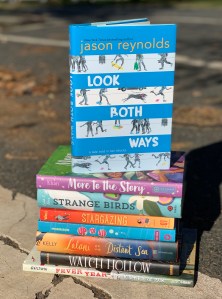 Of the dozens of middle-grade books I’ve read so far this fall (and I see no reason to stop anytime soon), here are the ones that have risen to the top. All except one I’ve featured on Instagram in recent weeks, but it seemed like a good time to round them up here. Publishers often save their best titles for fall, and this fall is proving pretty spectacular. May your children take advantage of the dwindling daylight to curl up with one of these gems. Perhaps they’ll find their people. Perhaps they’ll re-frame what it means to be an American. Perhaps they’ll even get closer to answering the question on the back of Jason Reynolds’ newest contribution to the tween psyche: How you gon’ change the world?
(Oh, and should you need something for yourself or your older teen, you’ll just have to get on the ‘gram to see this review. It’s only my favorite read of the fall.)
When is a Stone a Story?
September 12, 2019 § 5 Comments
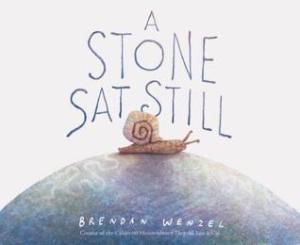 If we want our children to entertain different perspectives when they get to middle or high school—to become critical thinkers and contributors—then they should have opportunities from an early age to consider that there is more than one way to see the world.
Picture book author-illustrator Brendan Wenzel is making something of a name for himself when it comes to creating books for young children about perspective and perception (his groundbreaking debut, They All Saw a Cat, received a Caldecott honor). His newest, A Stone Sat Still (Ages 4-7), similarly rendered with richly textured, mixed-media art and spare, poetic language, stole my heart from the moment I opened it (do yourself a favor and remove the jacket cover, because WOW). Even my children, well outside the target age, were captivated. This is visual storytelling at its best, where every page asks the reader to engage: to wonder, question, and understand. « Read the rest of this entry »
When They Want the Truth
September 5, 2019 § 2 Comments
 When I was eight, I led my father into our coat closet, pushed aside the coats to make a small opening, closed the door, and sat him opposite me on the floor. As we both hunched uncomfortably, I handed him a piece of torn notebook paper and a pencil. On the paper was a list of every swear word I had ever heard. “I want you to write down what each of these words mean,” I said. “Please,” I added, so as not to sound bossy.
I’ll never forget the way my dad didn’t miss a beat. As if this was a natural ask from a firstborn. He didn’t speak, just wrote down a word or two beside each of mine. When he was finished, he handed me the list, and that was that. We stood up, opened the door, and went our separate ways.
In the safety of my bedroom, I got up the nerve to look at what my father had written. It may have been the most anticlimactic moment of my life to date. Female dog. Human feces. I’m sure there were others, but I can’t remember the complete list. I stared in disbelief. I wasn’t entirely sure what all of them meant (what the heck was feces?), but I did know they didn’t sound particularly harmful, certainly not worth the drama which ensued each time someone used one of them at school.
In that moment, I also knew I wasn’t getting the whole truth. I thought the answer was in my father’s pencil strokes, but what I failed to realize was that I actually craved a conversation with him. I wanted to understand what was so terrible about these words. I wanted to understand why they were used the way they were. Looking back, I even wish he had explained some of the gender politics behind them. But I didn’t know how to make any of that happen.
In an effort to demystify these words for me, my father stood in the way of my more fully understanding the world I was sharing with him. « Read the rest of this entry »
Summer Reading Beckons (Middle-Grade Round Up)
May 24, 2019 Comments Off on Summer Reading Beckons (Middle-Grade Round Up)

As I’m limping over the finish line that is May, I’m dreaming of summer. Of days at the pool, nights in the backyard, and lots of opportunities for lazing around with our noses in a book. Should you (or your children) be itching for a distraction from making lunches or dressing for another concert, let me help you plot a summer reading list, beginning with my favorite middle-grade reads of late. (Link to my last round up is here; or go back and check out this and this.) First up is a book which should go straight to the top of your list: it’s fresh, funny, and eerily timely.
« Read the rest of this entry »Finding Hope on the Ocean Floor
March 21, 2019 Comments Off on Finding Hope on the Ocean Floor
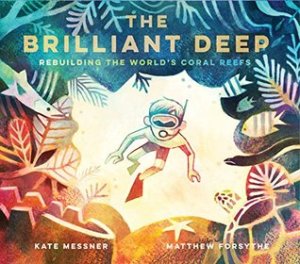 With no tropical destination in my near future, I am making do with reminiscing about our spectacular trip to Belize for last year’s Spring Break. I also find myself thinking about a book which was perfectly timed with our return home. Whether you are heading to or coming home from a trip to the bottom of the sea, I hope you will join me in singing the praises of this illuminating and inspiring book about saving our coral reefs. « Read the rest of this entry »
Taking Up Space (A Black History Month Post)
February 21, 2019 § 2 Comments
 In her modern dance classes, my daughter cherishes above all the few minutes devoted to “sparkle jumps.” One by one, the dancers crisscross the studio at a run. As each one reaches the middle, she explodes into a leap, arms reaching up and out, head tall, like the points of a star. For one perfect moment, my daughter takes up as much space as her little body will allow.
“I love watching you take up space,” I tell her. « Read the rest of this entry »
Hello, Awards Time!
January 31, 2019 § 1 Comment
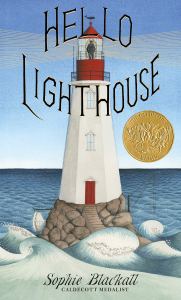 This past Monday, I watched and cheered at my computer as the American Library Association’s Youth Media Awards were announced (more fun than the Oscars for #kidlit crazies like me). Most parents are familiar with the Caldecott and Newbery medals, but there are quite a few other awards distributed, many to recognize racial, cultural, and gender diversity. Overall, I was pleased to see many of my 2018 favorites come away with shiny gold and silver stickers. At the end of today’s post, I’ll include some of these titles, along with links to what I’ve written about them.
Today, I want to devote some space to Sophie Blackall’s Hello Lighthouse, which came away with the Randolph Caldecott Medal, for the “most distinguished American picture book for children.” (It’s actually the second Caldecott for Blackall, who won three years ago for this gem). Hello Lighthouse (Ages 6-9) is one of my very favorites from last year; and yet, I haven’t talked about it until now. Why is that? Perhaps because the art in this book is so endlessly fascinating, my observations continue to evolve with every read. I suppose I’ve been at a loss for words. « Read the rest of this entry »
 What to Read to Your Kids