2021 Gift Guide: A Seek-and-Find Trifecta
November 4, 2021 § 1 Comment
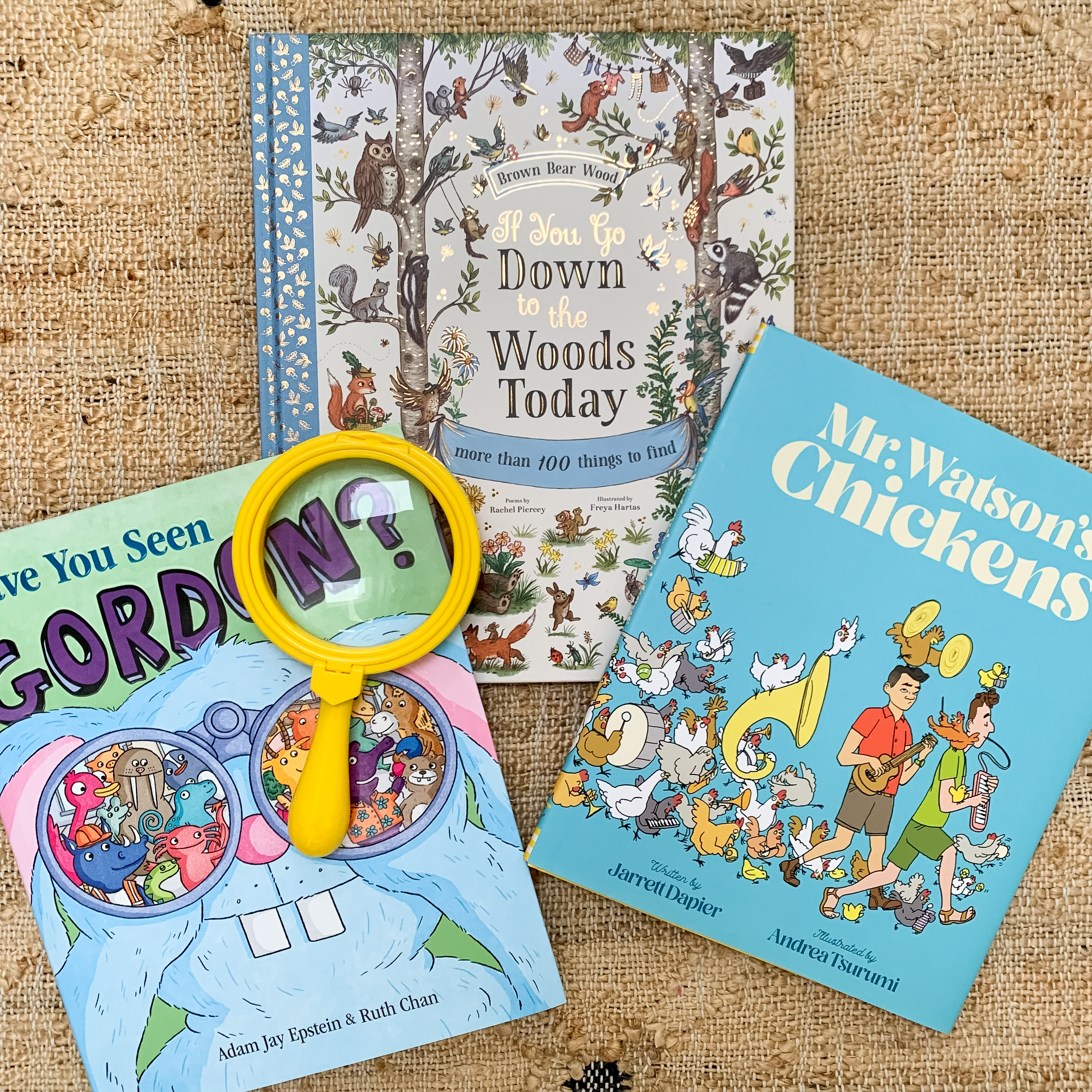
Last week, I launched the Gift Guide with My Favorite Picture Book of the Year. Next week, before moving onto other ages, I’ll do a round-up of a dozen more picture books perfect for gifting. But today, I want to call attention to three 2021 picture books that would make terrific gifts on their own or together. You know I can’t resist a bundling, and each of these treasure troves gives new meaning to the seek-and-find trope, a genre in need of updating before this year came along.
Every parent knows kids love nothing more than treasure hunts. But raise your hand if you’ve ever hidden a Where’s Waldo? book. Or a Richard Scarry book. Or any of those with dizzying pictures that have your child hunched over the page in your lap, scrunching up their eyes to look for a red-striped shirt or a tiny gold bug or any number of things, until it seems possible you’ve missed bedtime all together and it’s now morning again.
What if a child could get their seek-and-find fix in books that were cleverly crafted and delightfully fun to read aloud? What if these books featured art that was easy on our (tired) eyes? Wouldn’t that alone be worth welcoming the Holiday Season with open arms?
« Read the rest of this entry »2021 Gift Guide Kicks Off: Favorite Picture Book of the Year
October 28, 2021 § 2 Comments
It’s getting to be the most wonderful time of year: Gift Guide season! Over the next few weeks, you’ll be treated to round ups of picture books, graphic novels, middle-grade books, young adult books, and specialty books with a gifty flair. This year, I’m especially excited to be partnering with Old Town Books, a fantastic indie here in Alexandria, VA, where I’ll be presenting my full Gift Guide LIVE and IN PERSON at 7pm on November 12 and 13, with a chance to shop with me afterwards (get your tickets here!).
Traditionally, I kick off every Gift Guide with my favorite picture book of the year. (Some past picks are here, here, here, and here.) I recognize that choosing books for loved ones is immensely personal, but sometimes a book comes along that checks all the boxes. It’s beautiful. It’s original. It’s hefty, packed with details that demand repeat readings. It’s got a nostalgic charm that appeals to us oldies doing the gifting. To hold it feels inherently special.
Towering toadstools! All I’m saying is that there aren’t many books you want to clutch to your chest and carry around with you, so when you find one, you just want everyone to have it, OK?
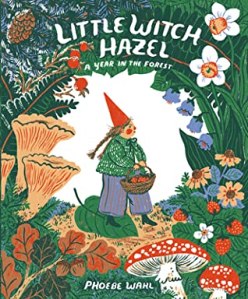
Little Witch Hazel: A Year in the Forest (Ages 4-8), by the extraordinary Phoebe Wahl—I blinked and missed her 2020 picture book for last year’s Gift Guide, and I’ll not make that mistake again—is an anthology of four stories, one for each season. It stars a cheery, capable, caring little witch with a pointed red cap and a fondness for messy braids and fair isle sweaters. Little Witch Hazel lives alone at the base of a tree in the enchanting Mosswood forest, surrounded by trees and waterfalls and a community of gnomes, elves, goblins, trolls, dryads, anthropomorphic amphibians, and tiny talking mammals. He days are spent divided between work and play, between helping others and tending to herself.
It has been a long two years, and I feel like we all deserve to spend some time in a place where tea cakes and twinkling lights are always in fashion, where coziness and cocoa reign supreme, and where the wonders of the wilderness are just an acorn’s throw away. A place where we can dip our tired toes in crystal clear water one minute and ride on an owl’s back the next. A place where creatures watch out for one another, repay favors, and are always happy for an impromptu dance party.
« Read the rest of this entry »Best. Birthday. Book.
September 30, 2021 § 2 Comments
September is many things—the return to school, the start of fall, the gearing up for holidays and sweaters and all things pumpkin—but in our house, it’s also Birthday Month. Both my kids share September birthdays, just two weeks apart. If September didn’t already feel like a sharp re-entry to scheduled life after the dog days of summer, adding in two back-to-back birthday celebrations has always felt like being launched into a marathon we forgot to train for.
Every year, the bleary-eyed exhaustion takes me by surprise. Shouldn’t it be easier now? My kids no longer desire the big backyard birthday parties we threw in the past (remember this post?), with magicians and bouncy houses and mad scientists who blew up stuff and left it all behind. By all accounts, the celebrations my kids want as tweens and teens require little prep on my part and are right up my alley. Ear piercing followed by lunch out with a few fabulous young ladies? Yes, please!
Still, no matter the celebration, there is an emotional charge to the day that radiates throughout the entire month. And, if I’m being honest, it sucks up a good bit of the oxygen in our house. Our children prize their birthdays above all other days of the year. And they aren’t alone. As Mary Lyn Ray puts it in the poetic picture book I’m about to share with you, “Almost anything could happen./ But what’s for sure is that/ your birthday is all yours to unwrap.”
There’s the delicious anticipation that builds over weeks, by some accounts as sweet as the day itself. There are wish lists, made and revised and revised again. There are discussions of favorite breakfasts and requested desserts and memories of things that happened in birthdays past that you wonder if you can re-create. Somewhere along the way, traditions are born.
Every year, my husband breaks out the colored pencils and renders homemade birthday cards, their fronts depicting the birthday kid engaged in a new venture or activity from the previous year (most recently, shooting a bow and arrow and rowing crew). It’s not uncommon for these cards to be drawn close to midnight the evening before, with me furiously wrapping packages beside him. Still, the delight on our kids’ faces when they see everything set out at breakfast the next morning always makes the effort worth it. (But seriously, when did I become the gift wrapper for all the out-of-towners?)
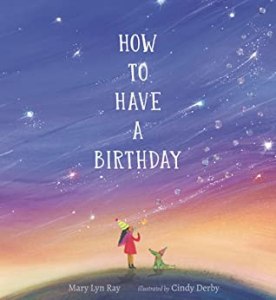
I have never encountered a picture book that more perfectly captures the essence of a child’s birthday than How to Have a Birthday (Ages 3-8), lyrically penned by Mary Lyn Ray and sumptuously illustrated by Cindy Derby. Mary Lyn Ray is a spellbinder with words, conjuring up phrases both playful and poignant; and Cindy Derby’s rich, dreamy art, infused with a touch of sparkle, feels at once intimate and open-ended. The text is delivered in the second person, inviting all readers to consider their own birthday experiences, while the pictures bring to life three specific birthday kids, with different skin tones and different celebration styles.
« Read the rest of this entry »An Interview with Shawn Harris
May 6, 2021 Comments Off on An Interview with Shawn Harris

Earlier this week, I talked about how much I adore the new picture book, Have You Ever Seen a Flower? Today, I’m back with an interview I did with its creator, Shawn Harris, in which we talk about his inspiration for the book, his musical past, what neon pink says to him, why he loves school visits, and the super exciting new projects he’s working on. I hope you enjoy it as much as I did!
Me: Welcome, Shawn! Thank you so much for dropping in today. I am delighted to have the chance to chat with you about your authorial debut picture book, Have You Ever Seen a Flower?, one of my very favorites of the year. I’ve been a fan of your art for years—both Her Right Foot (written by Dave Eggers) and A Polar Bear in the Snow (written by your good pal, Mac Barnett) have been the subject of previous blog posts—so I was excited to see you trying your hand at writing, too. What made you decide to take the plunge? And where did the idea for this special picture book come from?
Shawn: In my former life, I was a touring songwriter, so I’ve been writing since I was a kid penning lyrics. This was the first time my authorial tone conjured images since I’ve been working in the picture book world, so I set out to illustrate the words. It’s almost a song in book form, really. There’s a theme and an arc to the narration, but I hop around my subject really loosely, and dip in and out of different meters, which is the way I like to approach writing music.
« Read the rest of this entry »Have You Ever Seen a Flower? (Part One)
May 4, 2021 Comments Off on Have You Ever Seen a Flower? (Part One)
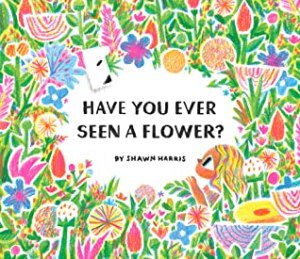
It’s another special week here on the blog, with a two-part post featuring one of my favorite picture books of the year, destined to become a read-aloud favorite. Award-winning illustrator, Shawn Harris, is making his authorial debut with Have You Ever Seen a Flower? (Ages 3-6), an imaginative, sensory-filled, hue-tastic journey inside flowers, starring an ebullient, neon-haired child. Today, I’m sharing why I love this energetic romp, which celebrates the connection between childhood and nature. Then, on Thursday, I’ll be back with my interview with the mastermind behind it, mister Shawn Harris himself. (I’ll also be running a giveaway on Instagram, so make sure you’re following me!)
As you may remember from previous posts, we are big fans of Shawn Harris, who created the delightfully unique cut-paper illustrations for Mac Barnett’s A Polar Bear in the Snow and, before that, Dave Eggers’ Her Right Foot, a speculative non-fiction picture book about the Statue of Liberty that’s still a favorite of my son. With Have You Ever Seen a Flower?, Shawn not only tries his hand at writing, but he trades cut-paper collage for stencils and colored pencils (seven-in-one colored pencils, to be precise). He’ll talk more about his inspiration and process in our interview, but suffice it to say that this departure makes him quite the creative chameleon, a true force to be reckoned with in picture book creation.
Have You Ever Seen a Flower? also proves that the best picture books are often a little trippy. (Think about greats like Maurice Sendak, Ruth Krauss, and James Marshall.) With a psychedelic intensity, Shawn plays with perspective, color, and language to blur the line between reality and fantasy, fusing his character with the vibrant nature around her and reminding us how much fun it is to see the world through the eyes of a child brimming with wonder and possibility.
« Read the rest of this entry »Seasonal Poems with a Twist (National Poetry Month)
April 15, 2021 Comments Off on Seasonal Poems with a Twist (National Poetry Month)
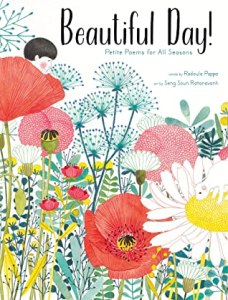
I have a soft spot for picture books with poetry organized by season. I’m not sure whether I’m particularly drawn to nature poetry, or whether these types of poems just tend to dominate picture book publishing. All I know is that back when my children were smaller, when there were at least twelve extra hours in every day, it made me happy to track the changing world outside our window with delightful little nuggets of word play.
Consequently, no shortage of wonderful poetry picture books has appeared in these pages. I’ve sung the praises of When Green Becomes Tomatoes: Poems for All Seasons, Firefly July: A Year of Very Short Poems, A Child’s Calendar, and Winter Bees & Other Poems of the Cold. And, of course, we can’t forget the meaty anthology, Sing a Song of Seasons: A Nature Poem for Each Day of the Year, which, given how many of you have reached out to me, remains one of the most popular books I’ve recommended (just wait until you see its follow-up, coming next fall).
With so many good titles, you might think there would be little need for more. But you haven’t seen the treasure 2021 has dropped in our laps. Beautiful Day! Petite Poems for All Seasons (Ages 4-8) features Haiku-inspired poems by Rodoula Pappa, alongside art by favorite French illustrator, Seng Soun Ratanavanh. It turns out we were missing something. In those earlier anthologies, the visuals accompanying the poems are largely literal. By contrast, Beautiful Day! infuses seasonal poems, still lovely and lyrical, with a touch of the fantastical. The abstract. The fanciful. There’s a playfulness in these pages, where a child paints rainbows in the sky, butterflies become lanterns, and origami birds take flight. The line between reality and imagination becomes deliciously blurred, as we see the natural world through a child’s eyes, up close and personal.
« Read the rest of this entry »The Stories We Need to Ask For
April 8, 2021 § 1 Comment

Occasionally, a book comes along that is so extraordinary, I’m daunted at the prospect of reviewing it. I worry I could never do it justice. I wish I could just say, This is hands down the most moving picture book I’ve read so far this year, and I want you to get it without knowing anything about it. Maybe, if you’ve been hanging around here for awhile, you’ll do just that. But I will try and find something eloquent to say for the rest of you.
Years ago, my husband helped his grandparents—first generation Italian-Americans—pack up their house to move into a retirement community. In the crawlspace, he uncovered boxes of mementos, all of which his grandmother had at one point tied up using the elastics from her husband’s old underwear. This discovery became one the family would chuckle about for years (Who salvages underwear elastic?!). But it was also a window into the past, a resourcefulness triggered by the Great Depression sixty years earlier, a self-reliance that perhaps belied pain, worry, wanting, loss. Only now does my husband express regret at not probing for the stories underscoring something he accepted as mere frugality.
All of us grow up surrounded by family history, including the cultural heritage this history often represents. Yet, as children, we often take this history for granted. At best, we’re blinded by our own fixation on the present; at worst, we’re embarrassed by the quirks of our elders, by their old-fashioned ways, by their insistence in holding fast to ideas or customs from their past.
Especially where immigrants are concerned, this silencing is further accentuated by the systemic racism underlying American society. Asian Americans, for example, are expected to fulfill the Model Minority Myth, to work hard towards prosperity, while keeping quiet about their struggles, past or present. The recent media attention on the massive spike in hate crimes against Asian Americans—up 1,900% since the start of the pandemic—has begun to open our eyes to an experience far from new, one we should have been talking about ages ago.
In the spirit of lifting up voices of Asian descent—and because this poignant story is at its heart about the value of listening to stories of the past—I urge you to purchase Watercress (Ages 5-9), Andrea Wang’s powerful autobiographical picture book, evocatively illustrated by Caldecott Honoree Jason Chin, who studied traditional Chinese landscape painting to infuse the story with added authenticity. (If Jason Chin doesn’t get his long-overdue Caldecott Medal for this, you will hear me screaming.) Against a backdrop of 1970s rural Ohio, a girl and her brother help their parents, immigrants from China, pick watercress on the side of a ditch to be served that evening. The immediate humiliation of the act later transforms into an opportunity for the girl to connect with her mother’s past life in China—and the grief she still carries in her heart.
« Read the rest of this entry »The Tree in Me: An Interview with Corinna Luyken
March 18, 2021 § 5 Comments

I am thrilled to welcome picture book creator, Corinna Luyken, to the blog today! I have long dreamed of hosting authors and illustrators in these pages, but I want to do it in a way that ties into my mission of creating lifelong readers by nurturing a culture of reading aloud in the home—even after kids are reading by themselves. Corinna isn’t just one of our family’s favorite author-illustrators; as a mother, she’s also deeply invested in reading to her tween daughter. What I hope will feel different and inspiring about this interview is that, in addition to talking about her creative process and her newest book, I ask about the ways in which she has nurtured her own daughter’s reading journey—and even what some of their favorite read alouds have been. (As a result, I now have an even bigger #tbr pile.)
Earlier this week, I did a deep dive into Corinna’s exquisite new picture book, The Tree in Me (you can find my post here), and that’s what we’ll predominantly be talking about today. But I wanted to mention some of our previous favorites as well. I believe Corinna has the distinct honor of appearing on this blog more than any other creator! Her debut picture book, The Book of Mistakes, is still one of my children’s all-time favorites. It gave us language for framing our mistakes as beginnings, not endings. She followed that up by illustrating Adrian Simcox Does Not Have a Horse, written by Marcy Campbell, which I chose for my Favorite Picture Book of the Year post in 2018, and I still tear up every time I read it. My Heart was the next book she both wrote and illustrated, and for its metaphorical musing on empathy and connection, it is a kind of companion book to The Tree in Me.
My children have always been drawn to Corinna’s art—in particular, her bold, expressive use of color. (I especially love what she says about color in our interview—specifically, her answer to a question my daughter wanted me to ask: “What is your favorite color?”) But, increasingly, I also find myself appreciating her touch with the written word. She doesn’t simply choose her words carefully, she gives them a rhythm that translates beautifully into reading aloud. In sum, she does what many strive to do and few succeed: she invites reflection. In a fresh, unexpected, and pared-back way, her books speak to something essential about the human experience; we can’t help but be a tiny little bit changed when we come to the last page.
« Read the rest of this entry »The Tree in Me: Part One
March 16, 2021 § 3 Comments
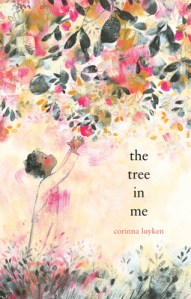
(This is an extra-special week on the blog, so you’re getting not one but TWO posts! First, on the day it officially releases, I’m talking about Corinna Luyken’s exquisite new picture book, The Tree in Me. Then, on Thursday, I’ll be featuring an interview I did with Corinna herself, in which we talk about her inspiration for the book, her writing process, and her favorite books to read aloud with her tween daughter. It’s the first interview I’ve done for the blog, and I’m hoping you’ll let me know if you’re excited for me to do more!)
We have been sleeping with the windows open of late. Here in Virginia, as winter takes its exit, it’s only the briefest of spells before the pollen seeps through the screens, followed by the aggressive rise in humidity, and we must shutter the windows and crank up the central air. But, right now, it’s perfection. Cocooned in blankets, with breezes dancing around my head, I embrace the fluidity between inside and outside. It awakens something within me—not unlike standing on a mountain top or in a grove of wildflowers—and puts me in mind of being a child again.
At no time more than childhood do we exhibit such a primal connection to the natural world. When I think of my own children in their early years, I think of them running barefoot in summer and catching snowflakes on their tongues in winter. I think of the sticks that never left their hands, the fairy houses they constructed from moss, the leaf piles they jumped in. I think about how picking apples off branches felt magical to them, biting into them moments later even more so. I think about how my daughter used to climb trees without reservation, even while we looked on with our hearts in our throats.
In her newest picture book, The Tree in Me (Ages 3-8), Corinna Luyken captures this childlike exuberance for the natural world with the careful intent, originality, and dazzling use of color we’ve come to adore from her. [More on previous favorites in Thursday’s interview with Corinna.] Through sparse, poetic text—each word carefully chosen and perfectly placed—and dynamic, gorgeously-saturated gouache illustrations—helllloooo, neon pink—The Tree in Me invokes the metaphor of a tree to celebrate the strength, resilience, and bounty inside all of us. It reminds us that, as part of the living world, we move and breathe and give and take in a way that binds us together. We can shutter our windows, but the natural world lives on inside us.
« Read the rest of this entry »How Will We Remember This L(o)st Year?
March 11, 2021 § 2 Comments
I’ve been accused of using these pages as a kind of glorified baby book, and if that’s true, I appreciate you indulging me. In the trappings of our busy-ness, we don’t take enough opportunities to pause and process our life experiences—the good and the bad, the big and the small—and I have found blogging to be (almost) as therapeutic as a conversation with a good girlfriend over a glass of wine.
But I would argue that children’s books themselves can be gateways to reflection—as much for us as for our kids. Sharing them offers a respite, a chance to connect with our little ones, while their content strips back unnecessary clutter, revealing something of life’s essentiality, its basic truths, through economies of words and pictures. Even when they’re not expressly representing our own experiences, children’s books reflect back the life taking place in and around us.
It has been exactly one year since I sat around a table with my daughter and her classmates to lead what would be our last in-person book club. Several of the children knew almost nothing about the coronavirus that would shut down their school—and life as they knew it—just twenty-four hours later. When I arrived to pick up my daughter the next day, teachers threw hastily gathered notebooks and supplies into the back of our car, and my daughter and her carpool group climbed into their seats looking shell-shocked. Some giggled nervously. One started crying.
How do we want to remember this last year—a year that took so much, that has produced a kind of cumulative weariness we’d like nothing more than to shed, but was also not without moments of profound beauty and growth?
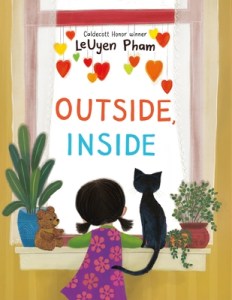
As it turns out, I have the perfect book for memorializing this time, for helping children of all ages process what they’ve seen and felt, done and not done. LeUyen Pham’s astute and gracefully executed Outside, Inside (Ages 3-103) is one that might find its forever home on a shelf beside baby books and photo albums. A book our children might someday take down and share with their own kids—let me show you what it was like when “everybody who was outside…went inside.” Amidst the many new children’s books tackling the subject of lockdown, this one rises to the top. Many would have us believe it was all rainbows, but this one holds the sadness alongside the wonder, the uncertainty alongside the hope. Outside, Inside reminds us that a new day is dawning, but we will never forget how we got here.
« Read the rest of this entry »Losing a Dog
February 18, 2021 § 2 Comments
When my son was four and our dog died, I checked out a pile of themed picture books from the library and we read them over and over for two weeks. Every time I asked my son how he was feeling, or whether he wanted to talk about what had happened, he walked over to the pile, grabbed a book off the top, and climbed into my lap. It shouldn’t have surprised me—after all, I have always turned to books to process life experiences—but it did. Before my eyes, I watched this small boy silently work out stuff right there on the page.
One of the most common requests I get from parents is for books about losing a dog or cat. There is no lack of picture books on the subject, but most of them are only OK. Some are beautiful, even profound, acknowledgments of loss—like this and this—and even though I love them, they tend towards the abstract. Others fall into the same trap that we parents do when our children are in pain: they are quick to reassure, to provide distraction, to provide replacement (The dog is happy in heaven! Let’s go pick out a new puppy!). Many pay lip service to the emotional upheaval that is grief, but few model what it means to make space for it.
In my personal experience, grief does not abate without time. Time can’t work alone, it won’t solve all things, but it creates distance, and with distance comes perspective and growth and opportunity. But in the wake of pain, time is at best uncomfortable; at worst it is infuriating, terrifying, and unfathomable. It’s no wonder we don’t like to acknowledge it, much less encourage our children to sit in it.
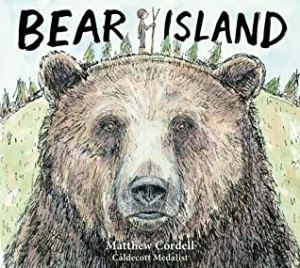
And yet, here’s a new picture book that does just that—and does it brilliantly. In Matthew Cordell’s Bear Island (Ages 4-8), a full year passes from the moment a girl loses her dog to the time her family welcomes a new one. In Cordell’s expert hands, this year unfolds slowly across every page turn. It unfolds while a girl spends her days on an island with a stick and a bear for company. It unfolds in the physical and mental space of the girl’s anger, sadness, boredom, regret, and fear.
« Read the rest of this entry »Seizing His Shot: A Black History Month Post
February 4, 2021 § 1 Comment

(Check out previous years’ picks for Black History Month here, here, and here. I’ll also be sharing other new titles celebrating Black history all month long over on Instagram.)
I’ve said it before, and I’ll say it ‘till the cows come home: picture books aren’t just for little kids! Keeping picture books alive and well at home, even after our kids are reading independently, means not only continuing to expose them to arresting art and sensational storytelling, it means piquing their interest about a range of subjects they might not seek out on their own. After all, it can be much less intimidating to pick up a picture book than a chapter book, especially on a subject you don’t know much about.
I love a picture book that sneaks in a history lesson without ever feeling instructional. One of my favorite picture book biographies published last year, Above the Rim: How Elgin Baylor Changed Basketball (Ages 6-10), also happens to be an excellent primer on the Civil Rights Movement. But you’d expect nothing left from the all-star team of Sibert Medalist, Jen Bryant, and two-time Coretta Scott King Medalist, Frank Morrison.
Jen Bryant is best known for her picture book biographies of artists and writers (A River of Words: The Story of William Carlos Williams is a favorite), but she was drawn to NBA Hall of Famer, Elgin Baylor, because in addition to his undeniable talent on the court, he also fundamentally changed the game itself. “Artists change how we see things, how we perceive human limits, and how we define ourselves and our culture,” Bryant writes in the Author’s Note at the end of the book. By this definition, Elgin Baylor—who as one of the first professional African-American players broke nearly every tradition in the sport—was every bit the artist. And Bryant uses her love of language to make his story leap off the page.
In that vein, too, it seems fitting that Frank Morrison should illustrate the basketball icon, using his signature unconventional style of oil painting that distorts and elongates the human figure, giving it both elasticity and a larger-than-life aura. (Morrison illustrates one of my other favorite 2020 picture book biographies, R-E-S-P-E-C-T: Aretha Franklin, the Queen of Soul.) Morrison’s art in Above the Rim is kinetic; it buzzes like the energy on a court. But it’s also dramatic, moving from shadow into light, much like the broader social movement in which Elgin Baylor found himself a quiet but powerful participant.
Should I mention my ten-year-old daughter (mourning the loss of basketball in this pandemic) adores this book and reaches for it often?
« Read the rest of this entry »Sweeter Together
January 21, 2021 § 8 Comments

Yesterday, at the 59th Presidential Inauguration, as my children and your children and the world looked on, President Biden called us to the work of unity, to “uniting to fight the foes we face. Anger, resentment and hatred, extremism, lawlessness, violence, disease, joblessness and hopelessness. With unity we can do great things, important things. We can right wrongs.” He was referring to Americans coming together, though he also spoke of healing alliances around the world.
Then, the 22-year-old inaugural poet, Amanda Gorman, took the stage—who, incredibly, before the age of twenty could not pronounce the letter “R” due to a severe speech impediment—and elevated that message of unity even further. She called us to hope and light and agency. “There’s always light if only we’re brave enough to see it. If only we’re brave enough to be it.”
(Side note: moments after the inauguration, it was announced that Amanda Gorman has a children’s picture book coming out in September, illustrated by fan-favorite Loren Long. This girl is here to stay, and I am here for it!)
I haven’t yet told you about one of the most exquisite picture books published last fall—actually, if I’m being honest, one of the finest examples of bookmaking I’ve ever seen. (It would have unquestionably made my 2020 Gift Guide had I discovered it in time.) On the surface, Sugar in Milk (Ages 5-10), written by Thrity Umrigar and lushly illustrated by Khoa Le, is a story about a modern girl’s immigration and assimilation; and yet, as it recalls an ancient Persian folktale, it reads as an allegory of unity and light. It’s a story honoring individual courage alongside diversity, acceptance, and inclusion—hallmarks of the American promise. It’s a story reminding us that we are sweeter together.
« Read the rest of this entry »An Inclusive Take on a Christmas Classic
December 17, 2020 § 1 Comment

Traditionally on Christmas Eve, I channel my father and do a stirring rendition of Clement C. Moore’s poem “The Night Before Christmas,” before the kids head up to bed and pretend to sleep. First published in 1823, Moore’s description of St. Nicholas and his eight flying reindeer, landing on rooftops and sliding down chimneys, has shaped our Western portrait of Santa Claus for the past 200 years. And yet, in almost every case, Moore’s words have been illustrated to center a white, upper middle-class family in a small New England town.
When we first moved to Virginia, we didn’t have a fireplace. A preschool classmate asked my son how Santa would get into our home to deliver presents. My son was dumbstruck; nothing I said assuaged his anxiety. When, a few weeks later, I took my kids on our local “Santa Train” (thank you, Virginia Railway Express) to spend an afternoon with the Big Man, my son queued up to ask that most important question: “What if someone doesn’t have a chimney?” To which the white-bearded man pointed to an oversized silver key hanging from his belt. “This magical key opens every door in the world, so if I can’t enter by chimney, I simply go through the front door.” And that was that.
There is a myriad of ways that adults have revised (or eschewed completely) the Santa myth to suit diverse living situations. Addressing economic disparity is tougher. There were years when my son would ask, as we shopped for our local toy drive, “But won’t Santa bring toys to these children?” Those of us who talk to our children of Santa Claus find ourselves perpetuating a myth as privileged and problematic as it is enticing.
Children’s illustrator Loren Long—already beloved in our house for his picture books starring Otis the tractor—has breathed new life into Clement C. Moore’s The Night Before Christmas (Ages 3-10), setting the original poem to illustrations featuring four diverse families. As we page through the book, the warm, atmospheric, cleverly detailed paintings tell their own stories about what Santa’s arrival looks like for a family on a rural farm, in a mobile home, a city apartment, and an island bungalow. (Even before the poem starts, the endpapers show the different children engaged in Christmassy pursuits, like cookie making and letter writing.) The result is a fresh, if idealized, take on a Christmas classic—which, even as it doesn’t address all the paradoxes of the Santa myth, suggests that the magic of the holiday touches everyone who believes.
« Read the rest of this entry »2020 Gift Guide: Picture Book Round-Up
October 29, 2020 Comments Off on 2020 Gift Guide: Picture Book Round-Up
Last week, I told you about my two verrrrry favorite picture books of the year: The Bear and the Moon (Ages 2-6) and Girl on a Motorcycle (Ages 5-9). Today, I’m telling you about others I like a whole heck of a lot. I’ve selected titles, both fiction and non-fiction, for a range of ages, from two to ten years old. Some of them are jaw-droppingly beautiful; others elicit laughter; many invite wonder and compassion. All of them are deserving of a permanent home, where they can be enjoyed again and again and again.
Before we start, there are several I’ve already blogged about this year. Rather than repeating myself, I’m going to link to my original posts. The ones with mega gift potential from earlier in the year are Me and Mama (Ages 2-6), The Ocean Calls (Ages 4-8), Madame Bedobedah (Ages 5-9), Swashby and the Sea (Ages 3-7), The Fabled Life of Aesop (Ages 5-9), In a Jar (Ages 4-8), and The Oldest Student (Ages 6-10).
And now, here are ones new to these pages:
« Read the rest of this entry »2020 Gift Guide: My Favorite Picture Book for the Elementary Crowd
October 22, 2020 § 3 Comments
As a nervous flyer, I never thought I’d write this, but I really miss getting on airplanes. Traveling is something I’ve never taken for granted, but I’m not sure I realized just how much I crave it until it wasn’t an option. I miss stepping off a plane, filled with the adrenaline of adventures ahead. I miss unfamiliar restaurants and museums. I miss natural wonders so far from my everyday environs it’s hard to believe they’re on the same planet. I miss squishing into a single hotel room, each of us climbing into shared beds after a day of sensory overload and, one by one, closing our eyes. I can’t wait until we can travel again.
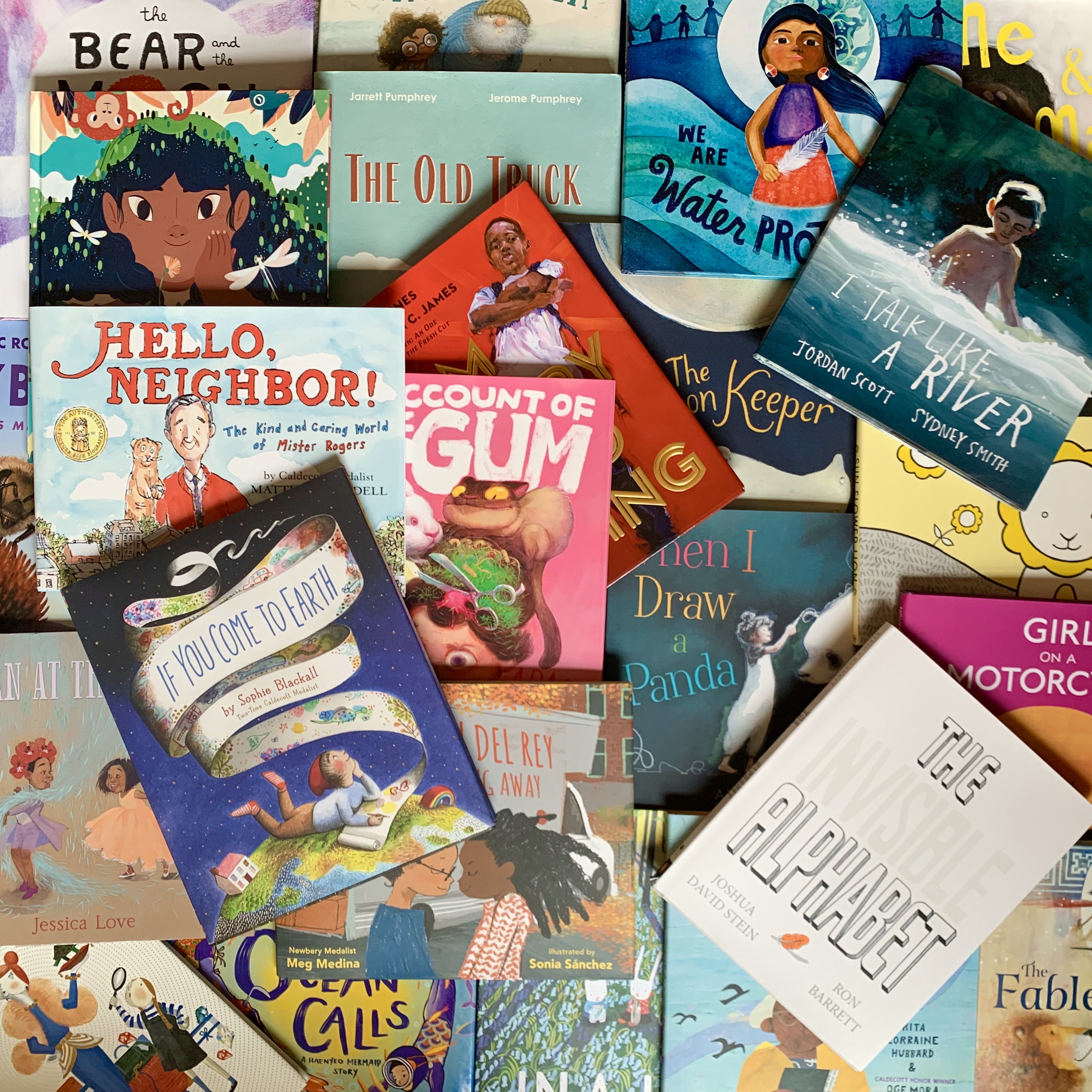
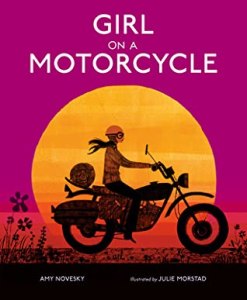
In the meantime, we look to books to fuel our longing to see the world, to keep alive this thirst for the unfamiliar and the undiscovered. No picture book this year delivers on this promise quite like Girl on a Motorcycle (Ages 5-9), by Amy Novesky, illustrated by Julie Morstad, based on the actual adventures of Anne-France Dautheville, the first woman to ride a motorcycle around the world alone. From her hometown of Paris to Canada, India, Afghanistan, Turkey, and other exotic destinations, we travel alongside this inquisitive, fiercely independent girl as she heeds the call of the open road.
Morstad is no stranger to illustrating picture book biographies—It Began With a Page: How Gyo Fujikawa Drew the Way made last year’s Gift Guide—and part of her remarkable talent stems from adapting her illustrative style to the subject at hand, while still creating a look and feel entirely her own. In Girl on a Motorcycle, Morstad infuses a ’70s palette of glowy browns and moody mauves onto the dusty backdrops of the Middle East, the dense evergreens of the Canadian countryside, and the ethereal sunrises. Additionally, Morstad gives the protagonist herself a kind of badass glamour every bit as alluring as the scenery itself. How can we not fall for someone who packs lipstick next to a “sharp knife”? It’s as if Vogue jumped on the back of a motorcycle, slept in a tent at night, and made friends with locals along the way.
« Read the rest of this entry »2020 Gift Guide: My Favorite Picture Book for Preschoolers
October 20, 2020 § 5 Comments
Similar to last year (when I picked this and this), I find myself unable to choose between two picture books for my very favorite of 2020. Still, the two I’ve chosen play to slightly different audiences, so I’m using that as an excuse to bring you two picture book posts this week. I’ll begin with my favorite for the littles.
It seems to me that what we should really gift our youngest children this year is what we wish for ourselves: the literary equivalent of a giant bear hug. In a year dominated by disconnection and uncertainty, we have had to work harder to love both one another and ourselves. If we are to fill the void that 2020 has left on our hearts, it will be through care and compassion, including and especially self-compassion. And that’s where The Bear and the Moon delivers beautifully.
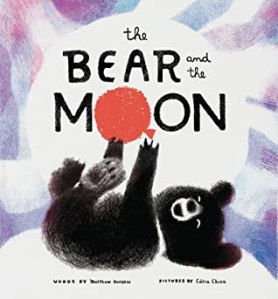
Written by Matthew Burgess and illustrated by Cátia Chien, The Bear and the Moon (Ages 2-6) is a playful, poetic story about a bear and a balloon. But it’s also a visceral meditation on life’s impermanence—and on the forgiveness and self-love required to weather these moments of loneliness and sorrow. I’ve always believed that the best picture books should offer a little something to the adults called upon to read them again and again, and The Bear and the Moon provides comfort and reassurance to both reader and listener alike.
And then, of course, there are the mixed-media illustrations, which are in a class by themselves. Smudgy and sublime, they wash over us with a gorgeous palette of purples and blues, accented by the velvety black of the bear and the clean paper cut-out of the red balloon. And that expressive bear face? A thousand times yes.
« Read the rest of this entry »When You Don’t Have a Mute Button
October 1, 2020 § 2 Comments
 If Tuesday’s presidential debate has taught us anything, it’s that 2020 should have come with a mute button. Because meditation alone isn’t going to cut it. Ditto to stocking our freezers with double-chocolate brownie ice cream. Adulting is hard enough right now without adding parenting (and schooling) to the mix. And yet, our children are bystanders to this hot mess unfolding around them. With our own blood pressure camped out at dangerously high levels, how do we offer some semblance of sanity for our precious little ones?
Back in July, I came across a blog post written by a practicing psychotherapist out of Colorado named Sara Waters. She was addressing the stress parents were feeling while waiting for schools to announce their reopening plans (HA, remember when we thought that was worth losing sleep over?). Like many parents at the time, I was spending way too much time crawling along the bottom of the Internet, desperate for someone to reassure me that my children would be safe this fall. Waters surfaced with the reassuring reminder that, while we might not be in control of what happens outside our front door, we can control what happens inside:
The number one most determining factor of your child’s 2020 experience is YOUR ability to manage your OWN discomfort. Mirror neurons are real and even children who haven’t yet learned to understand or speak language will pick up on the quantum vibrational frequencies of distress that you emit. Your children hear you talk, even when you aren’t talking to them. They hear you complain. They hear you vent. They watch your facial expressions when you are on a phone call or responding to an email or social media post on your computer. They can feel whether you are relaxed or whether you are in a state of stress when you wake them up in the morning, sit down for a family meal, or tuck them into bed at night. […] Whether you like it or are aware of it or not, they will feel what you feel.
I’ve thought about this reminder many times since that last week in July, including and especially when I picked up Cozbi A. Cabrera’s joyous new picture book, Me & Mama (Ages 2-6), a lyrical celebration of the bond between one daughter and her mother. Reading this story is like wrapping yourself in a cocoon of domestic love. Reminiscent of one of last year’s favorites—Oga More’s Saturday—this book speaks directly to the power we hold as parents to set tone, to cue young children’s feelings about the world and their place in it.
We sometimes forget that motherhood comes with its own special set of superpowers. We can smile at our children; we can dance in their presence; we can light up when they walk in the room. None of the stressors in the world can compete with that.
Emily Dickinson: Perfect Reading for a Pandemic?
September 24, 2020 § 2 Comments
 Not many people know this, but my daughter is named after Emily Dickinson. (Well, and the heroine of L.M. Montgomery’s Emily of New Moon.) I didn’t fall for Emily Dickinson’s poetry until I got to college, when I fell hard and fast and ended up featuring her poems in no fewer than seven essays, including my Senior Thesis. I had never been a big poetry lover, but there was something about the compactness of her poems which fascinated me. So much meaning was packed into such few words. And even then, the meaning was like an ever-shifting target, evolving with every reading.
To read Emily Dickinson is to contemplate universal truths.
Apart from reading Michael Bedard and Barbara Cooney’s 1992 picture book, Emily, I hadn’t had much occasion talk to my own Emily about her namesake. But that changed last spring, when my Emily started writing poetry of her own. Nothing about virtual learning was working for her, until her teachers started leading her and her classmates in poetry writing. Suddenly, my daughter couldn’t jot down poems fast enough, filling loose sheets of paper before designating an orange journal for the occasion. She wrote poems for school, for fun, and for birthday cards. It didn’t matter that they weren’t going to win awards for originality; what mattered was that she had found a means of self-expression during a stressful, beguiling time.
Jennifer Berne’s On Wings of Words: The Extraordinary Life of Emily Dickinson (Ages 7-10), stunningly illustrated by Becca Stadtlander, could not have entered the world at a more perfect time. It opens a dialogue, not only about Dickinson’s unconventional life, but about her poems themselves. At a time when a pandemic has prompted many of us and our children to turn inward, this picture book is less a traditional biography than an homage to the rich interior life developed by this extraordinary poet and showcased in her poetry.
At Home in the Ocean
September 3, 2020 § 3 Comments
 My son’s favorite sport is swimming, but it wasn’t always this way. For five years after he was born, he refused to put his head under water. He was delighted to be held in water, or to float with a floatie, but none of us—not me, not his dad, not his grandfather, not his aunt—could convince him to submerge his face.
Eventually, I got the name of a private swim instructor who was supposed to have a magic touch. I phoned her but she was fully booked. A few weeks later, she phoned back. She had a cancellation on an upcoming Thursday at 7pm. JP’s bedtime was 7pm, so this seemed like poor parenting at best, but I was a mother on a mission, with a zeal often reserved for firstborns. I told her we’d see her Thursday.
What happened next is a story our family loves to tell. While I watched from deck, the instructor, clad in a black wet suit, took JP’s hand and led him down the ramp of the zero-entry pool. When the water hit JP’s waist, she stopped. “So, JP,” she said, “do you go under water?”
“No,” my son replied.
“Would you like to try?” she asked.
Barely a pause. “OK,” he said. And then, right before my eyes, this child with a stubbornness to match mine, threw himself face down into the water.
He threw himself face down into the water. Part of me was overjoyed. And part of me had to keep from screaming, ARE YOU KIDDING ME?!
My husbands like to joke that this was when we realized that our son has no interest in learning from his family. Our teaching is inherently suspect, probably flawed, because what do we know? This instructor—who went on to teach him very fine strokes for the next five years—was an expert in his eyes, and so he instantly trusted her. (We consider it a major triumph that we did not have to hire a professional to teach him to ride a bicycle.)
Still, I don’t think the swim teacher’s trust was won just because JP regarded her as an expert (whereas we were just flailing novices). Truth be told, she exuded calm. You had only to spend ten seconds with her to understand that she was more at home in the water than out of it. She loved the water, she trusted herself in the water, and when she directed her full attention onto my son, he felt like he’d come home, too.
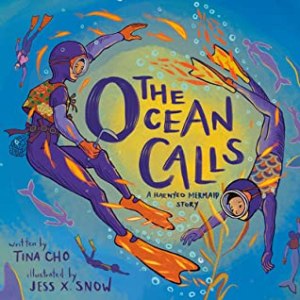
“The ocean is calling me today,” says the grandmother at the beginning of Tina Cho’s new picture book, The Ocean Calls: A Haenyeo Mermaid Story (Ages 4-8), one of the most fascinating and exquisite examples of a symbiotic relationship with water that I have ever seen. Set on the shores of Jeju Island in South Korea and luminously illustrated in jewel tones by Jess X. Snow, the story is about the relationship between a girl, struggling with her fear of the ocean, and her grandmother, a haenyeo mermaid, who holds her breath for two minutes at a time and dives up to thirty meters to bring back armfuls of shellfish for eating and selling. Here’s the coolest thing: the haenyeo tradition is real! It goes back centuries among indigenous Pacific islanders, remains alive today, and plays a vital role in ocean ecology.
 What to Read to Your Kids