Gift Guide 2016 (No. 6): For the Non-Fiction Lover
December 20, 2016 § 1 Comment
 Call it Seasonal Affective Disorder; call it the anticipation of school closures (let’s just give up now); call it the fact that it now takes us seven times longer to get out of the house: whatever the reason, as soon as a cold snap hits every year, I want to hibernate. And yet, consider this, my fair-weathered friends: the polar bear—a creature who lives in the coldest corners of the Earth; who eats, walks and sleeps on ice; and who is surrounded by nothing but white and blue all day, every day—does not hibernate.
That someone can love the cold this much—and, in fact, depend on it for its very survival—is just one of the many things that endear us to the polar bear, as evidenced in Jenni Desmond’s extraordinary tribute, The Polar Bear (Ages 6-10), a factually accurate yet poetic picture book with some of the most stunning illustrations I have ever seen (seriously, I’m not sure I can bring myself to shelve this book, its cover is so gorgeous). « Read the rest of this entry »
Gift Guide 2016 (No. 3): For the Aspiring Writer
December 8, 2016 § 3 Comments
 I am rarely at a loss for words. But, in thinking about how to recommend Melissa Sweet’s Some Writer! The Story of E.B. White (Ages 8 to adult), a 158-page tribute to one of children’s literature’s most enduring legacies, I find that I am. You see, I would like to reproduce nearly every one of White’s sublime quotations peppered throughout this biography—of which there are too many to count—yet doing so without Sweet’s exquisite accompanying collages would feel bereft. Plus, in the chapter dedicated to White’s rewrite of The Elements of Style, the tiny but quintessential guide to writing originally penned by his former Cornell professor, William Strunk, White makes clear his disdain for “needless words.”
So, in the spirit of White, and because Melissa Sweet’s biography of the writer stands alone in absolute perfection, I will attempt to keep my words (somewhat) brief. I encourage you to experience this marvel for yourself—that is, before you gift it to an aspiring child writer, or to anyone with a fondness for boating, impeccable grammar, farm animals, New England, and manual typewriters. « Read the rest of this entry »
Introducing Activism to Children
November 17, 2016 § 11 Comments
 In light of last week’s election results, I am struggling, like so many millions of Americans, with the question of what I can and should do to combat the rhetoric of hate and intolerance that has prevailed in this unfathomable reality, where someone running on a platform of racism, misogyny, and xenophobia would be awarded the highest position of power in our country.
What do we do now? Specifically, how do we advocate—and inspire our children to advocate—on behalf of those who are afraid, of those who are on the receiving end of vitriolic slurs and physical threats, of those whose place in our communities is suddenly threatened? « Read the rest of this entry »
Standing Up to “Passive Violence”
October 20, 2016 § 3 Comments
 Invoking the eloquent and emotionally-charged words of Michelle Obama last week, I must echo that what is happening in our country right now has “shaken me to my core.” It’s not just the vulgar “locker room” banter from a certain presidential candidate, loaded language that has awakened sordid memories of my own experience with sexual aggression and objectification—and made me suddenly painfully aware that my own daughter will likely walk a similar and sometimes terrifying path.
It’s not just the blatant hostility slathered across so many of the election signs lining our highways, obscene graphics and words that render me speechless as I struggle to explain to my inquiring children why a certain presidential candidate would be depicted on a billboard as the Wicked Witch of the West. « Read the rest of this entry »
Winning Against All Odds
September 29, 2016 § 3 Comments
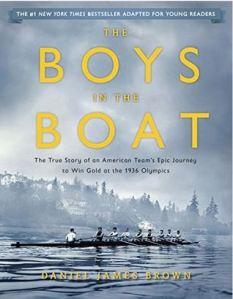 We are still feeling the effects of Olympics Fever in our house. Before his weekly swim lesson, JP flaps his arms back and forth across his chest, a.k.a. Michael Phelps. Emily vaults off the arm of our leather chair and lands with her hands above her head, chest lifted. I’m still smiling at the charisma of Usain Bolt, who runs so fast it’s scarcely comprehensible. While we were watching the Olympics one Saturday afternoon, with footage of fencing and archery and discus throwing, JP exclaimed, “I didn’t even know there were this many sports!” (We aren’t typically a sports-watching family, as I’ve mentioned before.)
For all the glory that my children witnessed unfolding on the television screen this past summer, I don’t think they really grasped the guts that were involved. The sacrifices made. The arduous, sometimes circuitous journeys of these athletes to Rio. What actually went on behind the scenes.
I started to feel like I was doing these athletes a disservice by not talking to my kids about how painfully difficult—how physically and mentally trying—these journeys to victory often are. « Read the rest of this entry »
Subterranean Thrills
May 19, 2016 Comments Off on Subterranean Thrills
 There was a moment on the subway, during our recent trip to New York City, when my five-year-old daughter turned to me and said, “Wait. Mommy. Are we actually underneath buildings and streets?” At first, I was a bit taken aback. Since birth, she has ridden on the subway, both in New York and at home in Washington DC. Why is she just grasping this now? And yet, the more I watched her absorb my affirmative answer, then spend the next several days kneeling on her seat, staring out the window into the blackness of the roaring tunnel, the more I realized that the whole concept of the subway is in itself quite astonishing.
Astonishment is exactly what the “distinguished citizens, reporters, and government officials” of New York City felt on February 26, 1870, when an inventor named Alfred Ely Beach led them into a 294-foot-long tunnel that he had helped build underneath the streets of New York, in order to showcase his fan-powered train that he believed would solve the city’s transportation problem. How this came about and what happened next—the largely forgotten story of New York’s unofficial first subway, which predated by 42 years the city’s plans to build an official subway system—is detailed in the fascinating new picture book, The Secret Subway (Ages 6-12), by Shana Corey and illustrated by Red Nose Studio. « Read the rest of this entry »
The Right to Vote
February 11, 2016 § 6 Comments
 With such a heated presidential election upon us, voting has been a popular topic of conversation in our house. My eight year old is trying to make sense of the candidate names he has heard; and he repeatedly asks my husband and I who we “want to win” this November, convinced with that blind, beautiful eight-year-old innocence that his parents’ choice must be the right one. (I’m tempted to blow his mind by telling him that his dad and I might each want someone different.)
The right to vote may be one that many of us Americans take for granted today (much like trying on shoes at a store—see last year’s post for Black History Month); and yet, it also seems to inspire a certain awe in our children. Or at least it did in me when I was young. My mother would take me along when she voted in major elections. We’d wait in line, hand in hand, and then part of me would cringe in betrayal when at last it was her turn and she would pull the curtain closed around the voting booth, leaving her on one side and me on the other. I would strain to see her shadow beneath the curtain, trying to make heads or tails of what she was doing in there. “Can’t I come in with you?” I’d lament. “Isn’t it unsafe to leave me out here all alone?” I’d try. But her answer was always the same: “Voting is private. What I do in here is nobody’s business but my own.” That night, I’d try harassing my father: “But you did vote for who you said you were going to, right?” “That’s for me to know,” my dad would reply, the corners of his mouth turning up slightly. « Read the rest of this entry »
Long Live the Polar Bear
January 30, 2016 § 1 Comment
 If there was ever a time to turn our children sympathetic to the plight of the endangered polar bear, it is on the heels of this recent Snowpocalypse, which dumped more than two feet of the white stuff on us (snow novices) here in Northern Virginia. As my kids and I gazed wide-eyed out our window, the snow fell for two days, swirling and collecting and mounting into perfect waves of whiteness, occasionally drifting into piles almost as high as the stop sign at the end of our block (the stop sign being my son’s unofficial measuring tool of a blizzard, ever since we read John Rocco’s Blizzard last winter). Long before the sun came out and the wind died down, my children were out shoveling trenches down the middle of the street and crawling into hand-dug snow tunnels.
But after just a few days, the sledding hills became slushy. The snow banks started to recede from the edges of our sidewalks, betraying the brownish-green grass beneath. Our once crisp white snow in the backyard has overnight become freckled with twigs and dirt and those (abhorrent) spiky balls from our sweet gum trees. The other morning at breakfast, JP buried his head in his hands and pronounced, “I can’t look. I just wanted it to stay the way it was.” « Read the rest of this entry »
2015 Gift Guide (No. 4): For the Mechanically Inclined
December 12, 2015 Comments Off on 2015 Gift Guide (No. 4): For the Mechanically Inclined
 Today, I want to tell you about a super-duper-awesome new non-fiction book. David Macaulay, who launched the Beast of Gifts in 1988 with The Way Things Work (Ages 10-16), a massive hardcover volume dedicated to demystifying science and technology for children with clear language and beautifully rendered line drawings, has this year created a fully interactive and substantive spin-off. How Machines Work: Zoo Break (Ages 6-9) is targeted at a slightly younger audience and is aimed at exposing specific scientific principles. Here, through a combination of flaps, pop-ups, and inset booklets—as well as a silly story line about a sloth and mouse determined to break free of their zoo enclosure—children are introduced to simple machines. « Read the rest of this entry »
2015 Gift Guide (No. 3): Chapter Books for the Courage Seeker
December 10, 2015 § 2 Comments
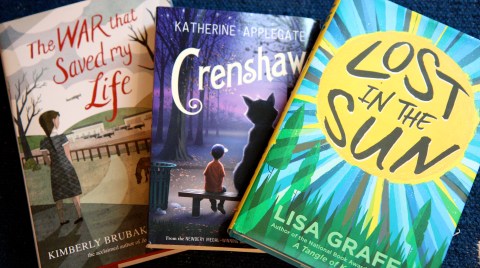 As a child who loved reading all sorts of books, the characters that stayed with me long after I finished the final page were not the knights in shining armor or the warrior princesses. They were everyday children—characters who looked or felt or went to school like me—whose strength and courage were greatly tested by circumstances beyond their control. These children got dealt a bad hand; and yet, they managed to come through with grace and humor, with an increased sensitivity to others, and with a wealth of self-knowledge. Perhaps it is through reading stories about loss, disability, bullying, or poverty that we can create our own personal roadmap to peace, compassion, and joy.
Without further ado, I present my three favorite middle-grade chapter books of the year for the 9-14 year-old set. (Mind you, these are in addition to Echo and Circus Mirandus, which I wrote about over the summer here and which are every bit as awesome as the ones below). These three novels are vastly different from one another, both in subject and in narrative voice—and yet all of them sing with the beauty of the human spirit. « Read the rest of this entry »
The Real Winnie the Pooh
November 19, 2015 § 8 Comments
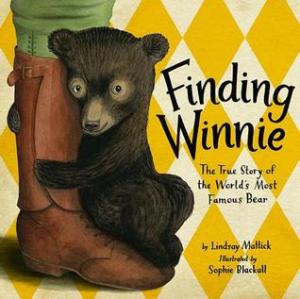 A. A. Milne’s iconic classic, Winnie the Pooh, the collected tales of a stuffed-bear-come-to-life and his friends, was one of those books I was most excited as a new parent to read to my children. I still have the copy that once belonged to my own mother and her brothers: a water-stained hardback with their own handwritten improvisations along the way.
While I vaguely recollect reading and enjoying this classic as a child myself, I’ll admit that my more prominent memories are of decorating friends’ yearbooks with A.A. Milne quotations (“We’ll be friends forever, won’t we, Pooh?” said Piglet. “Even longer,” Pooh answered.) Pooh and his friends, it seems, have an enduring resonance.
When it came to cracking the spine on this treasure for my firstborn, I didn’t anticipate how surprisingly sophisticated A.A. Milne’s writing is. I first tried to read Winnie the Pooh to JP when he was only three and a half. Big mistake. The dry humor was over his head (it’s hard to find Owl’s misspellings funny when you don’t know how to spell yourself); and the sudden jumps in narration were jarring (one minute we’re in the 100 Acre Wood, the next we’re in Christopher Robin’s bedroom hearing about the 100 Acre Wood). I would be erupting in giggles, while JP would be eyeing me as if to say, This is funny why?
We tried again when JP was six, with much greater success, although I think the beauty of Pooh (in the vein of other classics, like The Little Prince) is that it can be re-read at almost every age from here on out for different gain. The 100 Acre Wood is like a microcosm for the world. In it, we encounter the same personalities that we do on the outside. Look at bossy pants over there, hopping around like ‘ol Rabbit. Cool it with the Kanga-like cheerleading, kay? I need a lunch date with my Piglet.
Less Creepy, More Crawly
October 8, 2015 § 2 Comments
 At a time of year when people (ahem, my husband) seem to think it’s funny to leave plastic rats lying casually around the house, I thought there might be some value in remembering that even the creepiest and crawliest of creatures have some pretty awe-inspiring merits. Or, at least, maybe we don’t need to run screaming all the time.
Recently, I’ve been noticing that there seems to be a new kind of science picture book afoot—a refreshing companion to the National Geographic-types, which pair a myriad of facts with in-your-face photography. Don’t get me wrong: my son loves himself a fat, meaty information-packed book. My daughter, on the other hand, won’t touch one with a ten foot pole. Maybe it’s that she’s only five; maybe it’s a gender thing; or maybe it’s just that she’s wired differently. But I tend to think she craves the same kind of information—just in a different format.
Allow me to introduce two books in this new genre, which for lack of a more official term I am calling Conversational Non-Fiction. These are picture books with disarming first-person narrators, whimsical illustrations, a hefty dose of humor, and loads of true and fascinating facts slipped casually between the pages. These books—at least the two I’m about to discuss—are also the first informational picture books that my daughter has ever requested to hear again and again.
Seduced by Engineering
July 23, 2015 § 1 Comment
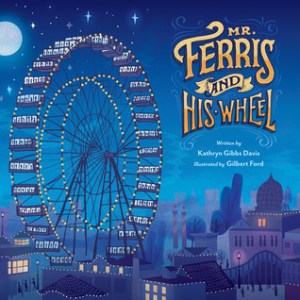 One of the Great Surprises of my life came on a hot, clear summer day last August. My sister in law was visiting, and she and I decided to take the kids over to National Harbor in Maryland. “You know, Mommy, I heard they built a Ferris wheel there. I think we should ride it,” offers my eldest.
SAY WHAT? Now, I’ve read the parenting books, and I know we’re not supposed to label our children. So, in lieu of describing my seven year old as cautious, I’ll just say that he prefers to apply the road sign, PROCEED WITH CAUTION, to as much of his life as possible. If JP determines something to be of physical risk, he’ll likely avoid it all together—or spend weeks (ahem, years) ruminating on it, observing others doing it, until he’s absolutely sure he can proceed safely and confidently and without anyone’s assistance (see: bike riding). Heck, there are slides in our neighborhood that he still deems too tall to slide down.
So, I’m suddenly supposed to believe that my son is going to leave the safety of the ground aboard a giant rotating wheel that he has never actually laid eyes on? Don’t get me wrong, I was positively giddy at the prospect (wait, do you think we can start going to theme parks and rock walls?!), although I was careful to do my best nonchalant impersonation when I answered him, “Yeah, sure, we can do that, maybe, whatevs.” No need to jinx things with my shock and excitement.
On the ferry ride over, as we caught first sight of the Metal Monstrosity, hanging precariously out over the pier, I once again thought, NOT A CHANCE. And I once again was floored. “Wow, it’s a lot bigger than I thought, Mommy. But we are definitely riding it.”
As we got in line and paid a mere fortune (honestly, I would have forked over any amount to reward this burst of spontaneity), I watched with trepidation as the color began to drain from JP’s face. I realized he was listening to the attendant, who was loading people into what turned out to be giant glass-enclosed cars and then pointing out the large red “panic” buttons located in each interior. “Why do they need those buttons?” JP asked me.
“Um, in case someone feels sick and they want to come down and get out. I’m sure they hardly ever get used,” I quickly responded. Although I was beginning to wonder the same thing.
And then we were bolted in, quickly rising higher and higher, until we were suspended over the water on one side and the itty bitty figures of people waiting in line on the other. And then—as is the custom with every Ferris wheel I’ve ever been on—we were paused, dangling, SWAYING, for what seemed like an eternity, as a new round of people boarded at the bottom. And we still had four more laps to go.

I looked at JP. “How are you feeling, buddy?”
He shot me a look like, don’t you dare talk to me right now or I’m going to start screaming like a banshee. Or maybe I’m just projecting how I was feeling. That panic button was calling to me. My sister in law looked equally frozen. (My three year old, on the other hand, seemed completely unfazed.)
But we did it. All of us. All five laps. We oooed and we ahhhed, and then we ventured that we might, we might, do it again someday. As we stepped off, I turned and asked the attendant (out of earshot of JP), “How often do people use that panic button?” She rolled her eyes. “You have no idea,” she said. But I did.
Weeks later, I asked JP what made him decide to ride the Ferris wheel. He started rambling about metal and motors and making grand gestures with his hands—and, suddenly, it dawned on me that it was sheer engineering that had seduced him. Even before he saw it in real life—when it was just something he had seen in pictures—the lure was magnificently romantic.
As if right on cue, Kathryn Gibbs Davis’ Mr. Ferris and His Wheel (Ages 5-10), a fascinating picture book biography of the man who invented the Ferris wheel, was soon published and quickly became a favorite in our house (along with the other engineering-themed picture books listed at the end of this post).
Once again, as with the best non-fiction children’s books, I was learning alongside my children. « Read the rest of this entry »
Hibernating with Poetry (Joyce Sidman Style)
February 26, 2015 § 2 Comments
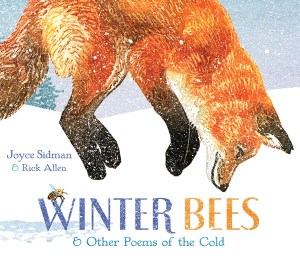 News flash: right now, under your very own backyard or front porch, there could be as many as 20,000 garter snakes huddled together, using the body warmth of one another to wait out these cold winter months. SAY WHAT? If you think I’m exaggerating, I’m not. And now you, too, can be reminded of said news flash by your seven year old every morning as you leave the house. All thanks to one of twelve poems in Winter Bees & Other Poems of the Cold (Ages 6-12), the latest lyrical and visual masterpiece by poet Joyce Sidman and printmaker Rick Allen.
Thankfully, Winter Bees IS a masterpiece, so you won’t mind reading about snakes, which may or may not be lurking in “hibernaculums” beneath the ground on which you tread (if you remember, our snake obsession started here). Thankfully, too, most of the poems in Winter Bees are more beautiful than creepy, inspiring awe for animals like tundra swans, moose, beavers, moles, and chickadees, as well as frosty events, like ice crystal formation. « Read the rest of this entry »
Creative Activism (In Honor of Black History Month)
February 19, 2015 § 3 Comments
 Last spring, I took my then three year old daughter shopping for shoes. It was a rainy Saturday, we had just come from her first early morning soccer practice (to which she had worn rain boots), and with plenty of time to kill before lunch, I figured we’d hunt down some sensible, sports-worthy sneakers. As we stepped, hand in hand, through the automatic doors and into the giant monstrosity that is Rack Room, it occurred to me that I had never taken her shopping before. I was feeling a little giddy.
We soon found ourselves standing before towering steel shelves, endless rows filled with mix-matched boxes of child-sized sneakers. “Let’s see,” I said, pulling down a Nike box with a pair of bright turquoise Velcro sneakers. “How about these?”
There was a squeal. “Mommy, look! These ones over here have PRINCESSES on them!” “Oh, wait! Look at that girl over there: she’s got on shoes that LIGHT UP! Those are the ones! Those are the ones I want!”
I started to panic. Oh right, this is why I have never taken her shopping. Why did I forsake my precious Zappos for this place?! As the steel walls and high-pitched whining began to close in on me, I made a quick decision. « Read the rest of this entry »
Gift Guide 2014 (No. 6): For the Future World Leader
December 22, 2014 Comments Off on Gift Guide 2014 (No. 6): For the Future World Leader
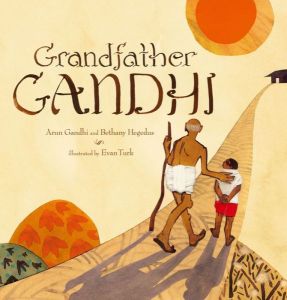 I have been waiting all year to tell you about this book. Then, last week, terrorists stormed a school in Pakistan and savagely butchered innocent children. My heart broke as I watched the news coverage; and suddenly, I didn’t want to wait a second longer to discuss this special book. Let’s all hold hands and agree to share this book with our children early and often. Please.
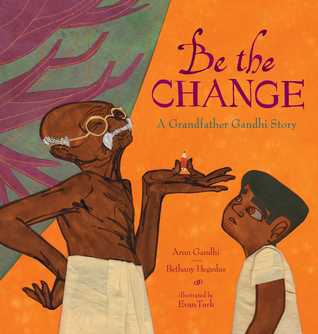
Amidst its powerful message of familial relationships and responsibilities, set against the historical backdrop of one of the greatest leaders our world has ever seen, Grandfather Gandhi (Ages 6-12) is also about the very real, very universal feeling of anger. What the book reminds us is that, however inevitable our anger may be, we always, always have a choice in how we express it.
But let me back up. Let me start by saying that Grandfather Gandhi is not a traditional biography of Mahatma Gandhi (in fact, the book assumes the reader has some basic biographical knowledge—a feat easily accomplished by a parent elaborating as he or she shares this book aloud).
Rather, this picture book is a deeply personal account of Gandhi as an old man—as seen through the eyes of his adolescent grandson. « Read the rest of this entry »
Gift Guide 2014 (No. 2): Three Books for the Linguist (Ages 6-12)
November 25, 2014 § 1 Comment
Children have an inherent drive towards language. As infants, they hang on our every word. Once they begin to speak, they never tire of the sound of their own voice; and, as they develop more self-control, they relish in the discovery of expressing themselves (“Use your words!”) to get what they want. But it’s in the elementary years, when our kids are at last reading and writing on their own, that they become most keenly aware of the power of words, not only to shape and alter meaning, but also to connect them to the world.
Of course, it can’t hurt to nudge an awareness of the nuance of language into the forefront of our children’s minds. (We have to believe our kids are capable of more than “It was fine,” when asked about their day.) It just so happens that 2014 has given us three exceptional books (one picture book and two middle-grade chapter books) that showcase the power of language.
 Jen Bryant and Melissa Sweet’s The Right Word: Roget and His Thesaurus (Ages 6-12) introduces children to the notion that, in the vast archives of the English language, there is a “right” word to express a precise meaning. Bryant and Sweet have become masters of picture book biographies in recent years (remember this post?); but their portrait of the man who invented the thesaurus is their most magnificent to date. The story of Dr. Peter Roget’s life is narrated beautifully for a young audience; but it is the way in which Sweet has visualized Roget’s fascination with language that truly captivates the reader. Like the thesaurus itself (which comes from the Greek word meaning “treasure house”), this is a book that’s impossible to absorb in one—or ten, or twenty—sittings. Visual feasts of collage beckon the eye on every page. « Read the rest of this entry »
Learning Alongside Our Children
November 13, 2014 § 11 Comments
 At a recent Parents Night, JP’s elementary teacher said something that I haven’t stopped thinking about. We were having a conversation about whether we as parents have a responsibility to teach our children, to reinforce what they are learning at school, to push them in subjects in which they might be struggling. No, she said. “The most important thing you can do for your children,” she said, “is to love life—and to let your children witness and share in that love.”
When we take our children to a museum, she continued, we should take them to the exhibits that we are dying to see; we should read to them from a plaque because we want to find out more information about that painting. If we take them on a nature walk, we should point out leaves or pontificate on seasons—not because we are trying to teach them—but because we want to share with them the very things that are amazing to us in that moment. In other words, we want to inspire our children to learn by letting them see how much fun we’re having doing it. « Read the rest of this entry »
The Magic of Fall
October 23, 2014 § 5 Comments
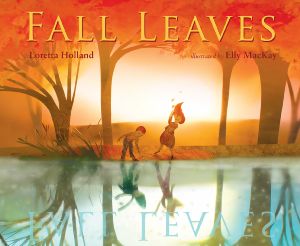 The other evening, after cleaning up from dinner, I walked into the living room to find JP sticking his nose out the mail slot of our front door. “Mommy, I can smell winter coming! I forgot how delicious it smells! I thought I wanted summer to stay, but now I want winter to come!”
Perhaps because of my children’s innate excitement around seasonal transformations, or perhaps because of wanting to sway my own ambivalence about the onset of winter towards something more positive—either way, I have always had a special place in my heart for stories about fall (remember Fletcher and the Falling Leaves?). This year, I have discovered my most favorite presentation to date. It’s not a story. There are no frantic animals preparing for hibernation (see Bear Has a Story to Tell), or children frolicking in pumpkin patches (although you should still read Otis and the Scarecrow). Rather, there is a simple phrase on each page, accompanied by a stunning picture, and the meaning lies in the intersection between the two.
Fall Leaves (Ages 4-8), by Loretta Holland, with illustrations by Elly MacKay, is one of those picture books that can be enjoyed on multiple levels. At its simplest, it reads as a kind of lyrical, free verse poem, with one line per page. But each phrase is also a kind of headline, with a smaller-print paragraph below, containing detailed and carefully chosen information about a unique aspect of fall, like the migration of birds, the hibernation of perennials, or the heavy downpours (am I the only one who is consistently blind-sided by these rainy days, assuming every morning is going to bring a bright cloudless sky against which to pick apples and pumpkins?). « Read the rest of this entry »
The Stuff That Doesn’t Grow on Trees
October 2, 2014 § 5 Comments
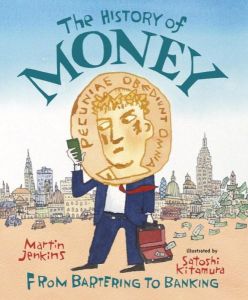 One of the most enjoyable afternoons I spent with my son this past summer had nothing to do with summer. It didn’t involve beaches or roller coasters or ice cream. It didn’t cost a cent, although it was all about money.
JP turned seven last week, and we had been telling him for awhile that we would begin giving him an allowance on his seventh birthday. Then, last June, it occurred to me that the kid had no practical knowledge of money, an inauspicious beginning to forging a lifetime relationship with the stuff that doesn’t grow on trees. I decided to make it my Goal of Summer 2014 to teach him, not only how to count and sort coins and bills, but also about how money came to exist in the first place—and how it has changed over time. Like most of my endeavors in parenting, this one started with a book.
The timing turned out to be perfect, because Candlewick happened to send me a copy of their newly published 52-page chapter book titled The History of Money: From Bartering to Banking (Ages 7-12), with text by Martin Jenkins and cartoonish illustrations by Satoshi Kitamura. From page one, JP was riveted. The book reads as a kind of anthropological, time-travel narrative, beginning in the early age of man when “nobody had any money.” « Read the rest of this entry »
 What to Read to Your Kids