Winning Against All Odds
September 29, 2016 § 3 Comments
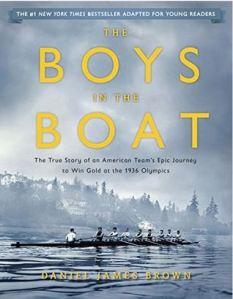 We are still feeling the effects of Olympics Fever in our house. Before his weekly swim lesson, JP flaps his arms back and forth across his chest, a.k.a. Michael Phelps. Emily vaults off the arm of our leather chair and lands with her hands above her head, chest lifted. I’m still smiling at the charisma of Usain Bolt, who runs so fast it’s scarcely comprehensible. While we were watching the Olympics one Saturday afternoon, with footage of fencing and archery and discus throwing, JP exclaimed, “I didn’t even know there were this many sports!” (We aren’t typically a sports-watching family, as I’ve mentioned before.)
For all the glory that my children witnessed unfolding on the television screen this past summer, I don’t think they really grasped the guts that were involved. The sacrifices made. The arduous, sometimes circuitous journeys of these athletes to Rio. What actually went on behind the scenes.
I started to feel like I was doing these athletes a disservice by not talking to my kids about how painfully difficult—how physically and mentally trying—these journeys to victory often are. « Read the rest of this entry »
Facing the Past to Better the Future (A Book Club Post)
June 23, 2016 § 1 Comment
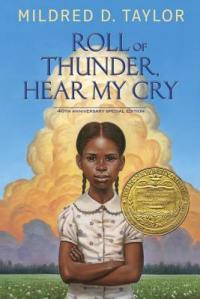 Like many of you, I am appalled, heartsick, and deeply concerned by some of the rhetoric surrounding this election—particularly by the latent racism and bigotry that appear to be awakening in pockets of our country. Each time I check my news feed, my own powerlessness in the face of what seems like a funnel cloud of hate threatens to consume me.
But then I am reminded of our children. Of how good and true and fiercely righteous they are. Of how doing the right thing is of paramount importance to them at their young age.
“Right” can be subjective. People can act in a way that they justify as right, but which others would judge as cruel and hateful.
How do we teach our children the right “right”? Or, perhaps more critically, how do we inspire our children’s conscience to make those distinctions for themselves? « Read the rest of this entry »
The Real Winnie the Pooh
November 19, 2015 § 8 Comments
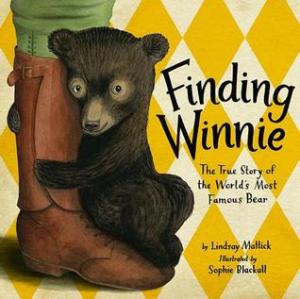 A. A. Milne’s iconic classic, Winnie the Pooh, the collected tales of a stuffed-bear-come-to-life and his friends, was one of those books I was most excited as a new parent to read to my children. I still have the copy that once belonged to my own mother and her brothers: a water-stained hardback with their own handwritten improvisations along the way.
While I vaguely recollect reading and enjoying this classic as a child myself, I’ll admit that my more prominent memories are of decorating friends’ yearbooks with A.A. Milne quotations (“We’ll be friends forever, won’t we, Pooh?” said Piglet. “Even longer,” Pooh answered.) Pooh and his friends, it seems, have an enduring resonance.
When it came to cracking the spine on this treasure for my firstborn, I didn’t anticipate how surprisingly sophisticated A.A. Milne’s writing is. I first tried to read Winnie the Pooh to JP when he was only three and a half. Big mistake. The dry humor was over his head (it’s hard to find Owl’s misspellings funny when you don’t know how to spell yourself); and the sudden jumps in narration were jarring (one minute we’re in the 100 Acre Wood, the next we’re in Christopher Robin’s bedroom hearing about the 100 Acre Wood). I would be erupting in giggles, while JP would be eyeing me as if to say, This is funny why?
We tried again when JP was six, with much greater success, although I think the beauty of Pooh (in the vein of other classics, like The Little Prince) is that it can be re-read at almost every age from here on out for different gain. The 100 Acre Wood is like a microcosm for the world. In it, we encounter the same personalities that we do on the outside. Look at bossy pants over there, hopping around like ‘ol Rabbit. Cool it with the Kanga-like cheerleading, kay? I need a lunch date with my Piglet.
Creative Activism (In Honor of Black History Month)
February 19, 2015 § 3 Comments
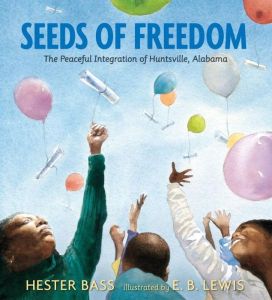 Last spring, I took my then three year old daughter shopping for shoes. It was a rainy Saturday, we had just come from her first early morning soccer practice (to which she had worn rain boots), and with plenty of time to kill before lunch, I figured we’d hunt down some sensible, sports-worthy sneakers. As we stepped, hand in hand, through the automatic doors and into the giant monstrosity that is Rack Room, it occurred to me that I had never taken her shopping before. I was feeling a little giddy.
We soon found ourselves standing before towering steel shelves, endless rows filled with mix-matched boxes of child-sized sneakers. “Let’s see,” I said, pulling down a Nike box with a pair of bright turquoise Velcro sneakers. “How about these?”
There was a squeal. “Mommy, look! These ones over here have PRINCESSES on them!” “Oh, wait! Look at that girl over there: she’s got on shoes that LIGHT UP! Those are the ones! Those are the ones I want!”
I started to panic. Oh right, this is why I have never taken her shopping. Why did I forsake my precious Zappos for this place?! As the steel walls and high-pitched whining began to close in on me, I made a quick decision. « Read the rest of this entry »
What’s Old is New Again
January 8, 2015 § 1 Comment
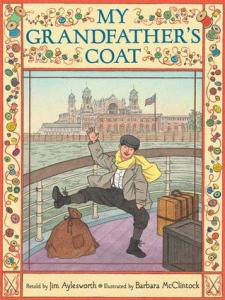 In what increasingly feels like the Age of Excess, one of my greatest parenting rushes has become the Art of Purging. Quick, toss the stacks of paint-splotched easel paper while the kids are still at school! Drag missing-pieced toys to the curb as the garbage truck rounds the corner! Bag up old PJs, hats, and shoes for Goodwill! I look around my newly streamlined rooms and closets and feel a brief, momentary thrill. In a matter of weeks, it will feel like I need to purge again.
While we’re busy tossing out, our children are busy holding on. “Wait! I want to save my (broken) balance bike for my own children!” my son laments. “Can we put my old dresses in my memory box?” asks my daughter.
It recently dawned on me that, if left to their own devices, children make marvelous recyclers. This past fall, on a Sunday morning, while my husband was overseas for work (read: far, far away), I lay in bed burning up with a fever and cursing the Murphy’s Law of Motherhood, whereby moms only fall prey to The Plague when we’re on our own with no one around to help. I drifted in and out of sleep and didn’t realize until it was approaching lunchtime that my children had been awake and downstairs for hours. My son poked his head in: “Hi, Mommy. It’s OK, you don’t need to come down. I just wanted to let you know that we have been playing with the recycling.” « Read the rest of this entry »
Gift Guide 2014 (No. 2): Three Books for the Linguist (Ages 6-12)
November 25, 2014 § 1 Comment
Children have an inherent drive towards language. As infants, they hang on our every word. Once they begin to speak, they never tire of the sound of their own voice; and, as they develop more self-control, they relish in the discovery of expressing themselves (“Use your words!”) to get what they want. But it’s in the elementary years, when our kids are at last reading and writing on their own, that they become most keenly aware of the power of words, not only to shape and alter meaning, but also to connect them to the world.
Of course, it can’t hurt to nudge an awareness of the nuance of language into the forefront of our children’s minds. (We have to believe our kids are capable of more than “It was fine,” when asked about their day.) It just so happens that 2014 has given us three exceptional books (one picture book and two middle-grade chapter books) that showcase the power of language.
 Jen Bryant and Melissa Sweet’s The Right Word: Roget and His Thesaurus (Ages 6-12) introduces children to the notion that, in the vast archives of the English language, there is a “right” word to express a precise meaning. Bryant and Sweet have become masters of picture book biographies in recent years (remember this post?); but their portrait of the man who invented the thesaurus is their most magnificent to date. The story of Dr. Peter Roget’s life is narrated beautifully for a young audience; but it is the way in which Sweet has visualized Roget’s fascination with language that truly captivates the reader. Like the thesaurus itself (which comes from the Greek word meaning “treasure house”), this is a book that’s impossible to absorb in one—or ten, or twenty—sittings. Visual feasts of collage beckon the eye on every page. « Read the rest of this entry »
Morning at The Met (Courtesy of E.L. Konigsburg)
October 30, 2014 § 5 Comments
 Earlier this fall, JP and I embarked on our annual trip to New York City, where I grew up and where my Mom still lives. Normally on these visits, we are content to plot and rehash the day’s adventures by pouring over the vibrant illustrations in Kathy Jakobsen’s My New York, which my Mom brings down from a closet upon our arrival.
This time, I decided that some advance reading was in order. So, in the weeks leading up to our departure, I read to JP one of the novels I most remember from my childhood: E.L. Konigsburg’s From the Mixed-Up Files of Mrs. Basil E. Frankweiler (Ages 9-12; younger if reading aloud), which won the Newberry Medal in 1968. Through the eyes of two runaway siblings from Greenwich, Connecticut, who secretly live (and sleep) in The Metropolitan Museum of Art for an entire week, we are introduced to this incredible museum with drama and intrigue. The last time I took JP to the Met—albeit he was only five—was a disheartening disaster; he was bored within minutes of my ramblings about Impressionist painters. This time was different. This time, we had purpose: we were following in the steps of Claudia and Jamie Kincaid. « Read the rest of this entry »
The Stuff That Doesn’t Grow on Trees
October 2, 2014 § 5 Comments
 One of the most enjoyable afternoons I spent with my son this past summer had nothing to do with summer. It didn’t involve beaches or roller coasters or ice cream. It didn’t cost a cent, although it was all about money.
JP turned seven last week, and we had been telling him for awhile that we would begin giving him an allowance on his seventh birthday. Then, last June, it occurred to me that the kid had no practical knowledge of money, an inauspicious beginning to forging a lifetime relationship with the stuff that doesn’t grow on trees. I decided to make it my Goal of Summer 2014 to teach him, not only how to count and sort coins and bills, but also about how money came to exist in the first place—and how it has changed over time. Like most of my endeavors in parenting, this one started with a book.
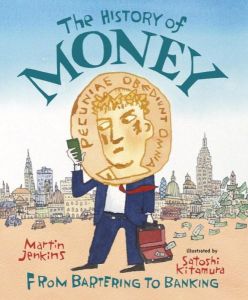
The timing turned out to be perfect, because Candlewick happened to send me a copy of their newly published 52-page chapter book titled The History of Money: From Bartering to Banking (Ages 7-12), with text by Martin Jenkins and cartoonish illustrations by Satoshi Kitamura. From page one, JP was riveted. The book reads as a kind of anthropological, time-travel narrative, beginning in the early age of man when “nobody had any money.” « Read the rest of this entry »
A Master Class in Art History (Without Leaving Your House)
June 16, 2014 § 2 Comments
 I don’t know how the rest of you are planning to get through a hot and steamy summer, but I am counting on a lot of time at the craft table. Especially good news for today’s parents is that we don’t have to live next door to an art museum to teach our kids about the great artists and artistic movements of the past. Last June, I kicked off a “summer school” series with a post about some of my favorite picture book biographies for elementary-aged children, a rich and growing subset of children’s literature. Nowhere is the picture book format better utilized than in biographies of famous artists. These aren’t the books of our past, which reproduce notable paintings aside dry critical analysis; rather, they are true and entertaining stories about formative artists who, beginning as children, overcame struggles, searched for inspiration, and broke down conventional barriers to define their unique artistic styles. As your child sits before a blank piece of paper, wouldn’t you love for him or her to channel the stories of Henri Matisse, Jackson Pollock, Henri Rousseau, and Vasily Kandinsky? (See my list of favorite books at the end.)
The latest of these gems, Barb Rosenstock’s The Noisy Paint Box: The Colors and Sounds of Kandinsky’s Abstract Art (Ages 6-12), strikes a particular chord with my family. At almost seven, JP loves to draw and paint, but while his peers are steering more and more towards realistic creations, JP still prefers abstraction. Some might call it scribbling, although to imply that it is rushed or without meaning would be misguided. JP (and now Emily, following in his footsteps) never stops talking—not for one second—while he draws. He narrates the action as it takes shape before him: comets blasting through the sky, submarines bursting into flames, houses pitched airborne towards a burning sun (the theme of explosion is strong with this one). I’m not exactly sure what he is working out on that paper—because there is clearly something cathartic going on—but when he is finished, his entire body is relaxed, his mind at peace. « Read the rest of this entry »
Connecting Through Diversity
March 25, 2014 § 1 Comment
 A rousing op-ed piece by acclaimed children’s author Walter Dean Myers, recently appearing in The New York Times, poses the uncomfortable question: “Where Are the People of Color in Children’s Books?” The startling statistic cited at the beginning reveals that of the 3,200 children’s books published in 2013, only 93 were about black people. Myers later compares this statistic to the 40% of public school students nationwide who are black or Latino. As a black boy growing up in Harlem, Myers’ initial love affair with reading quickly turned to disinterest, as he discovered the glaring lack of literary characters who looked and lived like him. As an adult, Myers has dedicated his career to writing prolifically about inner-city youth, calling his novels “a validation of their existence as human beings.” But it’s about more than providing validation to people with color, he notes. It’s also about how these individuals are seen by the rest of us:
Books transmit values. They explore our common humanity. What is the message when some children are not represented in those books?
As someone who sold picture books for many years, what often strikes me about today’s offerings for young people is not the lack of books featuring people of color (that is clearly a fact), but how quickly a book with a black figure on its cover almost always signifies a story about a “race issue,” be it a story about a slave traversing the Underground Railroad or one about a contemporary black girl overcoming her classmates’ prejudice to star in the school play. Many of these are beautiful, powerful picture books—but they are also ones that, too often, only end up seeing the light of day during calendar events like Black History Month. Especially among white families, they are treated more like “teaching tools” for the classroom and less like the books we purchase and leave strewn around our house, hoping for our children to discover and devour them. « Read the rest of this entry »
“Life, Liberty, and the Pursuit of Happiness”
February 17, 2014 § 1 Comment
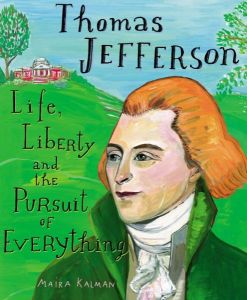 My wish has come true: the exquisite Maira Kalman has graced us with another presidential picture book! Last year, she gave us Looking at Lincoln, which I’ve gifted to more people than I can count (read why here). This year, she introduces our children to Monticello, the Declaration of Independence, and the brilliant, curious, and at times hypocritical Thomas Jefferson, in her just-published Thomas Jefferson: Life, Liberty, and the Pursuit of Everything (Ages 6-12).
Instead of beginning, as we might expect, with chronological details of Jefferson’s life, Kalman’s biography takes us straight to the heart of her subject—or, rather, to his mind. The book opens with Jefferson’s love of books (“I cannot live without books,” he said—a man after my own heart); manners (he could say “please” in seven languages); vegetables (his gardens sported nine varieties of peas, his favorite); and “light and air” (he constantly changed Monticello’s architecture to let in both). « Read the rest of this entry »
Changing the World Through Song: A Post for MLK Jr. Day
January 19, 2014 § 1 Comment
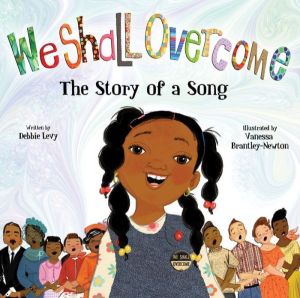 Last year’s post, in honor of Martin Luther King Jr’s birthday, continues to be one of my most read and shared posts. I don’t think there’s any way to top Kadir Nelson’s moving picture book biography of King, so I thought I’d talk this year, not about the leader of the Civil Rights Movement, but about his followers—the ones who marched, the ones who stood up for what they believed, the ones who sang. I was giddy with excitement to discover Debbie Levy’s new picture book, We Shall Overcome: The Story of a Song (Ages 5-10)—one, because I have always loved that song (it crops up at surprising times, like when I’m hiding in the bathroom in an attempt to keep from screaming at my children); and two, because music has recently taken our house by a storm. « Read the rest of this entry »
Digging for Mummies
January 15, 2014 § 1 Comment
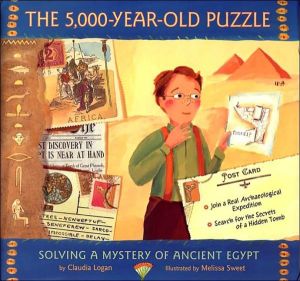 While my son and I were on the subject of excavating fossils, it seemed it might be logical to jump from paleontology to archaeology. It didn’t hurt that, over winter break, JP’s teacher had emailed me about tracking down some good books about Ancient Egypt (see list at the end). And so, one snowy night, JP and I sat down on the couch to read the Treasure Trove that is The 5,000-Year-Puzzle-Old Puzzle: Solving a Mystery of Ancient Egypt (Ages 6-12), by Claudia Logan, illustrated by Melissa Sweet.
An hour later, we were still reading it, my daughter and husband had joined us, and I almost couldn’t tear myself away to meet my girlfriends for a scheduled drink. Almost. I can’t think of a better introduction, not only to Ancient Egypt, but also to the painstaking role that archaeologists play in unearthing clues about ancient life. While the American boy and his father in the book are fictitious, they join an actual historic dig, led by a Harvard team of scientists, which occurred in 1924 at the Egyptian site of Giza 7000X, where a secret and unusually well-preserved tomb was discovered. Through a combination of actual historic records and the young boy’s first-person narrative, we learn about the team’s efforts to excavate this ancient site over the course of a year—including their continual revisions to hypotheses over whose tomb it was and why it was constructed in such a way. « Read the rest of this entry »
Digging for Dinosaurs
January 6, 2014 § 4 Comments
 The last week of my winter break was spent in a cloud of plaster dust. No, we’re not putting an addition on our house; and no, my husband did not finally repair our bedroom ceiling. I’m referring to the Excavation Kits that my son received for Christmas, the kind that come with kid-sized tools for chipping away at blocks of pink plaster, in an attempt to unearth miniature replicas of prehistoric bones. We are talking about a six year old engaged in hours upon hours of independent, uninterrupted work. Are you hearing this, my fellow parents? You need to get Santa to come back. Right now. And you won’t even mind the mess—in fact, you’ll never be happier to clean plaster dust off the floor.
There are kids so obsessed with dinosaurs that they not only know the names of them, but they can pronounce them correctly, tell you in which periods they lived, and rattle off lists of what they ate. JP is not one of those kids. He might be able to identify 15 dinosaurs, despite our reading extensively about them over the years (and I wouldn’t fare much better). For him, the lure lies in the process of dinosaur discovery, the means by which fossilized bones get from some remote dusty location to the pristine museum halls. I’ve mentioned before how much we love Jessie Hartland’s How the Dinosaur Got to the Museum (Ages 4-8), arguably one of the simplest and best introductions to the science of paleontology. And don’t even get me started on the downright fascinating portrayal of field work in Barnum’s Bones: How Barnum Brown Discovered the Most Famous Dinosaur in the World (Ages 5-10), by Tracey Fern and Boris Kulikov.
But (and I do apologize for this) I’ve been holding out on telling you about another of our favorites: the Pièce de Résistance of Dinosaur Books. I’m talking about National Geographic’s The Dinosaur Museum: An Unforgettable, Interactive, Virtual Tour Through Dinosaur History (Ages 5-10). « Read the rest of this entry »
Holiday Gift Guide 2013: Illustrated Chapter Books for the Adventure Seeker
December 19, 2013 § 5 Comments
 Many of us remember the first novels we read, the ones that instilled in us a love of reading (off the top of my head: A Secret Garden, A Wrinkle in Time, anything written by Ruth Chew…). Earlier this year, the prolific writer, Neil Gaiman, wrote a beautiful defense of fiction, which I absolutely love. Fiction, he claims, is not only our best entry into literacy (the what-will-happen-next phenomenon being utterly addictive), but it teaches, above all, the power of empathy:
“When you watch TV or see a film, you are looking at things happening to other people. Prose fiction is something you build up from 26 letters and a handful of punctuation marks, and you, and you alone, using your imagination, create a world and people in it and look out through other eyes. You get to feel things, visit places and worlds you would never otherwise know. You learn that everyone else out there is a me, as well. You’re being someone else, and when you return to your own world, you’re going to be slightly changed.”
I’ve thought a lot about Gaiman’s words, as my six year old and I have been devouring some of the year’s newest chapter books. I’m hoping some of our favorites will find a way into your bedtime routines as well, beginning with Gaiman’s newest novel, Fortunately, the Milk (Ages 7-10, younger if reading aloud). This fantastically over-the-top book begs to be read aloud and is itself a kind of commentary on the power of storytelling. In an attempt to entertain his rambunctious children during their mother’s business trip, a father spins a fantastical tall tale (think pirates, piranhas, aliens, and singing dinosaurs all in the same breathlessly-paced story) about what happens when he goes to the store for a simple carton of milk. « Read the rest of this entry »
Holiday Gift Guide 2013: Stories of Perseverance for the Engineer
December 10, 2013 § 1 Comment
 If at first you don’t succeed, try, try again. That might be easy to say as a parent, but we have only to remember our own childhoods to know how hard it is to hear. Just the other night, my son was attempting to draw a human profile by following one of those step-by-step guidebooks. Diligently huddled over his paper, he suddenly threw the pencil across the room and yelled, “This isn’t working at all! It doesn’t even look like a person!” Actually, I thought, it does look like a person—just not like the one in the book. Oftentimes, we cannot see our triumphs for what they are.
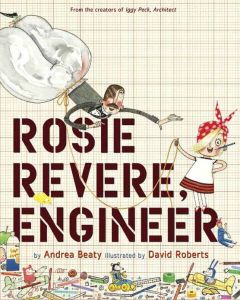
The creative process—its ups, its downs, its just plain hard work—is wonderfully captured in Rosie Revere, Engineer (Ages 5-8), the newest venture by Andrea Beaty and David Roberts, the team that created one of my favorite picture books of all time: Iggy Peck Architect. What black-turtleneck-sporting Iggy Peck did for building designs, red-scarf-sporting Rosie Revere (yes, her namesake is Rosie the Riveter) does for engineering. She makes it look—well—cool. « Read the rest of this entry »
Holiday Gift Guide 2013: Other-Worldly Encounters For the Young Artist
December 8, 2013 § 4 Comments
 When I was young, one of my favorite picture books was Harold and the Purple Crayon, where a little boy makes his own adventures with the help of a single purple crayon. As a child, I loved to draw, but I think the greater appeal for me lay in Harold’s vivid imagination—an imagination that empowers him with an inner resourcefulness, that entertains him when he can’t fall asleep, that gets him out of any sticky situation (drowning? simply draw a boat).
This same spirit echoes across Aaron Becker’s Journey (Ages 4-8), easily the most stunning picture book of 2013 and an inspiration for young artists and adventure-seekers alike. Unlike Harold, a simple visual presentation of purple and white, Journey makes use of a broad palette, although weighted emphasis is given to red, the color of the crayon with which a girl begins her escape by drawing a door (after all, what else can you do when your mom is cooking, your dad is working, and your big sister is too busy?). « Read the rest of this entry »
“Our Trees are Coming!” “Our Trees are Coming!”
November 21, 2013 Comments Off on “Our Trees are Coming!” “Our Trees are Coming!”
 I’m completely obsessed with trees right now. I know what you’re thinking: this is not news. And, you’re right, I’ve written about my love for trees (and stories featuring trees) here, here, here and here. But I’m really, really obsessed with trees right now—and that’s because I have recently been tree shopping. When my kids were baptized last spring, their grandmother offered to buy each of them a tree to grow up alongside. So, earlier this fall, the kids and I did what we do best: we walked, we scooted, and we drove around our neighborhood looking at trees. How had we missed so many of these beauties before? “How about we get one of each?” my son ventured.
Eventually, we narrowed down our choices, but then there was the question of how and where to buy the trees. I initially thought, I’ll look for a deal on the Internet. But then my gardening friend reproached me: you need to see a tree before you buy it, need to study its form, need to find one that speaks to you. This is why, one crystal clear November morning, I found myself standing in a wholesale nursery an hour away in Maryland, surrounded by 600 different varieties of trees. I was walking up and down rows of trees, examining curves of trunks and canopy shapes, paying way too many people to follow me around offering their opinions, and starting to feel like I was going to have a hard time explaining to my husband how this simple decision to buy two trees had gotten totally out of hand. Did I mention how much fun I was having? « Read the rest of this entry »
Bang! Crash! Interstellar Collisions!
October 18, 2013 § 2 Comments
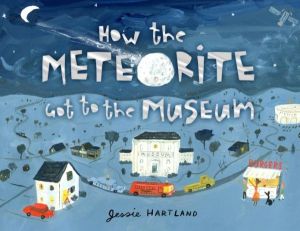 I may have given an audible little yelp the other day when I discovered that Jessie Hartland had published a new title in her “museum” series, but it was nothing like the squeal of joy that my six year old emitted when I brought it home and gave it to him. You see, How the Dinosaur Got to the Museum (Ages 4-8) and How the Sphinx Got to the Museum (Ages 5-10) are among our All Time Favorites, rivaled only by Hartland’s newest addition to the series, How the Meteorite Got to the Museum (Ages 5-10). All three books are brilliantly simple slices of science and history; they introduce children to paleontology, Egyptology, and now astronomy by following a specific artifact from its discovery in the field to its place in the exhibition hall of a museum.
Most great science books take their inspiration from true historical events. Here’s an especially awesome one: on a clear night in October of 1992, a meteor that had been predictably orbiting the sun for four billion years suddenly and inexplicably changed course, entered the Earth’s atmosphere, flew over Kentucky, West Virginia, and Pennsylvania, and crashed into the trunk of a Chevy Malibu parked outside a house in Peekskill, New York (that’s right, crashed—as in, totaled the back of the car and sprung a leak in the fuel tank and precipitated a 911 call to police and fire fighters—pretty much the coolest thing my six year old has ever conceived of). « Read the rest of this entry »
Would Your Life Story Fit In a Box? What We Learn From Our Ancestors
October 3, 2013 § 1 Comment
 Our month of Birthday Mania was bound to have some fall out. Last night, after a particularly exhausting day for my kids (school followed by swim lessons followed by dinner out with friends), I finished putting Emily down and walked into JP’s room to begin his story time. I found my newly-turned six year old curled up in a ball on his bed, sobbing into the deflated husk of his bright green birthday balloon, a remnant from last weekend’s party. “My buh-buh-buh-buh-llllooooon!” he convulsed. “It’s all I have left from my bestest day evvvvvvv-errrrrrrr!” And then he looked at me with lion eyes: “I want a new balloon RIGHT NOW!”
As parents, we’ve all been here. Missed that window to leave the park, to leave the restaurant, to get into bed. So. Far. Gone. I tried the parenting-with-empathy approach: “It’s hard when something so fun comes to an end, huh?” But the wailing continued, accompanied now by a strange rocking of the shriveled green mass. I need to get this poor kid in bed. “Wait! I know!” I offered. “We can save it and put it in your memory box!” JP eyed me suspiciously. “Not that box that you keep, Mommy. I’m going to start my own memory box and make a special pillow in it for my balloon stub.”
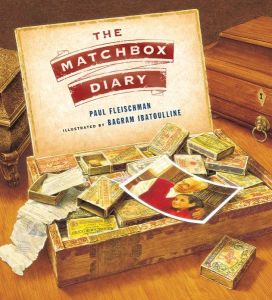
Just a few weeks earlier, JP and I had been discussing the concept of “memory boxes,” after reading Paul Fleischman’s extraordinary and deeply moving new picture book, The Matchbox Diary (Ages 6-10). The book chronicles the life story of an Italian-American boy, who sailed with his family to Ellis Island in search of a better life. « Read the rest of this entry »
 What to Read to Your Kids