Moving Past Color-Blindness
June 25, 2020 § 2 Comments
 I have been drafting this post in my head for two weeks, terrified to put pen to paper for the dozens of ways I will certainly mis-step. Raising children dedicated to equity and justice has always been important to me—if you’ve been following my blog, you’ll recognize it as a frequent theme here—but only lately have I pushed myself to consider the ways my own privilege, upbringing, and anxiety have stood in the way of that. It is clear that I cannot raise my children to be antiracist if I am not prepared to do the work myself.
When my daughter was three, I brought her to the pediatrician’s office for a rash. As we sat in the waiting room, watching and remarking on the colorful fish swimming in the aquarium, my daughter suddenly turned to me. “Mommy, is the nurse going to be black-skinned?”
Embarrassment rose in my cheeks. “Oh honey, I’m sure any nurse here is a good nurse. Let’s not—”
Her interrupting voice rose about ten decimals. “Because I am not taking off my clothes for anyone with black skin!”
Just typing this, my hands are shaking. I am back, seven years ago, in that waiting room, aware of all eyes upon us. Aware of the brown-skinned couple with their newborn baby sitting directly across from us. This can’t be happening, I thought. This can’t be my child. She goes to a preschool with a multicultural curriculum. We read books with racially diverse characters. She plays with children who look different than her. Shock, outrage, and humiliation flooded every inch of my being.
Caught off guard and determined to rid myself of my own shame, I fell into a trap familiar to many white parents. For starters, I came down hard on her. I took my shame and put it squarely onto her. I was going to stop this talk immediately. I was going to prove to everyone listening that this was unacceptable behavior in our family. I was going to make it…all about me.
“Stop it!” I said firmly. “We do not say things like that.” Then, I started rambling about how we shouldn’t judge people by how they look, how underneath skin color we’re all the same, how we’re all one big human family, and so on. You know: the speech. The color-blind speech. The one where white parents tell their children to look past skin tone to the person underneath. The one where we imply that because skin color is something we’re born with, something “accidental,” we shouldn’t draw attention to it. The one where we try and push on our children a version of the world we’d like to inhabit, as opposed to the one we actually do.
My three year old was observing—albeit not kindly or subtly—that not everyone looked the way she did. And she wasn’t sure if that was OK. She was scared. She was uncomfortable. Because we weren’t talking about skin tone or race with her at home, because our conversations (however well-intentioned) steered mainly towards platitudes of kindness and acceptance, she had begun to internalize the racial assumptions around her. She had used the descriptor “black-skinned,” I later realized, whereas if she had simply been observing skin tone, she would have said brown skin or dark skin. The word she chose was a reference to race. A loaded word. Something she had heard. Something she didn’t understand. Something she was beginning to associate with something less than.
We don’t want our children to use race to make judgments about people, so we’d rather them dismiss race completely. Except, in a society where race is embedded into nearly every policy and practice, it is impossible not to see race. So instead, what we are really communicating to our young children is, I know you notice these differences, but I don’t want you to admit it. (Including to yourself). Good white liberal children don’t talk about their black and brown friends as being different from them. Even more problematic, good white liberal children love their black and brown friends in spite of these differences.
Sharing a Love of Travel (A Father’s Day Post)
June 11, 2020 § 1 Comment
 This Father’s Day, my own father will have been gone for twenty-six years. Twenty-six years. One of the most devastating things about losing a parent when you’re eighteen is that you never get to know that parent through an adult lens. I knew my father intimately, from his scratchy mustache to his eye-rolling wisecracks to his endless patience as I described every painstaking detail of my day. But I knew him as a child knows a parent. How I wish I could have known him as an adult.
In times of great upheaval and unrest, I feel my father’s absence most keenly. Every seismic shift in our world puts that much more space between him and me. How would he be participating in this national conversation about race? Would he be marching with a Black Lives Matter sign? What candidate would he have supported in the last Democratic primary? How would social distancing have impacted his life in retirement—or would he still be practicing law? What kinds of things would he enjoy doing with his grandchildren?
I can’t pretend to know the answers to these questions, though I ask them quietly to myself all the time.
What I do know is that there are certain things which always bring him back to me. And one of them is travel. My father’s love of travel was legendary. When I was very young and he would travel internationally for work, he’d always bring me souvenirs—usually dolls—from places like Brazil, Mexico, and Germany. I loved gazing at the tiny porcelain faces or printed fabric clothes and imagining where they had been. Our house was full of black-and-white photographs from before my time: my father on a camel in the Sahara, my father on a motorcycle in Greece. When I decided to spend a gap year in Vietnam after high school, he jumped at the chance to accompany me across the ocean. When, weeks later, it came time for him to return to the States, his parting words were, “It looks like you’ve got the travel bug now, too.” I beamed with pride.
It seems fated that I would fall deeply in love with Jenny Sue Kostecki-Shaw’s new picture book, Papa Brings Me the World (Ages 3-7), in which a young girl describes her affection for a father who travels the world and brings pieces of it back to her. I’ve long been a fan of Kostecki-Shaw’s (my daughter still pulls out Luna & Me), but this book positively transported me. Maybe because it’s inspired by the author-illustrator’s own father; maybe it’s because the theme of found objects lends itself beautifully to mixed-media collage; or maybe it’s because the voice of the little girl reminds me of my young self, brimming with tenderness and curiosity and admiration and longing for my father’s stories of adventure.
What Does It Mean to Be Woke?
June 4, 2020 Comments Off on What Does It Mean to Be Woke?
 In the preface to her scintillating picture book of poems for young readers, Mahogany L. Browne provides this definition of “woke”:
It means to be aware. It means to see your surroundings and challenge how we strengthen our relationship with the government, the community, and nature. To be WOKE is to fight for your civil rights and to fight for the rights of your neighbors…The idea of being aware of your surroundings, especially in a time when we are taught to be quiet and not rock the boat, can be difficult to embrace, but this is where our freedom begins.
The events of the last week are calling us to become woke. They are calling us to listen, especially to Black voices unleashing decades of pain and injustice. They are calling us to expand our bookshelves and our social media feeds to include more voices of color (@hereweeread and @theconsciouskid are a great place to start for parents). They are calling us to talk to our children about difficult topics like race, privilege, and racism and help them revise their summer reading lists to include stories by people of color. They are calling us to begin the uncomfortable and long-overdue work of examining the way our own whiteness makes us complicit in the sickness of systemic racism, because until we change what’s in our hearts, we can’t lead our children to do the same.
Topics like police brutality and racial profiling can be overwhelming and frightening to children of all races, but we can also use these conversations to empower them. “Rocking the boat” starts with finding the words to describe what’s happening and how it makes us feel—and then turning these words into beacons of inspiration, hope, and change.
We are being called to help our children find their voice, and I can think of no better vehicle than Woke: A Young Poet’s Call to Justice (Ages 8-12). Historically, poets have been on the forefront of social movements. Here, Mahogany L. Browne’s poems sit alongside those from Elizabeth Acevedo and Olivia Gatwood, serving as “instruction manuals and anthems,” as “literary heartbeats and blueprints of survival,” for our children to sift through cruelty and injustice and find the words and courage to speak out about them. Several of the poems address racial history and discrimination. Others speak to gender bias, immigration, activism, body image, physical disability, intersectionality, and our relationship with nature. Taken as a whole, the poems celebrate a definition of community that’s richer for its diversity of voices, skin colors, and genders. Double-page illustrations by Theodore Taylor III enhance the vibrancy of the poems. As “Instructions on Listening to the Trees” concludes, “We are all part of someone else’s journey/ That’s the way communities are built/ Each root sprawling toward the edge of an infinite smile.”
Summer Reading to Save Us: Massive Middle-Grade Roundup
May 21, 2020 § 1 Comment
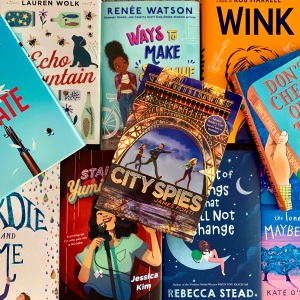 I have a confession. As our summer plans are being ripped away from us—slowly, painfully, like the stickiest of band-aids—I am secretly stockpiling books and puzzles. It’s compulsive. Possibly certifiable. But I can’t help it. In some tiny, naively optimistic part of my brain, I believe if we have stockpiles of books and puzzles, we won’t wake every morning and cry over missed swim meets and sleepaway camps and beach vacations. Even if it’s sweltering. Even if we can’t leave the house. Oh, who am I kidding? We’ll still cry. But at least we’ll have books and puzzles.
It seems I might not be alone. I ran a survey yesterday on Instagram and 85% of you voted for my gargantuan list of favorite new middle-grade books to come out now, as opposed to after Memorial Day. So maybe you’re getting ready, too. And it is a gargantuan list. (A reminder that I recently covered new graphic novels here, as well as three chapter books which we read aloud but could easily be read independently.) Some skew younger and some much older, so I’ve listed age ranges below each title. Here’s the thing: I read a ton over the past six months, and these are what made the cut. There were others I expected to like or wanted to like, but they just didn’t feel like anything I could give a kid and say, with confidence, You’re going to love this. You’re going to forget, for a few minutes, that the world is all kinds of suckiness right now.
But here’s the other thing. I’m not going anywhere, and I’m still reading. Like crazy. So keep tuning in. (You can always track what the kids and I are reading in real time on Instagram.) Summer is coming, and we’ll get through it together. With a little help from the books (and puzzles).
A Light in the Dark: Three New Read-Aloud Chapter Books
May 14, 2020 § 3 Comments
 It has been said that the only two certainties in life are death and taxes, but—at least, while quarantined—I can now add a third. Every morning for the past two months, the same conversation has transpired as soon as the breakfast dishes are cleared, around 8:15am.
Me: “OK, kids, head to the couch for read-aloud time.”
My son: “What? No! I need to get upstairs to get ready for school!” (“Getting ready for school” means opening up his Chromebook, clicking on a Zoom link, and waiting for the administrator to let him into the meeting…45 minutes before said meeting actually starts.)
Me: “Your class doesn’t start until 9am.”
Him: “But sometimes they come on early!”
Me: “You don’t need to stare at a screen any more than is necessary. Park your tush next to your sister.”
Every morning, we have this same exchange. Every single morning. For the record, I always win. I only insist on one tiny little fragment of consistency during corna-time and it’s that the kids and I spend forty minutes every morning reading aloud. It’s how we connect before dispersing into our own “virtual” agendas. It’s how we remind ourselves that the world still exists outside our doors, that it waits patiently for us to return, that it invites us to visit in our imaginations until we can come in person. It’s how we remind ourselves that we don’t have to leave the house to get our minds blown.
Quite simply, reading aloud is the one light in these dark days that we can always count on.
As soon as my fidgety, eager-for-that-screen-fix tween sits down on that couch and tunes into my voice, he doesn’t want to be anywhere else. I know this because he gasps the loudest, laughs the hardest, leans in the closest. Reading aloud to tweens and teens can initially seem like an uphill battle, but it’s almost always worth the struggle. In our family, it’s non-negotiable. And it always, always leaves them begging for more…even if just a few minutes earlier they were all too happy to skip it.
In the upcoming weeks, I’ll be doing a gargantuan middle-grade round up with favorite new books to put in front of your kiddos for independent reading. Today, though, I want to share three new middle-grade novels which lend themselves especially well to reading aloud, as evidenced by our own experience. Their genres—fantasy, comedy, and historical fiction—couldn’t be more different, but their characters, prose, and stories are similarly unforgettable.
Attention Deficit Corona: Graphic Novels for Tweens and Teens
April 30, 2020 § 1 Comment
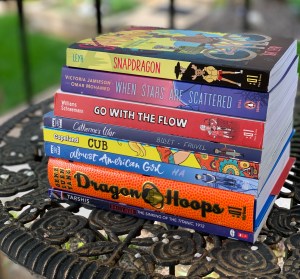 Of all the complaints I’ve heard during Quarantine, one of the most common is an inability to focus. If your former bookworms are having trouble losing themselves in literature (hey, Zoom zombification is real), look no further than these new graphic novels. Take it from me.
We moved last week. Moving is challenging in the best of times much less during a pandemic. So, you can bet I threw a bunch of graphic novels at my kids, and you can bet they were more than happy to stay out of everyone’s way. And the best news? You already know that graphic novels are the type of books your kids like to read again and again, so you can feel good about investing in them and supporting your local Indie bookstore at the same time.
Truly, 2020 is shaping up to be a STELLAR year for graphic novels. This list builds from young to older, with selections all the way up to high schoolers. (If you’re new to my site, you might check out my last graphic novel round-up here.)
Bees: To Fear or Not to Fear
April 2, 2020 § 2 Comments
 Remember last week when I talked about returning our children to nature during this pandemic vis-á-vis secret gardens and long hikes in the woods? Well, there’s just one teeny tiny problem. While we were hiking a few days ago, my son spotted a bee.
Let me back up.
When JP was almost three, during a family reunion in rural Rhode Island, he climbed a ladder to reach an aged treehouse and stood up into a nest of wasps. He was stung twenty-seven times. I know this because the pediatrician, whom I panic dialed, asked me to count the stings. JP was just shy of the number where the poison level would have necessitated getting into the car and trying to find a hospital. Instead, we sat him on the second step of my uncle’s swimming pool, where, immersed in cold water, the screams and swelling eventually subsided.
Perhaps owing to this traumatic event or perhaps just because of the way he’s wired, JP has moved through the past nine years immensely fearful of stinging insects. His fear doesn’t differentiate between wasps and bees. He has read countless books on the subject; he has taken field trips to bee farms; he can rattle off the statistical improbabilities of being stung. No matter. If he hears buzzing, his body goes rigid; if he spots a bee, he flails and shrieks and spends the rest of his outdoor time willing it to be over. He is a hostage to this fear. While I know that with enough exposure and time, he will someday share the outdoors more easily with these creatures, I also know that right now, even more than being afraid of them, he is afraid he will never stop being afraid.
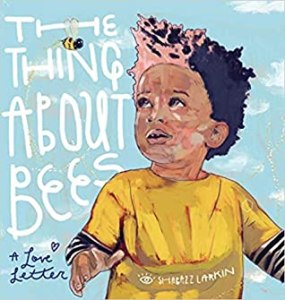
If I could go back in time, short of stopping JP from climbing that ladder, I would take this 2019 picture book with me. It’s what I wish I had read to him in the wake of the wasp event. It’s what I wish I had read to him a hundred times since. In The Thing About Bees: A Love Letter (Ages 3-7), author-illustrator Shabazz Larkin shares his steadfast love for his two young sons alongside an evolving love for bees (not to be confused with wasps), the great pollinators of everyone’s favorite fruits and vegetables. It’s a refreshingly original treatment of a popular subject—why bees matter—because it acknowledges front and center that bees are not easy to love. Indeed, this deeply personal book grew out of the author’s desire not to pass on his own fear of bees to his children. (Quick shout out to Capitol Choices, the children’s literary group of which I’m a part and where I learned of this book last year. Find other treasures on our 2020 list, published here.)
Moving the Classroom to the Woods
March 27, 2020 § 2 Comments
 (Friends, these are rough times. I feel you all. And I promise to keep showing up for you with book ideas for all ages. In addition to these weekly posts, I have (almost) daily recommendations on Instagram, so follow me there. We’ll get through this pandemic with the help of fictional worlds and gripping history and funny comics. Worst comes to worst, we can always use the pages to wipe our bottoms.)
It was only the second morning of #pandemicparenting, and the kids and I were already on the verge of strangling one another. My husband needed a quiet house for conference calls, so I threw out our daily schedule (just one day old) and drove the kids to the woods…where we stayed for four hours. It was cold and drizzly when we arrived, and I found myself willing it to be over. We walked and walked, saw no one, walked some more, and eventually settled into our own rhythms. My daughter ran off trail to climb on logs and rocks. My son stopped talking about his stress level and moved through the world quietly. We got lost, had to scramble up rocky ledges to find the trail again, discovered deserted outcroppings of beaches. The sun came out. I sat and listened to the water, while the kids skipped stones. Later, my son threw his arms around a tree, and I laughed out loud.
We’ve had our fair share of highs and lows these first two weeks of social distancing, but I am endlessly grateful that the trees still welcome our closeness. If there are silver linings amidst this collective heartbreak, one is an opportunity to return our children to nature. I never wanted to homeschool my kids; I knew I’d be rubbish at it. (I knew my kids would be equally rubbish at it.) Thankfully, they still have their wonderful teachers, even if they can only see them on a screen right now. I figure, for as long as we’re packed in together like sardines, I can give my kids two blessings: I can read them books; and I can gently push them towards the trees.
You know what social distancing is good for? Secret gardens. If your children need convincing to let nature step in as teacher, read them the extraordinary new picture book biography, The Secret Garden of George Washington Carver (Ages 7-10). My kids were riveted. Evocatively written by Gene Barretta and accented with richly expressive oil paintings by Frank Morrison, the story demonstrates how young George Washington Carver’s intimate relationship with nature as a child grew into a passionate career as a botanist, inventor, and activist.
Concluding Black History Month on the Train
February 27, 2020 Comments Off on Concluding Black History Month on the Train
 Every year, once in the fall and once in the spring, I take each of my children on a mommy-and-me trip to New York City for a long weekend in the city where I grew up. We board the train in Alexandria, Virginia and make stops in Washington, D.C.; Baltimore, Maryland; Newark, Delaware; Philadelphia, Pennsylvania; and, finally, New York City, Penn Station. My kids have come to enjoy the train ride almost as much as the destination itself, glancing up from their books to watch the changing scenery speeding by—there is something innately lolling and contemplative about train travel—and anticipating the stops to come.
These same train stops come to life against an important and fascinating historical backdrop in Overground Railroad (Ages 4-9), a new picture book by superstar husband-and-wife team Lesa Cline-Ransome and James Ransome, whose Before She Was Harriet I praised around this same time last year. “Isn’t it supposed to be “Underground Railroad?” my daughter asked, when I picked up the book to read it to her. Admittedly, I was equally stumped. As the Author’s Note explains, most people are familiar with the covert network known as the Underground Railroad, which assisted runaway slaves on their journey to the North, usually on foot. Lesser known but often equally secretive, the Overground Railroad refers to the train and bus routes traveled by millions of black Americans during the Great Migration, a time when former slaves opted to free themselves from the limitations and injustices of sharecropping to seek out better employment and educational opportunities in the North. Faced with the threat of violence from the owners of these tenant farms, who relied on the exploitation of sharecroppers for their livelihood, those who escaped often had to do so under cover of night.
Never Too Old to Learn
January 30, 2020 § 6 Comments
 Last week, I flew to Boston to see my 101-year-old grandmother for what will likely be the last time. Her lucidity came and went throughout our few hours together, and at times she seemed to look at me and see a much younger version of her granddaughter. “What are your studying in school?” she asked.
“I’m not in school anymore,” I answered. “I’m all grown up! I have kids in school now.”
“That’s no excuse!” she exclaimed, in a playful but insistent tone I recognized all too well.
Perhaps she was simply covering up her mistake. But perhaps not. My paternal grandmother may have attended college for only two years, but she spent much of her adult and geriatric life chasing down knowledge wherever she could. She read biographies voraciously. She traveled the world. She referred to herself as a “news junkie” when you came upon her studying a newspaper. When she moved into her retirement home at 88, she signed up for every class they offered, from Buddhism to World War Two. “I’m taking a fascinating class about the decision to drop the atomic bomb,” she reported on the phone one day. “It has me quite disturbed, actually.”
On another call: “I’m reading E.O. Wilson’s new book. He’s an absolutely brilliant biologist. I’m not sure I’m understanding a word of it, but I suppose some of it might be sneaking in!”
Learning as something to be seized and cherished is a value I will always credit to my grandmother. Still, learning is a luxury not afforded to all, and nowhere is this more painfully evident than in the stories of American slaves. Rita Lorraine Hubbard’s new picture book biography, The Oldest Student: How Mary Walker Learned to Read (Ages 6-10), movingly illustrated by collage artist Oge Mora, tells the incredible true story of a former slave who achieved her lifelong dream of learning to read at the astounding age of 116.
2019 Gift Guide: Middle-Grade Fiction for Ages 8-14
December 15, 2019 § 2 Comments
 The category of middle-grade fiction is rapidly broadening. On the one side are novels accessible to 8-12 year olds, while on the other are heavier, more mature stories aimed at the 10-14 crowd. As always, I’ve indicated age ranges after each title. Those with kids on the older end: don’t be in a hurry to move your kids to young-adult fiction. There’s still plenty of richness for the taking here.
The first five novels are new to this bog; the others are ones I’ve reviewed earlier in the year but couldn’t resist repeating, because they have mad gift potential. Or maybe it’s just that I’m madly in love with all of them. 2019: what a year. (And I can’t wait to see you in 2020. This wraps my Gift Guide, and I wish all of you a very Happy Holidays.)
2019 Gift Guide: Graphic Novels to Rock Their World (Ages 8-16)
December 11, 2019 § 1 Comment
 It’s what I hear most often from parents: “I can’t get my kid to read anything but graphic novels.” The assumption is one of concern: perhaps said kiddo is dabbling in literature less worthy than the meaty prose novels many of us devoured in our own childhoods. The question of whether to purchase graphic novels also stumps parents: is it worth buying books our kids will tear through so quickly? After all, a graphic novel that takes an entire year to create can often be finished by an avid young reader in a single sitting.
AND YET. I would argue that graphic novels are some of the greatest (material) gifts we can bestow on our children. Today’s kids are growing up in a more visual culture than we ever did. Couple that with the exploding innovation coming out of the comics market right now, and is it any wonder these books are so alluring to young readers? I’ve watched my own children fall in love with reading through these books. I’ve watched them return to favorite comics in times of stress or change. I’ve watched them bend over graphic novels in the backseat during carpool, with friends on either side leaning in.
Good graphic novels are clever and layered and poignant and often shockingly beautiful. Their vocabulary is rich. To read them is never a passive experience; rather, kids need to work to extract the complete narrative, to find the innuendos and deeper meanings hidden in the cross-section between picture and text. Herein lies the best case for owning graphic novels: the reason your kids return to them again and again isn’t just because they enjoy them; it’s because they get more out of every reading.
Best of all, today’s graphic novels are tackling a range of subjects and genres, including science, history, biography, and immensely valuable socio-emotional learning. 2019 was a banner year for graphic novels. Below are some of the stand-outs (including what my own kids are getting for the holidays!).
2019 Gift Guide: For The Littlest Ones
December 3, 2019 § 2 Comments
 The three and under set doesn’t get a lot of love on the blog these days, probably because my own kids are aging so darn quickly. But that’s no excuse. These early years are where we plant the seeds in our children for a love of stories. Plus, if you’re anything like me, these early years are when books sometimes feel like our only lifeline to sanity: no matter how much we’ve been spit up on or yelled at, falling under the spell of a story alongside our little one makes us feel like all is right with the world. If you do have a toddler, be sure to follow me on Instagram; that’s where I first reviewed many of these and where you’ll see more.
2019 Gift Guide: Picture Books for Ages 3-7
December 1, 2019 Comments Off on 2019 Gift Guide: Picture Books for Ages 3-7
 Today is part recap, part intro. To kick off the picture book portion of my Gift Guide, I’ve already told you about my mad love for Home in the Woods and Pokko and the Drum. Earlier in the year in these pages, I sang the praises of Crab Cake, Lubna and Pebble, I am Hermes!, Camp Tiger, A Stone Sat Still, The Scarecrow, and Who Wet My Pants?—all of which would also make fantastic holiday gifts. But if you haven’t kept up with my reviews on Instagram all year long, I thought it was high time I shared some of them here. Because one or two (or all) of these might be perfect for someone on your list.
Fall is Looking Good: Middle-Grade Round Up
November 7, 2019 Comments Off on Fall is Looking Good: Middle-Grade Round Up
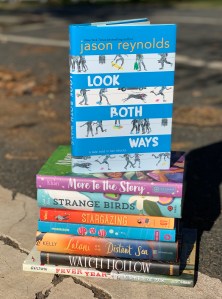 Of the dozens of middle-grade books I’ve read so far this fall (and I see no reason to stop anytime soon), here are the ones that have risen to the top. All except one I’ve featured on Instagram in recent weeks, but it seemed like a good time to round them up here. Publishers often save their best titles for fall, and this fall is proving pretty spectacular. May your children take advantage of the dwindling daylight to curl up with one of these gems. Perhaps they’ll find their people. Perhaps they’ll re-frame what it means to be an American. Perhaps they’ll even get closer to answering the question on the back of Jason Reynolds’ newest contribution to the tween psyche: How you gon’ change the world?
(Oh, and should you need something for yourself or your older teen, you’ll just have to get on the ‘gram to see this review. It’s only my favorite read of the fall.)
Mindfulness: Start ‘Em Young
October 17, 2019 § 2 Comments
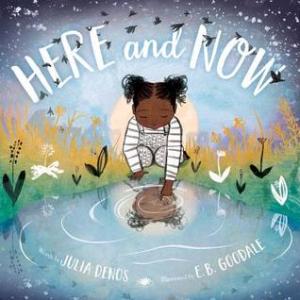 “A well-known teacher was asked to describe the modern world. He answered: Lost in thought.” I’m currently taking a 30-day online mindfulness course from Jack Kornfield and Tara Brach—a series of short guided meditations—and this was how the third session began. Lost in thought: a modern epidemic. I’ve thought about this observation multiple times since, always with sadness and identification. How much of my daily life is spent worrying, planning, remembering, regretting, being somewhere other than where I am?
When we’re lost in thought, Kornfield notes, we’re missing out on what’s in front of us, perhaps on the very parts of life we cherish most. He quotes from the great poet Khalil Gibran: “…and forget not that the earth delights to feel your bare feet and the winds long to play with your hair.”
This is my third attempt in the last eighteen months at developing a regular mindfulness practice. I’ve never lasted more than ten consecutive days. This month has been a mixed bag, too. October has thrown me a number of curve balls, and the pull to become lost in thought—mourning, stewing, deliberating—often eschews the discipline of sitting for a guided meditation.
I want to be better at this. To be more present in my senses, to more fully embrace the adventure of life. To feel the warm sun on the back of my neck, the hard earth beneath my feet. To smell the crispness in the air. To notice my daughter singing in the bathroom.
I want to be better at this for my kids. The ones watching me model being lost in thought as if my life depends on it. When my son experiences an emotion, I wish for him to notice how it manifests in his body, instead of ruminating on it or wishing it away. When my daughter walks home from her violin lesson, I wish for her to notice the shifting beauty around her, even while she plans which games she’s going to play with her waiting friend.
Author Julia Denos has teamed up with illustrator E.B. Goodale to produce another beautiful picture book (I regret not making time on this blog for their first, Windows) which is itself a kind of guided meditation for kids. Here and Now (Ages 4-8) gently and effectively brings children’s attention to the present moment. It grounds the reader in her own bodily sensations, while also connecting her to the wider world. It prompts parent and child alike to think about what might happen if we turn towards, instead of away from, the present moment, with all its beauty and mystery and wonder.
“The Bravest Thing a Person Can Do”: Three Immigrant Stories
July 12, 2019 Comments Off on “The Bravest Thing a Person Can Do”: Three Immigrant Stories
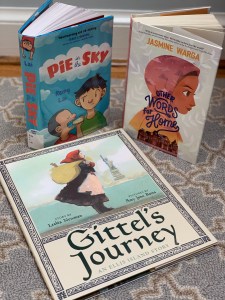
These provocative words hail from Jasmine Warga’s Other Words from Home, one of three new books with a unique, powerful presentation of the immigrant experience for a different age group. Whether set in the past or present, these stories have never been more relevant to share with our children. If our kids are someday to have a hand in the creation of fair, just, compassionate policy, they should spend some time in the shoes of the very people whose lives these policies aim to impact.
What does it mean to arrive in this country with hope in your heart? What does it mean to walk away from family, from the familiar, from foods you’ve eaten all your life, and step into the Unknown? Each of the below books explores these questions, while posing another of its own.
« Read the rest of this entry »Summer Reading Beckons (Middle-Grade Round Up)
May 24, 2019 Comments Off on Summer Reading Beckons (Middle-Grade Round Up)

As I’m limping over the finish line that is May, I’m dreaming of summer. Of days at the pool, nights in the backyard, and lots of opportunities for lazing around with our noses in a book. Should you (or your children) be itching for a distraction from making lunches or dressing for another concert, let me help you plot a summer reading list, beginning with my favorite middle-grade reads of late. (Link to my last round up is here; or go back and check out this and this.) First up is a book which should go straight to the top of your list: it’s fresh, funny, and eerily timely.
« Read the rest of this entry »In the Eye of the Beholder
April 11, 2019 Comments Off on In the Eye of the Beholder
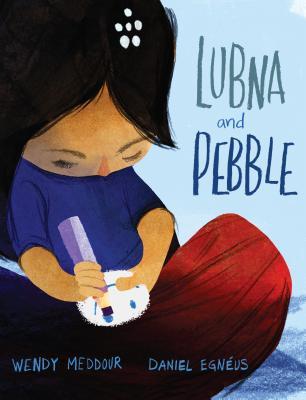
One of the superpowers young children possess is the ability to transfer human qualities onto inanimate objects. My Emily might be eight years old—well versed in the impossibility of stuffed animals coming to life—but she still likes to tell me about the skydiving adventures her plush lamb has at home while she’s off at school (apparently in cohorts with my stuffed bear). When I tuck her in at night, it’s not uncommon for Emily to inform me that Baba will be keeping watch for bad dreams. Whenever her pride is bruised or her tears are flowing, Emily predictably runs to her room, snatches up Baba, and presses the soft frayed body to her cheek. (Baba has also been known to “peck at” prime offenders, otherwise known as Older Brothers.)
It’s remarkable, this ability of children to draw entertainment, companionship, and comfort from non-living things. It certainly plays a part in why children are naturally resilient, even or especially when the humans around them fall short. After all, an object can be whatever a child wants or needs it to be. It can be a kind of “stand in,” or a bridge to a time when that child might reliably find that entertainment, companionship, or comfort in another living being.
Lubna and Pebble (Ages 4-8), an impossibly gorgeous and profoundly moving new picture book about the refugee experience, takes at its center the conceit of a young girl’s redemptive friendship with a pebble, which she finds on the momentous night she arrives with her father at the “World of Tents.”
« Read the rest of this entry »Middle-Grade Round Up (Or What I’ve Been Doing on Instagram)
April 4, 2019 § 3 Comments

I’ve been feeling a teensy bit guilty that those of you not on Instagram are missing out on all the mini reviews I’ve been doing over there, particularly of middle-grade books. These books are too good to miss! So, I’ve decided to do occasional “round-up” posts to catch you up. Several of these titles are brand-spanking new; the rest are new within the past year.
« Read the rest of this entry » What to Read to Your Kids