2024 Gift Guide: The Picture Books
November 23, 2024 Comments Off on 2024 Gift Guide: The Picture Books

This year’s Gift Guide continues with twelve favorite picture books of the late summer and fall. I think this might be the best collection of picture books I’ve ever put on a Gift Guide: every single one is a book I would have happily bought for my own kids and never tired of reading (on repeat!). Many a night I lay in bed turning picture book titles over in my head to land on just the right combination. And I love where I landed. I really, really love these quirky, imaginative, beautiful, memorable books that enfold the listener in the magic and merriment of storytelling. (Spoiler alert: even when they smell like vomit.)
I wish you luck making the hard choices, because there are so many good options. As always, links will take you to Old Town Books, where I take great pride in curating the kids and teens collection, and I hope you will consider supporting us.
And PSST, if you’ve got a kiddo who is starting to come out of picture books, don’t miss the last one on this list: it’s long-form, wonderfully inventive, and proves once again that the Brits are in a class of their own when it comes to children’s stories.
« Read the rest of this entry »Valentine’s Day: Self-Love Edition
February 8, 2024 Comments Off on Valentine’s Day: Self-Love Edition

In my opinion, Valentine’s Day greatly improved as a holiday when I started thinking of it as a chance to gift myself and my loves ones a new book (or three). Any great book will do, of course, but I do love something that approaches the idea of love in a clever, non-traditional way. Past favorites have included Viking in Love, All the Beating Hearts, and Brimsby’s Hats. (If you’re following me on Instagram, you’ll be getting a new recommendation every day between now and the 14th). But I think today’s picture book takes the (heart-shaped) cake for Most Unlikely Book to Gift for Valentine’s Day.
Pepper & Me is a story about a scab. You heard me. Well, more accurately, it’s a story about a girl who gets a scab from falling down—and then goes on to name that scab, talk to that scab, and befriend that scab. Is that weird? Yup, it’s super-duper weird. Does it also feel authentic, like could I picture my own children doing something like this when they were younger? Absolutely. (I mean, my son did warm to a restaurant straw wrapper that he kept on his bedside table for months.) Is it all kinds of delightful because the story is written and illustrated by the magnificent Italian storyteller, Beatrice Alemagna, the talent behind one of my forever favorites, On a Magical Do-Nothing Day? You better believe it.
All those points aside, what could Pepper & Me possibly have to do with Valentine’s Day? Well, here’s the thing. Initially, our protagonist is repulsed by this scab on her knee. “Hideous scab,” she calls it. She feels marred by its presence and fearful of its persistence. And yet, as the days go on, she turns her curiosity on the bloody aberration and, in doing so, begins to accept, even embrace, it as part of herself. Ultimately, what makes this story one of love is the way it showcases the girl’s emotional journey from resistance to re-framing. It may be the quirkiest expression of self-love to grace the pages of a picture book, but it’s a marvelous way to introduce the idea of what might happen if we learn to love all our parts, even the ugly ones.
« Read the rest of this entry »Back-to-School: Meltdown Edition
September 7, 2023 Comments Off on Back-to-School: Meltdown Edition

After sleeping on different beds, bunks, or floors for most of August, one of my kids was desperate to get back on a routine (barely holding it together, if we’re being honest) and the other would have gladly accepted an invitation to extend her Bohemian lifestyle. Still, regardless of age or temperament, one thing’s for sure: neither will be exempt from the back-to-school meltdowns. I’m talking complaints about the lunch they packed themselves (are we really still talking about mushy grapes?), falling to the floor when they’re reminded (again) to set the table, and accusations that nothing I say or do is right, especially if it relates to getting a good night’s sleep or finding a quiet space to do homework or daring to suggest they reconsider their jeans and hoodie since it’s 98 degrees. As I’m typing this, one is raging about the absence of graph paper and can I order it RIGHT NOW.
You might remember that in our house, thanks to Jory John and Lane Smith, we refer to these gripes as Penguin Problems.
The magical solution to back-to-school meltdowns? There is none, of course. We can delude ourselves that the perfect snack or perfectly-timed bath will stave off implosion, but we’re not fooling our kids. Short of a complete ban on speaking or making eye contact, about the only thing that approximates a balm for a back-to-school meltdown is to pull out a book…or two. Our children want us, but they do not want our questions about their day. Our children’s bodies are depleted, but they do not want suggestions for how to refuel. But nestling into our side (yes, even in 98 degrees) and listening to our voice, knowing they’re getting our full selves in that moment without any demands on them? That they can do. That’s the reset.
Usually. Sometimes.
And if those books can simultaneously validate that our children’s world has just been turned upside down, that instead of running around like feral beings they have to sit their bums in a chair and USE AN ACTUAL PENCIL, even better. Which is why, today, I’m showcasing two picture books with fantastic social-emotional content. One directly addresses school drop-off separation, while the other talks about the woes of nothing, not one single thing, going right across a school day. Both of them aren’t quick to offer fixes; rather, their power lies in the way they normalize and empathize, while also reassuring the listener that these feelings will pass.
As a bonus, both books are illustrated by one of my favorites, Hyewon Yum, whose whimsical, warm-toned pencil drawings never fail to bring a smile to my face, even (and especially) as she nails the different stages of a meltdown.
How does that saying go? If you can’t beat ‘em, you might as well laugh at ‘em? (Something like that.)
« Read the rest of this entry »Back to School: One for Laughs, One for Tears
August 3, 2023 Comments Off on Back to School: One for Laughs, One for Tears

Whether you’re (maniacally) laughing or (despondently) crying at the prospect of sending your kids back to school depends entirely on their ages—at least, in my experience. As my kids have gotten older and (a bit?) better at handling unstructured days—actually in need of unstructured time after nine months of homework—I’ve cherished our summers together more and more. There was a time when I couldn’t wait to drop off my kids for their first day of school and run home to an empty house. These days, I find myself poignantly aware that our years of summering together are running out, and my heart feels more heavy than light when September rolls around. (Full disclosure: my kids are currently at sleepaway camp for two weeks, so ask me later this month, after we’ve road-tripped home from Maine with three stops to visit with family, because I might be kicking them to the schoolyard.)
Whether back-to-school season feels like friend or foe, I can at least promise you some good prep reading. I’m focusing today on two especially unique releases, though I could easily have sung the praises of a variety of new titles (some of which I’ll feature on The Gram over the next few weeks and all of which are currently on display at Old Town Books), including Kaz Windness’s Bitsy Bat, School Star (for anyone who has ever felt boxed in by the “right” and “wrong” ways to do school, starring the cutest neurodivergent bat); Lucy Morris’ May’s Brave Day (a charming presentation of mustering courage on the first day of school and whose illustrations elicit classic feels); Becky Scharnhorst’s How to Get Your Octopus to School (if we’re going to fight about lunches and coats then we should at least get to laugh about it); Supriya Keller’s My Name (the newest in a line of important picture books about honoring classmates’ names); Liz Garton Scanlon’s The World’s Best Class Plant (guaranteed to help ease the disappoint when your kid learns that their classroom has neither pet rat nor pet rabbit); and, finally, Stephen Krensky’s I am Ready for School (the latest in a favorite board book series for wee ones starting preschool).
With today’s post, I’m choosing to focus on two completely different approaches to the back-to-school conversation. One is laugh-out-loud funny, because nothing cuts through the stress of change like humor, while the other is a somber, exquisite, and ultimately hopeful meditation on weathering the bittersweet loss of summer.
« Read the rest of this entry »A (Literal) Train of Thought
May 11, 2023 § 2 Comments
When I was almost ten, our family moved from a large, ramshackle house in the lush green suburbs of Milwaukee, Wisconsin, to the fifteenth floor of an apartment building in Manhattan, and I did not handle it well. My parents adored New York City—they had lived there before having kids and couldn’t wait to return—but all I saw was no backyard, a shared bedroom with my younger sister, and more people and noise in a single day than I’d known in the decade I’d been alive. In a memory that still makes me cringe—though I was a deeply feeling child I prided myself on my poise—I pitched a fit in front of our realtor, yelling to my parents about how dirty and smelly and noisy the city’s streets were, while we rode an elevator to another prospective apartment, from which the sounds of car horns and ambulance sirens and buses pulling away from the curb would only be slightly dampened.
Kids generally underestimate their ability to adapt, and I quickly grew to love the city. But I never entirely shed the feeling that I was an outdoor kid living in an indoor city, and I sought out changes of scenery whenever I could. Sometimes, the escape was literal, like the summers I spent at sleepaway camp in Vermont. Mostly, I escaped through books—or through my imagination, spurred on by the stories I read. A handful of tap water before bed was the icy, life-saving stream water from My Side of the Mountain. The six-block concrete walk to school was an enchanted yellow-brick road, visible only when I looked down at my quickly advancing feet. I was a dreamy child, something I’ve never been sorry about passing along to my daughter, even when her liberal interpretations of reality have been known to try my patience.
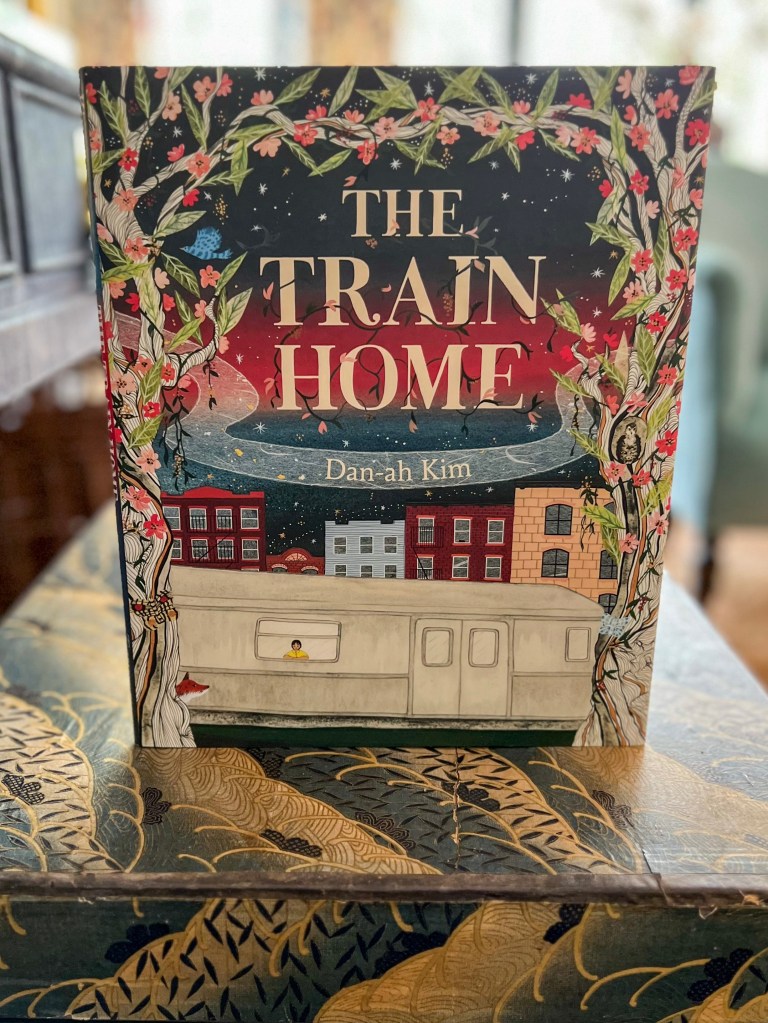
With it being Asian American Pacific Islander Heritage Month, the timing seems perfect to share one of the most beautiful picture books of the year, as it is both written and illustrated by Dan-ah Kim, born in Seoul, South Korea and now living in Brooklyn, New York. I dare you not to gasp aloud as you page through these glorious spreads. But I don’t only adore the book for its artwork. Its story speaks directly to that child I once was, the one who never kicked and screamed in an elevator again but definitely felt like it, even as she found love and belonging and wonder in city life. That the book is inspired by real subway stops in New York City doesn’t hurt, either, though its message of creativity and imagination is undoubtedly universal.
The Train Home (ages 4-8) is an inventive story about a girl who conjures up a train for a magical journey away from the noisy reality of her city apartment. Along the way, amidst the alluring, refreshing, fantastical scenery of her imagination, she surprises herself by yearning for the home she has left behind. Ultimately, like the dichotomy that exists in the art—some spreads fancifully populated, others pared way back—the story is a reassuring validation that the desire to escape and the desire to return home are never mutually exclusive. Rather, they exist in a tug-of-war dance alongside our own journeys of growing up.
« Read the rest of this entry »The Seed That Keeps On Giving
February 23, 2023 Comments Off on The Seed That Keeps On Giving
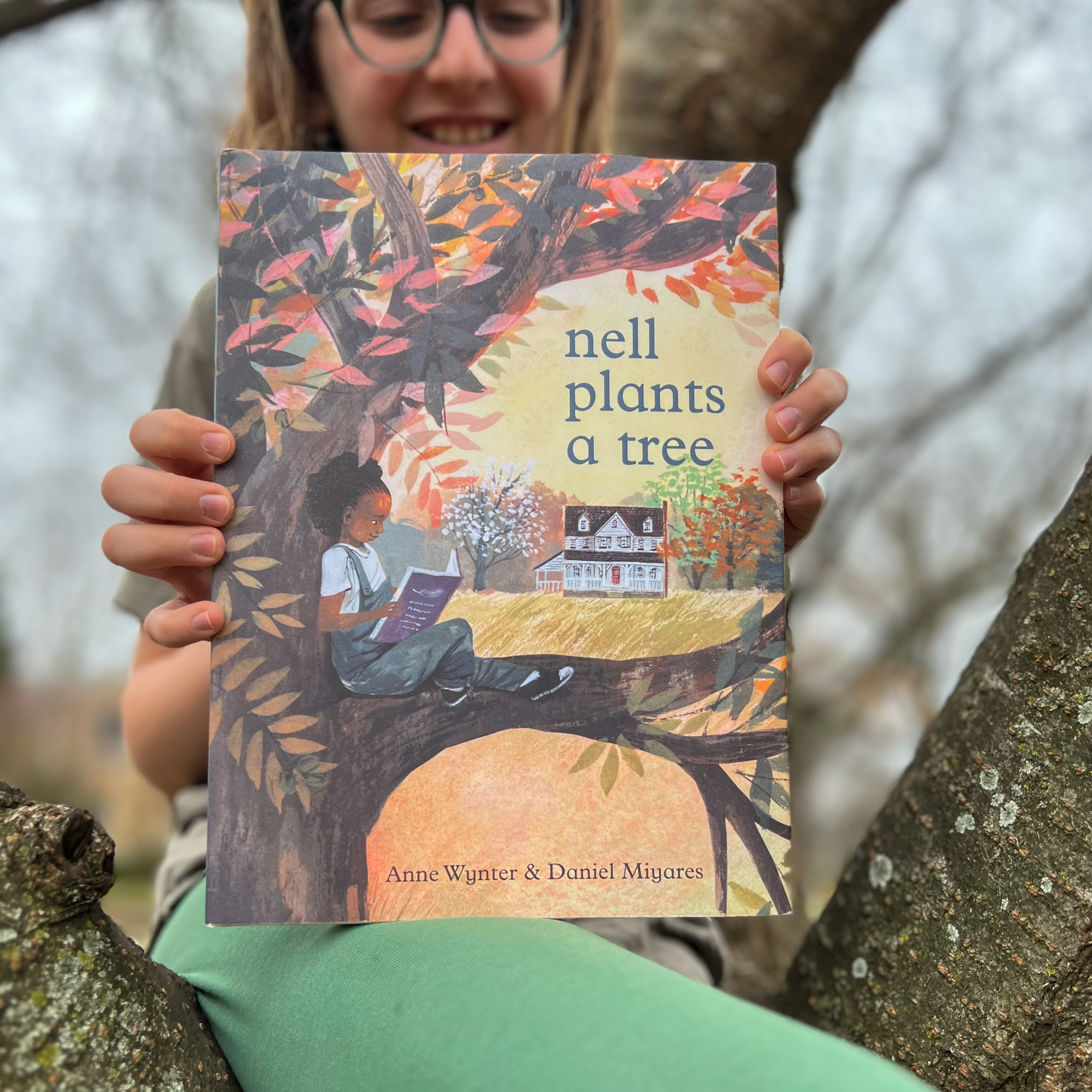
We may have just wrapped up Awards season (if you need a recap on the 2023 Caldecott & Newbery winners, check out my Instagram reel), but it’s never too early to speculate on next year’s winners. If we’re placing bets, my money is on one new picture book in particular, a story so lyrically crafted and gorgeously illustrated that I think it could be a contender for both a Newbery (words) and a Caldecott (illustration). Only time will tell, but the good news is you don’t have to wait until next January’s announcements to begin reaping the rewards of this one. Its depiction of Black Joy makes it perfect for Black History Month. Its emphasis on planting makes it perfect for spring. Its poetic text would be a terrific asset to National Poetry Month. But its child-centric joy will ensure little ones request it all year long—is there a child who hasn’t heeded the call to climb a tree?—and it’s one you’ll never tire of reading for its simple but profound beauty.
If we’re talking awards, it’s also a perfect book. Nary a superfluous word. Nary a picture that doesn’t expand on those words.
And, yes, if you’ve been hanging around for some time, you know I CANNOT RESIST A TREE STORY. (Past examples here, here, here…) My children might disagree, but I don’t think it’s solely a symptom of middle age that I notice trees (and birds, flowers, and strange beetles) more than ever. I think it’s also owing to the wealth of contemporary picture books on the subject! I’m quite certain we didn’t have the literature about the natural world that kids do today. And while we were content with Frog and Toad and magical wardrobes, I can’t help but think we were missing out on stories intended to invite reflection about the very life outside our window. Maybe that’s why, as a parent, I’m especially attracted to sharing these stories with my kids. I have as much to gain as they do.
Nell Plants a Tree (ages 4-8), written by Anne Wynter and illustrated by Daniel Miyares, is a fresh twist on the trees-are-great trope. Inspired by Wynter’s Texas childhood and Miyares’ weekly visits to his grandmother in rural South Carolina, the book explores the plentiful gifts a tree bestows on the generations lucky enough to grow up in its shade—particularly the children, who climb it, read beneath it, and play games around it. It’s a look at how the simple, child-friendly act of planting a tree can impact the world for years to come. It’s a book that invites marveling at the trees in our own backyards and parks, as much as it reminds us that the natural world is ever-changing, that the marks we leave on it today can shape our loved ones tomorrow.
« Read the rest of this entry »A Balm for the Soul (& a Perfect Valentine)
February 9, 2023 § 2 Comments

At a time when we’re normally asked to assume New Resolutions in the name of Self-Improvement, I actually began 2023 by stumbling onto some news that took the pressure off. Want to join me in shedding unnecessary guilt? Read on, good book people!
In January, The Today Show ran a news piece on their website, authored by Sarah Lemire, with “10 Surprising Psychological and Physical Perks Associated with Reading.” Most of them weren’t news to me—I’d previously read, for example, the 2016 study about recreational reading lowering mortality rates by as much as 20% (heck, yeah!)—but one of the perks had me doing a double take. According to a 2009 study, 30 minutes of reading has the same ability to decrease stress as 30 minutes of yoga. The article discusses the link between reading and wellness by quoting from a licensed psychotherapist:
“Reading has been connected to meditation in terms of the way our brain processes our environment and our physiological state,” Zoe Shaw, Psy.D., licensed psychotherapist and author of “A Year of Self-Care: Daily Practices and Inspiration for Caring for Yourself,” tells TODAY.com.
“If you’re sitting in a chair or laying in your bed and you’re focusing on reading, your body can actually go into a type of meditative state,” Shaw says. “So, you can get some of the benefits of meditating by reading.”
DO YOU REALIZE WHAT THIS MEANS? I can let go the burden of traditional meditation! Yes, I know meditation offers a myriad of benefits guaranteed to alleviate stress, but I really, really don’t like it. I hate it! (There, I said it.) Time and again, I’ve proven to be terrible at it, and my failure only creates more of the thing I’m supposed to be driving away! (I chronicled some of this here, because occasionally I get inspired to try again. At least, with the help of kids’ books.) While I have successfully adopted some mindfulness strategies—a few times a day I bring my attention to my breath—I cannot embrace the discipline that comes from true, sit-in-a-chair meditation.
Praise the literary gods, because it turns out that if I adopt the discipline of reading for at least thirty minutes a day—which I already do!—then it’s akin(ish) to meditation. It turns out I’ve been practicing meditation all along! I finished that article and I felt like throwing myself a party.
We all need the gratification that comes from being told, early and often, that we are already enough.
Enter Julie Fogliano’s thoughtful new picture book, all the beating hearts (ages 4-8), sublimely illustrated by Cátia Chien. It’s a book that echoes the message that we’re enough just as we are. It’s a poem that reads like a balm for our soul. It has nothing in common with Valentine’s Day other than a beating hearts message, but I’m all for using Valentine’s Day as an excuse to collect books that remind us of our connection to one another.
With her lyrical poetry at once grounded in detail and abstract in ideas, Julie Fogliano excels at authoring books that are about everything and nothing at the same time—my favorite kind of books, if I’m being honest. (I guess it’s no surprise that these are favorites, because Julie Fogliano’s work has made frequent appearances on this blog, including here, here, here, and here, that last being the second post I ever wrote! If you follow me on Instagram, you might have caught yesterday’s post about another new Fogliano title that would also be perfect for Valentine’s Day. So, yes, Team Fogliano.)
I’m also a card-carrying fan of Cátia Chien, originally from Brazil, whose art made Matthew Burgess’ picture book, The Bear and the Moon, my 2020 pick for Favorite Picture Book of the Year. In the case of all the beating hearts, her impressionistic pastel and colored pencil artwork, which often distorts form in ways that tug at our imagination, feels like a perfect fit for Julia Fogliano’s open-ended text.
One of the reasons I’ve always tried to uphold the daily practice of reading aloud to my kids is because it’s one of the few moments across the course of the day where I’m completely immersed in what I’m doing. The chatter in my brain quiets, and I can direct my attention to the task at hand—not just the words or pictures on the page, but the experience of sharing them with my children. I feel their energy alongside mine. It’s a moment of grounding. A moment of inspiration, joy, levity, or contemplation, depending on what I need it to be. Now, I can add meditation to the list.
In all the beating hearts, Fogliano and Chien invite us to reflect on our collective presence, the way we’re co-existing with every rotation of our planet in a way that’s “together but apart/ the same but exactly different.” It’s not a new concept for a picture book, the idea of drawing comfort from the reminder that we are not alone. That there’s wonder to be found in the predictability of our everyday lives. That, as Anne of Green Gables reminds us, “Tomorrow is always fresh, with no mistakes in it yet.” But it’s done here with the full package, from the poignant lyricism to the jewel-toned illustrations to the extra-large trim size. And it’s one parents will relish reading, because its message feels equally good to us.
Let’s take a look inside.
« Read the rest of this entry »2022 Gift Guide Addendum (Or, a Last Hurrah Before Hibernating)
December 15, 2022 Comments Off on 2022 Gift Guide Addendum (Or, a Last Hurrah Before Hibernating)
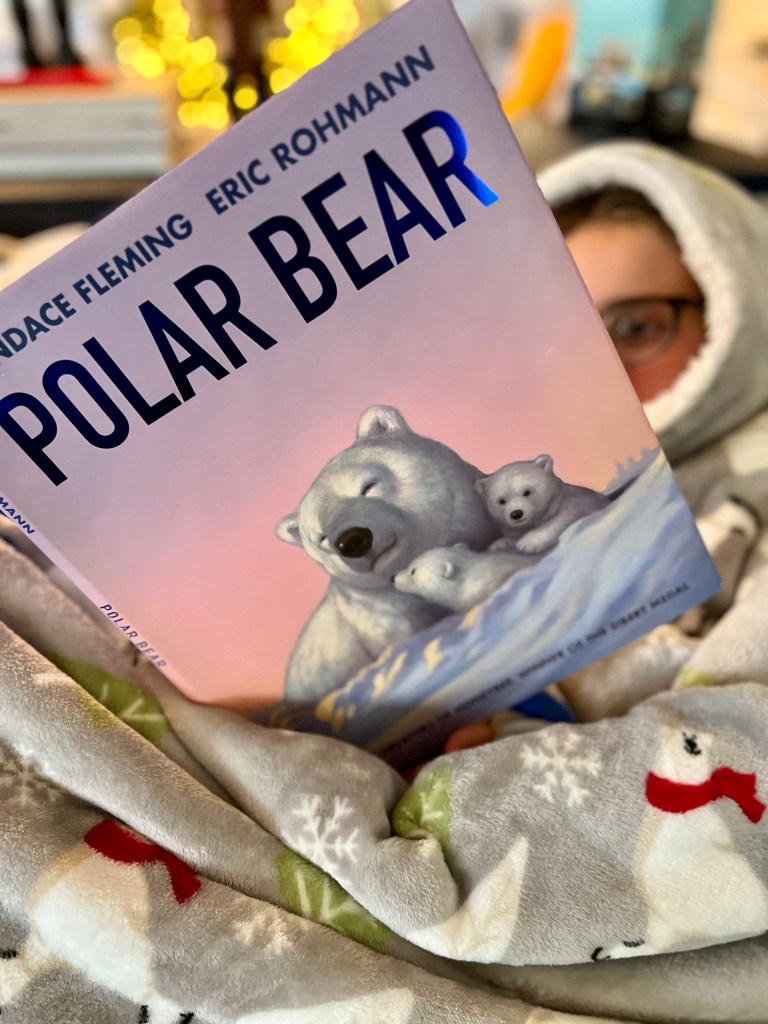
It’s my final blog post of 2022, and I’m closing out the year with a BANG! Today’s book was actually the first book I chose for this year’s Gift Guide, only I had to replace it when the publication date got pushed again and again…and again. For awhile there, it looked like it wasn’t going to come out in 2022 at all, but it’s finally here, and it’s very much worth the wait! So consider this your 2022 Gift Guide ADDENDUM.
I’ve previously established my kids’ obsession with polar bears, not to mention that we probably own every book published on the subject, fiction or non-fiction, so I won’t belabor that now. What I will tell you is that none of the polar bear books on our shelves—none of them!—hold a candle to this one. Candace Fleming and Eric Rohmann are no strangers to spectacular narrative non-fiction. Their 2020 title, Honeybee: The Busy Life of Apis Mellifera, meticulously researched and brilliantly executed, won the prestigious Sibert Medal for best informational picture book of the year (plus it was a 2020 Gift Guide pick!). But consider this: honeybees aren’t actually that cute; vital, of course, but not exactly a species you’d like to cuddle. So, imagine Fleming and Rohmann turning that same artistry onto the subject of polar bears—arguably the cutest (albeit deadliest) animals alive!—and you’ll understand why kids are going to swoon over this book.
It’s not just the stunning, oversized oil paintings on every page that make this the standout title of polar bear troves. (Seriously, though, can we talk about the gatefold in the middle of the story?!) Equal parts entertaining and educational, Polar Bear (ages 4-9) is read-aloud gold. The dramatic, lyrical text puts us front and center in an epic, year-long journey of survival. It’s a nail-biter of a odyssey, fueled by instinct and love and threatened by an ever-changing landscape, as a mother polar bear shepherds her two cubs across months and miles of obstacles to find the ice they desperately need to survive. (Rest assured: they all make it.)
« Read the rest of this entry »2022 Gift Guide: The Picture Books
November 10, 2022 Comments Off on 2022 Gift Guide: The Picture Books
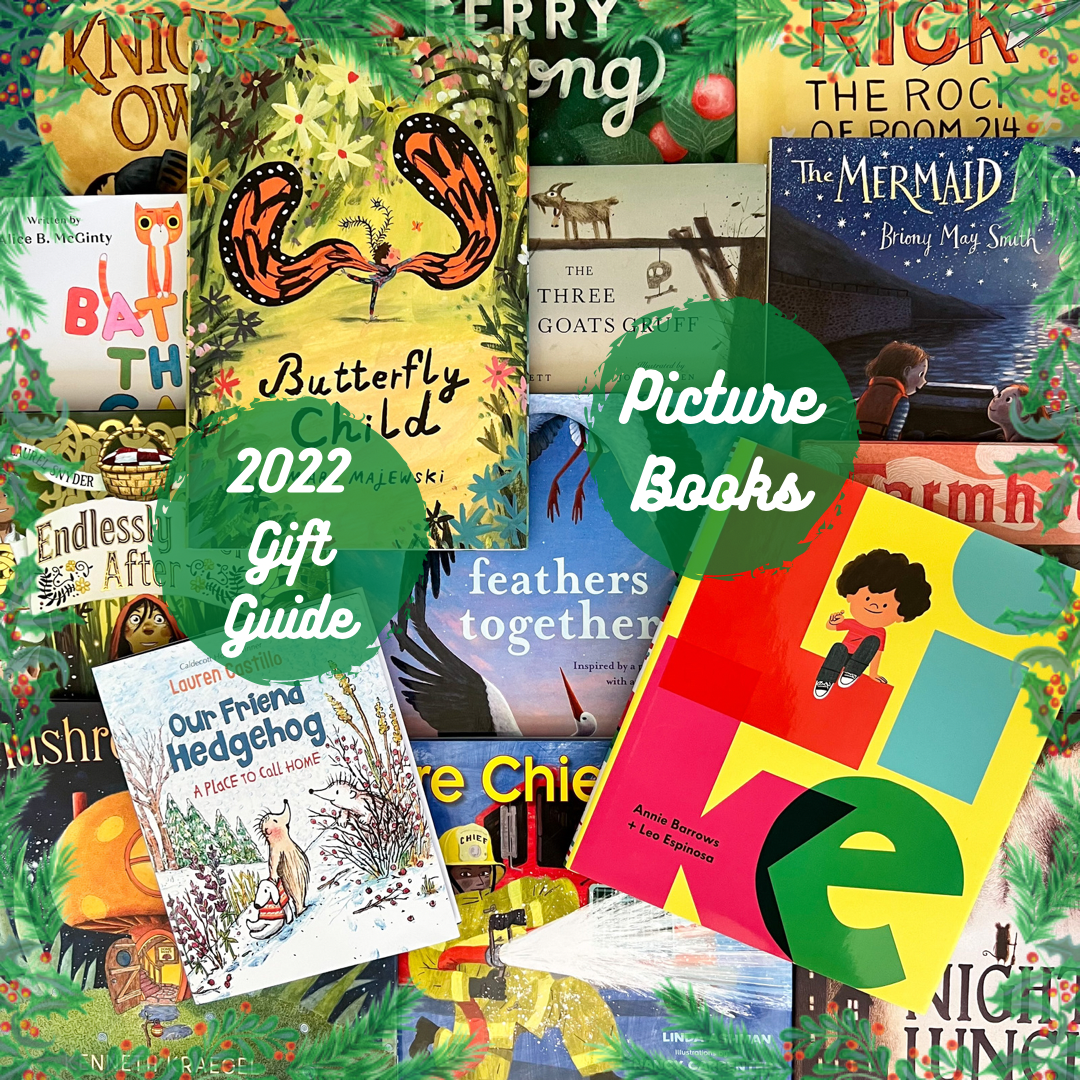
With so many spectacular stories, every year it gets harder to narrow down a list of picture books for my Gift Guide. I’ve weighted this year’s list towards fall releases, hoping to ensure that the titles will be new to you or your gift recipient. But I also made exceptions. There were a few books published in the first half of the year that stand the test of time, and I couldn’t imagine a 2022 favorites list without them (Bathe the Cat, Knight Owl, and Endlessly Ever After).
I’ve also concentrated on books that feel inherently gifty. These are books you could gift to almost any child, regardless of how well you know them, and be confident that they’d be charmed and you’d be heroic. If I was strictly making a “best of” list, I would have added titles like Blue: A History of the Color as Deep as the Sea and as Wide as the Sky.
If space and time permitted, I’d remind you of all the books I’ve already blogged about this year (because I only blog about books I love). As well as others I’ve highlighted on Instagram, like Mina, Does a Bulldozer Have a Butt?, Izzy and the Cloud, and Poopsie Gets Lost.
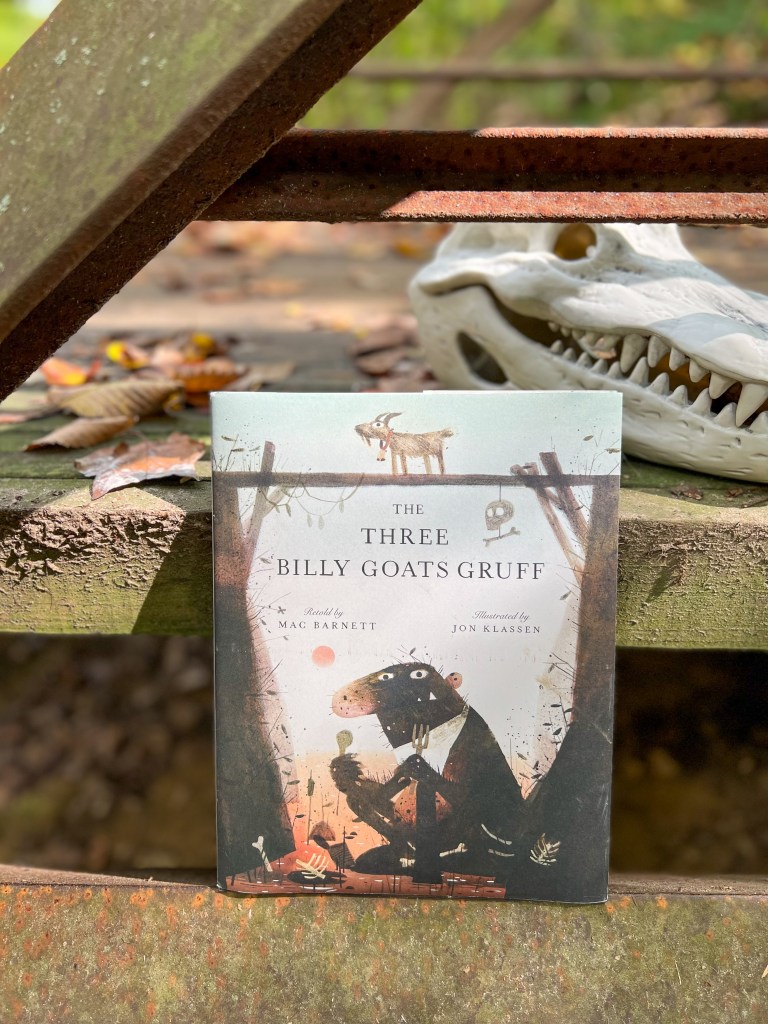
Finally, before we get started, I’ll remind you that I kicked off the Gift Guide a few weeks ago with My Favorite Picture Book of the Year: Mac Barnett and Jon Klassen’s fresh telling of The Three Billy Goats Gruff. I won’t repeat myself here, but don’t forget that if you really want to wow your audience, that’s the ticket.
But, of course, these others are incredibly special, too. Presented here from youngest to oldest. (As always, links support the lovely indie where I work as the kids’ buyer. We ship!)
« Read the rest of this entry »2022 Gift Guide Kicks Off: My Favorite Picture Book of the Year
October 18, 2022 Comments Off on 2022 Gift Guide Kicks Off: My Favorite Picture Book of the Year
It’s that time of year again! For months, I have been working behind the scenes, reading hundreds of picture books, middle-grade books, young adult, and non-fiction in order to bring you this fall’s top picks for kids, tweens, & teens (nearly 60 titles in all!). I’ll be rolling out the Gift Guide in a series of blog posts between now and Thanksgiving, but if you live in the Northern Virginia area, I’d LOVE to see you at one of two In-Person Events I’ll be doing on the first two Friday evenings in November at Old Town Books, the beautiful indie where I’m the kids’ buyer. You’ll get a chance to hear me present the entire guide in person, followed by personal shopping and gift wrapping. Knock out all your holiday shopping and stockpile fabulous books for the year to come! (Just hurry, because tickets are going fast.)
It has become traditional for me to kick off each year’s Gift Guide with My Favorite Picture Book of the Year. (Last year, it was Little Witch Hazel (swoon!) and before that we had memorable titles like this, this, this, and this, which actually bears some fun similarities to today’s book.) This year’s pick officially hits shelves today, but it was actually the very first book I picked for this year’s guide, after reading a digital copy six months ago, so it has taken every ounce of restraint I have not to tell you about it until now.
I knew a fairy tale remixed by Mac Barnett and Jon Klassen—the launch of a new picture book trilogy, no less!—was bound to be brilliant, but I also knew it would need no help from me to find its audience. Between the two of them, these kid lit superstars have garnered numerous Caldecott Honors, not to mention countless other accolades, so there was no way this book was falling off anyone’s radar. Normally, for “My Favorite Book of the Year” posts, I tend towards the hidden gems.
But while this will undoubtedly be one of the biggest books of the year, I’m happy to jump on the bandwagon, because The Three Billy Goats Gruff (ages 4-8) is the bomb. This story is READ-ALOUD PERFECTION. The humor! The pacing! The rhyme! The bonus endings! The ode to gourmands! The chin hair! The VOICES! I can’t think of a single child who won’t hang on every word of this book, alternately holding their breath and howling with laughter. Or a single adult who won’t be game to read it again and again.
Are you ready to step onto the bridge with me?
« Read the rest of this entry »Welcoming Surprise
September 15, 2022 § 3 Comments

As a parent, one of the things I continue to wrestle against is the temptation to label my children, to fit them inside tidy little boxes for the sake of proving (to the world? to myself?) that I’ve got everything figured out. On the one hand, of course I know my kids aren’t some puzzle begging to be solved; on the other hand, everywhere we turn as parents, we’re being asked to declare our children’s interests, to commit to one sport at the exclusion of others, to sum up their personalities for new teachers or turn them into soundbites for small talk with other parents.
If we’re talking labels, then my son is a math and science kid. Has been for a long time. He will tell you his plan is to be a rocket scientist for NASA, and he will steer almost every conversation at the dinner table back to whatever launch attempt has been in the news that day. As parents, all we want is for our kids to find something they love, so phew, let’s check that box and call it a day.
But wait. What about his eye for color and design? His love of drawing photo-realistic animals on birthday cards? What about the fact that he was the first one in our family who could handle our traumatized puppy, the first one to leash him and teach him tricks? What about his love for Anne of Green Gables that (almost) rivals mine?
What else might I miss by boxing him in?
Though he has an indisputable aptitude and passion for math and science, his favorite class last year was actually history, a class comprised of reading, writing, and public speaking. He has an obsession with current events that grew out of stress-induced vigilance but has morphed into a fascination with politics and economics. He has loved swimming, then hated it, loved running, now finds his interest depends on the day. He used to wince when a soccer ball flew at him, but last year I watched as he ran straight into the action on the basketball court, so maybe my telling people for years that, “yeah, he doesn’t like contact sports,” wasn’t actually true.
Will he grow up to become a rocket scientist? Quite possibly. Might he grow up to do any number of things seemingly incongruous with that goal? Quite possibly. All I know is that the more I can get out of the way, the freer he is to be open to possibility. And to surprise those of us along for the ride.
Easier said than done. That’s why we need frequent, insightful reminders.
You are more than a single note—
played again and again.
You are a symphony.
You are sounds plucked from all the places you’ve been
and all the people you’ve met
and all the feelings you’ve felt.
You are blues and pinks and loneliness and laughter,
mismatched scraps accumulated over time
and stitched together
into a kind of patchwork.
These resounding words come near the end of Patchwork (Ages 5-10), a stunning collaboration between two of our family’s favorites: Matt de la Peña (of Last Stop on Market Street) and Corinna Luyken (remember when I interviewed her here?). A paean to self-discovery, the book speaks to the capacity of children to change. Even as it highlights six specific children’s experiences, the second-person narration feels universal: the “you” is at once the child pictured in a pink tutu and the young reader studying her on the page.
Earlier this month, I read the book to my own children, despite them being well outside the target age, and I watched as a kind of peace settled around them. “What did you like about the book?” I asked. My daughter was quick to say she liked Corinna’s choice of a different color for each of the children’s stories (something I’ll talk more about in a bit).
My son took longer to think. Finally, he spoke: “I liked the way the children were always surprising the adults.”
In its invitation to witness and celebrate the surprises of self-discovery, Patchwork succeeds in both affirming the curiosity our children already know to be inside them and reminding those who love them to make room for that curiosity.
« Read the rest of this entry »Picture Books as Performance
May 19, 2022 Comments Off on Picture Books as Performance

I recently tuned into the podcast Picturebooking, where Mac Barnett was being interviewed by host Nick Patton. It was fortuitous timing, because earlier that day I had told a friend that I thought Barnett’s newest picture book, The Great Zapfino (Ages 3-6), an almost wordless story in partnership with the great Marla Frazee, was one of the most brilliant and exciting wordless picture books I’d ever seen. But I couldn’t entirely put my finger on why.
Wordless picture books are a hard sell for parents. I could sit here all day and list the ways they build early literacy skills in young children (and I once did, here, with our family’s favorite wordless trilogy), but when it comes down to it, they just don’t seem like they’re going to be much fun to read aloud.
That’s because there’s a performative element to picture books that feels like it’s getting lost in the absence of words. On the podcast, Mac Barnett talks about how the story of a picture book cannot exist independent of its delivery. And that delivery changes every single time. No parent or teacher will read aloud the same book in quite the same way, with the same cadence or expression or energy, not to mention with the same participatory feedback from their young audience, which means that once an author unleashes a picture book into the world, it becomes a living, breathing entity. It becomes performance art.
When we adult readers are looking to entertain our listeners, we understandably look to text, both to build a story’s arc and to provide us with the dialogue to exercise our comedic or dramatic voices. In the absence of text, when we must look to pictorial representation for meaning, we’re unsure how to translate what we’re seeing aloud. We feel a bit adrift. We forget that what feels awkward to us is actually part of the charm of wordless books for children: they have to work a bit harder, participate in the read-aloud experience a bit more, but the payoff of discovery is that much sweeter.
Creating a picture book guaranteed to hold a listener’s attention no matter how it’s read is no easy feat, but Mac Barnett has proved himself infallible. Everything he touches has slam-dunk crowd appeal. (Spoiler alert: I’ve already chosen his forthcoming fall release, The Three Billy Goats Gruff, for this year’s Holiday Gift Guide!) In the case of The Great Zapfino, Mac Barnett has done something highly effective. He front loads the book with two pages of text—the words of a circus ringmaster, introducing his biggest act—before letting Marla Frazee’s spectacular illustrations tell the rest of the story. This means that right out of the gate, he satisfies our desire for a fun, over-the-top character voice, then uses that voice to invest the listener in what’s to come. Right out of the gate, we’re poised for the performance in these pages.
But The Great Zapfino isn’t just a picture book that performs well. It’s also a story about a literal performance. And not the one we think we’re getting from the book’s opening pages, either. Because the Great Zapfino is about to blow it. He’s about to throw away his big shot in a public spectacle of embarrassment. But he’s also about to rewrite his own script, cast himself in a different role, and give himself the time and permission for second chances. His performance, we come to realize, is the performance of life, and we are lucky to be along for the ride.
« Read the rest of this entry »For the Sensitive Souls (A Post for Mental Health Awareness Month)
May 12, 2022 § 4 Comments
All the time I get asked, What’s a good book for my [insert: nervous, fearful, shy, super sensitive] kid? With everything this crazy world has been dishing out, even kids who aren’t naturally wired towards sensitivity are struggling under the weight of big, heavy, messy emotions. And, as parents, it’s hard to resist the temptation to make the discomfort go away.
My firstborn is an immensely sensitive child. My husband and I joke that he’s a raw nerve walking around on two legs, and the whiplash from highs to lows and back again is not always easy to witness.
Five years ago—I would remember it like it was yesterday, even if I hadn’t journaled about it at the time—my son looked on as garbage workers hauled away our twenty-year-old sofa. We had spent a few weeks trying to donate the sofa, but with a frayed slipcover and sunken cushions, no one seemed to want it.
The hysteria peaked as the garbage truck drove away. The garbage men didn’t treat it well! he wailed. They broke it apart! They tore off the slipcover! It went into the truck in PIECES! They treated it no differently than a container of moldy food! I know it was ripped and didn’t look very good, but it was so comfortable. It made us happy for so long. It should have gone to a good home! It still had life left to give! It could have made people happy! Now, IT’S RUINED!
For a long time, my maternal response to such spectacles was, MAKE. IT. STOP. You’re fine. Here are all the ways that what you’re losing your mind over isn’t actually that bad. Just please stop suffering because my heart cannot take it and also I feel very out of control right now.
But if my son’s extreme responses to everyday life were hard on me, they were a million times harder on him—and often brought with them feelings of shame and loneliness.
I’d like to tell you there was a single turning point for me, but I think it was probably lots of little signs along the way that pointed towards re-framing this sensitivity for both him and me. We began to regard it, not as a condition to overcome, but as a superpower of sorts. You won’t find a more empathetic kid than my son. A more grateful one, too. I could never add up the number of times he has hugged us before bed and said, “Today was the best day of my life.” (Lots more have been the “worst,” of course.)
If, in these turbulent moments, I don’t let his emotions hijack mine—easier said than done, of course—there is usually a nugget of truth telling that can inform my life, our life, for the better. “We did try and donate the sofa,” I reminded him. “Well, maybe someone was afraid to come forward, afraid for us to see their poverty,” he said. “We could have done more, Mommy.” I haven’t forgotten this exchange. Because he’s not wrong. He keeps me honest to the plight of others. He keeps me honest to the plight of himself.
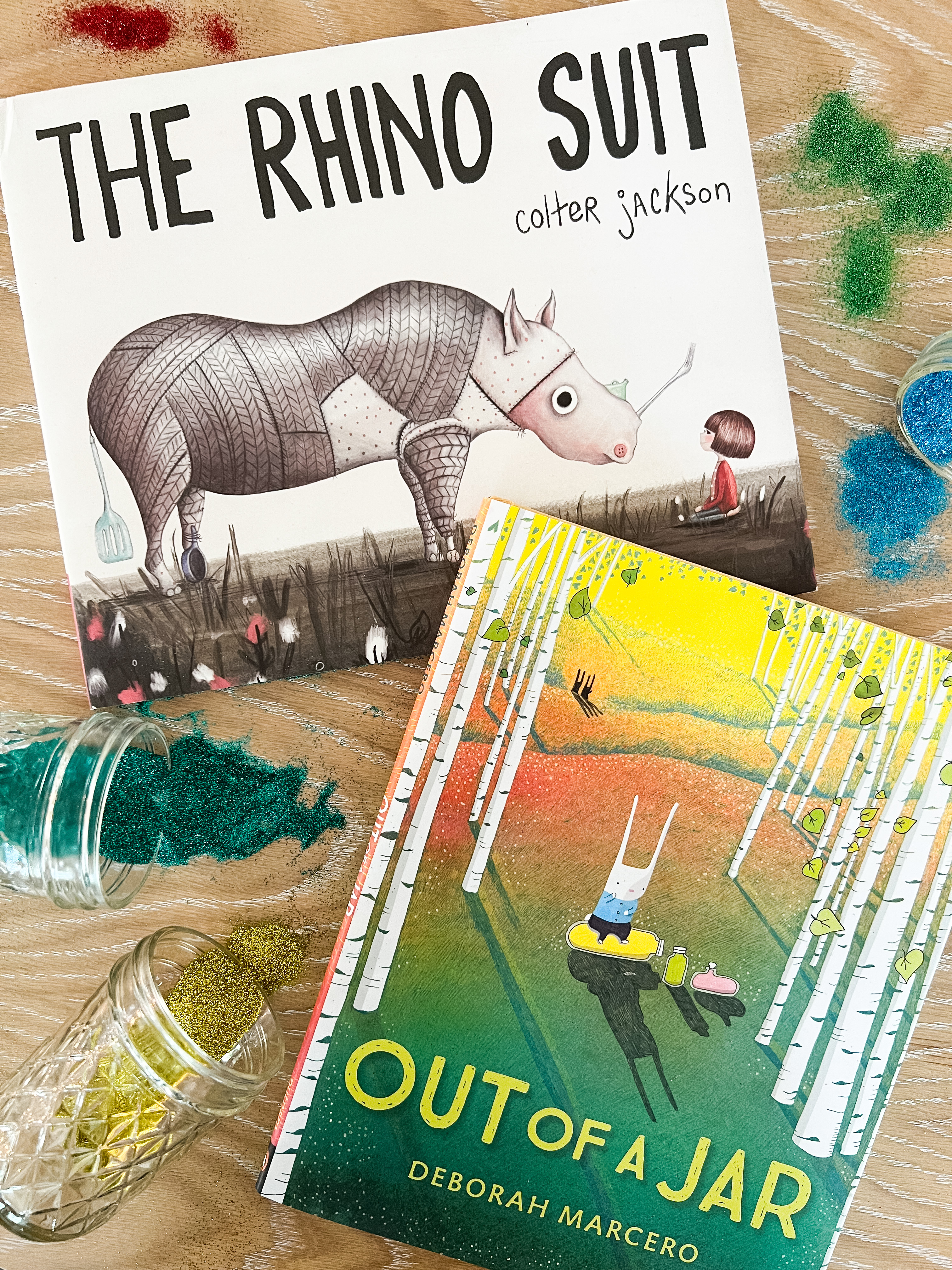
Today, I’m sharing two important new picture books that I wish I’d had when my son was younger. That I wish I’d had for my daughter, too, who sits on the opposite end of the spectrum from her brother, keeping her feelings close to the breast, wary of betraying vulnerability, wary of losing control (can’t imagine who she gets that from). Embedded in their charming, gorgeously illustrated stories, Deborah Marcero’s Out of a Jar (Ages 4-8) and Colter Jackson’s The Rhino Suit (Ages 4-8) employ creative, effective metaphors to explore the temptation to bottle up big, messy emotions and shelve them out of sight. To trap them on the other side of a coat of armor. Both stories ask their young readers to consider the good that might come from leaning into, not away from, uncomfortable emotions. Leaning into sensitivity, rather than fearing or disguising it.
There’s plenty of truth telling in these books for the parents and caregivers of sensitive kids, too.
« Read the rest of this entry »Our Words Matter
March 17, 2022 § 1 Comment
Surprising as this may sound, my son will tell you that one of his happiest memories is the day we told him he had ADHD. (He has given me his blessing to share this story here.) After years of angry outbursts, struggles to complete assignments, feeling like he didn’t fit in, and an approach to writing defined largely by paralysis, suddenly he had answers. He had clarity. He had a path before him that was not without more struggle but was also well-trodden, ripe with options, ready with support. Plus, he had a community—the Percy Jacksons of the world—who had this in common with him, many of them with inspiring stories of success to share.
All of this relieved a burden he had carried around, often without realizing it, for years. Overnight, he had been given a missing piece to the puzzle of himself.
But when I consider that this moment held so much joy for him, when it just as easily could have spurred fear, shame, or intimidation, I also credit the way we presented the diagnosis. After years of meeting his behavior with exasperation, concern, and (gulp) disappointment, this time we got it right.
On the heels of a neuro-psychological evaluation, my husband and I sat on my son’s bed, on a Saturday morning, and shared a colorful diagram I’d penned the night before. This single piece of paper attempted to capture my son’s learning profile: what his ADHD makes difficult, alongside the litany of strengths his unique wiring offers, like creativity, empathy, an insatiable quest for knowledge, and the superpower of hyper-focus when it comes to things he loves. His neurodiverse brain was all there, in its colorful, complex magnificence.
Bless second chances in parenting, because it was the magnificence piece that came through loud and clear that morning. In many ways, the process of having our son tested was as re-framing for us as it was for him. It helped us to see all of him, instead of just the parts that had monopolized the emotional space in our house in recent years. Somewhere along the way, in our obsession with trying to puzzle him out, we’d lost sight of reminding him, with our words and our actions, how deeply loved he is. How special he is. How miraculous he is.
Progress is rarely a straight line, and I won’t pretend my words don’t sometimes still veer too far in the direction of annoyance over acceptance. But I have become more cognizant of the power my words wield over the way my children see themselves. And that sometimes I need to check my own expectations at the door—my own ideas of what success or bravery or “normal” looks like—to land on the words my kids most need to hear.
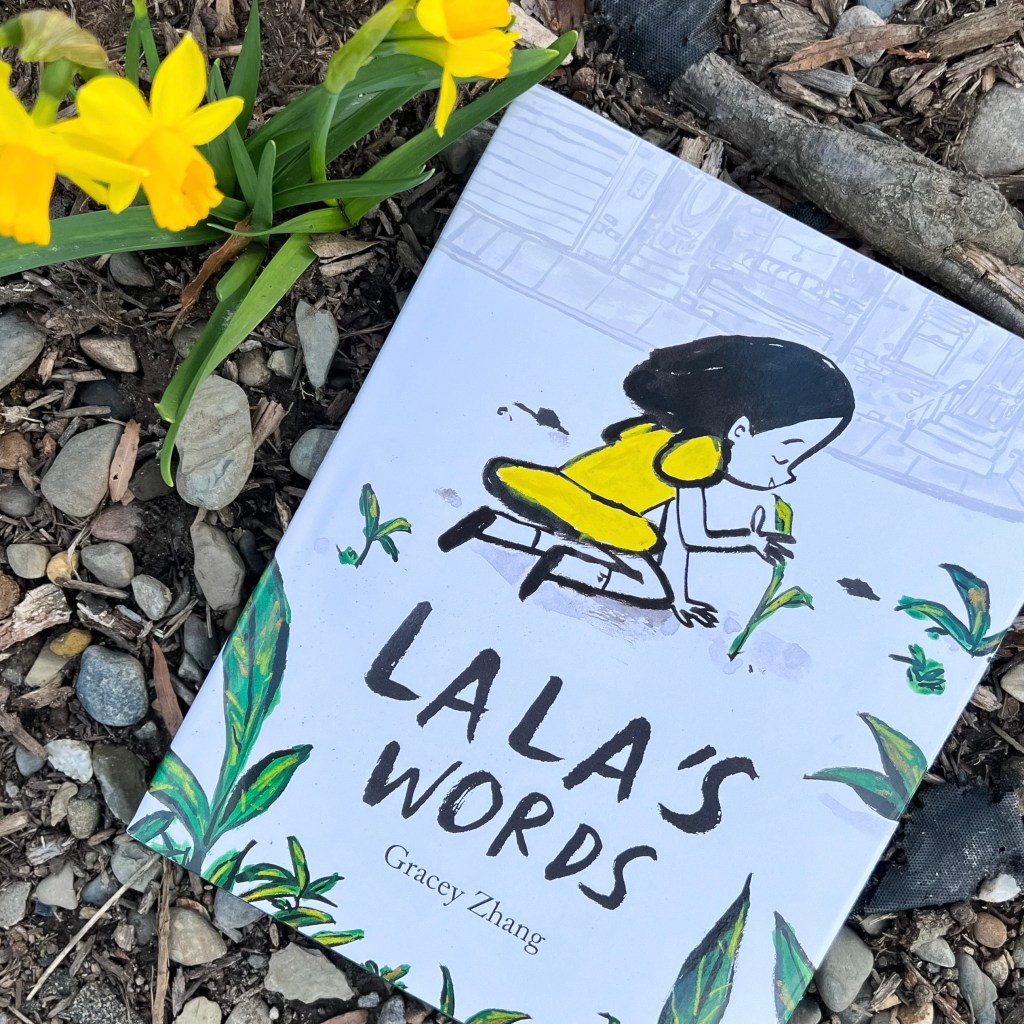
Lala’s Words (Ages 4-8) isn’t about a child with any particular diagnosis. In fact, author-illustrator Gracey Zhang, a rising star just awarded the 2022 Ezra Jack Keats Medal for this brilliant and perceptive debut picture book, dedicates her book to “The Lala in All of Us,” a tribute to the universal desire to be seen, loved, and believed in for who we are. At the same time, it’s a story about a girl who doesn’t fit the model of success that her mother sets out for her. A girl who meets with more exasperation than encouragement. It’s a story that resonates deeply with me, a parent who once nearly lost sight of the magic in her own child.
And it’s a reminder that, if we look closely enough, our children will tell us exactly what they need to hear to blossom and thrive.
« Read the rest of this entry »Welcoming Absurdity
February 24, 2022 Comments Off on Welcoming Absurdity

Last week, on an episode of the podcast, “We Can Do Hard Things” (fess up, I know you listen, too), Glennon Doyle pronounced that the 2022 vibe most worthy of embracing is “absurdity.” We’re “fresh out of giddy-up,” she says. The last two years have depleted every ounce of resiliency we had, leaving us largely “dead inside.” In her line of reasoning, it follows that the only antidote to this zombie-like state is the Theater of the Absurd.
I immediately thought of Alice B. McGinty’s absurd—and absurdly funny—new picture book, Bathe the Cat (Ages 4-8), brilliantly illustrated as per usual by David Roberts (you know him from the beloved “Questioneers” series—most recently, Aaron Slater, Illustrator). While a family scrambles to ready their house for Grandma’s visit, their pet cat repeatedly and mischievously scrambles the chore list—spelled out in magnetic letters on the fridge—resulting in a mayhem of misunderstandings. Sweep the dishes? Scrub the fishes? Mop the baby? Bathe the mat? Just you wait.
Bathe the Cat is a guaranteed crowd pleaser. The rhyming text relishes being read aloud, and the giggles will only increase with repeat readings. We’re well outside the age range over here, and my kids were still delighted by it. Much the way the four of us have been delighting in our new doodle puppy, who can’t manage to chase a ball across the wood floor without at least three of his legs splaying in different directions. Whose muppet face breaks out into the silliest lopsided grin when you scratch his neck, and whose paws move to their own mysterious beat when he’s sleeping.
Yes, our home has welcomed its own brand of absurdity in the past six weeks, and it does feel a bit like shaking off the grogginess from a nap that’s gone on too long. Who knew watching a dog run after a ball and come back with a stick could be so entertaining? “He’s proud as a pumpkin!” my son recently said, as the dog paraded around the living room with a piece of bubble wrap in his mouth. Rather than correcting the metaphor, we merely adopted it as our new Fozzie-speak.
But back to today’s book. Because there’s something else you need to know, beyond the entertaining premise, high-energy illustrations, and purr-fect ending (trust me on that last one). The story centers a biracial family of five, headed up by two dads. In the publishing industry, the is called “incidental” representation, and it’s something to celebrate. We are finally beginning to see racial and LGBTQ+ diversity in stories that are not about that diversity. The two dads here are simply doing what families with babies and toddlers do best: rolling up their sleeves, keeping a sense of humor, and trying to survive Grandma’s visit.
« Read the rest of this entry »My Caldecott Front Runner
January 12, 2022 Comments Off on My Caldecott Front Runner

Awards season is upon us! On Monday, January 24, the American Library Association will award the prestigious Caldecott and Newbery Medals, as well as a host of other coveted honors and awards. It’s like the Oscars for kid lit! I’ll be tuning in with bated breath, ready to celebrate many of the winners and, if history is any indication, scratch my head at a few others. There will probably be some books I haven’t read yet, perhaps even one I haven’t heard of, but I’m hoping many of my favorites will make the list. In any event, I promise to share a recap on Instagram after the announcements!
Let’s talk about the picture book I’d love to see sport a shiny gold Caldecott sticker. (I’m also pulling for Watercress, which I gushed about in April. Born on the Water, of course. Time is a Flower. Probably Unspeakable, if my library hold would ever come in.) Today, though, I’m talking about Wishes (Ages 4-8), written by Múón Thi Vãn and illustrated by Victo Ngai, based on the former’s refugee journey out of Vietnam as a young child in the 1980s. This book sends my jaw to the floor. Every. single. time. (Back in May, my daughter discovered it on our dining table, sat down and read it, and called out, “WHOA, Mommy, I think I just found your favorite book of the year.”)
And yet, I’ve been putting off sharing my thoughts about Wishes. It’s a daunting book to review, because its power lies largely in what is left unsaid. How do I write about a book that manages to tell a sweeping, suspenseful, emotionally pulsating narrative in just twelve short sentences, without my own clunky words compromising the grace of such economical text? (Heck, I’ve greatly exceeded that sentence count already!)
But that’s precisely why Wishes is deserving of a Caldecott, which I’ll remind you is awarded for pictorial interpretation. To be sure, Múón’s sparse text is immensely effective: loaded with lyricism and vital in relaying the story’s central theme of desire—the wishes that frame our periods of loss and uncertainty. But the reason Múón is able to communicate such depth and breadth with her text is owing to Ngai’s luminous illustrations, which carry a great deal of the storytelling weight. (Ngai herself is a migrant, moving from Hong Kong to the United States when she was eighteen.) Wishes is that rare example of a perfect marriage between words and pictures, each working to interpret and augment the other.
Wishes is about more than one journey. Taken literally, it’s the story of a girl who leaves behind her home—including her grandfather, her dog, and nearly all her worldly possessions—to journey by boat to a foreign city of safety and promise. But it’s also an emotional journey: a sequence of wishes that speak to the turbulence within. Ngai underscores this journey with her color palette, beginning the story in dark, somber tones, moving towards super-saturated reds and oranges as the oppressive sun beats down upon the tiny boat, and concluding with a soft palette of greens and pinks for an ending tinged in the hope of fresh starts.
« Read the rest of this entry »2021 Gift Guide: The Picture Books
November 11, 2021 Comments Off on 2021 Gift Guide: The Picture Books
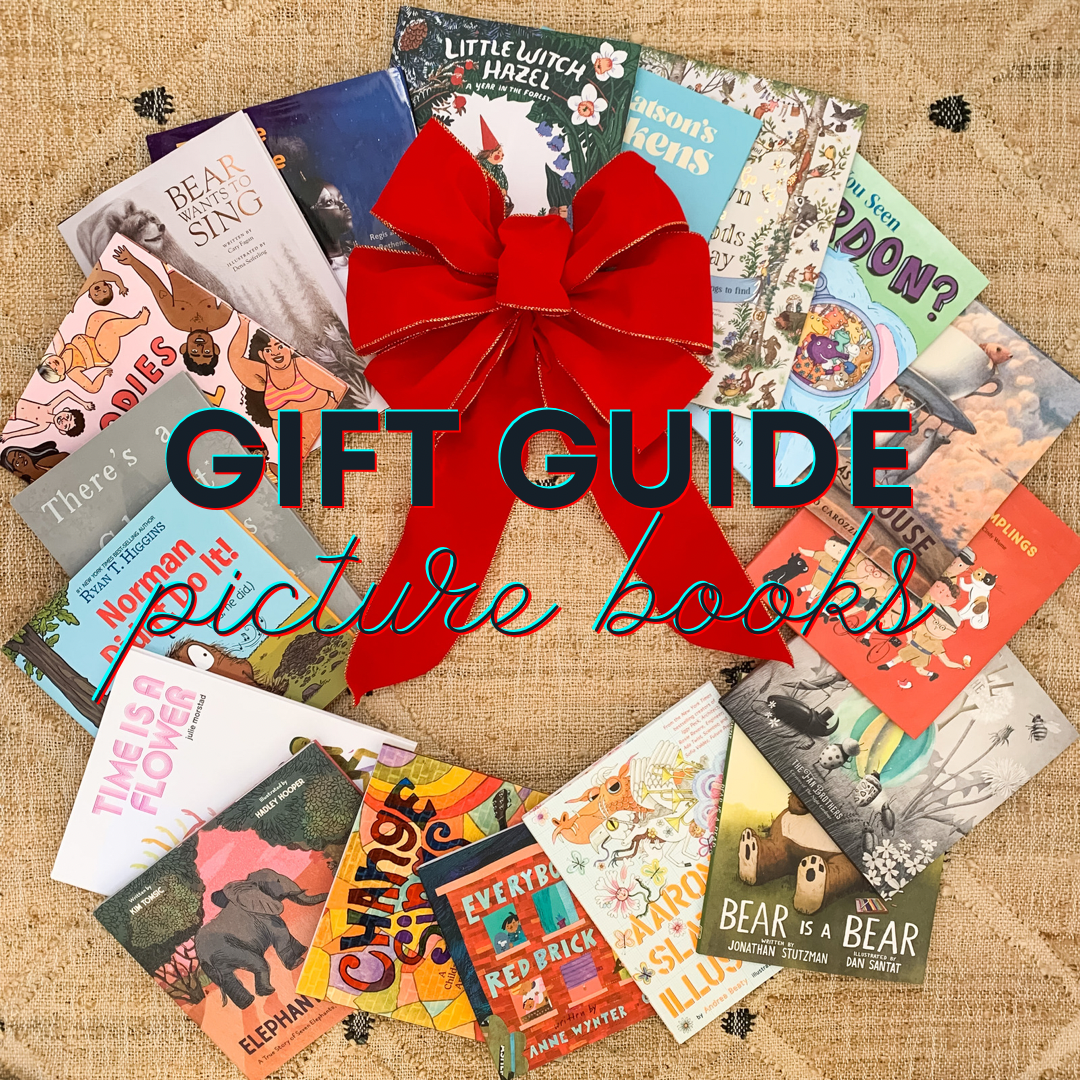
It was another stellar year for picture books! Given the size of the list below (sorry not sorry), you’re going to roll your eyes when I tell you I had a very difficult time narrowing it down. But it’s true, and I already regret leaving some out. (Thankfully, there’s always Instagram.) What I’m focusing on today are those with the giftiest potential. Whether you’re looking for surprise twists, laugh-out-loud humor, exquisite beauty, moving true stories, affirmations of self-love and acceptance, or ridiculously cute animals, you’ll find something novel and memorable here. Most importantly, you’ll gift a book to be relished and revisited for years. Still, I don’t envy you making these decisions, because these books are all so, so good.
« Read the rest of this entry »2021 Gift Guide: A Seek-and-Find Trifecta
November 4, 2021 § 1 Comment
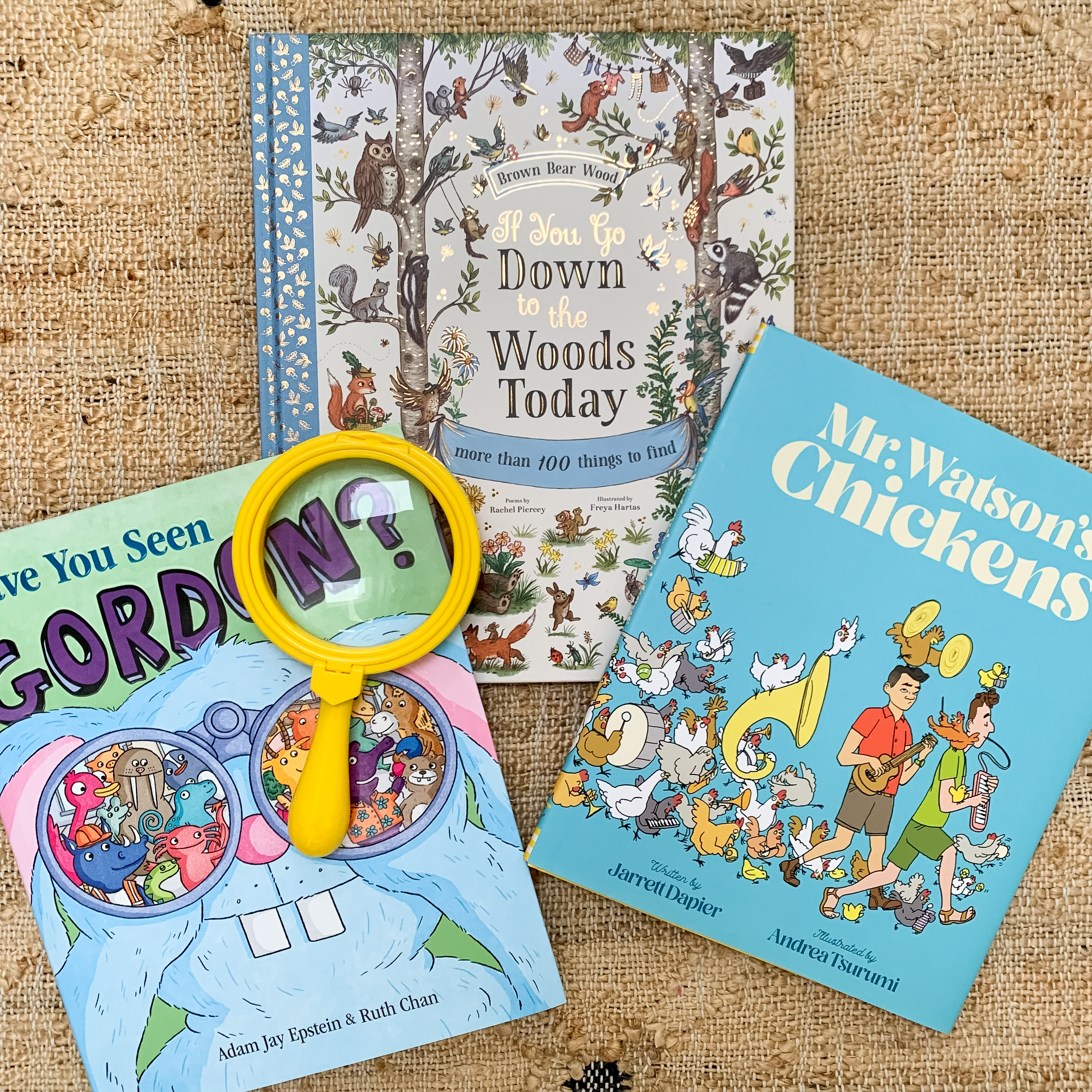
Last week, I launched the Gift Guide with My Favorite Picture Book of the Year. Next week, before moving onto other ages, I’ll do a round-up of a dozen more picture books perfect for gifting. But today, I want to call attention to three 2021 picture books that would make terrific gifts on their own or together. You know I can’t resist a bundling, and each of these treasure troves gives new meaning to the seek-and-find trope, a genre in need of updating before this year came along.
Every parent knows kids love nothing more than treasure hunts. But raise your hand if you’ve ever hidden a Where’s Waldo? book. Or a Richard Scarry book. Or any of those with dizzying pictures that have your child hunched over the page in your lap, scrunching up their eyes to look for a red-striped shirt or a tiny gold bug or any number of things, until it seems possible you’ve missed bedtime all together and it’s now morning again.
What if a child could get their seek-and-find fix in books that were cleverly crafted and delightfully fun to read aloud? What if these books featured art that was easy on our (tired) eyes? Wouldn’t that alone be worth welcoming the Holiday Season with open arms?
« Read the rest of this entry »Taking Our Cue from Them
June 17, 2021 Comments Off on Taking Our Cue from Them

Is that a naked boy on the cover? Why, yes. Are you mostly just posting about books with neon pink themes this year? Um, maybe.
For me, the biggest challenge of parenting continues to be taking the lead from my kids—and not the other way around. It’s seems simple enough—to guide, not instruct; to support, not push; to listen more and talk less—but it becomes intensely complicated when my own biases, fears, and failures get in the way of seeing my kids for who they are in the moment. Labels are comforting; they help us feel like we’re making sense of the chaos and uncertainty that is our children’s becoming. Look, he’s good at swimming—yes, swimming is his sport! He’s got brains, but she’s got compassion. He’ll never agree to that—he hated it last year. Wait, you want to wear a dress? I thought you hated dresses!
Being a parent can feel a lot like being tied to the end of a yo-yo that someone else is operating, and the whiplash isn’t always pleasant. But when we manage to extricate ourselves from that emotional tether, when we take a step back and observe the messy evolution unfold, we make space for wonder, joy, and acceptance—on both sides.
Upholding traditional gender roles is a trap most of us parents fall into at one time or another (regardless of how many feminist classes we took in college). It starts when our babes are in utero, as we fantasize about the mother-daughter shopping trips or decorate the nursery in a baseball theme, and it continues each time we measure our child against others of the same gender. Shyness in girls is sweet, but shyness in boys might be a sign of weakness. A boy who shows an interest in math confirms what everyone expected, but a girl who shows an interest in math is intriguing—as long as she’s not a dork, because then she’ll struggle socially. It’s OK for her to pick dance as a sport, but he needs a “real” workout. And so the dialogue goes, even if we never utter the words aloud.
And a boy who likes pink? Who wears make-up? What does that imply? What does that signal about the future?
Must it mean anything?
I’m thirteen years into this parenting gig, and the only thing I know for certain is that kids change. They change their minds, their habits, their styles. Sometimes it’s awesome, and sometimes it’s nerve-wracking. Sometimes, it’s along traditional gender lines, and sometimes it’s not. Sometimes it’s a signal of what’s to come, but just as often, it’s not. Most of the time, it has nothing to do with us, though how we react can be everything.
The supremely talented Peter Brown—creator of picture book favorites like Mr. Tiger Goes Wild, My Teacher is a Monster (No, I Am Not), and Creepy Carrots, and author of the equally brilliant chapter series The Wild Robot —has a new picture book out, and it brings the biggest smile to my face every time I read it. It’s also his most personal book to date, based on an incident when Brown was five years old and got into his mother’s make-up drawer. In many ways, it’s a tribute to his mother, whom he credits as being ahead of her time in her ability to validate who he was at every changing moment.
Fred Gets Dressed (Ages 2-6) may be a simple story about self-expression, but its execution is anything but ordinary. Design reigns, characters glow, and nakedness abounds. There’s the supportive mother, joined by a father who plays a small but mighty role. There’s a warm, inviting home, with books, dog, plants, and oversized throw pillows. But at the center of the story, stealing the show, is Fred. Fred is pure exuberance. Fred is that kid whose unbridled enthusiasm you want to bottle. Fred is that kid who prefers to air-dry au naturel (and who doesn’t, really?).
Fred is a boy who, on a whim, dresses up in his mom’s clothes and make-up. And because of his parents’ reaction, there’s no labeling, there’s no foreshadowing, there’s no shame. He’s simply allowed the freedom that comes with non-traditional gender roles. And his beaming smile says it all.
« Read the rest of this entry »An Interview with Shawn Harris
May 6, 2021 Comments Off on An Interview with Shawn Harris

Earlier this week, I talked about how much I adore the new picture book, Have You Ever Seen a Flower? Today, I’m back with an interview I did with its creator, Shawn Harris, in which we talk about his inspiration for the book, his musical past, what neon pink says to him, why he loves school visits, and the super exciting new projects he’s working on. I hope you enjoy it as much as I did!
Me: Welcome, Shawn! Thank you so much for dropping in today. I am delighted to have the chance to chat with you about your authorial debut picture book, Have You Ever Seen a Flower?, one of my very favorites of the year. I’ve been a fan of your art for years—both Her Right Foot (written by Dave Eggers) and A Polar Bear in the Snow (written by your good pal, Mac Barnett) have been the subject of previous blog posts—so I was excited to see you trying your hand at writing, too. What made you decide to take the plunge? And where did the idea for this special picture book come from?
Shawn: In my former life, I was a touring songwriter, so I’ve been writing since I was a kid penning lyrics. This was the first time my authorial tone conjured images since I’ve been working in the picture book world, so I set out to illustrate the words. It’s almost a song in book form, really. There’s a theme and an arc to the narration, but I hop around my subject really loosely, and dip in and out of different meters, which is the way I like to approach writing music.
« Read the rest of this entry » What to Read to Your Kids