Fairies (Not Just for Girls)
June 4, 2015 § 4 Comments
 “Mommy, can we plant some chives in our garden this summer?” my son asked me earlier this spring. “You know, for the fairies. It turns out they really, really like them.”
This was how I discovered that my seven year old had been spending his recess time, alongside several of his classmates, building fairy houses out of twigs, stones, moss, leaves, and mud; filling them with wild onion stems; and then returning the next day to discover with delight that things were not exactly as they’d left them. This obsession with fairy houses would later move into our own backyard (with the addition of miniature serving plates fashioned from the caps of milk bottles), and the momentum seems only to be building.
I don’t live under a rock, so I’m aware that fairies are EXTREMELY POPULAR. I was just a bit surprised that my skeptical and scientifically-minded son, the same being who reminds me that there is no such thing as witches, wizards, monsters, and dragons; who loves to do a magic trick and then immediately reveal the technique behind it; who appears (with the exception of Santa Claus and the Easter Bunny) to have his two feet squarely rooted in reality—that this person would suddenly talk about fairies as if they were as ordinary an occurrence as the postal workers walking through our neighborhood. “I don’t have to see a fairy to know they’re real,” he told me. “Just look outside—there are signs everywhere.”
Don’t get me wrong. JP’s belief in fairy magic, in the idea of miniature people living miniature lives amidst the trees and leaves and grass, makes me bubble over with happiness. (Yes! Let’s believe in what we cannot see! Yes! Let’s find more reasons to play in the dirt!). But the best part? My son’s new-found interest presented the perfect excuse to purchase a book that I (shame on me) had been saving for when my daughter got a little bit older.
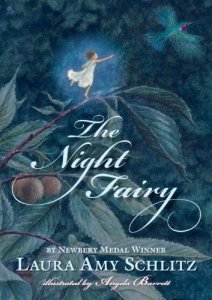
I’m frequently asked by parents for recommendations of fairy-themed chapter books. This isn’t just because fairy lore is undergoing a kind of comeback (or maybe it never left?). It’s also because, despite the high demand, there is a surprising dearth of quality literary offerings. Yes, I know your daughter is obsessed with the Rainbow Fairies series, for its colorful covers and overtly girly content, but have you tried reading one of those awkwardly-constructed, downright-insipid books aloud? Bleh. Let her read those on her own if she must. In the meantime, do both of you a favor and get your hands on Laura Amy Schlitz’s The Night Fairy, which is EVERYTHING A FAIRY BOOK SHOULD BE. This is reading aloud at its best.
Since it came out in 2010, The Night Fairy (Ages 5-10, if reading aloud) has become one of my favorite books to give as a gift. Hold the 117-page hardcover in your hands, and you know you are dealing with something special. It’s petite (as a book about a fairy should be); its pages are thick and glossy; and it features exquisite watercolor plates by British illustrator Angela Barrett. But here’s the clincher: the writing is absolutely exquisite. The descriptive passages soar. The action is tight. The multidimensional characters tug at our heartstrings. And—drum roll please—the story is steeped in the natural world, in the world right outside our front door. « Read the rest of this entry »
Weird and Wonderful Hospitality (Courtesy of Ben Hatke)
May 21, 2015 § 8 Comments
 I’d like to be the kind of mom who has the house where all the kids want to hang out. I’d like to be the kind of mom who throws back her head and exclaims breezily, “The more the merrier!” Who pulls out a sheet of warm chocolate chip cookies from the oven and, after grubby little fists have snatched them up, goes on to say, “You know, why don’t you all stay for dinner? I have something delicious bubbling away in the crock pot!” I’d like to be the kind of mom who turns the other cheek at dirty footprints, blots of ink, trails of sand, and piles of crumbs; who sighs and thinks, “All that matters is that they are here and they are happy.”
I am not that kind of mom. Two years ago, I participated in a Spring Break Swap with a group of close friends, where we each took turns at our respective houses watching nine kids for a day. My kids have lovely friends. Kind, intelligent, creative friends. But that did little to quell the feeling that I was UNDER SIEGE. So many little mouths telling me they were hungry! So many eager eyes imploring me to admire their drawings! So many children running up and down stairs, squealing and shouting and scrabbling!
Nope, I am not that kind of mom. It turns out that becoming a parent didn’t transform my Type A personality. I’m often still as inflexible as my daughter is when she’s presiding over her tea parties. Still, the idea of having an open-door policy, of creating a space where everyone feels welcomed and accepted, holds great romantic appeal. On paper.
This promise of hospitality is just one of the many reasons that I continue to be taken with Ben Hatke’s 2014 picture book, Julia’s House for Lost Creatures (Ages 3-6). The only reason I didn’t write sooner about one of my favorite books of last year is that it was initially such a runaway hit, the Indie publisher couldn’t print them fast enough! « Read the rest of this entry »
A Mother’s Greatest Gifts to Her Children
May 7, 2015 § 4 Comments
 In this age, where our self-worth seems increasingly defined by how busy we are, I find that one of my greatest challenges as a mother is quieting the “to do” list in my head when I am around my children. I’m not talking about simply spending time with them. I’m talking about being in the moment with them. I might be on the floor playing Candy Land, but I’m secretly fretting over when I should start dinner. I might be throwing a ball in the backyard, but I’m all the while thinking about the mountain of weeding that needs to get done.
My children know I love them. But how often do they feel the gift of my time?
This winter, I fell in love with a picture book by the lovely Scottish author-illustrator, Debi Gliori, titled Dragon’s Extraordinary Egg (Ages 4-8). It’s about dragons, yes, but it’s also about penguins and a landscape of ice and snow, so by all accounts, I should have shared it with you in the height of snow days and sub-zero temperatures. Except that it’s also one of the most beautiful portraits of motherhood that I’ve ever come across in a children’s book (it’s right up there with this one). So, I’ve been saving telling you about it until Mother’s Day, a time for celebrating those who are trying so hard every day to do right by the little ones we love. « Read the rest of this entry »
The Physical Comedy of Pippi Longstocking
April 24, 2015 § 3 Comments
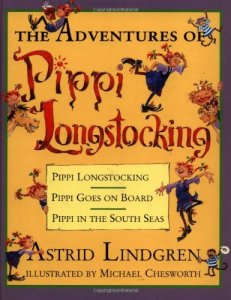 There was a point earlier this year, when I was recovering from the flu and still not up and about, that I found myself lying in bed, reading aloud to my kids—both of whom, instead of tucked in beside me, were at the foot of the bed, running in place on my foam roller. If you’ve ever tried running in place on a foam roller, you’ll know that it is not possible. Hence, as I was lying there reading, little heads kept disappearing from sight and then popping back up again. Normally, as a reader, this would have driven me insane. Except that this particular shenanigan seemed perfectly fitting for the reading material at hand.
It is downright impossible to sit demurely while listening to The Adventures of Pippi Longstocking (Ages 5-8 if reading aloud, older if reading independently). This beautifully bound anthology combines three of Astrid Lindgren’s unabridged 1950s chapter books (Pippi Longstocking, Pippi Goes on Board, and Pippi in the South Seas) with the ebullient, contemporary pen-and-ink illustrations of Michael Chesworth.
You see, there’s just something about Pippi—one of children’s literature’s most infamous, compelling, and downright hilarious young heroines—that invites physical participation from her audience. « Read the rest of this entry »
No More Sitting Pretty
April 16, 2015 § 3 Comments
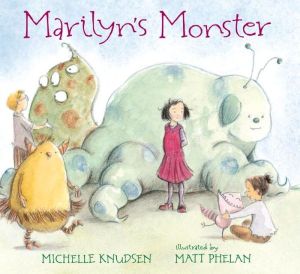 After spring break ate up my last two weeks, I’ve found my way back to writing, and I’m especially glad to be back, because I have a very special new book to tell you about. It’s a book that can be enjoyed simply for the fun, quirky, heartwarming story that it is. Or, it’s a book that can be read as a metaphor for one of the most important examples we can provide our children: that when life doesn’t give us what we want, we possess the power to stand up and change it.
It’s a book that boys and girls will enjoy equally, as my two already do. But, it’s also a book that must be shared with our girls. In fact, Marilyn has quickly become one of my favorite picture book heroines OF ALL TIME.
If that hasn’t piqued your interest, consider this: Marilyn’s Monster (Ages 4-8) is written by Michelle Knudsen, the same author who gave us Library Lion (need I say more?!). Marilyn’s Monster showcases the same beautiful fluidity of narration, the same perfectly orchestrated dramatic arc, and engenders the same depth of empathy for its central character. « Read the rest of this entry »
The Book That Saved December
December 31, 2014 § 7 Comments
 Reading to our children can sometimes be the best way to slow down and live in the moment; to see the world through the wonder of young eyes and to have our own faith restored. Never has this been truer for me than in the past month. This December, reading threw me a lifeline. And boy, did I need it.
What is normally a time of sweet anticipation (cutting down our Christmas tree! driving the kids around to look at decorations! shopping for the perfect wrapping paper!), felt this year like an insurmountable list of to dos. The word drudgery came to mind on more than a few occasions. With my husband traveling for much of the month, I was exhausted. With every step, it felt like my legs were at risk of crumpling, of reducing me to a cast-aside pile of expired Christmas lights. The rain didn’t help (because who enjoys tromping around a Christmas tree farm in the pouring rain?). No matter how many times I scaled back my expectations (the teachers will get store-bought gifts this year!), I never felt the burden lighten.
I don’t have to tell you what our stress level does to our ability to parent with patience. As my daughter erupted into yet another round of crocodile-tear hysterics (over, at one point, a hypothetical snowball fight with her brother), I began to have fantasies of walking into the neighbor’s mass of giant inflatable Santas and Frostys and never coming out. « Read the rest of this entry »
Gift Guide 2014 (No. 4): Three Books for the Scientist (Ages 5-12)
December 11, 2014 § 1 Comment
If I had a dollar for every time my children tell me they are doing a science experiment, I would be a rich Mama. Most of these experiments involve putting water in a cup with some household item and sticking it in the freezer (spoiler alert: it freezes). Sometimes, usually with the help of birthday gifts, they might raise their game by building baking-soda volcanoes or citrus-powered clocks.
Our children’s natural curiosity about the inner-workings of the world has been given extra-special treatment in books this year. Today, I’ll be singing the praises of two novels for the 9-12 crowd, which seamlessly weave science into the drama of middle-school life (one stars a boy, the other a girl). For the younger elementary child, a picture book biography on Carl Sagan will prove the perfect entrée into the mysteries of the cosmos. Without further ado, let us begin.
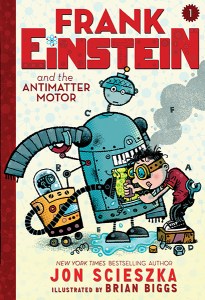 [Warning: this book may cause your child to talk like a robot well beyond the last page.] Author Jon Scieszka, long-time advocate for the reluctant boy reader (see his inspiring tips here), embarks on the ultimate Science is Cool chapter book series, with Frank Einstein and the Antimatter Motor (Ages 9-12; younger if reading aloud). Frank Einstein is a kid-genius inventor—with a special fondness for his Grampa Al, as well as for his Grampa Al’s Fix-It! Shop (“the greatest place in the world to test any invention you might think of”). Determined to win the Midville Science Prize and reap a large cash reward to pay off Grampa Al’s debts, Frank, his best-pal Watson, and two self-assembled artificial intelligence entities named Klink and Klank (my son’s new favorite literary characters), create a Fly Bike powered by an Antimatter Motor. Naturally, all this gets complicated by Frank’s arch-nemesis: the doomsday-plotting, idea-stealing, robot-napping T.Edison. « Read the rest of this entry »
Gift Guide 2014 (No. 3): For the Rebel Princess (Ages 5-8)
December 4, 2014 § 1 Comment
 Five years ago, when I learned I was having a girl, I self-righteously vowed that I would bar the door from tiaras and princess costumes and those scary high-heeled plastic dress-up shoes with the sequins on the toes. My daughter won’t equate beauty with Disney-fied princesses! My daughter will read books about trains and science and daring adventures! My daughter won’t be held back by stereotypes of femininity!
Of course, ultimatums rarely work out in parenting—nor are they usually for the best. Those of you with girls already know that The Princess Obsession eventually finds its way into the house—slipping through the gap beneath the front door, if need be. Before my kids watched Frozen, my daughter already knew the words to every song, just from listening to her classmates. Before my son pointed to a hot pink skirt with 20 layers of tulle at Target and said (in the sweetest voice, so how could I resist?), “Oh, Mommy, Emily would just love something like that”—before that, Emily was already coming home from play dates in borrowed glitter-encrusted frocks.
What I failed to anticipate as a new parent, is that there are complex dichotomies at work in the princess fantasies of my daughter and her friends. When playing, Emily is just as likely to wear her tulle skirt on her head than around her waist. She likes to pair her purple metallic slippers with a red superhero cape and an astronaut helmet. « Read the rest of this entry »
Gift Guide 2014 (No. 2): Three Books for the Linguist (Ages 6-12)
November 25, 2014 § 1 Comment
Children have an inherent drive towards language. As infants, they hang on our every word. Once they begin to speak, they never tire of the sound of their own voice; and, as they develop more self-control, they relish in the discovery of expressing themselves (“Use your words!”) to get what they want. But it’s in the elementary years, when our kids are at last reading and writing on their own, that they become most keenly aware of the power of words, not only to shape and alter meaning, but also to connect them to the world.
Of course, it can’t hurt to nudge an awareness of the nuance of language into the forefront of our children’s minds. (We have to believe our kids are capable of more than “It was fine,” when asked about their day.) It just so happens that 2014 has given us three exceptional books (one picture book and two middle-grade chapter books) that showcase the power of language.
 Jen Bryant and Melissa Sweet’s The Right Word: Roget and His Thesaurus (Ages 6-12) introduces children to the notion that, in the vast archives of the English language, there is a “right” word to express a precise meaning. Bryant and Sweet have become masters of picture book biographies in recent years (remember this post?); but their portrait of the man who invented the thesaurus is their most magnificent to date. The story of Dr. Peter Roget’s life is narrated beautifully for a young audience; but it is the way in which Sweet has visualized Roget’s fascination with language that truly captivates the reader. Like the thesaurus itself (which comes from the Greek word meaning “treasure house”), this is a book that’s impossible to absorb in one—or ten, or twenty—sittings. Visual feasts of collage beckon the eye on every page. « Read the rest of this entry »
At Last, Something for the Youngest Sibling
November 6, 2014 § 1 Comment
 One book that all the Book People will be talking about this holiday season is Abby Hanlon’s Dory Fantasmagory (Ages 5-9), an illustrated early-chapter book featuring one of the spunkiest, most imaginative, most genuinely real six-year-old girls to grace the pages of children’s literature. (After all, it was written by a former first-grade teacher.) If you really want to impress people with how in the know you are, you should buy the book this month, instead of waiting until next month, and then you should give it to everyone you know—regardless of whether it’s their birthday or not. Just a thought.
It’s possible that I’ve lost perspective on this 153-page gem, because I have, by request, read it upwards of ten times to my four year old in the past month (and don’t think that her seven-year-old brother doesn’t listen in at every chance he gets). I’m beginning to feel like Dory (nicknamed Rascal) and Emily are actually the same person (wait, are they?). Both talk to themselves incessantly, invent wild fantasies in their play, wear strange things around the house, and will stop at nothing to get the attention of their older siblings. I don’t think that Emily has a bearded fairy godmother named Mr. Nugget, or that she believes there are at least seven (mostly) hospitable monsters living in our house…but then again, I can’t be sure. « Read the rest of this entry »
Morning at The Met (Courtesy of E.L. Konigsburg)
October 30, 2014 § 5 Comments
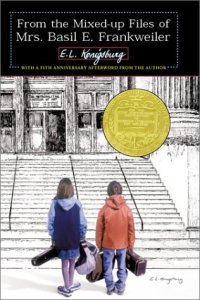 Earlier this fall, JP and I embarked on our annual trip to New York City, where I grew up and where my Mom still lives. Normally on these visits, we are content to plot and rehash the day’s adventures by pouring over the vibrant illustrations in Kathy Jakobsen’s My New York, which my Mom brings down from a closet upon our arrival.
This time, I decided that some advance reading was in order. So, in the weeks leading up to our departure, I read to JP one of the novels I most remember from my childhood: E.L. Konigsburg’s From the Mixed-Up Files of Mrs. Basil E. Frankweiler (Ages 9-12; younger if reading aloud), which won the Newberry Medal in 1968. Through the eyes of two runaway siblings from Greenwich, Connecticut, who secretly live (and sleep) in The Metropolitan Museum of Art for an entire week, we are introduced to this incredible museum with drama and intrigue. The last time I took JP to the Met—albeit he was only five—was a disheartening disaster; he was bored within minutes of my ramblings about Impressionist painters. This time was different. This time, we had purpose: we were following in the steps of Claudia and Jamie Kincaid. « Read the rest of this entry »
Feeling Witchy
October 16, 2014 § 4 Comments
 “Mommy, you know how those witch hats got there?” my four year old casually ventured, as we walked through the Halloween section of our local variety store. Then, before I could answer, she stopped and turned towards me, her expression suddenly serious. “The witches dropped them,” she whispered.
I love October. Not for the costumes, or the weeks of planning that go into them (read: daily changing of minds). Not for the candy, which I can never get out of the house fast enough. I love it for its air of anticipation. That mysterious, slightly uneasy, could-it-might-it-be-real feeling that pokes at the back of our minds. As the evenings darken, the wind picks up, and the creaks on the roof grow louder, the lines between real and imaginary begin to get a little messy. You might say that for these few weeks, we get a taste of the way our kids feel all year long.
Indeed, many of my favorite “Halloween” stories to share with my kids are, in fact, not about Halloween at all—which means (hooray) that they can be enjoyed all 365 days. I’m referring to gems like Creepy Carrots, The Monsters’ Monster, and Vampirina Ballerina. This year’s newcomer is I Am a Witch’s Cat (Ages 2-6), by Harriet Muncaster: a simple picture book narrated in the voice of a little girl, who loves to dress up like a little black cat, because she believes her mother to be a witch (“but I don’t mind, because she is a good witch”). « Read the rest of this entry »
Where Imagination Reigns
September 18, 2014 § 3 Comments
 I’m going to tell you something I’ve never told anyone before. When I was ten, I was obsessed with Jean Craighead George’s My Side of the Mountain, the award-winning novel about a boy who runs away to live in a hollowed-out tree in the Catskill Mountains. This (naturally) meant that I started pretending that my New York City bedroom, a tiny room off the kitchen, on the opposite end of our apartment from my parents and sister, was actually the top of a mountain, covered with rocky terrain and miles from civilization. When I’d wash my face before bed, in the teeny adjoining bathroom, I’d turn on the cold tap, close my eyes, and imagine that I was splashing myself from an icy mountain stream.
Yes, I was a book nerd (still am). But I’m letting you in on this little secret twenty years later to make a point: for children, bedrooms have always been magical gateways to flights of imagination. Take Where the Wild Things Are, my four-year-old daughter’s current obsession. Is it a coincidence that young Max is sent to his bedroom before the walls fall away and he journeys to the land of the Wild Things? Of course not. The boy’s adventures behind closed doors are entirely his own. They are private. They are bizarre. They are scary. They are magnificent.
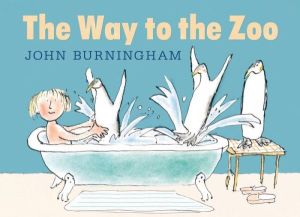
I told you recently about how my daughter claims a raccoon visits her each night while she sleeps, making a “racket-tacket” loud enough to wake her up. So I instantly knew that John Burningham’s The Way to the Zoo (Ages 3-7)—a new picture book about a girl who discovers a secret door in her bedroom leading to a zoo, thereby unleashing a slew of nightly visits from different animals—would be a slam dunk for us. « Read the rest of this entry »
For the Dancers
July 29, 2014 § 3 Comments
 One of our greatest rewards as parents is watching our children experience joy. For me, I get to see that look of joy upon my daughter’s face each time I peek through the fogged glass into the studio where she takes her weekly dance class. It’s a look that’s markedly different from the furrowed brow of concentration she often wears when observing something new; or the aghast expression of betrayal when her brother knocks over her tower of blocks; or her silly mischievous grin while tearing across the park with friends. When she dances, she is lost in the moment; she is happy; she is free. It’s no wonder that she asks me almost every single day, “When’s my next dance class?”
In a world in which our girls are dying to get their hands on pink tutus, ballet slippers, and all the glitter that seems to equate ballerinas with princesses, I love that Emily’s class is very deliberately titled Creative Movement. True ballet, with its discipline and choreography, doesn’t start until age five at this studio. In the meantime, the emphasis is on movement, on body awareness, on feeling the music. The girls and boys imitate animals, hop through hula-hoops, and roll across the big open floor.
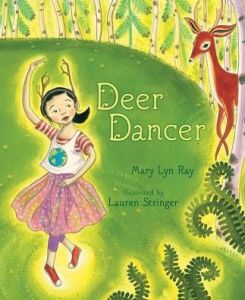
Where children’s books are concerned, there are many charming, full-of-heart stories featuring the indoor world of ballet (my favorites are mentioned in the lengthy list at the end of this post). Still, I find it especially refreshing that, in their new picture book, Deer Dancer (Ages 3-6), author Mary Lyn Ray and illustrator Lauren Stringer have taken dance out of the mirrored studio and into nature, where the trees make their own music, and where movement is at its freest and purest form. To put it another way, Deer Dancer is as green as it is pink. « Read the rest of this entry »
GOOOOOOAAAAAAAALLLLLLLL!
July 2, 2014 § 1 Comment
 We are not a sports-watching family (my husband jokes that he lost TV sports in marriage). But then came the World Cup. All four of us are possessed over the World Cup, and I can’t entirely explain it. I mean, it can’t just be the hotness of the players, the incredible headers that out of nowhere tip a speeding ball into the net; the non-stop, pinball-like passing. We scream at the TV (“Mommy, you are using your outside voice!” I’ve been reprimanded more than once); we jump up and down and hug each other over goals; we run into the backyard and kick the ball at halftime; and we despair when the US team fights the fight of its life and comes up short.
The World Cup will end, but I hope our family’s new love of soccer will not. Both kids are more excited than ever for their own soccer season this fall (although JP reports that he does not think he would like to be as good as the World Cup players, because “it looks very dangerous out there”). In the meantime, we will be reading some of the fantastic soccer-themed books that have popped up this year. Our favorite of these is Soccer Star (Ages 4-8), by Mina Javaherbin (illustrations by Renalto Alarcao), a picture book which not only exudes the excitement of soccer, but places it in a valuable cultural context. « Read the rest of this entry »
Hurry Up, Already
May 5, 2014 § 2 Comments
 Most parents have some part of the morning routine that they dread. For me, it’s not convincing my kids to get dressed; it’s not getting them to sit still long enough to finish their oatmeal; it’s not even brushing their teeth or standing by as they wrestle with any amount of outdoor attire. No, the moment that requires the most patience, that threatens to unravel me almost every day, comes at the very end—ironically, when the finish line is so close that I can almost taste it. It’s the simple, straightforward 10 foot walk from our front door to the car.
Getting my children into the car is like herding sloths. To look at them, you would think they had never stepped foot in the Great Outdoors before, the way they suddenly stop, stare off blankly into space, and eventually fix upon some object (a leaf, a truck, a worm misplaced from last night’s rainstorm), which inevitably prompts 25 questions Of The Utmost and Immediate Importance. At some point, they will begin to walk ever so slowly to the car, wedging themselves through the open car door with their overstuffed backpacks still on (will it ever occur to them to take off the bag before climbing in?), then struggling with car straps in some kind of slow-motion agony (my youngest: “You do it! No, I do it! Wait, what day is it?”), until finally 94 minutes have passed (which in actuality is only 4 minutes but feels like 94) and you pull out of the driveway. I adore my children. But.
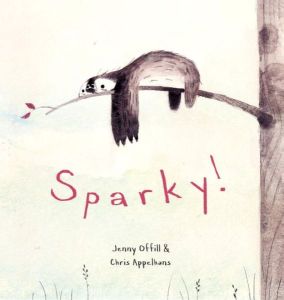
Perhaps given my children’s tendency to stallllllllll, or perhaps just because it’s a darling story from start to finish, I am totally taken with Jenny Offill and Chris Appelhans’ Sparky! (Ages 4-8), a new picture book about a girl’s ambivalence surrounding her pet sloth’s inability to perform on command (or, frankly, do much of anything). « Read the rest of this entry »
An Easter Bunny All Moms Can Get Behind
April 15, 2014 Comments Off on An Easter Bunny All Moms Can Get Behind
 When JP was three years old, and I went from working full time to staying home full time, these were the thoughts that kept me up at night: What will happen when my children see me as “just a mom” instead of as a mom and a professional? Will they respect the work I do? Will they think of it with the same importance that they bestow upon their father, when he leaves for the office every morning? Will they grow up believing that women aren’t capable of the same career success as men—or entitled to make the same sacrifices, reap the same compensation for comparable work? Will I be a role model for them or merely someone whom they take for granted?
In the past four years, I have largely reconciled my angst around these questions. I’m keenly aware that even to have the choice to stay home is a luxury not afforded to all—and one that could abruptly end for me someday. The work that I do every day on behalf of my kids, my husband, and our house makes all of us happy. But I’m also aware that when I did work 9-5, the time that I made for my (at the time only) child was quality, focused time. I got down on the floor and played with my son more than I probably do today, when too often I’m in the kitchen or chatting to other moms on the sidelines of playdates. I think about my own mom, who was around every single day, and how out-of-this-world excited I got when my dad’s car pulled into the driveway at night. There is perhaps some inevitability in taking for granted quantity and romanticizing quality.
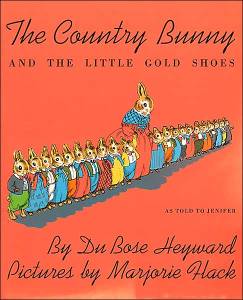
But perhaps at no time do I feel greater validation as a mother—stay-at-home or not—than when I take out The Country Bunny and the Little Gold Shoes (Ages 4-10) and read Du Bose Heyward’s 1939 classic to my kids each Easter season. As much as the story is a celebration of traditional motherhood, it is also one of the earliest feminist tales—for a simple mother bunny outwits her bigger, stronger, prouder, and more handsome male competitors to earn the coveted position of fifth Easter Bunny. « Read the rest of this entry »
Connecting Through Diversity
March 25, 2014 § 1 Comment
 A rousing op-ed piece by acclaimed children’s author Walter Dean Myers, recently appearing in The New York Times, poses the uncomfortable question: “Where Are the People of Color in Children’s Books?” The startling statistic cited at the beginning reveals that of the 3,200 children’s books published in 2013, only 93 were about black people. Myers later compares this statistic to the 40% of public school students nationwide who are black or Latino. As a black boy growing up in Harlem, Myers’ initial love affair with reading quickly turned to disinterest, as he discovered the glaring lack of literary characters who looked and lived like him. As an adult, Myers has dedicated his career to writing prolifically about inner-city youth, calling his novels “a validation of their existence as human beings.” But it’s about more than providing validation to people with color, he notes. It’s also about how these individuals are seen by the rest of us:
Books transmit values. They explore our common humanity. What is the message when some children are not represented in those books?
As someone who sold picture books for many years, what often strikes me about today’s offerings for young people is not the lack of books featuring people of color (that is clearly a fact), but how quickly a book with a black figure on its cover almost always signifies a story about a “race issue,” be it a story about a slave traversing the Underground Railroad or one about a contemporary black girl overcoming her classmates’ prejudice to star in the school play. Many of these are beautiful, powerful picture books—but they are also ones that, too often, only end up seeing the light of day during calendar events like Black History Month. Especially among white families, they are treated more like “teaching tools” for the classroom and less like the books we purchase and leave strewn around our house, hoping for our children to discover and devour them. « Read the rest of this entry »
Embracing Ordinariness
February 26, 2014 § 6 Comments
 The lovely new picture book, ExtraOrdinary Jane (Ages 3-100), by first time author-illustrator Hannah E. Harrison, has me all fired up—but in a good way. Jane, a fluffy little white circus dog, “was ordinary, in a world that was extraordinary.” She isn’t “mighty” like her elephant-lifting father, or “graceful” like her ballerina mother. She isn’t “daring” enough to be shot out of a cannon like her six canine brothers. Try as she does to “find her special talent,” she encounters either mediocrity (her paintings lack “pizzazz”) or failure (her musical renditions send others running).
While the book may be set in a circus, its poignant, carefully worded message is clearly intended to transcend the Big Top. Recently, I’ve been thinking a lot about what it means to be ordinary in our increasingly supercharged, achievement-obsessed society. Bringing up kids today means confronting talent at seemingly every turn: the athlete that tears down the soccer field; the six year old who is already in her third year of violin; the kid who reads at three grade levels above her peers. It’s not enough for children to be good at something; they are expected to be the best. When I was growing up, it wasn’t until I was applying to college that I was asked to think about the concept of “expertise.” Today, the question is on preschool applications: “What special skills/talents does your child have?” « Read the rest of this entry »
Friends Make Everything Better (A Pick for Valentine’s Day)
February 10, 2014 § 2 Comments
My family spent this past weekend holed up in the snowy hills of West Virginia with three other families. Once we adults began to block out the chatter and squeals of nine (mostly) happy children running circles around us, we were able to entertain some blissful grown-up time. And as I watched my children mature and transform across three full days of kid-on-kid time, I found myself feeling immensely grateful for friendships of both the tall and short kind. In this winter that has gone on too long, it is our friends that have put smiles on our faces, ideas in our head, and glasses of wine in our (adult) hands.
With Valentine’s Day shortly upon us, I’ve once again chosen a bit of a non-traditional path for my children’s gifts (and, gasp, I’ve even cheated and given the gifts early!). This new picture book—by a first-time author-illustrator—rises above the saccharine-sweet-mushy-gushy-dime-a-dozen stories out there by celebrating friendship in a unique, quirky, unforgettable way.
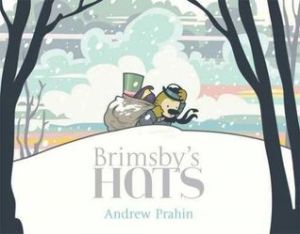
In Andrew Prahin’s Brimsby’s Hats (Ages 4-8), Brimsby, a hat maker by trade, already knows what it is like to have a best friend: someone with whom he shares his creations over tea, and “together, they have the most wonderful conversations.” But when the friend follows his dream to become a sea captain and sails away, Brimsby is left to pass the months away alone in his quiet cottage in the country, without so much as a single visitor.
 What to Read to Your Kids