2020 Gift Guide: Middle-Grade Fiction for Ages 8-14, Part One
November 12, 2020 § 1 Comment
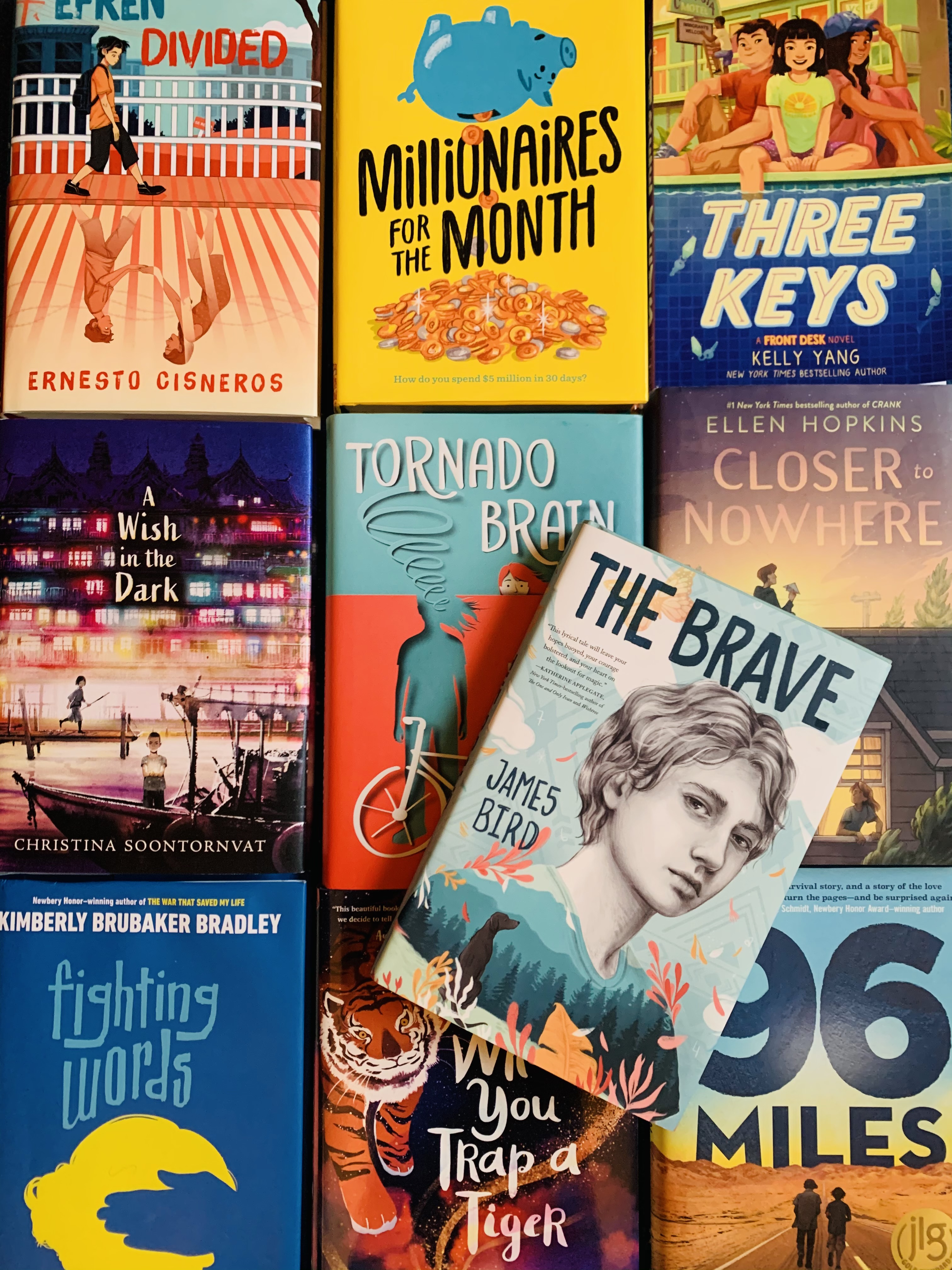
As evidenced by the massive stack I’m bringing to you today and tomorrow, 2020 delivered some fantastic middle-grade fiction, including a number of novels by debut authors your kids won’t forget anytime soon. (It delivered non-fiction as well, as evidenced by my earlier endorsement of the astounding All Thirteen.)
One could make a case that storytelling has never been more essential. The stories below will take children far beyond the four walls of their home. They will entertain and inspire, while also eliciting empathy for those with different lived experiences. They will comfort, nurture, even heal. They’re the hope our children need to go forth into a brighter 2021.
A few of the novels I blogged about earlier in the year but mention again because I live in fear that you might miss them. The rest are new to these pages. (Remember, you won’t find any 2020 graphic novels here, because they got their own post.)
Below are the first ten. The second ten will follow tomorrow. I’ve taken particular care in noting the suggested age range below each title. Some of these skew younger, others older. I hope I’ve found something for every tween and young teen in your life.
« Read the rest of this entry »2020 Gift Guide: Favorite Graphic Novels for Ages 6-15
November 5, 2020 § 7 Comments
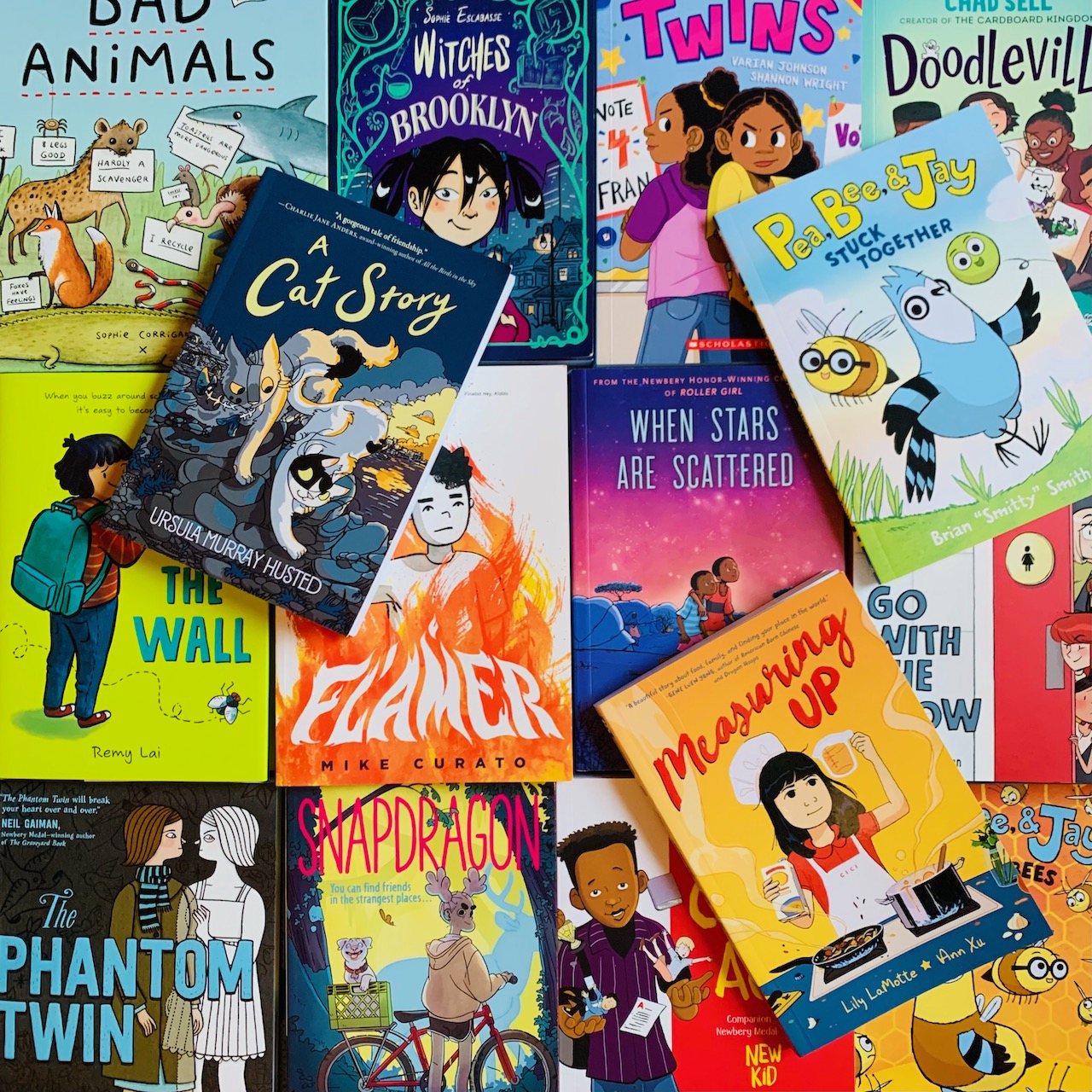
Back by popular demand: an installment of my Gift Guide devoted entirely to my favorite graphic novels of the year! Graphic novels make some of the best gifts. Not only are they coveted among emerging readers, tween readers, and teen readers alike, but they invite repeat readings. I’ve watched my kids race through a new graphic novel as soon as they get it, then a few days later start it over again, spending more time on each page. After that, they might set it down for a few weeks or months or years, only to pick it up again with fresh eyes. It’s no wonder many of the graphic novels below took over a year to create; they are packed with visual nuance, literary allusions, and layered meanings. Like treasured friends, graphic novels grow with their readers.
I read dozens and dozens of graphic novels in preparation for this post. Below are the ones that rose to the top in originality, beauty, fun, diversity, or impact. A few of these you’ll remember from a blog post I did earlier this year, but they bear repeating because they’re that good. There are others, like the new graphic adaptation of Roald Dahl’s The Witches, which my daughter was horrified wasn’t included here. I simply had to draw the line somewhere.
The list begins with selections for younger kids and concludes with teens. Enjoy and happy gifting!
« Read the rest of this entry »2020 Gift Guide: Picture Book Round-Up
October 29, 2020 Comments Off on 2020 Gift Guide: Picture Book Round-Up
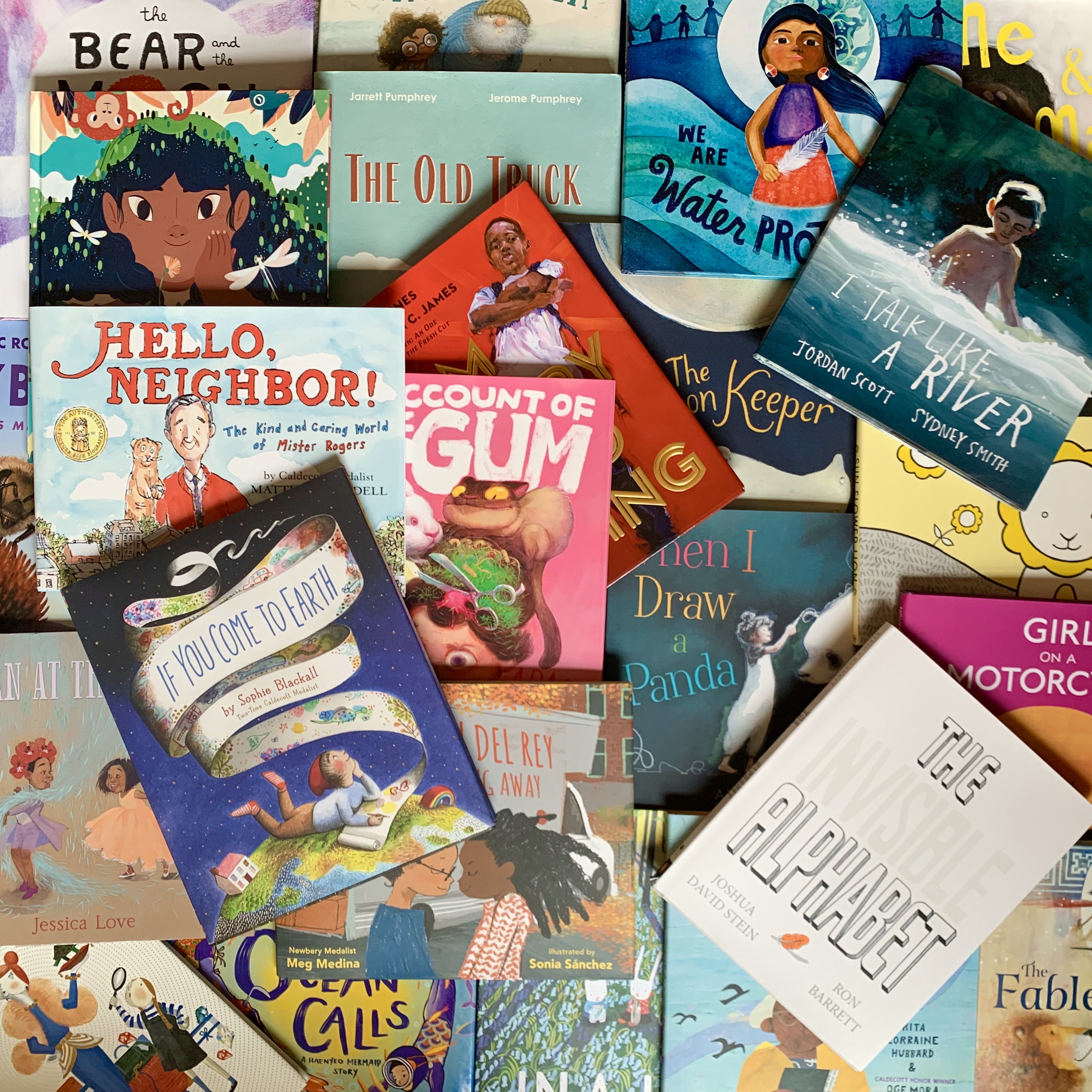
Last week, I told you about my two verrrrry favorite picture books of the year: The Bear and the Moon (Ages 2-6) and Girl on a Motorcycle (Ages 5-9). Today, I’m telling you about others I like a whole heck of a lot. I’ve selected titles, both fiction and non-fiction, for a range of ages, from two to ten years old. Some of them are jaw-droppingly beautiful; others elicit laughter; many invite wonder and compassion. All of them are deserving of a permanent home, where they can be enjoyed again and again and again.
Before we start, there are several I’ve already blogged about this year. Rather than repeating myself, I’m going to link to my original posts. The ones with mega gift potential from earlier in the year are Me and Mama (Ages 2-6), The Ocean Calls (Ages 4-8), Madame Bedobedah (Ages 5-9), Swashby and the Sea (Ages 3-7), The Fabled Life of Aesop (Ages 5-9), In a Jar (Ages 4-8), and The Oldest Student (Ages 6-10).
And now, here are ones new to these pages:
« Read the rest of this entry »2020 Gift Guide: My Favorite Picture Book for the Elementary Crowd
October 22, 2020 § 3 Comments
As a nervous flyer, I never thought I’d write this, but I really miss getting on airplanes. Traveling is something I’ve never taken for granted, but I’m not sure I realized just how much I crave it until it wasn’t an option. I miss stepping off a plane, filled with the adrenaline of adventures ahead. I miss unfamiliar restaurants and museums. I miss natural wonders so far from my everyday environs it’s hard to believe they’re on the same planet. I miss squishing into a single hotel room, each of us climbing into shared beds after a day of sensory overload and, one by one, closing our eyes. I can’t wait until we can travel again.
In the meantime, we look to books to fuel our longing to see the world, to keep alive this thirst for the unfamiliar and the undiscovered. No picture book this year delivers on this promise quite like Girl on a Motorcycle (Ages 5-9), by Amy Novesky, illustrated by Julie Morstad, based on the actual adventures of Anne-France Dautheville, the first woman to ride a motorcycle around the world alone. From her hometown of Paris to Canada, India, Afghanistan, Turkey, and other exotic destinations, we travel alongside this inquisitive, fiercely independent girl as she heeds the call of the open road.
Morstad is no stranger to illustrating picture book biographies—It Began With a Page: How Gyo Fujikawa Drew the Way made last year’s Gift Guide—and part of her remarkable talent stems from adapting her illustrative style to the subject at hand, while still creating a look and feel entirely her own. In Girl on a Motorcycle, Morstad infuses a ’70s palette of glowy browns and moody mauves onto the dusty backdrops of the Middle East, the dense evergreens of the Canadian countryside, and the ethereal sunrises. Additionally, Morstad gives the protagonist herself a kind of badass glamour every bit as alluring as the scenery itself. How can we not fall for someone who packs lipstick next to a “sharp knife”? It’s as if Vogue jumped on the back of a motorcycle, slept in a tent at night, and made friends with locals along the way.
« Read the rest of this entry »When You Don’t Have a Mute Button
October 1, 2020 § 2 Comments
 If Tuesday’s presidential debate has taught us anything, it’s that 2020 should have come with a mute button. Because meditation alone isn’t going to cut it. Ditto to stocking our freezers with double-chocolate brownie ice cream. Adulting is hard enough right now without adding parenting (and schooling) to the mix. And yet, our children are bystanders to this hot mess unfolding around them. With our own blood pressure camped out at dangerously high levels, how do we offer some semblance of sanity for our precious little ones?
Back in July, I came across a blog post written by a practicing psychotherapist out of Colorado named Sara Waters. She was addressing the stress parents were feeling while waiting for schools to announce their reopening plans (HA, remember when we thought that was worth losing sleep over?). Like many parents at the time, I was spending way too much time crawling along the bottom of the Internet, desperate for someone to reassure me that my children would be safe this fall. Waters surfaced with the reassuring reminder that, while we might not be in control of what happens outside our front door, we can control what happens inside:
The number one most determining factor of your child’s 2020 experience is YOUR ability to manage your OWN discomfort. Mirror neurons are real and even children who haven’t yet learned to understand or speak language will pick up on the quantum vibrational frequencies of distress that you emit. Your children hear you talk, even when you aren’t talking to them. They hear you complain. They hear you vent. They watch your facial expressions when you are on a phone call or responding to an email or social media post on your computer. They can feel whether you are relaxed or whether you are in a state of stress when you wake them up in the morning, sit down for a family meal, or tuck them into bed at night. […] Whether you like it or are aware of it or not, they will feel what you feel.
I’ve thought about this reminder many times since that last week in July, including and especially when I picked up Cozbi A. Cabrera’s joyous new picture book, Me & Mama (Ages 2-6), a lyrical celebration of the bond between one daughter and her mother. Reading this story is like wrapping yourself in a cocoon of domestic love. Reminiscent of one of last year’s favorites—Oga More’s Saturday—this book speaks directly to the power we hold as parents to set tone, to cue young children’s feelings about the world and their place in it.
We sometimes forget that motherhood comes with its own special set of superpowers. We can smile at our children; we can dance in their presence; we can light up when they walk in the room. None of the stressors in the world can compete with that.
Emily Dickinson: Perfect Reading for a Pandemic?
September 24, 2020 § 2 Comments
 Not many people know this, but my daughter is named after Emily Dickinson. (Well, and the heroine of L.M. Montgomery’s Emily of New Moon.) I didn’t fall for Emily Dickinson’s poetry until I got to college, when I fell hard and fast and ended up featuring her poems in no fewer than seven essays, including my Senior Thesis. I had never been a big poetry lover, but there was something about the compactness of her poems which fascinated me. So much meaning was packed into such few words. And even then, the meaning was like an ever-shifting target, evolving with every reading.
To read Emily Dickinson is to contemplate universal truths.
Apart from reading Michael Bedard and Barbara Cooney’s 1992 picture book, Emily, I hadn’t had much occasion talk to my own Emily about her namesake. But that changed last spring, when my Emily started writing poetry of her own. Nothing about virtual learning was working for her, until her teachers started leading her and her classmates in poetry writing. Suddenly, my daughter couldn’t jot down poems fast enough, filling loose sheets of paper before designating an orange journal for the occasion. She wrote poems for school, for fun, and for birthday cards. It didn’t matter that they weren’t going to win awards for originality; what mattered was that she had found a means of self-expression during a stressful, beguiling time.
Jennifer Berne’s On Wings of Words: The Extraordinary Life of Emily Dickinson (Ages 7-10), stunningly illustrated by Becca Stadtlander, could not have entered the world at a more perfect time. It opens a dialogue, not only about Dickinson’s unconventional life, but about her poems themselves. At a time when a pandemic has prompted many of us and our children to turn inward, this picture book is less a traditional biography than an homage to the rich interior life developed by this extraordinary poet and showcased in her poetry.
Family, Foes, and Frida the Fox
September 17, 2020 § 3 Comments
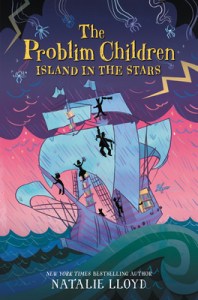 As my kids have gotten older, reading aloud to both of them together (at the dinner table, because sanity) has largely replaced reading to each one individually. Still, sometimes a book comes along that begs to be read to one and not the other. Natalie Llyod’s The Problim Children series, which recently concluded with Island in the Stars (Ages 8-12), feels as if it were written for my daughter, ever watchful for signs of magic in her own life and fascinated by the dynamics of large families. Lloyd’s plot lines, with their plucky heroines and sinister villains, are evocative of Roald Dahl, another read-aloud favorite, though her writing has a dreamy quality all her own—a perfect match for my daughter’s non-linear brain.
Over the past eighteen months, Emily and I have drawn out reading these books together, savoring them on weekend mornings when her brother wakes up full steam ahead but she’s still content to climb into my bed with her arms full of stuffed sheep, burrowing her sleepy body into mine. When we got to the end of the third and final book, I didn’t tear up just because of the story’s beautiful ending; I know these years of reading together are fleeting.
The fleetingness of childhood is a theme which runs through The Problim Children series, named for the seven siblings at the center of this most memorable family. On the one hand, a series of precipitous events pushes these siblings to grow up in a hurry: in just a few weeks, they must unravel a series of riddles left to them by their late grandfather, rescue their parents from the evil Augustus Snide (nicknamed Cheese Breath), and destroy a fountain of youth without being tempted to drink from it. And yet, even as they tackle these adult problems, the Problim siblings exist in that enticing storybook place outside the realm of the adult world. They march to the beat of their own drum, operating under their own set of rules and decorum. No matter what life deals them, they hold fast to their childlike sense of wonder, their belief in the impossible, and their fierce love for one another.
Overnights with Grandma
September 10, 2020 § 9 Comments
 This Sunday is Grandparents’ Day, a holiday I’ve never given much thought to until this year, when I am without any living grandparents. Losing both my grandmothers in the past year hasn’t just been about mourning these loving, larger-than-life figures. With their passing, I have lost physical places as well.
My mother’s mother died in her Buffalo home, where she lived for over forty years, and where I traveled every summer from the time I was eight and my parents put me on an airplane by myself. Gockamama, as I called her, lived on the top floor of an historic building, with a grand lobby, an old-fashioned elevator, and its own name to boot. Walking into that apartment was like walking into a musty, magical era, from the antique grandfather clock which tolled every thirty minutes, to the oil painting of Napoleon which hung in the dining room. With no other buildings between her and Lake Erie, you could stand at the window, curling your toes into the plush carpet, and see all the way to Canada. It was like being wrapped in a cozy cocoon, suspended above the world.
We’d spend mornings watering her dozens of plants lining every window, then evenings watching Murder, She Wrote (I pretended to watch, while sneaking peeks at my book). I’d take bubble baths in her bathroom, with its avocado-green tile and pink fluffy towels. At breakfast, she’d sprinkle sugar on my grapefruit; for dinner, I’d request her Spaghetti Bolognese. She kept a closet shelf stocked with old toys and a cookie tin filled with my favorites: misshapen wonders made with chocolate, peanut butter, and Rice Crispies. Photos in frames covered every horizontal surface, and as I became more interested in travel myself, she would pull down photo albums and show me pictures of the Great Wall of China or Ephesus in Turkey, places I immediately longed to visit.
Walking out of that apartment for the last time, on the heels of my grandmother’s funeral, felt like leaving behind a part of me. Inside those walls, during our cherished visits, I had been my grandmother’s entire world. I had taken up space in the way only a grandchild can, each treasure of that apartment intermingled with the love she felt for me. My mother couldn’t believe the sofa cushions had become so threadbare, but when I sank into them, it felt like I was exactly where I was supposed to be.
Sara O’Leary’s endearing new picture book, Maud and Grand-Maud (Ages 3-7), about the overnight visits a young girl has with her namesake grandmother, perfectly captures, not just the singular intimacy of the grandparent-grandchild relationship, but the special rituals and strong sense of place often intertwined with it. This feat is in large part owing to Kenard Pak’s delicate illustrations, whose muted tones conjure a hint of mustiness and whose washes of color exude wistfulness. It’s the kind of book you want to hold to your heart. It’s no wonder I spilled tears onto its pages the first time I shared it with my daughter.
At Home in the Ocean
September 3, 2020 § 3 Comments
 My son’s favorite sport is swimming, but it wasn’t always this way. For five years after he was born, he refused to put his head under water. He was delighted to be held in water, or to float with a floatie, but none of us—not me, not his dad, not his grandfather, not his aunt—could convince him to submerge his face.
Eventually, I got the name of a private swim instructor who was supposed to have a magic touch. I phoned her but she was fully booked. A few weeks later, she phoned back. She had a cancellation on an upcoming Thursday at 7pm. JP’s bedtime was 7pm, so this seemed like poor parenting at best, but I was a mother on a mission, with a zeal often reserved for firstborns. I told her we’d see her Thursday.
What happened next is a story our family loves to tell. While I watched from deck, the instructor, clad in a black wet suit, took JP’s hand and led him down the ramp of the zero-entry pool. When the water hit JP’s waist, she stopped. “So, JP,” she said, “do you go under water?”
“No,” my son replied.
“Would you like to try?” she asked.
Barely a pause. “OK,” he said. And then, right before my eyes, this child with a stubbornness to match mine, threw himself face down into the water.
He threw himself face down into the water. Part of me was overjoyed. And part of me had to keep from screaming, ARE YOU KIDDING ME?!
My husbands like to joke that this was when we realized that our son has no interest in learning from his family. Our teaching is inherently suspect, probably flawed, because what do we know? This instructor—who went on to teach him very fine strokes for the next five years—was an expert in his eyes, and so he instantly trusted her. (We consider it a major triumph that we did not have to hire a professional to teach him to ride a bicycle.)
Still, I don’t think the swim teacher’s trust was won just because JP regarded her as an expert (whereas we were just flailing novices). Truth be told, she exuded calm. You had only to spend ten seconds with her to understand that she was more at home in the water than out of it. She loved the water, she trusted herself in the water, and when she directed her full attention onto my son, he felt like he’d come home, too.
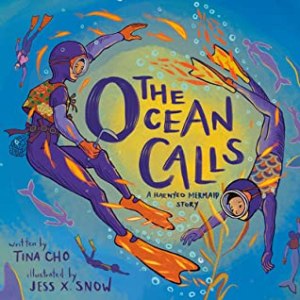
“The ocean is calling me today,” says the grandmother at the beginning of Tina Cho’s new picture book, The Ocean Calls: A Haenyeo Mermaid Story (Ages 4-8), one of the most fascinating and exquisite examples of a symbiotic relationship with water that I have ever seen. Set on the shores of Jeju Island in South Korea and luminously illustrated in jewel tones by Jess X. Snow, the story is about the relationship between a girl, struggling with her fear of the ocean, and her grandmother, a haenyeo mermaid, who holds her breath for two minutes at a time and dives up to thirty meters to bring back armfuls of shellfish for eating and selling. Here’s the coolest thing: the haenyeo tradition is real! It goes back centuries among indigenous Pacific islanders, remains alive today, and plays a vital role in ocean ecology.
The Stories We Tell Ourselves
August 27, 2020 § 2 Comments
 My aunt used to hold an annual Christmas Eve party at her apartment on the eighth floor of a building just two blocks from ours in New York City. It was a small group, rarely more than twelve, and we were the only relatives ever invited. We only saw these friends of my aunt once a year, but before the elevator reached the bottom floor at the end of the evening, I was already looking forward to next year’s gathering. My aunt had been the editor in chief of a major magazine, and her friends were artistic, eccentric, and alluringly mysterious.
There was one woman in particular whom I adored. Always the last to arrive, she would come through the door shrouded in a floor-length black fur coat. Her perfect coif of white hair was sharply angled at her chin, and she moved in a cloud of exotic perfume. Her raspy smokers’ voice was fond of the word “darling,” and she always addressed me as if I was an adult. Perched on the sofa sipping my ginger ale, I inched as close to her as I could, throwing back my head with laughter as she did.
She lived downtown where the artists were, and I knew little about how she spent her days, other than that she and her husband had never had children. What I wouldn’t give to go back in time and ask her any number of questions! As children, we’re content with the stories we tell ourselves, the ones we make up in her head, and I fashioned endless stories for this larger-than-life woman in black, who seemed to float effortlessly around my aunt’s apartment, captivated by everything and nothing at the same time.
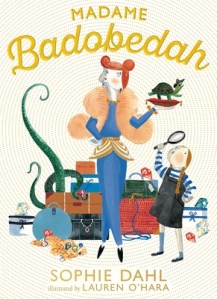
Sophie Dahl’s marvelous picture book, Madame Badobedah (Ages 5-9), told in three chapters over 53 pages and amply accentuated with retro illustrations by Lauren O’Hara, stars a young protagonist spellbound by an eccentric stranger who shows up for an unlimited stay at her parents’ hotel by the sea. This stranger barely opens her mouth before Mabel has developed theories about the feathers draped around her neck, her stacks of weathered trunks, and her prized pet tortoise. But warm to her from the start Mabel does not. Resentful of the woman’s haughty demeanor, Mabel quickly convinces herself that, rather than a solitary woman healing from heartbreak, she’s a jewel thief on the run. What follows is a riotous narrative, ultimately giving way to a warm intergenerational friendship perched somewhere in the middle of fiction and reality.
All in a Name: A Back-to-School Post
August 20, 2020 Comments Off on All in a Name: A Back-to-School Post
 When our kids return to school this fall, whether in person with a mask or at home over a computer, there will be unusual circumstances to navigate. But for many children, pandemic or not, the start of school is already fraught with potential landmines. Will I make a friend? Will I like my teacher? Will I understand the rules?
Will my name be mispronounced?
Those of us with Anglo-Saxon names may have never considered this last question, but those with African, Asian, Black-American, Latinx, and Middle Eastern names know how commonly, if unintentionally, their names are mispronounced. What does it feel like to be on the receiving end of a teacher or classmate stumbling through your name? What does it feel like to be expressly teased for your name? What does it feel like to be asked to shorten or alter your name to make it easier for classmates to say?
For many, personal names play a central role in cultural identity and identification. If we don’t put in the work to pronounce a name correctly, we’re not allowing that person—in this case, that young child—to be seen. At best, we are belittling them; at worst, we are erasing them.
One of my daughter’s dearest school friends has a name whose South Asian pronunciation is different than English phonetics would suggest. The difference is subtle, but my daughter will correct anyone—especially me—who doesn’t say it with the right cadence. I’ve been touched by this gesture of loyalty over the years, and I know it’s owing to the care the girls’ teachers have taken to create a space where students are actively working to understand and appreciate one another.
What I’ve also frequently noted is how musical my daughter’s voice sounds when she speaks her friend’s name. The idea that all names can be celebrated for their musicality is the inspiration behind Jamilah Thompkins-Bigelow’s new picture book, Your Name is a Song (Ages 4-8), a fast favorite with my daughter. Tenderly illustrated by Luisa Uribe, the story centers a Black American Muslim girl, who leaves her first day of school dejected and angry because “No one could say my name.” As her mother works to rebuild the girl’s confidence, she creatively and thoughtfully debunks many of the negative stereotypes associated with non-Anglo names, especially those with African or Middle Eastern origins: they’re hard to pronounce; they’re cacophonous; they signal danger; they’re made-up nonsense.
When the Sea Works its Magic
August 6, 2020 § 3 Comments
 The value of a change of scenery during this pandemic cannot be overstated. Last week, we spent five nights in a rental on the Chesapeake Bay, our front door just steps to a tiny slice of sand, a bank of beautiful rocks, two kayaks, and a half mile of clear shallow water for wading, before dropping off to deeper water and stunning sunrises beyond.
The entire trip felt like a brief return to normalcy (look, we’re a family who vacations!). It was also a gift which arrived at precisely the right time. In the weeks leading up to our departure, I felt a heaviness descend on our family, the sum total of weariness from the past five months and the grinding uncertainty of the new school year.
The sea knew what we needed. For a few magical days, it drew us out of our heads and into our bodies, then engulfed us in a delicious weightlessness. It gave us expanses of space—so much space—at which to marvel, after staring at the inside of four walls for too long.
The sea didn’t get everything right (we didn’t need the jellyfish), but it reminded us that there is beauty in the world, that it hasn’t gone anywhere, and that in connecting to this beauty we can connect to the best in ourselves. We can be a little looser. A little messier. Smile a little more.
As it turns out, one of my favorite picture books of the year also features some welcome meddling by the sea. It has been awhile since I hailed a beachy picture book (last were here and here), and this one proves well worth the wait. Swashby and the Sea (Ages 3-7), written by Beth Ferry and illustrated by Juana Martinez-Neal (quickly becoming one of my favorite contemporary illustrators), reminds us that sometimes the sea knows what we need even before we do.
Zoe Washington’s “Good Trouble”
July 23, 2020 § 1 Comment
 When John Lewis passed away last weekend—ending a 60-plus-year career of social activism and civil rights legislation—I was struck by how many tributes invoked the Congressman’s tweet from 2015, in which he shared a mugshot from his time in prison 54 years earlier, arrested for using a “white” bathroom in Jackson, Mississippi. The photo was captioned: Even though I was arrested, I smiled bc I was on the right side of history. Find a way to get in the way #goodtrouble
Another of his tweets in 2018 further underscores this notion of “good trouble”—a phrase Lewis became known for:
Do not get lost in a sea of despair. Be hopeful, be optimistic. Our struggle is not the struggle of a day, a week, a month, or a year, it is the struggle of a lifetime. Never, ever be afraid to make some noise and get in good trouble, necessary trouble.
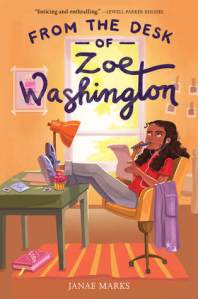
If you’ve asked me for a middle-grade book recommendation in the past two months, you’ve probably heard me go on and on and on about Janae Marks’ debut novel, From the Desk of Zoe Washington (Ages 9-13). If you follow me on Instagram, you may know I chose this title for a summer book club, after my third graders (bless them) begged me to continue hosting Zoom meetings. The book was not only a favorite of the year for most of the kids, nearly every parent emailed me to report that the story was yielding rich, important, anti-racist conversations around the dinner table.
If you are looking for a book to start a conversation about systemic racism, this one’s a gem. It’s not just that it offers awareness about the bias in our criminal justice system—the story features a Black character (Zoe’s father) serving time for a crime he may not have committed—it’s that it offers hope for a more just world. It’s a story about a girl who asks hard questions, who isn’t content to accept things as they are, and who makes some “good trouble” of her own when the adults in her life fail to step up.
Of course, none of these messages would be nearly as effective if the story itself wasn’t fan-freakin-tastic. This is not a heavy-handed “issues” book. It checks every box of a perfect tween story: it’s well-paced; the protagonist is immensely likable; there’s mystery, intrigue, and no shortage of fun and relatable sub-plots (baking! music! friendship drama!). It’s a book nearly impossible to put down, but it’s also a story packed with nuggets ripe for pulling apart and discussing. Read this book to or alongside your tween; you’ll both be better for it. (And may I recommend you encourage your child to make a playlist of the songs Zoe discovers from her father, because isn’t it high time our kids started listening to Stevie Wonder? Also: Fruit Loops cupcakes. Yup, it’s a thing.)
Moving Past Color-Blindness
June 25, 2020 § 2 Comments
 I have been drafting this post in my head for two weeks, terrified to put pen to paper for the dozens of ways I will certainly mis-step. Raising children dedicated to equity and justice has always been important to me—if you’ve been following my blog, you’ll recognize it as a frequent theme here—but only lately have I pushed myself to consider the ways my own privilege, upbringing, and anxiety have stood in the way of that. It is clear that I cannot raise my children to be antiracist if I am not prepared to do the work myself.
When my daughter was three, I brought her to the pediatrician’s office for a rash. As we sat in the waiting room, watching and remarking on the colorful fish swimming in the aquarium, my daughter suddenly turned to me. “Mommy, is the nurse going to be black-skinned?”
Embarrassment rose in my cheeks. “Oh honey, I’m sure any nurse here is a good nurse. Let’s not—”
Her interrupting voice rose about ten decimals. “Because I am not taking off my clothes for anyone with black skin!”
Just typing this, my hands are shaking. I am back, seven years ago, in that waiting room, aware of all eyes upon us. Aware of the brown-skinned couple with their newborn baby sitting directly across from us. This can’t be happening, I thought. This can’t be my child. She goes to a preschool with a multicultural curriculum. We read books with racially diverse characters. She plays with children who look different than her. Shock, outrage, and humiliation flooded every inch of my being.
Caught off guard and determined to rid myself of my own shame, I fell into a trap familiar to many white parents. For starters, I came down hard on her. I took my shame and put it squarely onto her. I was going to stop this talk immediately. I was going to prove to everyone listening that this was unacceptable behavior in our family. I was going to make it…all about me.
“Stop it!” I said firmly. “We do not say things like that.” Then, I started rambling about how we shouldn’t judge people by how they look, how underneath skin color we’re all the same, how we’re all one big human family, and so on. You know: the speech. The color-blind speech. The one where white parents tell their children to look past skin tone to the person underneath. The one where we imply that because skin color is something we’re born with, something “accidental,” we shouldn’t draw attention to it. The one where we try and push on our children a version of the world we’d like to inhabit, as opposed to the one we actually do.
My three year old was observing—albeit not kindly or subtly—that not everyone looked the way she did. And she wasn’t sure if that was OK. She was scared. She was uncomfortable. Because we weren’t talking about skin tone or race with her at home, because our conversations (however well-intentioned) steered mainly towards platitudes of kindness and acceptance, she had begun to internalize the racial assumptions around her. She had used the descriptor “black-skinned,” I later realized, whereas if she had simply been observing skin tone, she would have said brown skin or dark skin. The word she chose was a reference to race. A loaded word. Something she had heard. Something she didn’t understand. Something she was beginning to associate with something less than.
We don’t want our children to use race to make judgments about people, so we’d rather them dismiss race completely. Except, in a society where race is embedded into nearly every policy and practice, it is impossible not to see race. So instead, what we are really communicating to our young children is, I know you notice these differences, but I don’t want you to admit it. (Including to yourself). Good white liberal children don’t talk about their black and brown friends as being different from them. Even more problematic, good white liberal children love their black and brown friends in spite of these differences.
Sharing a Love of Travel (A Father’s Day Post)
June 11, 2020 § 1 Comment
 This Father’s Day, my own father will have been gone for twenty-six years. Twenty-six years. One of the most devastating things about losing a parent when you’re eighteen is that you never get to know that parent through an adult lens. I knew my father intimately, from his scratchy mustache to his eye-rolling wisecracks to his endless patience as I described every painstaking detail of my day. But I knew him as a child knows a parent. How I wish I could have known him as an adult.
In times of great upheaval and unrest, I feel my father’s absence most keenly. Every seismic shift in our world puts that much more space between him and me. How would he be participating in this national conversation about race? Would he be marching with a Black Lives Matter sign? What candidate would he have supported in the last Democratic primary? How would social distancing have impacted his life in retirement—or would he still be practicing law? What kinds of things would he enjoy doing with his grandchildren?
I can’t pretend to know the answers to these questions, though I ask them quietly to myself all the time.
What I do know is that there are certain things which always bring him back to me. And one of them is travel. My father’s love of travel was legendary. When I was very young and he would travel internationally for work, he’d always bring me souvenirs—usually dolls—from places like Brazil, Mexico, and Germany. I loved gazing at the tiny porcelain faces or printed fabric clothes and imagining where they had been. Our house was full of black-and-white photographs from before my time: my father on a camel in the Sahara, my father on a motorcycle in Greece. When I decided to spend a gap year in Vietnam after high school, he jumped at the chance to accompany me across the ocean. When, weeks later, it came time for him to return to the States, his parting words were, “It looks like you’ve got the travel bug now, too.” I beamed with pride.
It seems fated that I would fall deeply in love with Jenny Sue Kostecki-Shaw’s new picture book, Papa Brings Me the World (Ages 3-7), in which a young girl describes her affection for a father who travels the world and brings pieces of it back to her. I’ve long been a fan of Kostecki-Shaw’s (my daughter still pulls out Luna & Me), but this book positively transported me. Maybe because it’s inspired by the author-illustrator’s own father; maybe it’s because the theme of found objects lends itself beautifully to mixed-media collage; or maybe it’s because the voice of the little girl reminds me of my young self, brimming with tenderness and curiosity and admiration and longing for my father’s stories of adventure.
Adventures in Siblinghood, Quarantine Edition
May 28, 2020 § 7 Comments
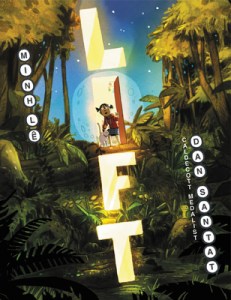 It was the best of times, it was the worst of times…it was the sibling relationship during quarantine. My daughter spent last Saturday night at her aunt’s house, and while my husband and I enjoyed a peaceful night with our son, it dawned on me: it’s not my children who have been sucking up all the oxygen in our house, it’s their relationship.
I’m grateful my children have each other at a time when they have no one else. But because they have no one else, they’ve pinned all their hopes and dreams and frustrations and jealousies on one another. Everything they’ve always done is now executed with a new level of intensity. They tear into each other over the smallest offenses (“Stop whistling!” “Stop looking at me!” “I can’t sit hit here because your feet smell!”), only it escalates into poking and clawing and just-plain-mean yelling, like they haven’t done since they were much younger. If I separate them (“This house may be small, but there is enough room for you to spread out”), they’re back together again before I can get down the stairs. Only, suddenly, they’re curled up in a teeny tiny fort of their own design, a tangle of limbs impossible to tell where one stops and the other begins, giggling and scheming and reveling in the giant mess they’ve strewn across the upstairs.
Four whole hours before my daughter was scheduled to come home from her sleepover last weekend, my son was already watching for her from the window.
The only thing that could make this current state of affairs any more intense would be an elevator button. If there is one small consolation to not being able to go places right now, it’s that we can at least avoid the universal sibling fight over who gets to push the elevator button. There has never been a harmonious moment of siblinghood that wasn’t ruined by a gosh darn elevator button.
Lest we forget about life with elevator buttons, Minh Lê and Dan Santat have teamed up to create a comics-inspired picture book to remind us. And yet, Lift (Ages 4-8) isn’t about ordinary elevator buttons. Well, at first it is. But then that button becomes something magical. Something illuminating and insightful and spectacularly fun. Something which drives siblings apart—but then brings them back together, united in a common purpose. All without leaving the house.
Summer Reading to Save Us: Massive Middle-Grade Roundup
May 21, 2020 § 1 Comment
 I have a confession. As our summer plans are being ripped away from us—slowly, painfully, like the stickiest of band-aids—I am secretly stockpiling books and puzzles. It’s compulsive. Possibly certifiable. But I can’t help it. In some tiny, naively optimistic part of my brain, I believe if we have stockpiles of books and puzzles, we won’t wake every morning and cry over missed swim meets and sleepaway camps and beach vacations. Even if it’s sweltering. Even if we can’t leave the house. Oh, who am I kidding? We’ll still cry. But at least we’ll have books and puzzles.
It seems I might not be alone. I ran a survey yesterday on Instagram and 85% of you voted for my gargantuan list of favorite new middle-grade books to come out now, as opposed to after Memorial Day. So maybe you’re getting ready, too. And it is a gargantuan list. (A reminder that I recently covered new graphic novels here, as well as three chapter books which we read aloud but could easily be read independently.) Some skew younger and some much older, so I’ve listed age ranges below each title. Here’s the thing: I read a ton over the past six months, and these are what made the cut. There were others I expected to like or wanted to like, but they just didn’t feel like anything I could give a kid and say, with confidence, You’re going to love this. You’re going to forget, for a few minutes, that the world is all kinds of suckiness right now.
But here’s the other thing. I’m not going anywhere, and I’m still reading. Like crazy. So keep tuning in. (You can always track what the kids and I are reading in real time on Instagram.) Summer is coming, and we’ll get through it together. With a little help from the books (and puzzles).
A Light in the Dark: Three New Read-Aloud Chapter Books
May 14, 2020 § 3 Comments
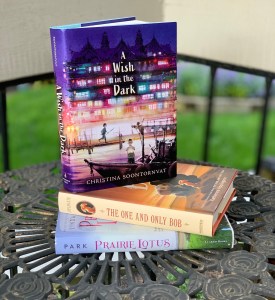 It has been said that the only two certainties in life are death and taxes, but—at least, while quarantined—I can now add a third. Every morning for the past two months, the same conversation has transpired as soon as the breakfast dishes are cleared, around 8:15am.
Me: “OK, kids, head to the couch for read-aloud time.”
My son: “What? No! I need to get upstairs to get ready for school!” (“Getting ready for school” means opening up his Chromebook, clicking on a Zoom link, and waiting for the administrator to let him into the meeting…45 minutes before said meeting actually starts.)
Me: “Your class doesn’t start until 9am.”
Him: “But sometimes they come on early!”
Me: “You don’t need to stare at a screen any more than is necessary. Park your tush next to your sister.”
Every morning, we have this same exchange. Every single morning. For the record, I always win. I only insist on one tiny little fragment of consistency during corna-time and it’s that the kids and I spend forty minutes every morning reading aloud. It’s how we connect before dispersing into our own “virtual” agendas. It’s how we remind ourselves that the world still exists outside our doors, that it waits patiently for us to return, that it invites us to visit in our imaginations until we can come in person. It’s how we remind ourselves that we don’t have to leave the house to get our minds blown.
Quite simply, reading aloud is the one light in these dark days that we can always count on.
As soon as my fidgety, eager-for-that-screen-fix tween sits down on that couch and tunes into my voice, he doesn’t want to be anywhere else. I know this because he gasps the loudest, laughs the hardest, leans in the closest. Reading aloud to tweens and teens can initially seem like an uphill battle, but it’s almost always worth the struggle. In our family, it’s non-negotiable. And it always, always leaves them begging for more…even if just a few minutes earlier they were all too happy to skip it.
In the upcoming weeks, I’ll be doing a gargantuan middle-grade round up with favorite new books to put in front of your kiddos for independent reading. Today, though, I want to share three new middle-grade novels which lend themselves especially well to reading aloud, as evidenced by our own experience. Their genres—fantasy, comedy, and historical fiction—couldn’t be more different, but their characters, prose, and stories are similarly unforgettable.
Attention Deficit Corona: Graphic Novels for Tweens and Teens
April 30, 2020 § 1 Comment
 Of all the complaints I’ve heard during Quarantine, one of the most common is an inability to focus. If your former bookworms are having trouble losing themselves in literature (hey, Zoom zombification is real), look no further than these new graphic novels. Take it from me.
We moved last week. Moving is challenging in the best of times much less during a pandemic. So, you can bet I threw a bunch of graphic novels at my kids, and you can bet they were more than happy to stay out of everyone’s way. And the best news? You already know that graphic novels are the type of books your kids like to read again and again, so you can feel good about investing in them and supporting your local Indie bookstore at the same time.
Truly, 2020 is shaping up to be a STELLAR year for graphic novels. This list builds from young to older, with selections all the way up to high schoolers. (If you’re new to my site, you might check out my last graphic novel round-up here.)
Friendship is Not Wasted on the Young
March 12, 2020 § 1 Comment
 My daughter has had the same best friend for nine years. She met her when she was just beginning to run and climb, when I used to swing by our local playground—what we called the “Tot Lot”—after dropping her brother off at preschool. It was an instant connection, the likes of which I had never experienced with my son, and it stopped me in my tracks. Child development literature would have placed my daughter squarely in the realm of “parallel play.” So how to explain that she never let fall the hand of this other little girl, that they climbed and descended the small slide, crawled through plastic boulders, and scampered up and down artificial hills as one?
After spending nearly every day together for years, the girls don’t see each other as often now; they live about an hour apart. Still, when they get together, they pick up like no time has passed. They disappear into their own world: talking in whispers, inventing elaborate games, often so wrapped in each other’s arms that it’s hard to tell where one stops and the other begins. To witness their togetherness feels like being in the presence of something magical, something almost miraculous.
Julie Fogliano and Jillian Tamaki’s my best friend (Ages 3-7) came out only a week ago, but so enthusiastic has the response been from the kid lit world, I feel like the last person to sing its praises. (Still, wild horses couldn’t keep me from joining in the fun.) An homage to the giddy abandon exhibited in early childhood friendships—particularly those born on the playground—the book has all the makings of a classic. Fogliano’s free verse sings and soars with the stream of consciousness of a child tasting the deliciousness of friendship for the first time. (i have a new friend/ and her hair is black/ and it shines/ and it shines/ and she always laughs at everything) Tamaki’s muted palette of rusty pink and olive green lends the book a timeless, vintage feel, while the figures themselves spill and explode off the page, their excitement literally uncontainable.
 What to Read to Your Kids