An Anthem to the “And”
September 9, 2021 § 5 Comments
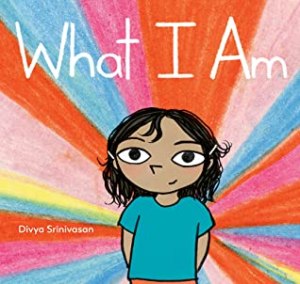
It has taken me a lot of growing up to realize how quickly the world demands that we put labels on ourselves, and how tempting it then becomes as parents to fit our own children into the same tidy little boxes. Even the questions we routinely ask of our children and their peers—Is she shy? Is he artistic? Is she kind?—assume two fixed outcomes: yes or no. Sides are chosen, identities are constructed; and then, inevitably, confusion sets in when the data points don’t consistently match up.
A few years out of college, when I was working in advertising, I attended a retreat designed around improving problem-solving skills. As part of it, we had to take the Myers-Brigg personality test. What was revolutionary to me wasn’t that I received at the end a set of letters to represent my dominant personality traits, but that each of those letters was plotted on a spectrum. I expected, for example, that I would score as extroverted (E)—I’ve always been social, albeit preferring intimate groups—but what surprised me was that I was quite close to the midway mark between extroverted (E) and introverted (I). This seems incredibly obvious to me now, but I had never previously considered that someone could be both things at the same time. That I could derive equal energy from social interactions and from being by myself. That I didn’t have to choose. That my identity might run on a spectrum, rather than conforming to a binary system.
When we fall into the trap of thinking of ourselves as one way or another, it’s not only limiting, it’s fundamentally inaccurate. We, all of us, are walking contradictions. It’s what makes us interesting. It’s what makes us human. Maybe we get nervous walking into a new classroom, but we can belt out a solo on stage. Maybe we can’t draw the likeness of anything, but we love moving paint around on canvas. Maybe we have a hard time sharing crayons at school, but we’ll sit and read to our baby sister at home when she’s sad. What if there was a way to encourage our children to take these “but”s and turn them into an “and”s? What if instead of contradicting one another, they are just two true things?
When I first opened Divya Srinivasan’s triumphant new picture book, What I Am (Ages 3-7), I thought it was going to be a book about a Brown girl responding to a microaggression that’s all too familiar to those whose non-whiteness doesn’t fit the idea of American that some people insist on holding onto, even though all evidence points to the contrary. It’s the “What are you?” question.
And it is a book about that. A beautiful, validating mirror for an Indian American reader.
AND it’s something more. Because, as our young narrator reflects on this question, she realizes that she is a whole lot more than her race or her ethnic heritage. And that many of these things might seem like contradictions—only they aren’t. They’re just her.
What this book is—and why I hope every child gets a chance to read it—is a testament to the complexities, to the nuance, within each and every one of us. It’s a kind of roadmap to how we might think about our own identities—and how we might express them to a world bent on incessantly inquiring.
« Read the rest of this entry »New Summery Graphic Novels for Ages 7-15
July 29, 2021 § 1 Comment
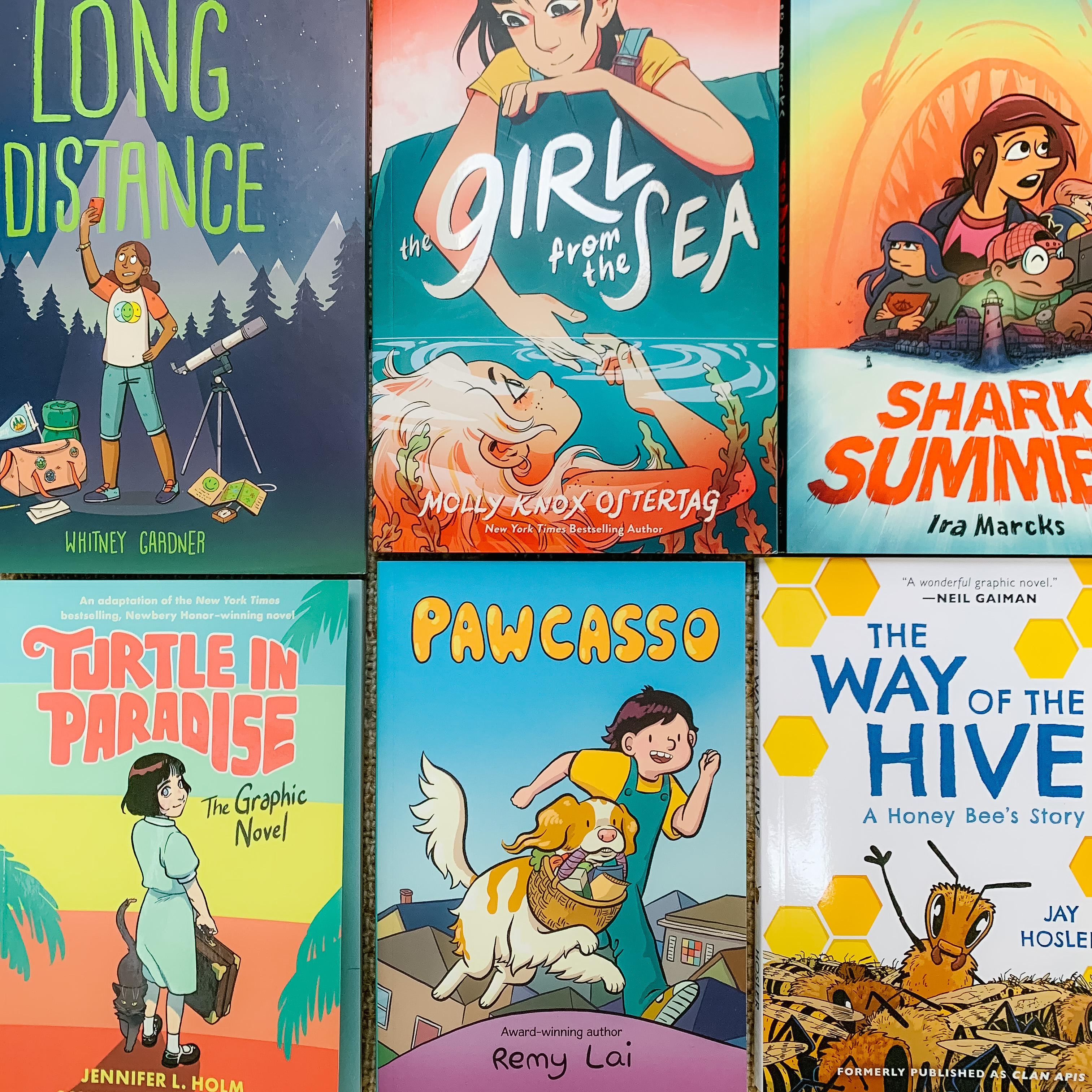
I can hardly keep up with all the graphic novels hitting bookshelves these days, but I’m not complaining, since they continue to make readers out of my kids. (Not convinced they count as real reading? Read what I said here.)
I had initially intended this to be a round-up of new favorites, only I found too many to fit in a single post. So, I’m limiting today’s post to favorite new graphic novels with summer themes. I realize back-to-school season is right around the corner (for some, it’s already here), but in our house, we are in blissful denial. We’ve just wrapped up summer swim team, and my kids are packing their bags for sleepaway camp. We’ve still got time with friends in Maine, time with cousins in Boston, and a family reunion in Rhode Island—fingers and toes and more fingers crossed for good health—and we’re determined to savor these precious days. It seems only right that our reading material should match the view outside. I hope you agree.
(Sadly, this means my Favorite Graphic Novel of the Year so far won’t make the cut, since it’s not set in summer. Those of you on Instagram know what I’m talking about. But the rest of you will have to wait for the ring of the school bell.)
« Read the rest of this entry »Summer’s Sweetness
July 22, 2021 Comments Off on Summer’s Sweetness
I’ve been caught in the hot, sticky, delicious embrace of summer (OK, but a little less heat, please), and it has kept me from showing up here as much as I would like. When I’m silent here, I’m usually still active on Instagram, so you can get lots of book recommendations there, but I do hope to get a few blog posts penned in the next few weeks (I’ve got a big graphic novel round-up planned, so stay tuned!).
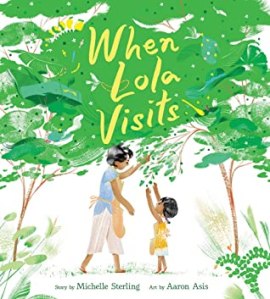
But today, let’s talk about one of my favorite picture books of the year, an especially fitting one for this mid-summer sweet spot we find ourselves in. We’re perfectly poised to reflect on summer’s arc, having traded the tentative newness of June for the wild abandon of July, with a creeping awareness that the final days of August will bring it all to a bittersweet end. When Lola Visits (Ages 4-8), lyrically penned by Michelle Sterling (fellow kid lit reviewer) and evocatively illustrated by Aaron Asis, perfectly expresses this arc by capturing the smells, tastes, and sensations of summer, as experienced by a young girl alongside her visiting Filipino grandmother.
When Lola Visits does something that isn’t easy to do in a picture book. It imparts a culturally specific experience while simultaneously invoking the universal wonder of this special season. It’s a book that asks us to reflect on the way we experience summer, to give language to our own observations, and to honor the richness of our memories from one year to the next.
For my children, at least right now, summer is the smell of chlorine, the tight hug of a swim cap, and the taste of glazed doughnuts, cherry popsicles, and concessions burgers with American cheese. In a few weeks, that will shift to the squish of pine needles beneath flip-flopped feet, the sharp bang of a cabin door, and a Styrofoam cup of steaming hot chocolate on a cool Maine morning where fog sits heavy on the lake.
For me, much like the young protagonist in When Lola Visits, summer will always conjure memories of my grandmothers, both of whom I would visit every year. Summer was the taste of warm popovers with melting pads of butter, enjoyed under an umbrella with my one grandmother, after a morning spent pouring over sawdusty cases of pinned bugs at the science museum, where she volunteered in the entomology department. Summer was make-your-own sundaes before Bingo night with my other grandmother, the excitement of watching the pot of money overflow with American and Canadian dollars outdone only by the anticipation of going to the water slide park the following day. Summer was a sticky tin straight from the fridge with chocolate-peanut-butter-Rice-Krispies cookies. The smoky smoothness of blue beach glass. The experience of hugging an older body, with its faint smell of talcum powder, soft, spidery-veined skin, and the security of a love that knows no bounds.
« Read the rest of this entry »The Secret to Picking Read-Aloud Chapter Books
May 13, 2021 Comments Off on The Secret to Picking Read-Aloud Chapter Books
How do you choose the chapter books you read to your kids? Maybe you consider whether the subject matter will appeal to them. Maybe you focus on what kind of characters they’ll identify with. Maybe you know they’ll be more likely to sit still for a funny story than one with long descriptive passages. Maybe you reach for a book because it’s one your child has asked you to read, or one you think you should read, or one by an author your child loves.
Whatever your criteria, it’s likely you’re thinking more about the audience than about yourself.
What if I told you your audience doesn’t matter?
OK, that’s not entirely true. Of course, your audience matters. Especially with younger children, there will always be ages and maturity levels to consider. But do you know what matters more than all the things I listed above? What matters the most?
The secret to picking a chapter book your kids will want to hear night after night is to pick one you will enjoy reading.
Your enthusiasm for what you’re reading influences your children’s enjoyment more than anything else. When you’re into a story, your eyes light up. Your voice is more dynamic. You are infinitely more likely to make that story enticing. Suddenly, the dishes in the sink or your buzzing phone fade into the background. Suddenly, there is nothing more important, nothing more exciting, than the mutual experience of immersing yourselves in a fictional world.
It’s tremendously liberating. Don’t enjoy fantasy? Don’t read it. Bored to tears by the likes of Magic Tree House? Save ‘em for your kids to read on their own. By reading aloud to your children, especially after they are reading on their own, you are giving them a precious gift. You’re choosing to prioritize reading in the home. I’m giving you permission to enjoy it as much as your kids do. Heck, I’m telling you your enjoyment will nearly guarantee their enjoyment—and, consequently, all the benefits that come with it.
For me, it always, always comes back to the writing. I’m a sucker for good writing. I love the way beautiful language rolls off the tongue. I love the drama of a perfectly placed sentence. I love smart, funny dialogue. Most of all, I love writing that’s tight. (Ironic, I know, since succinctness is clearly not my own specialty.) If a paragraph starts to drift or ramble, if the pacing of a story wanes, then my attention breaks. I’m no longer present. My heart’s not in it. The magic is broken…for a spell.
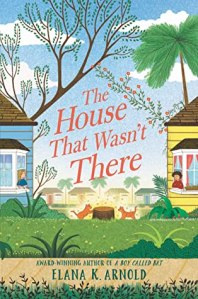
In that vein, I enjoyed every moment of Elana K. Arnold’s The House That Wasn’t There (Ages 8-12, younger if reading aloud), which I just finished reading to my ten-year-old daughter. Yes, the story itself has plenty to recommend it—who wouldn’t love middle-school realism with a few teleporting cats thrown in for good measure? But what struck me the entire time I was reading it was how good the writing is. Every sentence is an absolute pleasure to read out loud. It’s tight. It flows beautifully. It filled us with that same warm fuzzies as previous favorites like this, this, and this.
« Read the rest of this entry »The Stories We Need to Ask For
April 8, 2021 § 1 Comment

Occasionally, a book comes along that is so extraordinary, I’m daunted at the prospect of reviewing it. I worry I could never do it justice. I wish I could just say, This is hands down the most moving picture book I’ve read so far this year, and I want you to get it without knowing anything about it. Maybe, if you’ve been hanging around here for awhile, you’ll do just that. But I will try and find something eloquent to say for the rest of you.
Years ago, my husband helped his grandparents—first generation Italian-Americans—pack up their house to move into a retirement community. In the crawlspace, he uncovered boxes of mementos, all of which his grandmother had at one point tied up using the elastics from her husband’s old underwear. This discovery became one the family would chuckle about for years (Who salvages underwear elastic?!). But it was also a window into the past, a resourcefulness triggered by the Great Depression sixty years earlier, a self-reliance that perhaps belied pain, worry, wanting, loss. Only now does my husband express regret at not probing for the stories underscoring something he accepted as mere frugality.
All of us grow up surrounded by family history, including the cultural heritage this history often represents. Yet, as children, we often take this history for granted. At best, we’re blinded by our own fixation on the present; at worst, we’re embarrassed by the quirks of our elders, by their old-fashioned ways, by their insistence in holding fast to ideas or customs from their past.
Especially where immigrants are concerned, this silencing is further accentuated by the systemic racism underlying American society. Asian Americans, for example, are expected to fulfill the Model Minority Myth, to work hard towards prosperity, while keeping quiet about their struggles, past or present. The recent media attention on the massive spike in hate crimes against Asian Americans—up 1,900% since the start of the pandemic—has begun to open our eyes to an experience far from new, one we should have been talking about ages ago.
In the spirit of lifting up voices of Asian descent—and because this poignant story is at its heart about the value of listening to stories of the past—I urge you to purchase Watercress (Ages 5-9), Andrea Wang’s powerful autobiographical picture book, evocatively illustrated by Caldecott Honoree Jason Chin, who studied traditional Chinese landscape painting to infuse the story with added authenticity. (If Jason Chin doesn’t get his long-overdue Caldecott Medal for this, you will hear me screaming.) Against a backdrop of 1970s rural Ohio, a girl and her brother help their parents, immigrants from China, pick watercress on the side of a ditch to be served that evening. The immediate humiliation of the act later transforms into an opportunity for the girl to connect with her mother’s past life in China—and the grief she still carries in her heart.
« Read the rest of this entry »Losing a Dog
February 18, 2021 § 2 Comments
When my son was four and our dog died, I checked out a pile of themed picture books from the library and we read them over and over for two weeks. Every time I asked my son how he was feeling, or whether he wanted to talk about what had happened, he walked over to the pile, grabbed a book off the top, and climbed into my lap. It shouldn’t have surprised me—after all, I have always turned to books to process life experiences—but it did. Before my eyes, I watched this small boy silently work out stuff right there on the page.
One of the most common requests I get from parents is for books about losing a dog or cat. There is no lack of picture books on the subject, but most of them are only OK. Some are beautiful, even profound, acknowledgments of loss—like this and this—and even though I love them, they tend towards the abstract. Others fall into the same trap that we parents do when our children are in pain: they are quick to reassure, to provide distraction, to provide replacement (The dog is happy in heaven! Let’s go pick out a new puppy!). Many pay lip service to the emotional upheaval that is grief, but few model what it means to make space for it.
In my personal experience, grief does not abate without time. Time can’t work alone, it won’t solve all things, but it creates distance, and with distance comes perspective and growth and opportunity. But in the wake of pain, time is at best uncomfortable; at worst it is infuriating, terrifying, and unfathomable. It’s no wonder we don’t like to acknowledge it, much less encourage our children to sit in it.
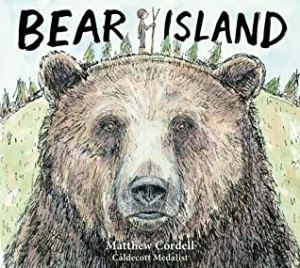
And yet, here’s a new picture book that does just that—and does it brilliantly. In Matthew Cordell’s Bear Island (Ages 4-8), a full year passes from the moment a girl loses her dog to the time her family welcomes a new one. In Cordell’s expert hands, this year unfolds slowly across every page turn. It unfolds while a girl spends her days on an island with a stick and a bear for company. It unfolds in the physical and mental space of the girl’s anger, sadness, boredom, regret, and fear.
« Read the rest of this entry »A Baby Unicorn for Valentine’s Day
February 11, 2021 § 4 Comments
Valentine’s Day approaches, so consider this your annual reminder that the only acceptable Valentine is a new book. You may recall I’m not a traditionalist when it comes to recommending books for Valentine’s Day. If a heart on a cover is what you’re after, you won’t do better than this. But I like a timeless story about friendship that can be read any time of year, which is why in past Valentine’s posts I’ve been about this, this, this, and this. This year, you’re in for an added treat if you head over to Instagram, where I’ve been running a mini gift guide all week, with selects from babies to teens.
Sometimes a book comes along, and even though it’s not breaking any ground, even though it won’t win any awards, it’s so insanely adorable you want to give it to everyone you know.
Let’s be clear. My daughter cannot abide the unicorn craze. She has never tolerated it for one minute. What did unicorns ever do to her? I don’t know. But I’ll tell you this: one year for her birthday, I bought her a pair of horse pajamas, only when she opened them, her eyes immediately locked onto a detail I had failed to notice; each of the horses had, in fact, teeny tiny silvery horns on their forehead. I watched her attempt to disguise her horror and choke out a thank you, but she never wears those PJs.
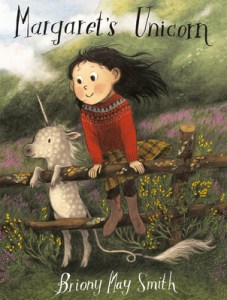
Now imagine that this same daughter should fall in love with Briony May Smith’s Margaret’s Unicorn (Ages 3-7), about a girl, recently relocated to the wild English countryside, who keeps watch over the CUTEST baby unicorn for two seasons until his mother returns for him. Imagine that this daughter was so taken by the book that she begged me to purchase our own copy, despite being well outside the target age. And then you’ll understand why it would be impossible for a book to receive a higher endorsement.
There is so much joy, so much heart, so much good will in this story that it’s destined to put the biggest smile on children’s faces. If that doesn’t make it perfect for Valentine’s Day, perhaps you ought to collect some moonlit water for your baby unicorn and then come back and we’ll talk.
« Read the rest of this entry »“Having Arms is Totally Overrated”
January 28, 2021 § 2 Comments

A friend once confided in me that she hated reading aloud to her kids; even more, she hated how bad she felt about hating it. Her kids were now reading independently, so she had hoped she’d be off the hook; and yet, they didn’t love reading. She worried she was failing them by not investing in time to read aloud. (Is anyone harder on herself than a mother?)
It’s true that I’m a passionate advocate for reading aloud to kids long after they are reading on their own. The benefits are vast (I’ve listed ten here), with the greatest being that our voice brings literature alive in a way that entices children to continue putting in the work on their own. But I’ve also always pressed parents to choose books they will enjoy as much as their kids, because our enjoyment should be genuine. No one can sniff out a half-hearted effort like a kid, and the last thing we want to convey to our kids is that reading is a chore.
Here’s what I told my friend: park your guilt at the door and do you. You love to read, so read alongside your children. When they’re ready for bed, or whenever you think you should be reading to them, get your own book, have them get their books, and snuggle together while reading quietly. We call these “reading parties” in our house—a term my son coined years ago. I have another friend who calls them “stop, drop, and read” moments, where everyone drops what they are doing, grabs a book, and reads together for at least fifteen minutes. Simply by enjoying your own book, you are modeling for your children the value your family places on reading.
There’s something else I recommend, if you’re looking for ways to connect with your kids around reading but aren’t keen to read to them—or, as happens to the best of us, are having trouble finding the time. Consider reading to yourself a book they’ve recently read and loved. Maybe even something they’re reading right now (my daughter and I are currently doing this with the crazy fun new supernatural thriller Amari and the Night Brothers; she leaves it outside her bedroom door each night and I grab it before I get into bed). What better message can we send than, I value your reading so much that I’m choosing to pick up one of your recommendations?
Before I fell down the rabbit hole of 2021 reading, my daughter convinced me to read two Dusti Bowling novels she inhaled in December: Insignificant Events in the Life of a Cactus (Ages 9-13) and its sequel, Momentous Events in the Life of a Cactus (Ages 10-14). I’m not sure why these evaded me when they first came out a few years ago, because the characters—every single one—are absolutely delightful. (I’ll add that the first book would make a terrific read aloud, too.)
« Read the rest of this entry »Sweeter Together
January 21, 2021 § 8 Comments

Yesterday, at the 59th Presidential Inauguration, as my children and your children and the world looked on, President Biden called us to the work of unity, to “uniting to fight the foes we face. Anger, resentment and hatred, extremism, lawlessness, violence, disease, joblessness and hopelessness. With unity we can do great things, important things. We can right wrongs.” He was referring to Americans coming together, though he also spoke of healing alliances around the world.
Then, the 22-year-old inaugural poet, Amanda Gorman, took the stage—who, incredibly, before the age of twenty could not pronounce the letter “R” due to a severe speech impediment—and elevated that message of unity even further. She called us to hope and light and agency. “There’s always light if only we’re brave enough to see it. If only we’re brave enough to be it.”
(Side note: moments after the inauguration, it was announced that Amanda Gorman has a children’s picture book coming out in September, illustrated by fan-favorite Loren Long. This girl is here to stay, and I am here for it!)
I haven’t yet told you about one of the most exquisite picture books published last fall—actually, if I’m being honest, one of the finest examples of bookmaking I’ve ever seen. (It would have unquestionably made my 2020 Gift Guide had I discovered it in time.) On the surface, Sugar in Milk (Ages 5-10), written by Thrity Umrigar and lushly illustrated by Khoa Le, is a story about a modern girl’s immigration and assimilation; and yet, as it recalls an ancient Persian folktale, it reads as an allegory of unity and light. It’s a story honoring individual courage alongside diversity, acceptance, and inclusion—hallmarks of the American promise. It’s a story reminding us that we are sweeter together.
« Read the rest of this entry »2020 Gift Guide: Favorite Graphic Novels for Ages 6-15
November 5, 2020 § 7 Comments
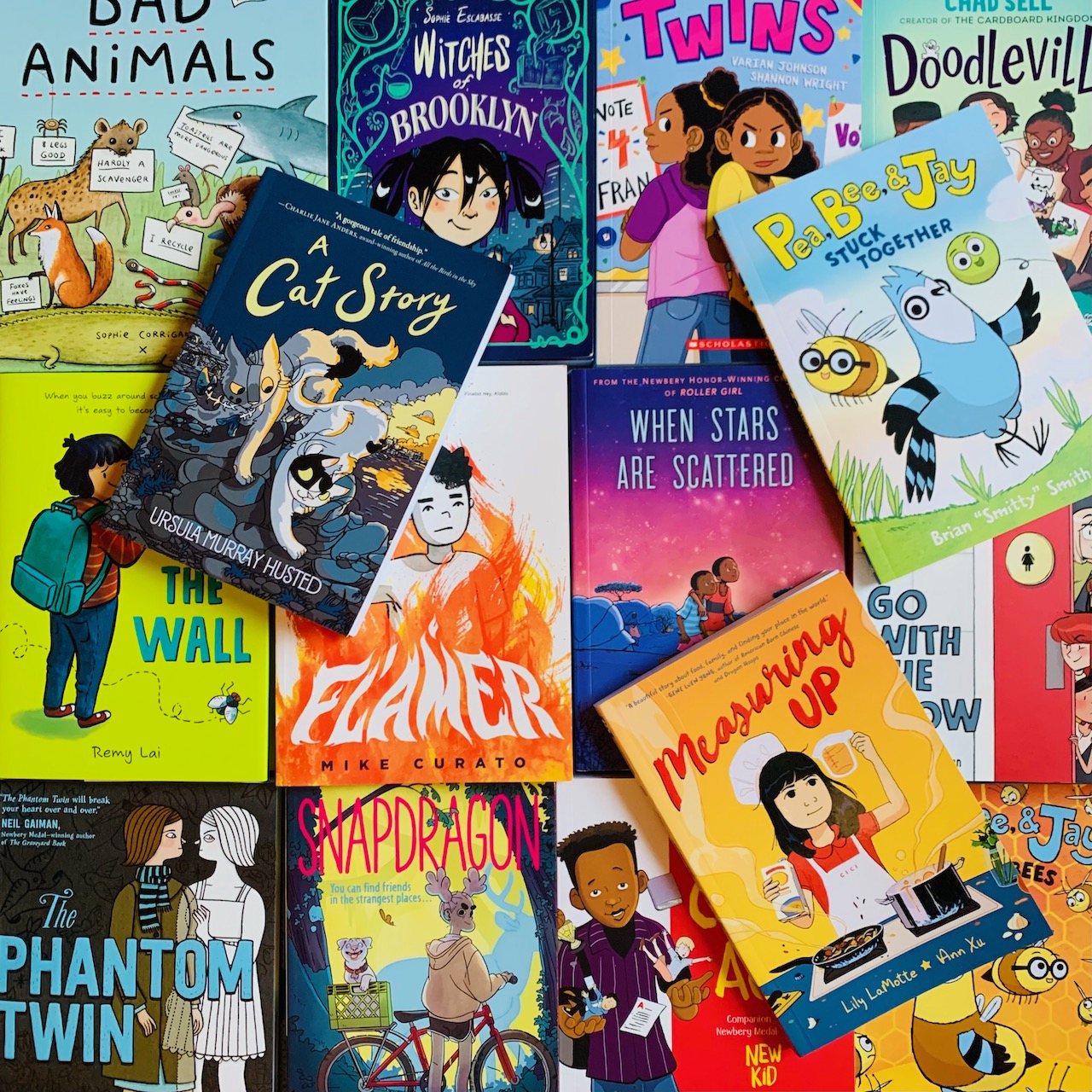
Back by popular demand: an installment of my Gift Guide devoted entirely to my favorite graphic novels of the year! Graphic novels make some of the best gifts. Not only are they coveted among emerging readers, tween readers, and teen readers alike, but they invite repeat readings. I’ve watched my kids race through a new graphic novel as soon as they get it, then a few days later start it over again, spending more time on each page. After that, they might set it down for a few weeks or months or years, only to pick it up again with fresh eyes. It’s no wonder many of the graphic novels below took over a year to create; they are packed with visual nuance, literary allusions, and layered meanings. Like treasured friends, graphic novels grow with their readers.
I read dozens and dozens of graphic novels in preparation for this post. Below are the ones that rose to the top in originality, beauty, fun, diversity, or impact. A few of these you’ll remember from a blog post I did earlier this year, but they bear repeating because they’re that good. There are others, like the new graphic adaptation of Roald Dahl’s The Witches, which my daughter was horrified wasn’t included here. I simply had to draw the line somewhere.
The list begins with selections for younger kids and concludes with teens. Enjoy and happy gifting!
« Read the rest of this entry »When You Don’t Have a Mute Button
October 1, 2020 § 2 Comments
 If Tuesday’s presidential debate has taught us anything, it’s that 2020 should have come with a mute button. Because meditation alone isn’t going to cut it. Ditto to stocking our freezers with double-chocolate brownie ice cream. Adulting is hard enough right now without adding parenting (and schooling) to the mix. And yet, our children are bystanders to this hot mess unfolding around them. With our own blood pressure camped out at dangerously high levels, how do we offer some semblance of sanity for our precious little ones?
Back in July, I came across a blog post written by a practicing psychotherapist out of Colorado named Sara Waters. She was addressing the stress parents were feeling while waiting for schools to announce their reopening plans (HA, remember when we thought that was worth losing sleep over?). Like many parents at the time, I was spending way too much time crawling along the bottom of the Internet, desperate for someone to reassure me that my children would be safe this fall. Waters surfaced with the reassuring reminder that, while we might not be in control of what happens outside our front door, we can control what happens inside:
The number one most determining factor of your child’s 2020 experience is YOUR ability to manage your OWN discomfort. Mirror neurons are real and even children who haven’t yet learned to understand or speak language will pick up on the quantum vibrational frequencies of distress that you emit. Your children hear you talk, even when you aren’t talking to them. They hear you complain. They hear you vent. They watch your facial expressions when you are on a phone call or responding to an email or social media post on your computer. They can feel whether you are relaxed or whether you are in a state of stress when you wake them up in the morning, sit down for a family meal, or tuck them into bed at night. […] Whether you like it or are aware of it or not, they will feel what you feel.
I’ve thought about this reminder many times since that last week in July, including and especially when I picked up Cozbi A. Cabrera’s joyous new picture book, Me & Mama (Ages 2-6), a lyrical celebration of the bond between one daughter and her mother. Reading this story is like wrapping yourself in a cocoon of domestic love. Reminiscent of one of last year’s favorites—Oga More’s Saturday—this book speaks directly to the power we hold as parents to set tone, to cue young children’s feelings about the world and their place in it.
We sometimes forget that motherhood comes with its own special set of superpowers. We can smile at our children; we can dance in their presence; we can light up when they walk in the room. None of the stressors in the world can compete with that.
Emily Dickinson: Perfect Reading for a Pandemic?
September 24, 2020 § 2 Comments
 Not many people know this, but my daughter is named after Emily Dickinson. (Well, and the heroine of L.M. Montgomery’s Emily of New Moon.) I didn’t fall for Emily Dickinson’s poetry until I got to college, when I fell hard and fast and ended up featuring her poems in no fewer than seven essays, including my Senior Thesis. I had never been a big poetry lover, but there was something about the compactness of her poems which fascinated me. So much meaning was packed into such few words. And even then, the meaning was like an ever-shifting target, evolving with every reading.
To read Emily Dickinson is to contemplate universal truths.
Apart from reading Michael Bedard and Barbara Cooney’s 1992 picture book, Emily, I hadn’t had much occasion talk to my own Emily about her namesake. But that changed last spring, when my Emily started writing poetry of her own. Nothing about virtual learning was working for her, until her teachers started leading her and her classmates in poetry writing. Suddenly, my daughter couldn’t jot down poems fast enough, filling loose sheets of paper before designating an orange journal for the occasion. She wrote poems for school, for fun, and for birthday cards. It didn’t matter that they weren’t going to win awards for originality; what mattered was that she had found a means of self-expression during a stressful, beguiling time.
Jennifer Berne’s On Wings of Words: The Extraordinary Life of Emily Dickinson (Ages 7-10), stunningly illustrated by Becca Stadtlander, could not have entered the world at a more perfect time. It opens a dialogue, not only about Dickinson’s unconventional life, but about her poems themselves. At a time when a pandemic has prompted many of us and our children to turn inward, this picture book is less a traditional biography than an homage to the rich interior life developed by this extraordinary poet and showcased in her poetry.
Family, Foes, and Frida the Fox
September 17, 2020 § 3 Comments
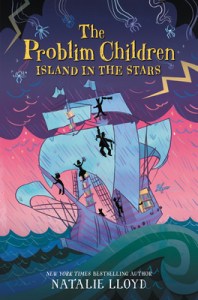 As my kids have gotten older, reading aloud to both of them together (at the dinner table, because sanity) has largely replaced reading to each one individually. Still, sometimes a book comes along that begs to be read to one and not the other. Natalie Llyod’s The Problim Children series, which recently concluded with Island in the Stars (Ages 8-12), feels as if it were written for my daughter, ever watchful for signs of magic in her own life and fascinated by the dynamics of large families. Lloyd’s plot lines, with their plucky heroines and sinister villains, are evocative of Roald Dahl, another read-aloud favorite, though her writing has a dreamy quality all her own—a perfect match for my daughter’s non-linear brain.
Over the past eighteen months, Emily and I have drawn out reading these books together, savoring them on weekend mornings when her brother wakes up full steam ahead but she’s still content to climb into my bed with her arms full of stuffed sheep, burrowing her sleepy body into mine. When we got to the end of the third and final book, I didn’t tear up just because of the story’s beautiful ending; I know these years of reading together are fleeting.
The fleetingness of childhood is a theme which runs through The Problim Children series, named for the seven siblings at the center of this most memorable family. On the one hand, a series of precipitous events pushes these siblings to grow up in a hurry: in just a few weeks, they must unravel a series of riddles left to them by their late grandfather, rescue their parents from the evil Augustus Snide (nicknamed Cheese Breath), and destroy a fountain of youth without being tempted to drink from it. And yet, even as they tackle these adult problems, the Problim siblings exist in that enticing storybook place outside the realm of the adult world. They march to the beat of their own drum, operating under their own set of rules and decorum. No matter what life deals them, they hold fast to their childlike sense of wonder, their belief in the impossible, and their fierce love for one another.
Overnights with Grandma
September 10, 2020 § 9 Comments
 This Sunday is Grandparents’ Day, a holiday I’ve never given much thought to until this year, when I am without any living grandparents. Losing both my grandmothers in the past year hasn’t just been about mourning these loving, larger-than-life figures. With their passing, I have lost physical places as well.
My mother’s mother died in her Buffalo home, where she lived for over forty years, and where I traveled every summer from the time I was eight and my parents put me on an airplane by myself. Gockamama, as I called her, lived on the top floor of an historic building, with a grand lobby, an old-fashioned elevator, and its own name to boot. Walking into that apartment was like walking into a musty, magical era, from the antique grandfather clock which tolled every thirty minutes, to the oil painting of Napoleon which hung in the dining room. With no other buildings between her and Lake Erie, you could stand at the window, curling your toes into the plush carpet, and see all the way to Canada. It was like being wrapped in a cozy cocoon, suspended above the world.
We’d spend mornings watering her dozens of plants lining every window, then evenings watching Murder, She Wrote (I pretended to watch, while sneaking peeks at my book). I’d take bubble baths in her bathroom, with its avocado-green tile and pink fluffy towels. At breakfast, she’d sprinkle sugar on my grapefruit; for dinner, I’d request her Spaghetti Bolognese. She kept a closet shelf stocked with old toys and a cookie tin filled with my favorites: misshapen wonders made with chocolate, peanut butter, and Rice Crispies. Photos in frames covered every horizontal surface, and as I became more interested in travel myself, she would pull down photo albums and show me pictures of the Great Wall of China or Ephesus in Turkey, places I immediately longed to visit.
Walking out of that apartment for the last time, on the heels of my grandmother’s funeral, felt like leaving behind a part of me. Inside those walls, during our cherished visits, I had been my grandmother’s entire world. I had taken up space in the way only a grandchild can, each treasure of that apartment intermingled with the love she felt for me. My mother couldn’t believe the sofa cushions had become so threadbare, but when I sank into them, it felt like I was exactly where I was supposed to be.
Sara O’Leary’s endearing new picture book, Maud and Grand-Maud (Ages 3-7), about the overnight visits a young girl has with her namesake grandmother, perfectly captures, not just the singular intimacy of the grandparent-grandchild relationship, but the special rituals and strong sense of place often intertwined with it. This feat is in large part owing to Kenard Pak’s delicate illustrations, whose muted tones conjure a hint of mustiness and whose washes of color exude wistfulness. It’s the kind of book you want to hold to your heart. It’s no wonder I spilled tears onto its pages the first time I shared it with my daughter.
At Home in the Ocean
September 3, 2020 § 3 Comments
 My son’s favorite sport is swimming, but it wasn’t always this way. For five years after he was born, he refused to put his head under water. He was delighted to be held in water, or to float with a floatie, but none of us—not me, not his dad, not his grandfather, not his aunt—could convince him to submerge his face.
Eventually, I got the name of a private swim instructor who was supposed to have a magic touch. I phoned her but she was fully booked. A few weeks later, she phoned back. She had a cancellation on an upcoming Thursday at 7pm. JP’s bedtime was 7pm, so this seemed like poor parenting at best, but I was a mother on a mission, with a zeal often reserved for firstborns. I told her we’d see her Thursday.
What happened next is a story our family loves to tell. While I watched from deck, the instructor, clad in a black wet suit, took JP’s hand and led him down the ramp of the zero-entry pool. When the water hit JP’s waist, she stopped. “So, JP,” she said, “do you go under water?”
“No,” my son replied.
“Would you like to try?” she asked.
Barely a pause. “OK,” he said. And then, right before my eyes, this child with a stubbornness to match mine, threw himself face down into the water.
He threw himself face down into the water. Part of me was overjoyed. And part of me had to keep from screaming, ARE YOU KIDDING ME?!
My husbands like to joke that this was when we realized that our son has no interest in learning from his family. Our teaching is inherently suspect, probably flawed, because what do we know? This instructor—who went on to teach him very fine strokes for the next five years—was an expert in his eyes, and so he instantly trusted her. (We consider it a major triumph that we did not have to hire a professional to teach him to ride a bicycle.)
Still, I don’t think the swim teacher’s trust was won just because JP regarded her as an expert (whereas we were just flailing novices). Truth be told, she exuded calm. You had only to spend ten seconds with her to understand that she was more at home in the water than out of it. She loved the water, she trusted herself in the water, and when she directed her full attention onto my son, he felt like he’d come home, too.
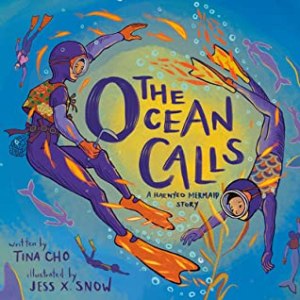
“The ocean is calling me today,” says the grandmother at the beginning of Tina Cho’s new picture book, The Ocean Calls: A Haenyeo Mermaid Story (Ages 4-8), one of the most fascinating and exquisite examples of a symbiotic relationship with water that I have ever seen. Set on the shores of Jeju Island in South Korea and luminously illustrated in jewel tones by Jess X. Snow, the story is about the relationship between a girl, struggling with her fear of the ocean, and her grandmother, a haenyeo mermaid, who holds her breath for two minutes at a time and dives up to thirty meters to bring back armfuls of shellfish for eating and selling. Here’s the coolest thing: the haenyeo tradition is real! It goes back centuries among indigenous Pacific islanders, remains alive today, and plays a vital role in ocean ecology.
The Stories We Tell Ourselves
August 27, 2020 § 2 Comments
 My aunt used to hold an annual Christmas Eve party at her apartment on the eighth floor of a building just two blocks from ours in New York City. It was a small group, rarely more than twelve, and we were the only relatives ever invited. We only saw these friends of my aunt once a year, but before the elevator reached the bottom floor at the end of the evening, I was already looking forward to next year’s gathering. My aunt had been the editor in chief of a major magazine, and her friends were artistic, eccentric, and alluringly mysterious.
There was one woman in particular whom I adored. Always the last to arrive, she would come through the door shrouded in a floor-length black fur coat. Her perfect coif of white hair was sharply angled at her chin, and she moved in a cloud of exotic perfume. Her raspy smokers’ voice was fond of the word “darling,” and she always addressed me as if I was an adult. Perched on the sofa sipping my ginger ale, I inched as close to her as I could, throwing back my head with laughter as she did.
She lived downtown where the artists were, and I knew little about how she spent her days, other than that she and her husband had never had children. What I wouldn’t give to go back in time and ask her any number of questions! As children, we’re content with the stories we tell ourselves, the ones we make up in her head, and I fashioned endless stories for this larger-than-life woman in black, who seemed to float effortlessly around my aunt’s apartment, captivated by everything and nothing at the same time.
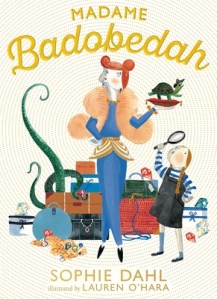
Sophie Dahl’s marvelous picture book, Madame Badobedah (Ages 5-9), told in three chapters over 53 pages and amply accentuated with retro illustrations by Lauren O’Hara, stars a young protagonist spellbound by an eccentric stranger who shows up for an unlimited stay at her parents’ hotel by the sea. This stranger barely opens her mouth before Mabel has developed theories about the feathers draped around her neck, her stacks of weathered trunks, and her prized pet tortoise. But warm to her from the start Mabel does not. Resentful of the woman’s haughty demeanor, Mabel quickly convinces herself that, rather than a solitary woman healing from heartbreak, she’s a jewel thief on the run. What follows is a riotous narrative, ultimately giving way to a warm intergenerational friendship perched somewhere in the middle of fiction and reality.
All in a Name: A Back-to-School Post
August 20, 2020 Comments Off on All in a Name: A Back-to-School Post
 When our kids return to school this fall, whether in person with a mask or at home over a computer, there will be unusual circumstances to navigate. But for many children, pandemic or not, the start of school is already fraught with potential landmines. Will I make a friend? Will I like my teacher? Will I understand the rules?
Will my name be mispronounced?
Those of us with Anglo-Saxon names may have never considered this last question, but those with African, Asian, Black-American, Latinx, and Middle Eastern names know how commonly, if unintentionally, their names are mispronounced. What does it feel like to be on the receiving end of a teacher or classmate stumbling through your name? What does it feel like to be expressly teased for your name? What does it feel like to be asked to shorten or alter your name to make it easier for classmates to say?
For many, personal names play a central role in cultural identity and identification. If we don’t put in the work to pronounce a name correctly, we’re not allowing that person—in this case, that young child—to be seen. At best, we are belittling them; at worst, we are erasing them.
One of my daughter’s dearest school friends has a name whose South Asian pronunciation is different than English phonetics would suggest. The difference is subtle, but my daughter will correct anyone—especially me—who doesn’t say it with the right cadence. I’ve been touched by this gesture of loyalty over the years, and I know it’s owing to the care the girls’ teachers have taken to create a space where students are actively working to understand and appreciate one another.
What I’ve also frequently noted is how musical my daughter’s voice sounds when she speaks her friend’s name. The idea that all names can be celebrated for their musicality is the inspiration behind Jamilah Thompkins-Bigelow’s new picture book, Your Name is a Song (Ages 4-8), a fast favorite with my daughter. Tenderly illustrated by Luisa Uribe, the story centers a Black American Muslim girl, who leaves her first day of school dejected and angry because “No one could say my name.” As her mother works to rebuild the girl’s confidence, she creatively and thoughtfully debunks many of the negative stereotypes associated with non-Anglo names, especially those with African or Middle Eastern origins: they’re hard to pronounce; they’re cacophonous; they signal danger; they’re made-up nonsense.
When the Sea Works its Magic
August 6, 2020 § 3 Comments
 The value of a change of scenery during this pandemic cannot be overstated. Last week, we spent five nights in a rental on the Chesapeake Bay, our front door just steps to a tiny slice of sand, a bank of beautiful rocks, two kayaks, and a half mile of clear shallow water for wading, before dropping off to deeper water and stunning sunrises beyond.
The entire trip felt like a brief return to normalcy (look, we’re a family who vacations!). It was also a gift which arrived at precisely the right time. In the weeks leading up to our departure, I felt a heaviness descend on our family, the sum total of weariness from the past five months and the grinding uncertainty of the new school year.
The sea knew what we needed. For a few magical days, it drew us out of our heads and into our bodies, then engulfed us in a delicious weightlessness. It gave us expanses of space—so much space—at which to marvel, after staring at the inside of four walls for too long.
The sea didn’t get everything right (we didn’t need the jellyfish), but it reminded us that there is beauty in the world, that it hasn’t gone anywhere, and that in connecting to this beauty we can connect to the best in ourselves. We can be a little looser. A little messier. Smile a little more.
As it turns out, one of my favorite picture books of the year also features some welcome meddling by the sea. It has been awhile since I hailed a beachy picture book (last were here and here), and this one proves well worth the wait. Swashby and the Sea (Ages 3-7), written by Beth Ferry and illustrated by Juana Martinez-Neal (quickly becoming one of my favorite contemporary illustrators), reminds us that sometimes the sea knows what we need even before we do.
Zoe Washington’s “Good Trouble”
July 23, 2020 § 1 Comment
 When John Lewis passed away last weekend—ending a 60-plus-year career of social activism and civil rights legislation—I was struck by how many tributes invoked the Congressman’s tweet from 2015, in which he shared a mugshot from his time in prison 54 years earlier, arrested for using a “white” bathroom in Jackson, Mississippi. The photo was captioned: Even though I was arrested, I smiled bc I was on the right side of history. Find a way to get in the way #goodtrouble
Another of his tweets in 2018 further underscores this notion of “good trouble”—a phrase Lewis became known for:
Do not get lost in a sea of despair. Be hopeful, be optimistic. Our struggle is not the struggle of a day, a week, a month, or a year, it is the struggle of a lifetime. Never, ever be afraid to make some noise and get in good trouble, necessary trouble.
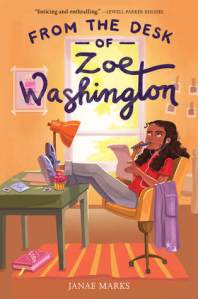
If you’ve asked me for a middle-grade book recommendation in the past two months, you’ve probably heard me go on and on and on about Janae Marks’ debut novel, From the Desk of Zoe Washington (Ages 9-13). If you follow me on Instagram, you may know I chose this title for a summer book club, after my third graders (bless them) begged me to continue hosting Zoom meetings. The book was not only a favorite of the year for most of the kids, nearly every parent emailed me to report that the story was yielding rich, important, anti-racist conversations around the dinner table.
If you are looking for a book to start a conversation about systemic racism, this one’s a gem. It’s not just that it offers awareness about the bias in our criminal justice system—the story features a Black character (Zoe’s father) serving time for a crime he may not have committed—it’s that it offers hope for a more just world. It’s a story about a girl who asks hard questions, who isn’t content to accept things as they are, and who makes some “good trouble” of her own when the adults in her life fail to step up.
Of course, none of these messages would be nearly as effective if the story itself wasn’t fan-freakin-tastic. This is not a heavy-handed “issues” book. It checks every box of a perfect tween story: it’s well-paced; the protagonist is immensely likable; there’s mystery, intrigue, and no shortage of fun and relatable sub-plots (baking! music! friendship drama!). It’s a book nearly impossible to put down, but it’s also a story packed with nuggets ripe for pulling apart and discussing. Read this book to or alongside your tween; you’ll both be better for it. (And may I recommend you encourage your child to make a playlist of the songs Zoe discovers from her father, because isn’t it high time our kids started listening to Stevie Wonder? Also: Fruit Loops cupcakes. Yup, it’s a thing.)
Moving Past Color-Blindness
June 25, 2020 § 2 Comments
 I have been drafting this post in my head for two weeks, terrified to put pen to paper for the dozens of ways I will certainly mis-step. Raising children dedicated to equity and justice has always been important to me—if you’ve been following my blog, you’ll recognize it as a frequent theme here—but only lately have I pushed myself to consider the ways my own privilege, upbringing, and anxiety have stood in the way of that. It is clear that I cannot raise my children to be antiracist if I am not prepared to do the work myself.
When my daughter was three, I brought her to the pediatrician’s office for a rash. As we sat in the waiting room, watching and remarking on the colorful fish swimming in the aquarium, my daughter suddenly turned to me. “Mommy, is the nurse going to be black-skinned?”
Embarrassment rose in my cheeks. “Oh honey, I’m sure any nurse here is a good nurse. Let’s not—”
Her interrupting voice rose about ten decimals. “Because I am not taking off my clothes for anyone with black skin!”
Just typing this, my hands are shaking. I am back, seven years ago, in that waiting room, aware of all eyes upon us. Aware of the brown-skinned couple with their newborn baby sitting directly across from us. This can’t be happening, I thought. This can’t be my child. She goes to a preschool with a multicultural curriculum. We read books with racially diverse characters. She plays with children who look different than her. Shock, outrage, and humiliation flooded every inch of my being.
Caught off guard and determined to rid myself of my own shame, I fell into a trap familiar to many white parents. For starters, I came down hard on her. I took my shame and put it squarely onto her. I was going to stop this talk immediately. I was going to prove to everyone listening that this was unacceptable behavior in our family. I was going to make it…all about me.
“Stop it!” I said firmly. “We do not say things like that.” Then, I started rambling about how we shouldn’t judge people by how they look, how underneath skin color we’re all the same, how we’re all one big human family, and so on. You know: the speech. The color-blind speech. The one where white parents tell their children to look past skin tone to the person underneath. The one where we imply that because skin color is something we’re born with, something “accidental,” we shouldn’t draw attention to it. The one where we try and push on our children a version of the world we’d like to inhabit, as opposed to the one we actually do.
My three year old was observing—albeit not kindly or subtly—that not everyone looked the way she did. And she wasn’t sure if that was OK. She was scared. She was uncomfortable. Because we weren’t talking about skin tone or race with her at home, because our conversations (however well-intentioned) steered mainly towards platitudes of kindness and acceptance, she had begun to internalize the racial assumptions around her. She had used the descriptor “black-skinned,” I later realized, whereas if she had simply been observing skin tone, she would have said brown skin or dark skin. The word she chose was a reference to race. A loaded word. Something she had heard. Something she didn’t understand. Something she was beginning to associate with something less than.
We don’t want our children to use race to make judgments about people, so we’d rather them dismiss race completely. Except, in a society where race is embedded into nearly every policy and practice, it is impossible not to see race. So instead, what we are really communicating to our young children is, I know you notice these differences, but I don’t want you to admit it. (Including to yourself). Good white liberal children don’t talk about their black and brown friends as being different from them. Even more problematic, good white liberal children love their black and brown friends in spite of these differences.
 What to Read to Your Kids