What This July Needs
July 23, 2014 § 1 Comment
 For all the reading that we intend to do with our children in the summer, many of the days pass instead in a sweaty haze of shifting feet, slamming doors, and long afternoons at the pool. By the time our little ones are ready for bed, their eyelids (and mine, if I’m being honest) are too heavy to sustain more than a few pages.
For this Reading Deficit Disorder that hits right about July, I have just the prescription, which you will want to dish out to your own family, as well as wrap up for all those summer birthday parties. I’m talking about POETRY! Poems are the answer! Allow me to introduce the delightful and timely-titled anthology, Firefly July: A Year of Very Short Poems (Ages 5-11), with poems selected by Paul B. Janeczko and spectacular mixed-media illustrations by Melissa Sweet (yes, I’ll say it again: I adore everything that Sweet puts her hands on). « Read the rest of this entry »
Let’s Hear it for the Birds
May 15, 2014 § 1 Comment
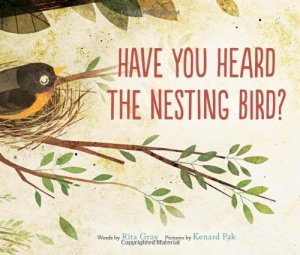 We’re all about birds this spring. Well, to be fair, I’m all about birds, but I’m filling my kids’ baskets with bird-related books, in hopes that they will catch on, too. I can’t help myself. There’s something about Spring Fever that drives me to obsess about some natural wonder alive and transforming outside my window (see past years’ obsessions with trees and worms). And what better way to drag my children along on this journey than through non-fiction picture books, which pair beautiful illustrations and poetic text with fascinating information?
I didn’t exactly choose birds as this year’s subject matter. They chose me. They chose me by waking me up at 4:30am with their frantic, high-pitched chirping. They chose me by making a nest between our roof and my bedroom ceiling, fast and furious work that sounded as if a much larger animal was ripping down sheets of metal. They chose me by distracting my children over breakfast, encouraging bowls of oatmeal to sit half-eaten, in favor of watching a pair of cardinals dancing in the dogwood outside our dining room window (my children are convinced that “Buddy” and “Lady Buddy” followed us two years ago when we moved up the hill to our current house). Let’s just say that the time seemed ripe to learn a thing or ten about the busy birds around us.
What I discovered was a treasure trove of non-fiction picture books starring birds, many published in recent years. I’ve shared my complete list of favorites at the end (with picks through age 10), but I had so much trouble choosing one to focus on here, that I have to expound on two. The first is Rita Gray’s Have You Heard the Nesting Bird? (Ages 3-6), illustrated by Kenard Pak. This is one of those deceptively simple picture books that educates as it delights. « Read the rest of this entry »
Fueling Up With Poetry
April 29, 2014 § 3 Comments
 On the Monday morning following Easter, JP crawled into my bed with a new book and proudly announced, “Mommy, I am going to read you some poems. I have lots of favorites. Some of them are very funny. Also some of them are very weird. A few of them I don’t even understand!” And hence followed one of the most enjoyable 45 minutes that I’ve had in awhile. All thanks to J. Patrick Lewis and Douglas Florian’s new Poem-Mobiles: Crazy Car Poems (Ages 5-10).
“Children dive into poetry with the same natural ease as swimmers into water, climbers into trees, and sleepers into dreams…Poetry’s narrative, rhythm and vibrant imagery is the real language of childhood.” So begins a recent online article in The Guardian about a movement among educators and publishers to bring back children’s poetry from “near extinction.” Why, if poetry is so intuitive, so enticing, for children, is it in danger of dying out? The article points a finger at booksellers, many of whom (and I admit to being guilty of this at one time) struggle with how to display and shelve a hard-to-pin-down category. Not considered picture books, not considered chapter books, they end up in their own “poetry” section way off in No Man’s Land. When was the last time you sought out the poetry shelves at your bookstore? « Read the rest of this entry »
Connecting Through Diversity
March 25, 2014 § 1 Comment
 A rousing op-ed piece by acclaimed children’s author Walter Dean Myers, recently appearing in The New York Times, poses the uncomfortable question: “Where Are the People of Color in Children’s Books?” The startling statistic cited at the beginning reveals that of the 3,200 children’s books published in 2013, only 93 were about black people. Myers later compares this statistic to the 40% of public school students nationwide who are black or Latino. As a black boy growing up in Harlem, Myers’ initial love affair with reading quickly turned to disinterest, as he discovered the glaring lack of literary characters who looked and lived like him. As an adult, Myers has dedicated his career to writing prolifically about inner-city youth, calling his novels “a validation of their existence as human beings.” But it’s about more than providing validation to people with color, he notes. It’s also about how these individuals are seen by the rest of us:
Books transmit values. They explore our common humanity. What is the message when some children are not represented in those books?
As someone who sold picture books for many years, what often strikes me about today’s offerings for young people is not the lack of books featuring people of color (that is clearly a fact), but how quickly a book with a black figure on its cover almost always signifies a story about a “race issue,” be it a story about a slave traversing the Underground Railroad or one about a contemporary black girl overcoming her classmates’ prejudice to star in the school play. Many of these are beautiful, powerful picture books—but they are also ones that, too often, only end up seeing the light of day during calendar events like Black History Month. Especially among white families, they are treated more like “teaching tools” for the classroom and less like the books we purchase and leave strewn around our house, hoping for our children to discover and devour them. « Read the rest of this entry »
Seasonal Inspiration from a Zen Master
March 7, 2014 § 3 Comments
 Normally, I’m all for aspiring to live in the moment. But not right now. Not this week. Because, it’s March, people, and the ground is once again covered in snow; we’ve lost another two days of school; it’s grey and cold and, frankly, there’s nothing to be gained from living in this moment.
Instead, our family is busy making plans for the future—and living in the delicious anticipation of those plans. My kids are dreaming up the giant sandcastles they intend to make on our upcoming trip to Florida (I am dreaming up the cocktails I intend to make). We are gazing out the window at the trees we planted last fall, wondering what they are going to look like with new, green leaves. JP is plotting how much money he might make selling freshly-squeezed lemonade on the hottest of summer days. And, because September is only six months away, both kids are beginning the daily debate about what their birthday parties should entail. Normally, I might interject a dismissive, “well, we’ll have lots of time to discuss that when it’s closer to the date”; but, right now, what else do I have to do? Sure, let’s talk about how the cake needs to have your name on it (“so everyone knows it’s my birthday”) and how the balloons need to be tied down just right so that they don’t blow away (“like that one time”). Bring it.
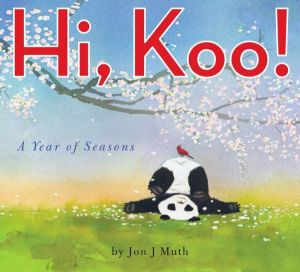
I’m betting that others are in the same boat. And that’s why I’m betting that Jon J. Muth’s brand new Hi, Koo!: A Year of Seasons (Ages 3-8) will be a sure bet for anyone in need of some assurance that spring (and summer) are just around the corner. « Read the rest of this entry »
The Best Chapter Books Talk to the Heart
May 17, 2013 § 3 Comments
 I’m often asked to recommend chapter books that lend themselves to reading aloud, either for a classroom setting or for a parent reading to an elementary-aged child. This is no small order: you need something where the subject matter isn’t too frightening or mature for the 5-8 year old set; you need something that’s going to engage the adult reader as much as the child (there’s no law that says this can’t be enjoyable for us!); and you need something that transcends the plot-driven, early-reader books that kids are reading on their own and helps them develop a taste for the kind of diverse language and emotionally-rich storytelling that will hopefully influence their reading choices in the future. This past winter, we read to my son the classic Little House on the Prairie series, which I adored as a child and whose themes feel just as timeless and important as ever (family values, the rewards of hard work, celebrating the non-material joys in life). But Laura Ingalls Wilder’s writing can also be quite tedious to read aloud, packed with lengthy explanations (twenty pages devoted to smoking a pig?) and repetitive sentence structures. There were moments when I could feel JP’s attention wandering, despite his avid assurance each night that he wanted to read more, more, more.
But then we finished that series and began Marion Dane Bauer’s stand-alone novel Little Dog, Lost (Ages 8-12, younger if reading aloud), published just last year, and it felt like a breath of fresh air. Here’s a book where not a single word is wasted, a book whose text flows off the tongue with such buttery smoothness that most of the time I couldn’t bring myself to stop when I got to the end of a chapter (that’s right, I was actually choosing in those moments to delay bedtime). Bauer achieves this incredible richness of language by breaking with a major narrative tradition: she writes her novel in free verse, creating chapters out of short, staccato poems, which loosely string together and sometimes even repeat words and phrases, all the while telling a very clear and cohesive story. There are 44 of these untitled poem-chapters; and they switch off narrating from the viewpoints of children, adults, and animals—all of whom live in a small contemporary town called Erthly and whose lives are forever touched by an incident involving a lost dog searching for someone to love him.
Freed from the confines of conventional narration, Bauer is able to cut straight to the emotional core of her characters—and the result is a story that children will feel deep in their hearts. Animal stories inherently engender sympathy from children (not coincidentally, some of JP’s favorite moments in the Little House books revolve around the Ingalls’ faithful dog, Jack). At the center of Little Dog, Lost is Buddy, an orphaned dog with “ears like airplane wings,” who “dances” along the sidewalk, longing for a home with “chasing balls,/ ear scratches,/ kisses.” Children will easily relate to Mark, a young boy “who had wanted a dog for as long as he could remember./ He had asked for a dog./ He had begged for a dog./ He had pleaded and prayed and whined for a dog./ Once he’d even tried barking for a dog.” And who wouldn’t be intrigued by a mysterious old man named Charles Larue, who lives alone in a pointy-towered mansion and never speaks to anyone? Throughout the story’s suspenseful twists and turns, even amidst the humorous touches (many coming from a bossy tabby cat who thinks he’s a dog), the story never strays from the hopes and dreams of its relatable, big-hearted characters. It’s fair to say that my son had a full-body experience while listening to this book. He chuckled, gasped, and emitted little exasperated grunts; he covered his eyes and held his breath; he beat his fists on the bed; he cheered; he hugged my arm to pieces; and he shed more than a tear or two (as he says, “I have a little water in my eyes right now because I’m so happy.”). Now that’s a chapter book.
Other Favorite Read-Aloud Chapter Books With Animals & Lots of Heart:
The Cricket in Times Square, by George Selden (Ages 5 & up*)
Charlotte’s Web, by E.B. White (Ages 5 & up)
The Trumpet of the Swan, by E.B. White (Ages 5 & up)
Mr. Popper’s Penguins, by Richard Atwater (Ages 5 & up)
Ginger Pye, by Eleanor Estes (Ages 6 & up)
The One and Only Ivan, by Katherine Applegate & Patricia Castelao (Ages 6 & up)
*Please note that these ages are assuming the reading is being done by an adult. For a child reading independently, the age range would be closer to eight and up.
Rethinking Mother Goose
April 30, 2013 § 3 Comments
 A customer once said to me, “Nursery rhymes are what parents used to have to read before better books were written.” A bit harsh, maybe, but there was a time when I could very much relate to this sentiment. With my firstborn, I quickly passed up Mother Goose in favor of reading him plot-driven stories featuring animals (my choice) or construction vehicles (his choice) or Richard Scarry (our compromise).
But then my daughter was born and my opinion of these verses—albeit old-fashioned, nonsensical, and odd—changed. Emily was born with an ear for music; she hears a song once and weeks later she’s belting out a bastardized version from her bed. Early on, her musical predisposition translated to reading material. The two Mother Goose board books on our shelves, whose spines were barely cracked by her brother, became Emily’s prized possessions (the better of the two being Tomie dePaola’s Tomie’s Little Mother Goose).
Saving the Trees
April 22, 2013 § 2 Comments
 Earlier today, in honor of Earth Day, I shared Dr. Seuss’ The Lorax (Ages 5-10) with the elementary children at my son’s Montessori school. While most people associate Dr. Seuss with the nonsensical but catchy I-Can-Read titles, like Green Eggs and Ham, I would argue that his narrative poems—his longer, more complex, often moralistic stories—were actually his greatest gift to children. Not only do these stories showcase a mastery of rhyme that is virtually unmatched in contemporary children’s literature, but many of them also serve as cautionary tales, introducing children to the dangers of things like running away from your problems (I Had Trouble in Getting to Solla Sollew), or prejudice (The Sneetches), or, as in the case of The Lorax, industrialization at the expense of natural resources.
The Lorax, a “brownish,” “mossy,” raspy-voiced creature, who famously utters, “I speak for the trees for the trees have no tongues,” may have been conjured up by Dr. Seuss in 1971, but his environmental message resonates just as clearly today. And yet, there’s a second hero in this story, one with greater power than The Lorax himself. I’m referring to the unnamed child, who appears at the beginning and the end of the story—the one to whom the Once-ler relates (and repents) his decision to knit every last Truffula Tree into an ambiguous but allegedly multipurpose Thneed, “which everyone, EVERYONE, EVERYONE needs.” This child, to whom the Once-ler entrusts the very last Truffula seed, along with instructions to nurture it with water and clean air, literally holds the future of the planet in his hands; he is the reader’s hope for a happy ending. « Read the rest of this entry »
The Year That Lies Ahead
January 3, 2013 § 2 Comments
On the morning of January 1, my five year old crawled into our bed and asked with great solemnity, “Is the year of Christmas over?” I’m not entirely sure what he was getting at; did he mean to say month? or season? or was he actually inquiring as to whether the Year of the Great Christmas of 2012 had ended? I’ll never know exactly what was ruminating in his little head, but it was a sweet reminder of how bewildering the concept of time is to children—even to a five year old who has plenty of memories of past years.
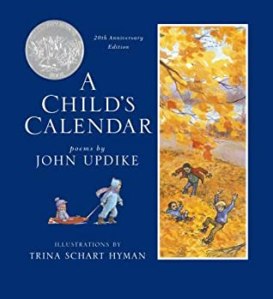
We as adults take for granted our assurance about the cyclical nature of time: that all seasons, all holidays, all of nature’s dramatic transformations, will occur again and again with each passing year. It will probably come as no surprise that my instinctual reaction to JP’s question on New Year’s morning was to send him downstairs to fetch some relevant reading material. One of my all-time favorite children’s books (a book so precious to me that it actually resides on the “adult” shelves of our living room library) is A Child’s Calendar (Ages 5-10), a 1965 treasure of poems by John Updike that was later given a ’90s makeover with the addition of award-winning illustrations by Trina Schart Hyman.
« Read the rest of this entry »Spring is Here!
April 21, 2012 § 1 Comment
 Perhaps at no other time in our lives than when we are parenting young children are we more attuned to the changing of the seasons. Seen through our children’s eyes, it’s positively magical, nature unfolding in all sorts of surprising ways. Regardless of our “mild” winter, on March 1 our family had a March into Spring around our living room, started giddily discussing planting vegetables and riding bikes to school without jackets–and started reading Spring Books. In my opinion, a picture book about spring should capture the anticipation, the wonder, the thrill, and the hope we feel at the beginning of the season.
Get ready to open your hearts to And Then It’s Spring (Ages 3-6), a 2012 picture book by newcomer poet Julie Fogliano and one of my favorite contemporary illustrators Erin E. Stead (side note: if you don’t already own her zoo-animal masterpiece A Sick Day for Amos McGee, do not delay a second longer). And Then It’s Spring is one of those perfect marriages of words and pictures, where the end result is more than the sum of its parts. Without any illustrations, it’s simply a lovely free verse poem about “first you have brown/ all around you have brown/ then there are seeds/ and a wish for rain” and more waiting and “you worry about those seeds” but it’s still brown—until you wake up one morning and suddenly “it’s green/all around you have green.” Now add to this verse subtly stunning pencil and woodblock illustrations, and suddenly you have a little boy, his dog, a bunny, a bird, and a turtle (sporting a red wool cap)—all moving around a backyard that gets a little less brown every day.
 What to Read to Your Kids