Sibling Play
April 11, 2014 § 1 Comment
 I’ll never forget the first time it happened. JP was four, Emily was a little over one, and I realized that 45 minutes had passed and there were still only happy voices in the other room. I called a friend: “The kids are playing together! ON THEIR OWN! For like a really long time! I’m just sitting here reading a book!” (Well, technically I was talking on the phone, but the point is that I could have been reading a book.) And that’s when it hit me: this is why some people have more than one kid (or more than one dog, cat, or fish).
Watching siblings play together is one of the most endearing and gratifying experiences for a parent. (Well, until it all goes south—which it inevitably does—usually right at the moment when you have finished the dishes, wiped down the lunch table, dust-bustered the floor, and finally sat down on the sofa to page through a magazine.) But when the stars do align, as they increasingly do with age, it is in these moments that I get the clearest glimpses of my children’s budding personalities, of the people they will someday become. I see tenderness and compromise in my now six and a half year old boy, amidst the bossiness and tendency to escalate play into some form of physical combat. And in my now three and a half year old daughter, I feel her excitement, her sheer pride, in the way she confidently prattles on after her brother agrees, “OK, you can be the mommy bird, and I’ll be the baby bird.” Because, really, is it not the best feeling in the world when that older brother whom you revere in every way decides to drop everything for you?
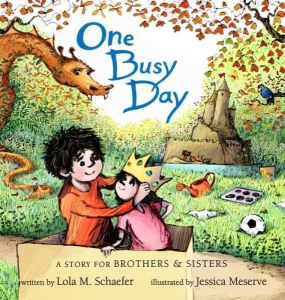
Imagination is the great equalizer in sibling play. In the world of pretend play, it doesn’t matter how old you are. Enter Lola M. Schaefer and Jessica Meserve’s latest picture book, One Busy Day: A Story for Big Brothers and Sisters (Ages 2-6), in some ways a sequel to their first book, One Special Day, about the moment in which a little boy becomes a big brother. « Read the rest of this entry »
Digging for Dinosaurs
January 6, 2014 § 4 Comments
 The last week of my winter break was spent in a cloud of plaster dust. No, we’re not putting an addition on our house; and no, my husband did not finally repair our bedroom ceiling. I’m referring to the Excavation Kits that my son received for Christmas, the kind that come with kid-sized tools for chipping away at blocks of pink plaster, in an attempt to unearth miniature replicas of prehistoric bones. We are talking about a six year old engaged in hours upon hours of independent, uninterrupted work. Are you hearing this, my fellow parents? You need to get Santa to come back. Right now. And you won’t even mind the mess—in fact, you’ll never be happier to clean plaster dust off the floor.
There are kids so obsessed with dinosaurs that they not only know the names of them, but they can pronounce them correctly, tell you in which periods they lived, and rattle off lists of what they ate. JP is not one of those kids. He might be able to identify 15 dinosaurs, despite our reading extensively about them over the years (and I wouldn’t fare much better). For him, the lure lies in the process of dinosaur discovery, the means by which fossilized bones get from some remote dusty location to the pristine museum halls. I’ve mentioned before how much we love Jessie Hartland’s How the Dinosaur Got to the Museum (Ages 4-8), arguably one of the simplest and best introductions to the science of paleontology. And don’t even get me started on the downright fascinating portrayal of field work in Barnum’s Bones: How Barnum Brown Discovered the Most Famous Dinosaur in the World (Ages 5-10), by Tracey Fern and Boris Kulikov.
But (and I do apologize for this) I’ve been holding out on telling you about another of our favorites: the Pièce de Résistance of Dinosaur Books. I’m talking about National Geographic’s The Dinosaur Museum: An Unforgettable, Interactive, Virtual Tour Through Dinosaur History (Ages 5-10). « Read the rest of this entry »
Thinking Outside the Box This Valentine’s Day
February 5, 2013 § 4 Comments
 Is there a better way to shower our children with love this Valentine’s Day than by snuggling under a blanket with them and sharing a new story? And yet, I’m never thrilled with the list of books that the media typically puts forth as gift ideas for V-Day. Chances are you already have your fair share of books about parental affection (the Guess How Much I love You? sort). If I’m being totally honest, I feel a tad exploited by these lovey-dovey books about hugging and kissing and eternal love; too often they’re lacking in imagination and art and feel instead like a cheap move by publishers to go after our vulnerability as parents (I’ll get off my soapbox now). There are some wonderful classics, like Judith Viorst’s Rosie and Michael and Sandal Stoddard Warbug’s I Like You, but their content is arguably more appropriate for grown-ups to give one another.
So when it comes to Valentine’s Day, I like to think outside the box. In the past, I’ve given my son the glorious Red Sings from the Treetops (hey, there’s red in the title) and The Jolly Postman (Valentines are like letters, right?). But this year, I have an especially good one pegged for my two-year-old daughter; I’ve been hiding it under my bed since it came out last fall and biding my time to spring it on her.
My Good Pal Mo (I Like to Pretend We’re On a First Name Basis)
November 10, 2012 § 1 Comment
 No one gets straight to the heart of kids like Mo Willems. It seems almost criminal that I’ve been at this blog for several months now and have yet to sing the praises of one of the most original author-illustrators of all time. While he’s best known for the Don’t Let the Pigeon Drive the Bus series (which, despite its popularity, is not my or my children’s favorite), Mo is at his best with one-off masterpieces, like Edwina, the Dinosaur Who Didn’t Know She Was Extinct and Leonardo the Terrible Monster (see my complete list at the end). And now we get to add his newest creation, Goldilocks and the Three Dinosaurs (Ages 4-8), in which three scheming dinosaurs lure Goldilocks into the wrong fairy tale in an effort to make “chocolate-filled-little-girl-bonbons” out of her.
During the 46 times that I’ve been asked by my son to read this book in the past month, I’ve started to put my finger on what it is that unites Mo’s seemingly disparate stories. Mo gives children A LOT of credit (probably more than us parents do). He doesn’t employ traditional literary devices (in fact, in Goldilocks he actually turns them on their head), and he offers few explanations; instead, he writes with the expectation that kids will pick up on the subtlety, the irony, the little side jokes, and the sophisticated vocabulary through their repeated readings. Over the years, I’ve had more than one person ask me whether Mo’s multi-layered storytelling is accessible enough to children or simply intended to amuse the parent who’s reading it. In response, let me give you an account of how my five year old experienced Goldilocks and the Three Dinosaurs:
Monsters With Manners
October 11, 2012 Comments Off on Monsters With Manners
 I recently asked my five-year-old son: “What do you think monsters are like?” His answer: “They have big teeth and sharp claws and they eat little kids.” Oh. Well, the good news is that there’s a new(ish) genre afoot in children’s literature: not-too-scary scary stories (my recent posts on Creepy Carrots and Vampirina Ballerina are great examples). There are also some fantastic monster-themed books, featuring a new generation of what I will call Funny Monsters.
What makes kids find the monsters in these books so funny? Precisely because our little ones, occasionally monstrous themselves, can identify with these monsters’ unpredictable bursts of rage and destruction. On some level, they recognize a shared vulnerability, a shared quest to fit in and make sense of a complex world.
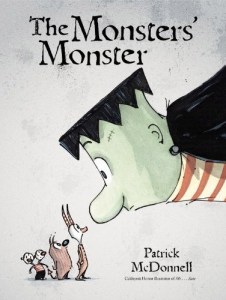
Author and illustrator Patrick McDonnell (best known for his Mutts comic strip) has a knack for creating deceptively simple picture books that get right to the heart of what it means to be human. In the beginning of his brand new The Monsters’ Monster (Ages 3-7), we are introduced to three tiny nay-saying monsters, named Grouch, Grump, and little Gloom ‘n’ Doom (how can you not immediately love this book?). The trio relishes their job of being monsters: they have tantrums, their favorite word is “NO,” and they love crashing, smashing, and bashing (sound familiar yet?).
September’s Birthday Pick (Arthurian Style)
September 7, 2012 § 1 Comment
 What do you buy the rough-and-tumble kid (the kid that turns everything into a sword)? And how do you simultaneously appeal to his mom, who grows a bit weary of this violent play-acting?
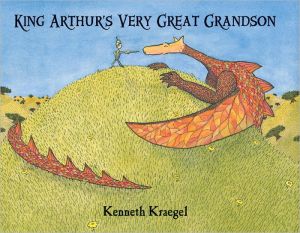
Never fear: everyone wins with the newly-published King Arthur’s Very Great Grandson, by Kenneth Kraegel (Ages 4-7), which is equal parts perfect for child and parent.
On the morning of his sixth birthday, Henry Alfred Grummorson is determined to honor his heritage as the “great-great-great-great-great-great-great-grandson” of King Arthur, “the noblest knight ever to wield a sword.” Armed and seated on the back of his trusty donkey Knuckles, our precocious protagonist sets off to battle the great and terrible monsters of the British countryside.
The appeal to kids is obvious. You’ve got a knight in shining armor (with a sword). You’ve got a fire-breathing dragon (and a Cyclops and a Griffin). You’ve got ten fanciful ways to say “fight” (as in, “Now unsheathe your claws and let us have ado!”). And you’ve got large amounts of text in all-caps, demanding only the most dramatic of readings (“BEHOLD, VILE WORM! I, HENRY ALFRED GRUMMORSON, A KNIGHT OF KING ARTHUR’S BLOOD, DO HEREBY CHALLENGE YOU TO A FIGHT TO THE UTTERMOST!”).
Chapter-a-Night Adventure
May 4, 2012 § 2 Comments
 How do chewing gum, hair ribbons, and six magnifying glasses help a little boy rescue an enslaved baby dragon on a wild island of ferocious talking animals? There are few early chapter books written with as much wit, cleverness, and heart as Ruth Stiles Gannett’s beloved trilogy, first published over 60 years ago: My Father’s Dragon, Elmer and the Dragon, & The Dragons of Blueland (Ages 4-9). With short digestible chapters, about 200 words per page, and enchanting black-and-white sketches peppered throughout, they are perfect for reading aloud.
JP and I started these books on a recent train ride to New York and finished them a few days later, only to start them over again. At the heart of the stories is the relationship between Elmer and his dragon, an evolving friendship that brings out the best in both parties. But the real draw for kids is the adventure (no shortage of “close-calls”) and the magic (who doesn’t love thinking about riding on the back of a flying dragon?).
 What to Read to Your Kids