Digging for Dinosaurs
January 6, 2014 § 4 Comments
 The last week of my winter break was spent in a cloud of plaster dust. No, we’re not putting an addition on our house; and no, my husband did not finally repair our bedroom ceiling. I’m referring to the Excavation Kits that my son received for Christmas, the kind that come with kid-sized tools for chipping away at blocks of pink plaster, in an attempt to unearth miniature replicas of prehistoric bones. We are talking about a six year old engaged in hours upon hours of independent, uninterrupted work. Are you hearing this, my fellow parents? You need to get Santa to come back. Right now. And you won’t even mind the mess—in fact, you’ll never be happier to clean plaster dust off the floor.
There are kids so obsessed with dinosaurs that they not only know the names of them, but they can pronounce them correctly, tell you in which periods they lived, and rattle off lists of what they ate. JP is not one of those kids. He might be able to identify 15 dinosaurs, despite our reading extensively about them over the years (and I wouldn’t fare much better). For him, the lure lies in the process of dinosaur discovery, the means by which fossilized bones get from some remote dusty location to the pristine museum halls. I’ve mentioned before how much we love Jessie Hartland’s How the Dinosaur Got to the Museum (Ages 4-8), arguably one of the simplest and best introductions to the science of paleontology. And don’t even get me started on the downright fascinating portrayal of field work in Barnum’s Bones: How Barnum Brown Discovered the Most Famous Dinosaur in the World (Ages 5-10), by Tracey Fern and Boris Kulikov.
But (and I do apologize for this) I’ve been holding out on telling you about another of our favorites: the Pièce de Résistance of Dinosaur Books. I’m talking about National Geographic’s The Dinosaur Museum: An Unforgettable, Interactive, Virtual Tour Through Dinosaur History (Ages 5-10). « Read the rest of this entry »
Holiday Gift Guide 2013: Compelling Non-Fiction For the Animal Lover
December 16, 2013 § 1 Comment
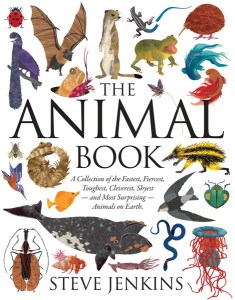 Last year around this time (equally last minute), I did a post about “books worth their weight” (great-looking reference books), as well as one about picture books by Steve Jenkins, a.k.a. Children’s Master of All Things Animal. This year, we can kill two birds with one stone when we buy Steve Jenkins’ new, overstuffed, and absolutely phenomenal The Animal Book: A Collection of the Fastest, Fiercest, Toughest, Cleverest, Shyest—and Most Surprising—Animals on Earth (Ages 6-12).
Over 300 fascinating animals are presented in sections like Family (chapters include “The Mating Dance” and “Bringing Up Baby”); Defenses (e.g. “Copycats” and “Bodily Fluids”); and The Story of Life (yes, Jenkins tackles evolution and, boy, does he succeed). I’m normally not a big fan of fact-centered non-fiction, preferring a more narrative approach that strengthens children’s attention spans and reading comprehension. But I make a BIG exception for Jenkins, whose presentation is as visually enticing (brilliant paper collages amidst an extraordinary use of white space) as it is factually addictive. I could look at this book for hours. I have looked at this book for hours (yes, I am hoarding it from my kids). « Read the rest of this entry »
Holiday Gift Guide 2013: Stories of Perseverance for the Engineer
December 10, 2013 § 1 Comment
 If at first you don’t succeed, try, try again. That might be easy to say as a parent, but we have only to remember our own childhoods to know how hard it is to hear. Just the other night, my son was attempting to draw a human profile by following one of those step-by-step guidebooks. Diligently huddled over his paper, he suddenly threw the pencil across the room and yelled, “This isn’t working at all! It doesn’t even look like a person!” Actually, I thought, it does look like a person—just not like the one in the book. Oftentimes, we cannot see our triumphs for what they are.
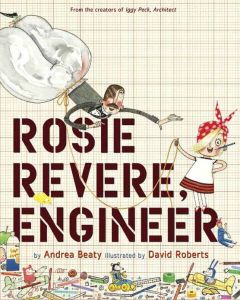
The creative process—its ups, its downs, its just plain hard work—is wonderfully captured in Rosie Revere, Engineer (Ages 5-8), the newest venture by Andrea Beaty and David Roberts, the team that created one of my favorite picture books of all time: Iggy Peck Architect. What black-turtleneck-sporting Iggy Peck did for building designs, red-scarf-sporting Rosie Revere (yes, her namesake is Rosie the Riveter) does for engineering. She makes it look—well—cool. « Read the rest of this entry »
“Our Trees are Coming!” “Our Trees are Coming!”
November 21, 2013 Comments Off on “Our Trees are Coming!” “Our Trees are Coming!”
 I’m completely obsessed with trees right now. I know what you’re thinking: this is not news. And, you’re right, I’ve written about my love for trees (and stories featuring trees) here, here, here and here. But I’m really, really obsessed with trees right now—and that’s because I have recently been tree shopping. When my kids were baptized last spring, their grandmother offered to buy each of them a tree to grow up alongside. So, earlier this fall, the kids and I did what we do best: we walked, we scooted, and we drove around our neighborhood looking at trees. How had we missed so many of these beauties before? “How about we get one of each?” my son ventured.
Eventually, we narrowed down our choices, but then there was the question of how and where to buy the trees. I initially thought, I’ll look for a deal on the Internet. But then my gardening friend reproached me: you need to see a tree before you buy it, need to study its form, need to find one that speaks to you. This is why, one crystal clear November morning, I found myself standing in a wholesale nursery an hour away in Maryland, surrounded by 600 different varieties of trees. I was walking up and down rows of trees, examining curves of trunks and canopy shapes, paying way too many people to follow me around offering their opinions, and starting to feel like I was going to have a hard time explaining to my husband how this simple decision to buy two trees had gotten totally out of hand. Did I mention how much fun I was having? « Read the rest of this entry »
Bang! Crash! Interstellar Collisions!
October 18, 2013 § 2 Comments
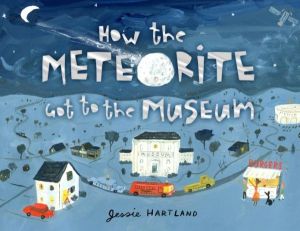 I may have given an audible little yelp the other day when I discovered that Jessie Hartland had published a new title in her “museum” series, but it was nothing like the squeal of joy that my six year old emitted when I brought it home and gave it to him. You see, How the Dinosaur Got to the Museum (Ages 4-8) and How the Sphinx Got to the Museum (Ages 5-10) are among our All Time Favorites, rivaled only by Hartland’s newest addition to the series, How the Meteorite Got to the Museum (Ages 5-10). All three books are brilliantly simple slices of science and history; they introduce children to paleontology, Egyptology, and now astronomy by following a specific artifact from its discovery in the field to its place in the exhibition hall of a museum.
Most great science books take their inspiration from true historical events. Here’s an especially awesome one: on a clear night in October of 1992, a meteor that had been predictably orbiting the sun for four billion years suddenly and inexplicably changed course, entered the Earth’s atmosphere, flew over Kentucky, West Virginia, and Pennsylvania, and crashed into the trunk of a Chevy Malibu parked outside a house in Peekskill, New York (that’s right, crashed—as in, totaled the back of the car and sprung a leak in the fuel tank and precipitated a 911 call to police and fire fighters—pretty much the coolest thing my six year old has ever conceived of). « Read the rest of this entry »
Learning From History’s Many Heroes
May 30, 2013 § 3 Comments
 Just because the school year ends shortly doesn’t mean that our children’s minds have to shrivel up like apples left out too long in the sun. Last week, I gave some ideas for great read-aloud novels to share with your kids. Now, I’m going to encourage you to add some non-fiction into the mix—specifically, historical biographies posing as picture books. In previous posts about Martin Luther King Jr. and Abraham Lincoln, I’ve hailed the rise of today’s picture book biographies, which (unlike the static, black-and-white books of our school days) read like interesting, action-packed stories accompanied by vibrant paintings and intriguing designs. But I’m not merely talking about the Most Obvious Historical Figures; there are lesser known but equally captivating true stories of ordinary boys and girls, men and women, who shaped the world with extraordinary acts of courage, defiance, or creativity.
Where picture book biographies are concerned, contemporary illustrator Melissa Sweet has been on a roll, creating the art for several of my favorite non-fiction books in recent years. Although these biographies are written by different authors, they are unified by Sweet’s signature style—at once instantly recognizable but also entirely unexpected for the historical genre. In place of photographic-like paintings in somber tones, Sweet uses fun colors, whimsical patterns, and collage elements specific to the person whose story she is bringing to life. In Jen Bryant’s A River of Words: The Story of William Carlos Williams (Ages 7-12), Sweet peppers her background collages with excerpts from Williams’ poems, opening up kids’ eyes to these words and thoughts as an art form unto itself. In Alicia Potter’s Mrs. Harkness and the Panda (Ages 5-8), an account of the first person to capture a wild panda in China and bring it to an American zoo for study, Sweet creates frames for her watercolors out of authentic Chinese decorative papers, lending an other-wordly, almost mystical charm to this already fascinating story.
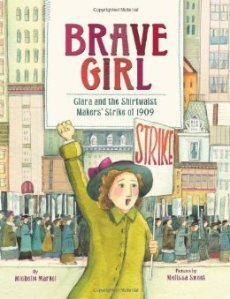
One of Sweet’s most recent triumphs is even more captivating for its portrayal not of an adult but of a young girl. Michelle Markel’s Brave Girl: Clara and the Shirtwaist Makers’ Strike of 1909 (Ages 6-10) tells the mind-boggling story of a Jewish immigrant girl, forced to endure long hours, harsh treatment, and poor pay, while sewing alongside hundreds of other girls in factories (her family’s only hope of putting food on the table.) Clara Lemlich’s “got grit,” and she “knows in her bones what is right and what is wrong”; ultimately, she leads the largest walkout of women workers in American history, inspiring thousands of male and female workers across the country to strike for better working conditions and the right to organize unions. « Read the rest of this entry »
Sometimes Reality Trumps Fiction
March 19, 2013 Comments Off on Sometimes Reality Trumps Fiction
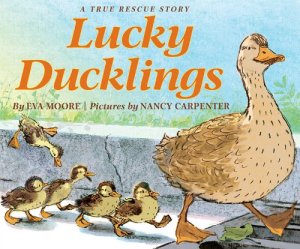 For the past year, my five year old has been obsessed with sorting out fiction from fact. “But did that really happen?” is a common question when we are reading stories, delivered with a furrowed brow and a skeptical tone (as if we as parents are deliberately trying to dupe him with our choice of fictitious books). “Swans can’t really talk and that’s how I know that this story did not really happen,” he announced with confidence at the dinner table one night, after fervently recounting the chapter his class had read that afternoon from The Trumpet of the Swan.
More and more, it would seem, JP has decided that stories are synonymous with make-believe. So, in an effort to challenge his thinking (and because it’s fun to blow his mind), I have been on the hunt for seemingly far-fetched stories that are actually based on real events. Lucky for us—and for our daughter who is obsessed with ducks right now—Eva Moore and Nancy Carpenter’s new Lucky Ducklings (Ages 2.5-6) is just such a story—and an actual rescue story at that.
Eyes on Abraham Lincoln
February 12, 2013 Comments Off on Eyes on Abraham Lincoln
 You might expect that my children, living so close to Washington DC, have many opportunities to learn about our nation’s history. But mere proximity does not a future scholar make. The Lincoln Memorial, for example, is consistently celebrated by my five year old as “the place where we picnic in the summer!” If you ask him the name of the president that sits in stone behind him during said picnics, he is likely to throw you a disinterested look and recommence staring out the car window, pointing out other landmarks whose names he boasts correctly but whose significance he understands not. Which begs the question: How do we get our kids to care about the past presidents that have shaped our country?
The biographies we read as kids were filled with dry facts and black-and-white photographs that made their content feel all too disconnected from our daily lives; too often we were encouraged to memorize names and dates for tests, only to forget them a week later. Thankfully, our own kids have access to a whole new generation of fresh reading material, including picture books that breathe colorful new life into historic periods and events.
“Use Your Words” (MLK Jr. Style)
January 17, 2013 § 1 Comment
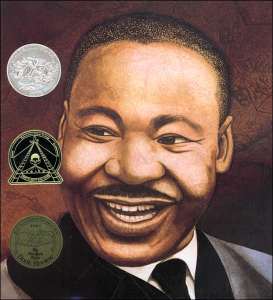 In a few days, our country will celebrate Martin Luther King, Jr.’s birthday and a presidential inauguration. Whatever our political views, whatever our race or gender or religion or socioeconomic background, we can do our children a great service by talking to them about Dr. King’s vision of justice and peace, his commitment to respecting the dignity of every human being.
I’ve found that parents, especially us white Americans, are reluctant to broach the subject of race relations with preschoolers or even young elementary students. Ashamed of our country’s past afflictions, it’s as if we can pretend they never existed if we don’t talk about them. But child development specialists and sociologists (like Po Bronson and Ashley Merryman, authors of NurtureShock) have pointed out that children naturally notice differences in appearances, and that if we don’t have these conversations with them from an early age, they will begin to draw their own conclusions—and, even worse, begin to view the subject as taboo—which does nothing to advance our nation’s long and still arduous progression toward equality. And, let’s be honest, have you ever met a five or seven or ten year old that isn’t obsessed with the notion of fairness? For that matter, how many times a day do we as parents plead with our children, “Use your words!” (say, when said children yank something out of their sibling’s hands or push a peer on the school playground)?
Holiday Gift Guide 2012 (No. 4): Books For the Hero Within
December 18, 2012 § 1 Comment
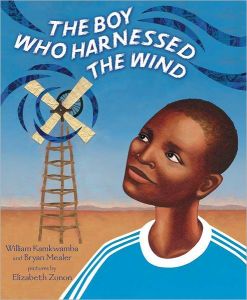 Benjamin Franklin once penned: “If you would not be forgotten/ As soon as you are dead and rotten,/ Either write things worth reading,/ Or do things worth the writing.” OK, that might not be a quote we need to read aloud to our young children, but its sentiment can and should inform the books we choose to share with them.
The genre of biographies written for children is taking off like never before; it seems not only are parents and educators seizing the chance to inspire our young ones with tales of historical figures, but kids themselves are embracing these literary opportunities to inform their own choices, to pave their own paths worth living. And it’s no accident that many of this past year’s biographies are picture books: against a backdrop of beautiful art and poetic text, stories about scientists, writers, inventors, artists, and peacemakers become that much more gripping. The books listed at the end of this post are treasures worth giving and owning; their artistic caliber alone makes them a far cry from the dry, fact-filled paperbacks that we once suffered through for school reports.
 What to Read to Your Kids