Protecting Our Planet: An Earth Day Round-Up
April 20, 2023 Comments Off on Protecting Our Planet: An Earth Day Round-Up

Fun fact: the second post I ever penned for this blog was for Earth Day 2012, when my then four-year-old daughter turned to me and said, “Aren’t we supposed to care about the Earth every day?” YES!
Heeding this call, the children’s publishing world has exploded in recent years with offerings about the natural world, many packed with fascinating nuggets and gorgeous art. While spring remains prime time for many of these releases, there’s no longer quite the urgency to time them around Earth Day. In other words, parents and educators alike are proving themselves game to purchase and enjoy these books with children all year long. Hurrah!
I often talk about how reading aloud to my children has been one of the best ways I’ve found as a parent to slow down, even on the days when time with my kiddos hasn’t felt savor-worthy (wink, wink). It’s also true that sharing picture books about the natural wonders outside our front door has sharpened my own powers of observation. I take as much—maybe even more?—enjoyment from these books as my kids do, perhaps because my own childhood was so devoid of them. Alongside my children, these picture books have made me more curious, knowledgeable, and appreciative about our planet. At a time when news headlines are rightly alarming us about the nearly irreversible dangers of climate change, these books instill in me a tiny grain of hope. With these books, we can get the next generation to care. We can make sure they know that this planet, our one beautiful home, is worth fighting for.
What a gift for our children to hone their observant eyes on the flowering tree, the squirmy worm, and the hummingbird’s work. What a gift for them to grow up with an appreciation for clean air and fresh water. What a gift for them to discover, early on, that young people have always been the drivers behind environmental activism.
In this vein, I am sharing four outstanding new non-fiction picture books with you today. The first two are focused specifically on the environmental movement, while the second two inspire awe about the biodiversity of Planet Earth, the reason we must fight so hard in the first place.
Titles span ages 4-10.
« Read the rest of this entry »The Story I Didn’t See Coming
January 19, 2023 Comments Off on The Story I Didn’t See Coming
A large part of my job as a bookstore buyer is perusing online catalogs. These days, most publishers include full interior PDFs of their picture book titles, so rather than taking a stab in the dark, I can read a book in full before deciding whether and how many to order. And with each catalog, especially the big ones, there’s a predictable flow. I begin with the excitement of Christmas morning—what treasures are waiting beneath this tree?—until my old lady eyes begin glazing over. I should take a break, I think. No, I should just push on! Only five more pages. Only a few dozen more titles. Where I began by carefully reading through each book, now I’m skimming. Then skipping. Now I’m bored. So bored. I’m bemoaning the fact that nothing feels exciting, nothing feels fresh. I should really take a break, because now I’m ready to give up my career because no one publishes anything good anymore. (All gross exaggerations, of course, but this is what computer fatigue will do to you.)
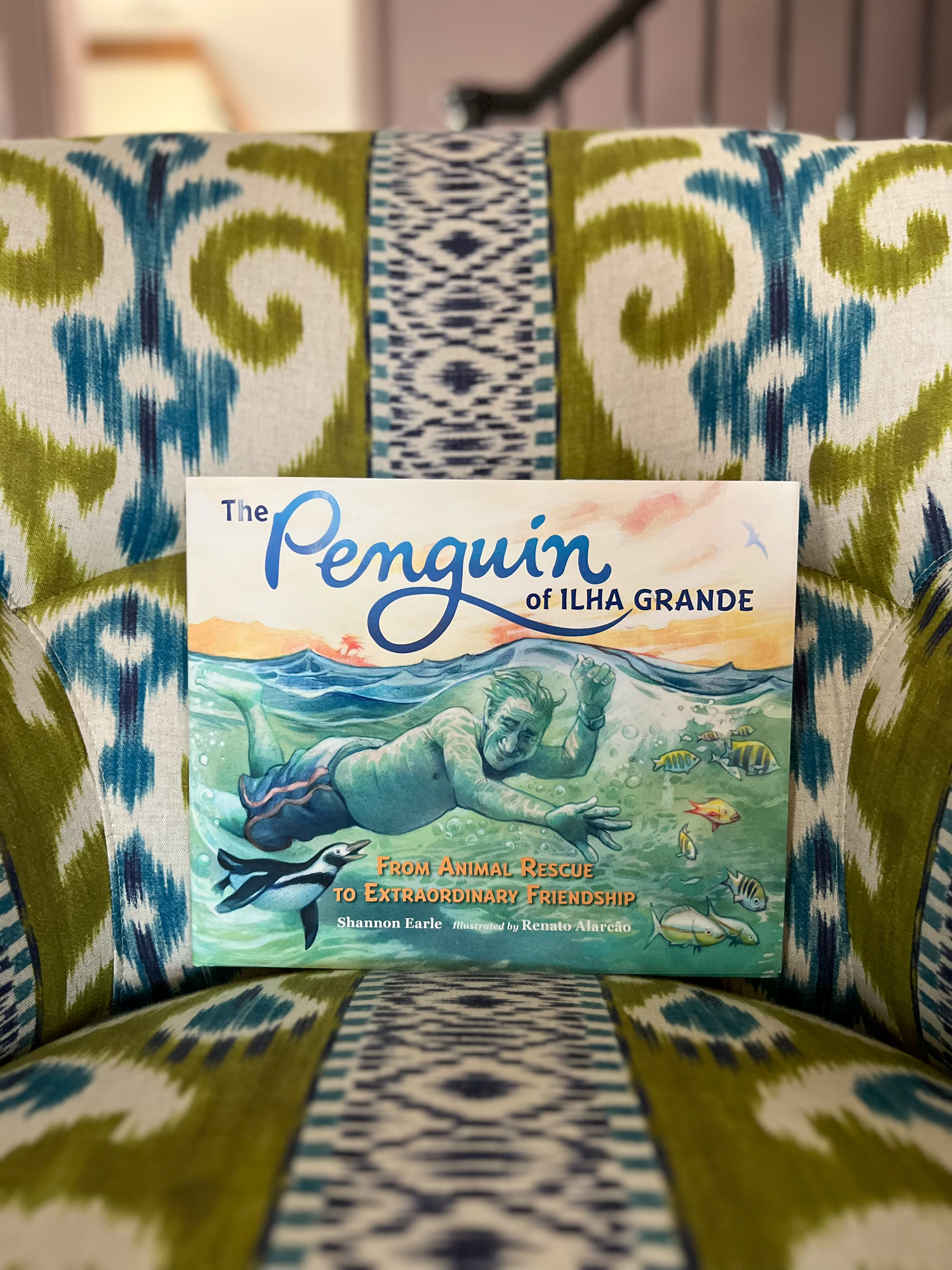
So there I was, back in October, perusing Penguin Random House, the monster of all catalogs, which also distributes titles published by the small press, Charlesbridge, when I came across the latter’s thumbnail for The Penguin of Ilha Grande, with a release date of January 17. No one buys a penguin book in January, I thought (as odd as it sounds, I generally can’t sell a book with snow once the New Year hits, because people are already thinking about spring). I was prepared to fly right on past, without clicking the link to open the book, only a tiny voice berated me: Don’t be lazy. You don’t want to miss something that could be great.
A few minutes later, I had tears rolling down my cheeks. I was shouting into the void of my living room, THIS STORY! Oh, my heart, THIS STORY! It turns out there wasn’t any snow or ice; this is the story of a Magellanic penguin, and Magellanic penguins migrate to feed in warm water. But to be clear: had it been covered in snow, I’d still have ordered it. Could I sell it as a non-traditional Valentine’s Day pick, seeing as it’s about an enduring friendship between a young penguin and an old man? Why not! Could I parade it out a few months later for our Earth Day displays, since it also carries a message about conservation? You betcha! Am I going to try and convince the author to come to our store? Yes indeedy.
Give me all the animal rescue stories! Especially if they’re based on true events; especially if they expose young readers to new corners of the world; especially if they teach the importance of science and conservation; and especially if they celebrate the amazing bond between humans and animals. Past favorites have included The Elephants Come Home, which landed on my 2021 Gift Guide, and Feathers Together, which was on last year’s guide. Is it my age that makes me a sentimental puddle? Quite possibly. But I’ve also seen firsthand how much children love these stories. They invite wonder about the world around them. They’re living proof that small hands can make a big impact.
Today, I can’t wait to introduce you and your children to The Penguin of Ilha Grande (ages 4-8), written by debut author, Shannon Earle, and illustrated by Brazilian artist, Renato Alarcão (the latter also illustrated this picture book from wayyyy back in the archives). The true story stars a penguin named Dindim, who was rescued off the coast of Brazil by an elderly man named Seu João—and the surprising and extraordinary friendship that followed.
« Read the rest of this entry »Four New Faves Celebrating Mamas and Grandmas
May 5, 2022 § 6 Comments
(Warning: I put on my most matronly dress to rage at the patriarchy.) Ouch, it’s a tough week to be a woman in this country. A tough week to contemplate the future for our daughters—and, let’s be honest, our sons, since a woman’s right to exercise autonomy over her body has always been inherently linked to the opposite sex. To say nothing of the repercussions SCOTUS’ decision will have for Black or Indigenous populations, or those living below the poverty line, or the precedent this could set for overturning protections for the LGBTQ+ community. We have only to dig into history to see that progress is never a straight line, but it’s one thing to recognize this and another to live it, to watch the work of generations collapse in a single moment. The list is growing long for horrifying things I never expected to witness in my lifetime.
Now, here we are, staring down Mother’s Day, an already complicated holiday for those mourning mothers, mourning children, mourning dreams of having children—and a day that now feels even more loaded, weighed down with the understanding that a woman’s body can be at once celebrated for its childbearing and stripped of its rights.
This is a cheery post, eh? Don’t worry, I promise we’re going to talk about some beautiful, uplifting, joyful books in just a second.
Yes, it’s a tough moment in history to be a woman. But, let’s not kid ourselves: it has always been a tough time to be a woman. Voting rights, equal pay, maternity leave, working outside the home, the right to wear pants, for crying out loud: the list for what women have been made to suffer is endless.
And still, I love being a woman. I love being a mom. I love following in the legacy of the curious, courageous, complicated women who raised me. When the fear of raising a daughter creeps in during times like this, I remember the strength of my own mother and grandmothers. My mom, who suffered the greatest heartbreak imaginable in the sudden death of my father at 51 and rallied to step into roles and master tasks she’d never imagined for herself, for the sake of her teenage daughters. My one grandmother, who for years endured physical pain without a word of complaint, because she didn’t want to miss out on a single family activity. My other grandmother, who attended science lectures in her 90s where she was the only woman, not because she knew anything about the topic, but because her own children and grandchildren’s involvement in the world had inspired her to expand her mind.
Today, I’m highlighting four new picture books that star formidable mothers and grandmothers—the kind I aspire to be, the kind who remind me that we will not go quietly into the night. Not when we know better, not when we’ve learned from the best. (You can also refer back to some older posts for favorites, like this, this, this, and this.)
« Read the rest of this entry »2020 Gift Guide: Picture Book Round-Up
October 29, 2020 Comments Off on 2020 Gift Guide: Picture Book Round-Up
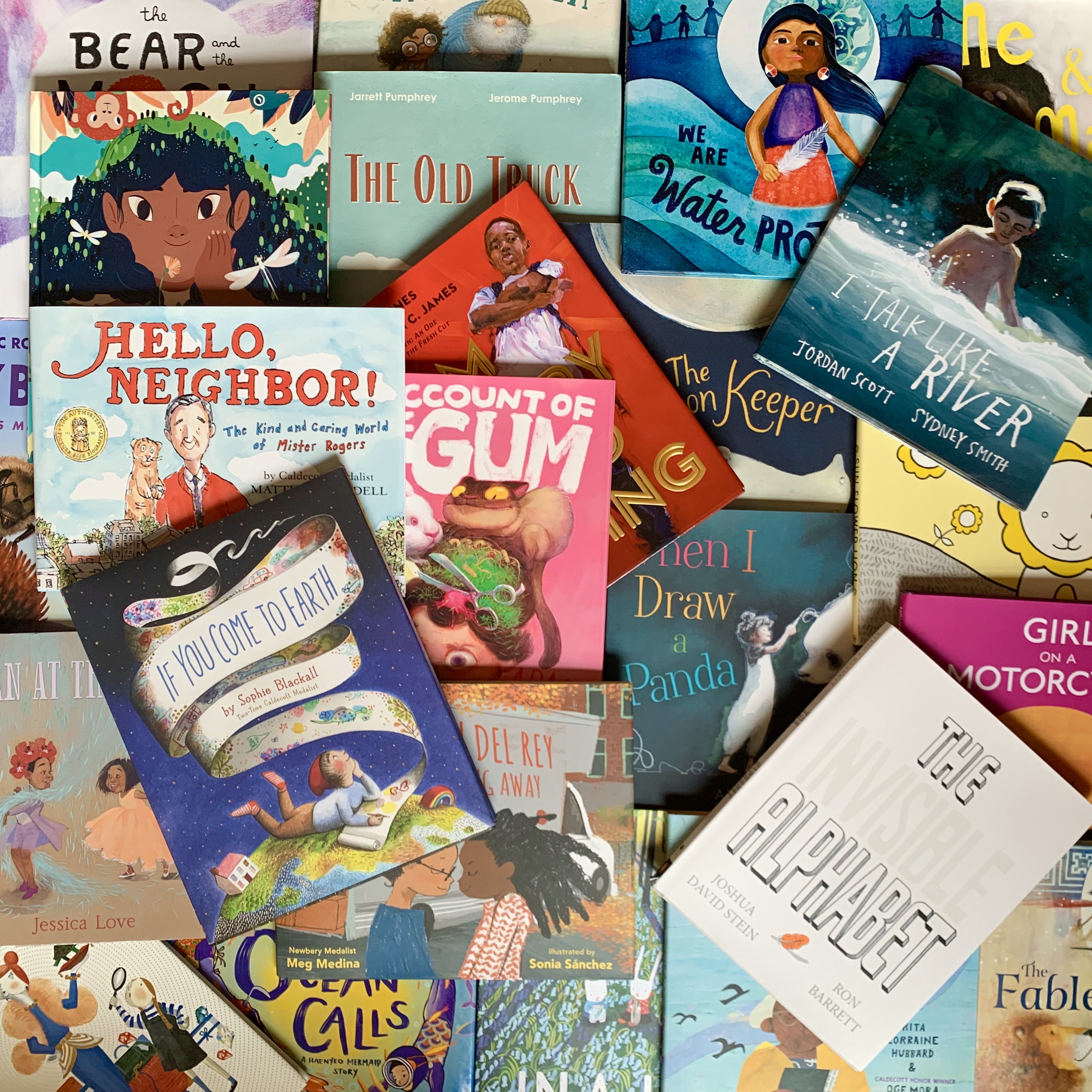
Last week, I told you about my two verrrrry favorite picture books of the year: The Bear and the Moon (Ages 2-6) and Girl on a Motorcycle (Ages 5-9). Today, I’m telling you about others I like a whole heck of a lot. I’ve selected titles, both fiction and non-fiction, for a range of ages, from two to ten years old. Some of them are jaw-droppingly beautiful; others elicit laughter; many invite wonder and compassion. All of them are deserving of a permanent home, where they can be enjoyed again and again and again.
Before we start, there are several I’ve already blogged about this year. Rather than repeating myself, I’m going to link to my original posts. The ones with mega gift potential from earlier in the year are Me and Mama (Ages 2-6), The Ocean Calls (Ages 4-8), Madame Bedobedah (Ages 5-9), Swashby and the Sea (Ages 3-7), The Fabled Life of Aesop (Ages 5-9), In a Jar (Ages 4-8), and The Oldest Student (Ages 6-10).
And now, here are ones new to these pages:
« Read the rest of this entry »Finding Hope on the Ocean Floor
March 21, 2019 Comments Off on Finding Hope on the Ocean Floor
 With no tropical destination in my near future, I am making do with reminiscing about our spectacular trip to Belize for last year’s Spring Break. I also find myself thinking about a book which was perfectly timed with our return home. Whether you are heading to or coming home from a trip to the bottom of the sea, I hope you will join me in singing the praises of this illuminating and inspiring book about saving our coral reefs. « Read the rest of this entry »
The Best Answer to Why We Should Conserve Water (An Earth Day Post)
April 20, 2017 § 2 Comments
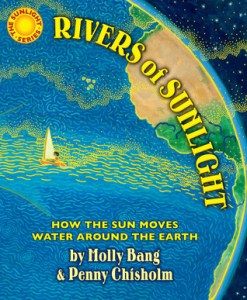 “Don’t leave the water running!” shouted one of my Girl Scouts, as she waited in line behind her fellow Daisies to wash hands during one of our recent meetings. She turned to me. “That’s true, right? My mom says you shouldn’t waste water.” I told her I thought that was a commendable goal, and then another girl asked why. A third girl piped in: “Because otherwise there won’t be any water left in the oceans, and the fish will all die.”
This is not dissimilar to adages which I have used with my own children in the past. And I’ve heard plenty of other parents try out similar renditions. But I’ve also felt slightly disingenuous and awkward delivering them, because explanations like these are neither correct nor that simple. A child has only to visit the beach and stare out into the vast expanse of blue to feel some futility at the prospect of draining the oceans by leaving the tap running a few extra seconds. It simply doesn’t hold up, and what seems implausible doesn’t ultimately motivate behavior. Perhaps the real reason we end up saying shorthand things like this is that many of us don’t know the ins and outs of how our planet’s closed-water system sustains itself. (Guilty as charged.) « Read the rest of this entry »
What This July Needs
July 23, 2014 § 1 Comment
 For all the reading that we intend to do with our children in the summer, many of the days pass instead in a sweaty haze of shifting feet, slamming doors, and long afternoons at the pool. By the time our little ones are ready for bed, their eyelids (and mine, if I’m being honest) are too heavy to sustain more than a few pages.
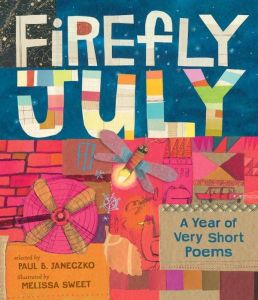
For this Reading Deficit Disorder that hits right about July, I have just the prescription, which you will want to dish out to your own family, as well as wrap up for all those summer birthday parties. I’m talking about POETRY! Poems are the answer! Allow me to introduce the delightful and timely-titled anthology, Firefly July: A Year of Very Short Poems (Ages 5-11), with poems selected by Paul B. Janeczko and spectacular mixed-media illustrations by Melissa Sweet (yes, I’ll say it again: I adore everything that Sweet puts her hands on). « Read the rest of this entry »
“Our Trees are Coming!” “Our Trees are Coming!”
November 21, 2013 Comments Off on “Our Trees are Coming!” “Our Trees are Coming!”
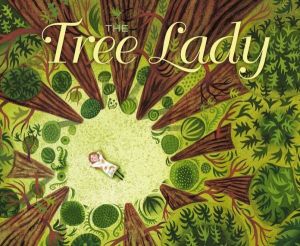 I’m completely obsessed with trees right now. I know what you’re thinking: this is not news. And, you’re right, I’ve written about my love for trees (and stories featuring trees) here, here, here and here. But I’m really, really obsessed with trees right now—and that’s because I have recently been tree shopping. When my kids were baptized last spring, their grandmother offered to buy each of them a tree to grow up alongside. So, earlier this fall, the kids and I did what we do best: we walked, we scooted, and we drove around our neighborhood looking at trees. How had we missed so many of these beauties before? “How about we get one of each?” my son ventured.
Eventually, we narrowed down our choices, but then there was the question of how and where to buy the trees. I initially thought, I’ll look for a deal on the Internet. But then my gardening friend reproached me: you need to see a tree before you buy it, need to study its form, need to find one that speaks to you. This is why, one crystal clear November morning, I found myself standing in a wholesale nursery an hour away in Maryland, surrounded by 600 different varieties of trees. I was walking up and down rows of trees, examining curves of trunks and canopy shapes, paying way too many people to follow me around offering their opinions, and starting to feel like I was going to have a hard time explaining to my husband how this simple decision to buy two trees had gotten totally out of hand. Did I mention how much fun I was having? « Read the rest of this entry »
Digging in the Backyard: Summer School Wraps Up!
August 22, 2013 § 1 Comment
 Earlier this summer, the kids and I were on a morning walk—JP in the lead on foot, Emily trailing on her scooter, and me bringing up the rear. It had rained most of the night before, and the sidewalks were still damp. Abruptly, JP let out one of his characteristic ear-splitting screeches (at almost six, the boy still has no regard for volume control): “STOOOOOOP, EMILY!” Before I could launch into my characteristic lecture about not screaming into people’s faces, especially when that sweet face belongs to your little sister, JP followed it up with, “MOMMY, EMILY WAS ABOUT TO RUN OVER A WORM!” I looked down and, sure enough, the sidewalk was covered in worms, evidently displaced from the previous night’s storm. Is it wrong that I immediately assumed JP’s reaction was based on the grossness factor of squashing a worm between one’s scooter’s wheels? I’ll admit I felt slightly guilty when, once everyone calmed down (by now Emily was screaming nonsensically about worms as well), JP explained, “We have to be so, so careful not to hurt these worms. They need to go back into the dirt to make the plants grow!” I wasn’t going to tell him that these worms didn’t look like they were going anywhere ever again; Emily and I simply followed in tow as he went first and pointed out any worms that we should steer around.
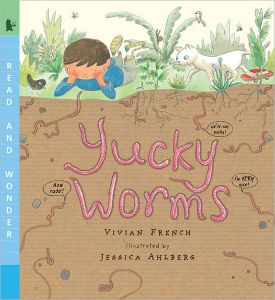
It’s moments like these—rare, fleeting moments—when I wonder if maybe I’ve done something right as a parent. That somehow in all my blabbing on about trees and seeds and caterpillars, my kids have begun to develop an appreciation for the natural world that surrounds them. I would have to credit any success I’ve had to books like Yucky Worms (Ages 4-8), by Vivian French and Jessica Ahlberg, which is part of a fantastic Read and Wonder Series published by Candlewick Press. This is natural science for young kids at its best: fictional stories packed with scientific facts that are woven accessibly into the narrative. In Yucky Worms, a boy gets a lesson in Wormology from his green-thumbed grandmother (perhaps it’s no coincidence that I was first introduced to spiders and butterflies by my two grandmothers?).
Quick to exclaim “Yuck! Throw it away!” when his grandmother digs up a “slimy, slithery, wiggly worm,” the boy in the story gets schooled on the different parts of the worm, how it tunnels through the ground, what it eats, and how its poop enriches the soil. It turns out that worm poop—white curly forms called “casts”—are very plentiful in our backyard. It also turns out that most earthworms do not regenerate when accidentally cut in half by a gardening spade (I now get schooled regularly on this by my “backseat gardeners”). There is much to love about this book, from the sweet relationship between grandmother and grandson, to the hand-drawn diagrams of the worm’s anatomy, to the answers to questions kids don’t even know they have, like what happens to worms in the winter. But perhaps the biggest appeal for kids are the word bubbles that occasionally come out of the mouths of the worms themselves, reinforcing the lessons in the book while adding some enticing humor. What is it about worms that seem to invite speech bubbles? Doreen Cronin and Harry Bliss incorporate a similar technique in their hilarious series, Diary of a Worm (more fun than fact but still surprisingly illuminating about these creatures). Worms have a lot to say, evidently, as they dodge predators or feast on moldy fruit.

Here, the story continues on the side, while the worms take front stage with their tunnels and word bubbles.
I have tried my darndest this summer to get my kids out into nature. When it comes time to make dinner, it’s all I can do to resist the temptation to turn on the TV, shooing them instead into the backyard. Inevitably, I am called out moments later to settle some dispute over an ancient half-broken toy that has been unearthed from the shed and is suddenly the Only Thing Worth Playing With. But, in time, they settle into the rhythm of things and begin to take closer notice of their surroundings. Once again, my dinner making is interrupted by yelling: “Mommy, come out here RIGHT NOW!” I trudge outside more than a little exasperated, only to find the kids, not fighting over toys, but instead huddled over a corner of the deck. I bend down to see a spider’s web glistening from drops of water that have fallen out of the just-watered planters above. “It’s just like the one in the book!” JP exclaims, referring to Helen Frost’s stunning photograph of a dew-covered spider’s web in Step Gently Out, which we had just been reading that morning. “Only it’s even more beautiful,” he adds. “Yes,” Emily pipes in. “It’s sooooo boootiful.”
Other Favorites About Backyard Critters:
Step Gently Out, by Helen Frost (Ages 3-6)
Where Butterflies Grow and The Snail’s Spell by Joanne Ryder & Lynne Cherry (Ages 3-6)
The Honeybee Man, by Lela Nargi (Ages 4-8)
Diary of a Worm, Diary of a Spider, & Diary of a Fly, by Doreen Cronin & Harry Bliss (Ages 4-8)
Insect Detective: Read and Wonder, by Steve Voake & Charlotte Voake (Ages 4-8)
Seeds, Bees, Butterflies & More: Poems for Two Voices, by Carole Gerber & Eugene Yelchin (Ages 5-10)
Plus these favs mentioned in a previous post about Young Naturalists!
The Human Body (Summer School Continues!)
June 12, 2013 § 1 Comment
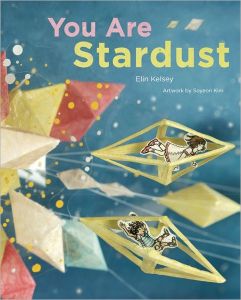 Summer is naturally a time for children to sharpen their senses and take notice of their bodies. Running barefoot through the freshly cut grass; relishing the pure silence underwater at the pool; feeling the sweat beads on the back of their necks; hearing the crack of thunder that sends them tearing for the house; stretching out on the earth’s back to gaze at a sky full of stars: this is what summer looks, sounds, and feels like to our children. So why not turn these grass-stained knees into a chance to study the human body? And what if we take these bodily lessons further; what if we create an awareness in our children that their bodies aren’t just little planets unto themselves but are connected to the mysteries of the greater universe?
I have long been puzzled by the lack of children’s books that bridge the scientific and natural worlds, so I was thrilled to discover a little gem published last year, written by Elin Kelsey. You Are Stardust (Ages 4-8) is that rare blend of scientific fact and poetic wonder. Beginning with the premise that “every tiny atom in your body came from a star that exploded long before you were born,” the book goes on to draw parallels between humans, animals, the earth, and the universe, from the salt water that flows through our tears like it flows through the ocean to the electricity that powers our thoughts like it powers the lightning in the sky. Every fact and connection is intended to shock and awe (and is backed up by scientific evidence). Did you know that the water we drink today is the same water that the dinosaurs drank? Or that “each time you blow a kiss to the world, you spread pollen that might grow to be a new plant?” (Both of these questions got an audible response from my son: “Is that seriously true?”)
One of my favorite things about sharing books with children is that you can never predict exactly what will rock their world. I would never have supposed that the fact which made the greatest impression upon JP was one having to do with continual renewal—specifically, that “you’ll replace your skin 100 times by the time you turn ten.” When he first heard this, JP threw back his head and roared, “I’m not a snake! Kids don’t shed their skin; that’s ridiculous!” “Not all in one piece like a snake, but in little bits at a time,” I told him, and we went on to discuss things like scrapes, sunburn, and dry skin. For the past week, he has now taken to brushing his hand across his arm 10 times a day, while declaring to his sister that “you can’t see it, but my skin is shedding RIGHT NOW!”
Prior to discovering You Are Stardust, my favorite “metaphysical” book for kids, although on a much simpler, toddler-targeted level, has been Molly Bang’s All of Me: A Book of Thanks (Ages 2-4). With loving, economical text, Bang pays tribute first to a child’s body (“thank you, hands, for gripping and throwing and patting and holding”); then to his senses (“my mouth tastes all my food before it slides down here, into my tummy”); then to his feelings (“today I felt curious, and excited, and angry, and brave…”); and, finally, to the way in which he is part of “this whole wide world…and this whole universe is inside…all of me!”).
What All of Me starts, You Are Stardust expands on for the older child, grounding wondrous observations about the body-universe connection with scientific data (the book’s afterward also cites a website for those who want to learn more about the science behind the book). Perhaps not just coincidentally, both Bang and Kelsey’s books are illustrated with collage, a fitting medium for a lesson on how we are greater than the sum of our parts. The collages in You Are Stardust, done by Soyeon Kim, are actually dioramas, combining rocks, dried flowers, painted leaves, string, tissue paper, and watercolor cut-outs to create a tactile, three-dimensional effect. The illustrations feel youthful and free-form, and I think my son immediately connected with them as something he could approximate with materials gathered from our backyard. I would love for my children (as the author similarly wishes in her afterward) to cart this book outside all summer long, to read it by flashlight in their tee-pee or while propped up on their elbows in the grass. I would like for them to look at the trees and the birds and the snails and the clouds—and to feel their own heartbeat answering back.

“You, me, birds flying through the rainforest. We are all connected. We are all nature.”
Other Favorites for a More In-Depth Study of the Human Body (and with a more traditionally fact-based presentation):
The Skeleton Inside You; Why I Sneeze, Shiver, Hiccup and Yawn; A Drop of Blood; Hear Your Heart; My Five Senses, all part of the wonderful Let’s-Read-And-Find-Out Science Series (Ages 4-8)
See Inside Your Body, by Usborne Publishing (Ages 5-10)
First Human Body Encyclopedia, by DK Pubishing (Ages 6-12)
Bones: Skeletons and How They Work, by Steve Jenkins (Ages 6-12)
Picture This! Human Body, by Margaret Hynes (Ages 8-14)
A Story to Grow Up On
May 7, 2013 Comments Off on A Story to Grow Up On
 If you’re big into symbolism (or if you, like me, tear up when inscribing books for gifts), then you’re going to want to give Miss Maple’s Seeds to all the young seedlings celebrating birthdays this spring. There are lots of wonderful picture books about seeds (Jean Richards’ A Fruit is a Suitcase for Seeds and Bonnie Christensen’s Plant a Little Seed are two favorites), but none have the magical realism of Miss Maple’s Seeds (Ages 3-7), written and illustrated by newcomer Eliza Wheeler.
Miss Maple is an eccentric, not-quite-of-this-world sort (a bit like my neighbor, who converses with chipmunks in her backyard). Out of her home inside a hundred-year-old Maple tree, she runs a kind of orphanage for lost seeds, dividing her time between searching for “seeds that got lost during the spring planting” and caring for those seeds until they’re strong enough to lay down roots of their own. “‘Take care, my little ones…for the world is big and you are small,’” she continually reminds her seeds—all the while bathing them, taking them on educational outings to learn about different soil types, reading to them “by firefly light,” and giving them chances to practice “burrowing down into the muddy ground” during thunderstorms. “She’s taking care of them like they’re her babies!” my son was quick to point out, an observation that quickly captured the attention of his younger, doll-obsessed sister.
The story’s prose is unquestionably beautiful: lyrical, concise, and easy to connect back to our own children and the figures (parents, relatives, teachers) who so lovingly and carefully nurture their growth. But it is Wheeler’s ink-and-watercolor illustrations, light and airy and with just a touch of whimsy, which make this gem soar. Sporting a willow weed hat, pointed nose, and delicate slit eyes, Miss Maple epitomizes tenderness in all that she does, whether sweeping her hearth to welcome new seeds or bidding each one farewell as she sends them down the river in lantern-lit leaf boats to find new homes.
One of our favorite illustrations looks like something out of a naturalist’s guide, depicting twenty seeds with their species’ names captioned below in cursive writing (presumably from the hand of Miss Maple). From the fat acorn to the oval pumpkin seed to the single grain of wild rice, the page exhibits not only the visual diversity of nature’s seeds but also the magic which seems to lie within (a giant sunflower grows out of THAT minuscule thing?).
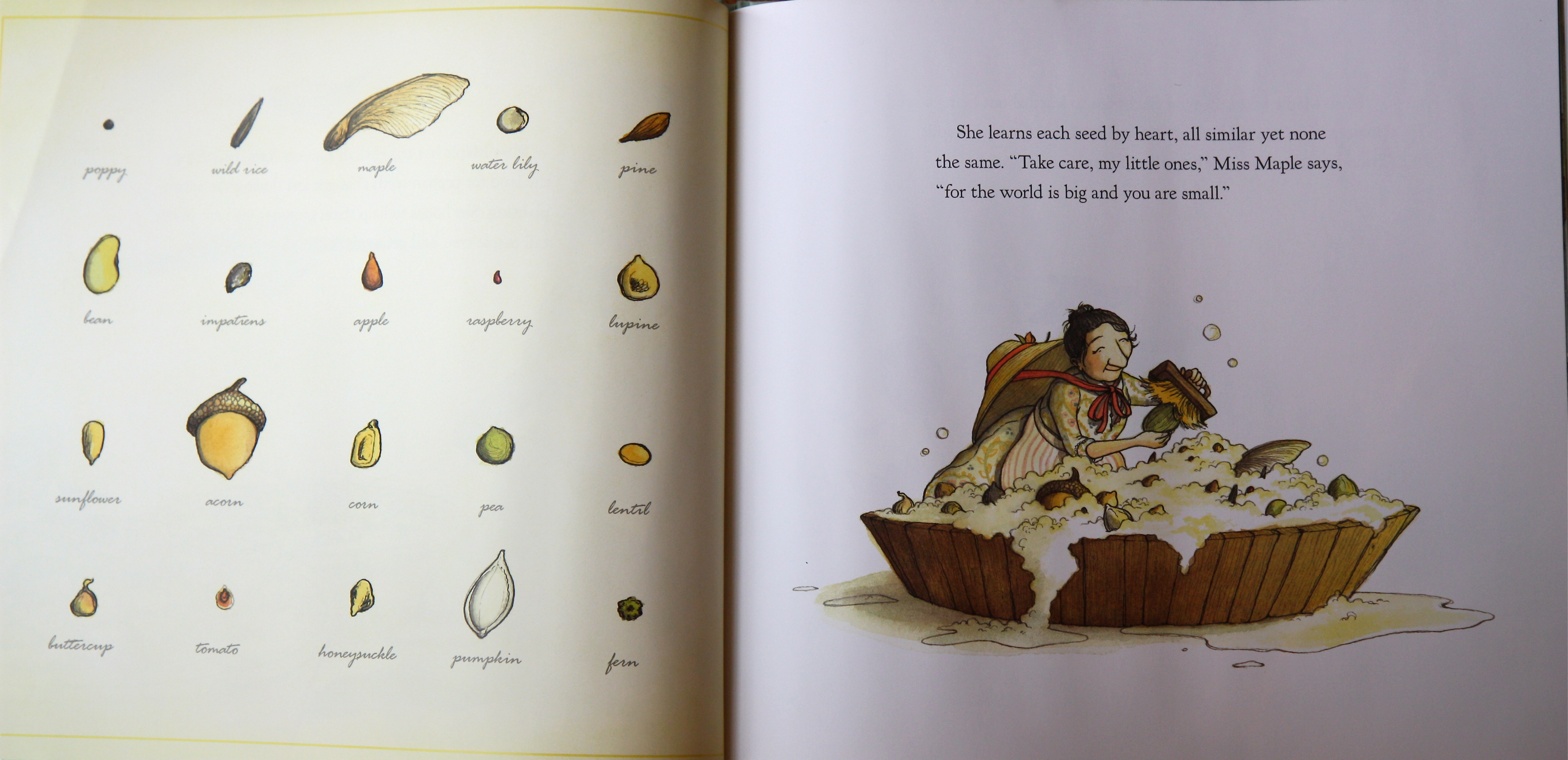
We could all use some of Miss Maple’s tenderness in our own relationship with the Earth, just like our own children need the reassurance that “even the grandest of trees once had to grow up from the smallest of seeds.” I dare you not to tear up when you copy that quote inside the cover of this book for your next gift.
Saving the Trees
April 22, 2013 § 2 Comments
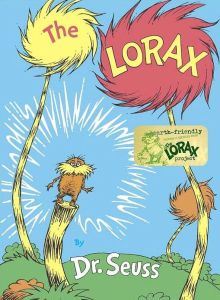 Earlier today, in honor of Earth Day, I shared Dr. Seuss’ The Lorax (Ages 5-10) with the elementary children at my son’s Montessori school. While most people associate Dr. Seuss with the nonsensical but catchy I-Can-Read titles, like Green Eggs and Ham, I would argue that his narrative poems—his longer, more complex, often moralistic stories—were actually his greatest gift to children. Not only do these stories showcase a mastery of rhyme that is virtually unmatched in contemporary children’s literature, but many of them also serve as cautionary tales, introducing children to the dangers of things like running away from your problems (I Had Trouble in Getting to Solla Sollew), or prejudice (The Sneetches), or, as in the case of The Lorax, industrialization at the expense of natural resources.
The Lorax, a “brownish,” “mossy,” raspy-voiced creature, who famously utters, “I speak for the trees for the trees have no tongues,” may have been conjured up by Dr. Seuss in 1971, but his environmental message resonates just as clearly today. And yet, there’s a second hero in this story, one with greater power than The Lorax himself. I’m referring to the unnamed child, who appears at the beginning and the end of the story—the one to whom the Once-ler relates (and repents) his decision to knit every last Truffula Tree into an ambiguous but allegedly multipurpose Thneed, “which everyone, EVERYONE, EVERYONE needs.” This child, to whom the Once-ler entrusts the very last Truffula seed, along with instructions to nurture it with water and clean air, literally holds the future of the planet in his hands; he is the reader’s hope for a happy ending. « Read the rest of this entry »
Beholding the Trees
April 17, 2013 § 1 Comment
 “I’m thankful for the trees,” my five year old blurted out last Thanksgiving, as we were going around the table giving thanks for the usual holiday stuff (togetherness, food, health, etc.). His comment was so unexpected that I’ll admit we all burst out laughing (being a child must feel like a thankless job at times). But for all its randomness, I believe his comment was 100% genuine. JP has always had a special place in his heart for trees (plus his favorite color has been green since he could talk—see last year’s post in honor of Earth Day).
I like to think that a tiny bit of his appreciation for these living, breathing, magnificent things, which line our streets and fill our forests, is owing to me. You see, as much as I want my children to grow up with the deepest love and appreciation for their planet, as much as I believe that the future of this planet lies heavily in the choices their generation will make, I can be lazy. I would like to be the kind of mom who plants a vegetable garden every summer with her children, who participates in volunteer days picking up litter at inner-city parks, who turns banana peels into compost. Instead, my kids get a single tomato plant and some herbs in planters on our deck.
Holiday Gift Guide 2012 (No. 4): Books For the Hero Within
December 18, 2012 § 1 Comment
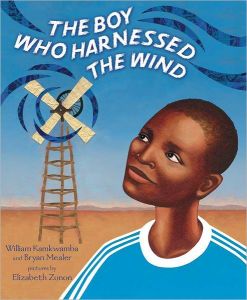 Benjamin Franklin once penned: “If you would not be forgotten/ As soon as you are dead and rotten,/ Either write things worth reading,/ Or do things worth the writing.” OK, that might not be a quote we need to read aloud to our young children, but its sentiment can and should inform the books we choose to share with them.
The genre of biographies written for children is taking off like never before; it seems not only are parents and educators seizing the chance to inspire our young ones with tales of historical figures, but kids themselves are embracing these literary opportunities to inform their own choices, to pave their own paths worth living. And it’s no accident that many of this past year’s biographies are picture books: against a backdrop of beautiful art and poetic text, stories about scientists, writers, inventors, artists, and peacemakers become that much more gripping. The books listed at the end of this post are treasures worth giving and owning; their artistic caliber alone makes them a far cry from the dry, fact-filled paperbacks that we once suffered through for school reports.
Alison Jay, Cloud Creator
April 25, 2012 § 3 Comments
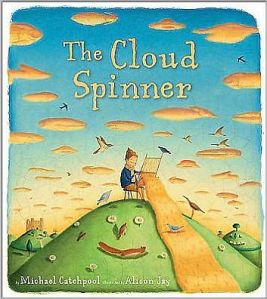 If you haven’t discovered the amazing British children’s artist Alison Jay, you’re in for a real treat. Or, if you’re as obsessed with her as I am, you’ll love her latest masterpiece, a fairy tale of sorts titled The Cloud Spinner (Ages 3-6), by Michael Catchpool (a fellow Brit).
The Brits have an unparalleled knack for creating books that feel Quintessentially Childlike, seamlessly blending fantasy with realism, and sprinkling on a quirkiness that makes these stories memorable for a lifetime. Alison Jay’s artistic signature, which she employs in all her work, is a “crackle finish” layered over her paintings, a technique which gives them a vintage look. In contrast, her animals, landscapes, and people feel anything but old-fashioned (here’s where that endearing quirkiness comes into play).
It seems that Jay’s artistic style has not gone unnoticed by JP, my four year old. Our favorite alphabet book is Jay’s ABC: A Child’s First Alphabet Book, which I’ve been reading to him since he was a baby (and which is jam packed with hidden surprises), along with a handful of her other storybooks (see my list at the end). A few months ago, while perusing the shelves at our local library, JP stumbled upon an Alison Jay book he’d never seen before (William and the Night Train), and he called out, “Look Mommy, it’s one of those books with the crazy clouds!” I had never thought of it that way before, but he was right: Alison Jay does have a very specific way of painting clouds.
Leaving the World a Little Bit Greener
April 22, 2012 § 3 Comments
 Happy Earth Day (or, as my very astute 4-year-old pointed out this morning, “Aren’t we supposed to care about the earth every day?”)! Oh right, yes.
Ironically, with all the increased mobilization around Going Green in the last several decades, the member of our family who actually most fully embodies and preaches a love for the planet is my 94-year-old grandmother, referred to affectionately by her grandchildren and great-grandchildren as Noni. As a child, I spent my summers at my grandparents’ farm house, on the shores of Lake Erie, getting lessons on the value of spiders (you never kill a spider, we were told, even if it is sitting on your toothbrush), the conservation of water (why shower when you can swim in the lake?), and that sometimes leaving trees and wildflowers right where they are makes the best kind of landscaping.
Today, one of the highlights of my son’s summers is the week he spends with Noni up at this same spot, where the house has been modernized but the land has not. These days, Noni’s mostly sedentary, but by golly if she doesn’t still go out with her hose to water her garden, and JP loves to trail behind her, occasionally earning a turn with the hose, but mostly getting an earful on “dead heading” flowers, which weeds are “not worth your time,” and how to grow the oldest and biggest Hibiscus plant in the history of time.
Perhaps this is why he (and I) respond so wholeheartedly to Grandpa Green (Ages 4-8), by the supremely talented (and deliciously quirky) Lane Smith. Through the simple and admiring words of a little boy (armed with his own watering can), we learn about his great-grandpa, a masterful hedge trimmer, who transforms ordinary garden hedges into dragons, elephants, wedding cakes–even the cast of “The Wizard of Oz” and “The Little Engine That Could.” As the boy explores his great-grandpa’s garden, we realize that every “milestone” of the latter’s life has been remembered in one of these stunning green creations.
 What to Read to Your Kids