Holiday Gift Guide 2013: Stories of Perseverance for the Engineer
December 10, 2013 § 1 Comment
 If at first you don’t succeed, try, try again. That might be easy to say as a parent, but we have only to remember our own childhoods to know how hard it is to hear. Just the other night, my son was attempting to draw a human profile by following one of those step-by-step guidebooks. Diligently huddled over his paper, he suddenly threw the pencil across the room and yelled, “This isn’t working at all! It doesn’t even look like a person!” Actually, I thought, it does look like a person—just not like the one in the book. Oftentimes, we cannot see our triumphs for what they are.
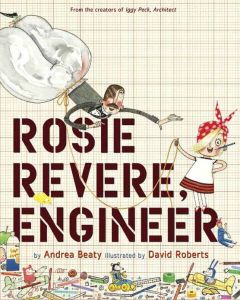
The creative process—its ups, its downs, its just plain hard work—is wonderfully captured in Rosie Revere, Engineer (Ages 5-8), the newest venture by Andrea Beaty and David Roberts, the team that created one of my favorite picture books of all time: Iggy Peck Architect. What black-turtleneck-sporting Iggy Peck did for building designs, red-scarf-sporting Rosie Revere (yes, her namesake is Rosie the Riveter) does for engineering. She makes it look—well—cool. « Read the rest of this entry »
Bang! Crash! Interstellar Collisions!
October 18, 2013 § 2 Comments
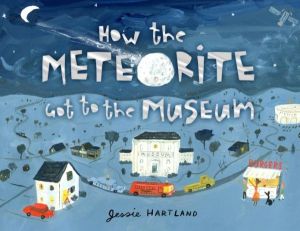 I may have given an audible little yelp the other day when I discovered that Jessie Hartland had published a new title in her “museum” series, but it was nothing like the squeal of joy that my six year old emitted when I brought it home and gave it to him. You see, How the Dinosaur Got to the Museum (Ages 4-8) and How the Sphinx Got to the Museum (Ages 5-10) are among our All Time Favorites, rivaled only by Hartland’s newest addition to the series, How the Meteorite Got to the Museum (Ages 5-10). All three books are brilliantly simple slices of science and history; they introduce children to paleontology, Egyptology, and now astronomy by following a specific artifact from its discovery in the field to its place in the exhibition hall of a museum.
Most great science books take their inspiration from true historical events. Here’s an especially awesome one: on a clear night in October of 1992, a meteor that had been predictably orbiting the sun for four billion years suddenly and inexplicably changed course, entered the Earth’s atmosphere, flew over Kentucky, West Virginia, and Pennsylvania, and crashed into the trunk of a Chevy Malibu parked outside a house in Peekskill, New York (that’s right, crashed—as in, totaled the back of the car and sprung a leak in the fuel tank and precipitated a 911 call to police and fire fighters—pretty much the coolest thing my six year old has ever conceived of). « Read the rest of this entry »
June’s Birthday Pick
June 5, 2013 § 1 Comment
 Last Friday, after a long week of 90 degree days, the kids and I were driving around struggling to fill the few hours between school and dinner. I suddenly remembered that earlier that day, I’d picked up a stack of just-published books at the store, and so I proposed that we head home to read in the AC. “Reading Party! Reading Party!” my son immediately began chanting, a phrase left over from when his sister was a baby and I would coax him into lying down with me while she took her morning nap in the other room, under the pretense that he could load up the bed with books and we’d have a “Reading Party” (true, my motivation was entirely selfish—must lay head down—but I’m also a big believer that, as parents, our excitement around reading rubs off on our kids).
So, as we sat down to read last Friday, I thought I’d use my kids’ reactions to decide which title to make my birthday pick for the month. I had all my money on Mini Grey’s new Toys in Space, because it’s hard to go wrong with a story involving a fleet of misplaced toys, a spaceship, a conflicted alien, a Wonderdoll blessed with storytelling prowess, and Grey’s hilarious (if occasionally crass) speech bubbles. (Incidentally, I chose another Mini Grey book for last July’s birthday pick, so there must be something about warm temperatures that puts me in the mind of Toys Coming Alive). As expected, Toys in Space captivated my kids and elicited no shortage of laughs. But when all was said and done, it was the final book in our pile that they asked to read a second and a third time—and which they both chose as their favorite.
Emily Jenkins and Stephanie Graegin’s Water in the Park: A Book About Water & the Times of the Day is a quiet, unassuming, lyrical portrait of the transformations that take place in a city park over the course of a typical hot summer day, from the early-morning canine visitors to the tottering babies putting their hands in sprinklers to the adults taking their lunch breaks on shady benches to the evening strollers that get caught in the cooling rain. Of course, there are lots of obvious reasons why my kids (and your kids) would like this book, most especially because it fits entirely into their frame of reference (dogs! swings! parents! nannies! boo-boos! containers of apple slices! tears over leaving the park!). In a season where the heat can make being outside feel oppressive, it’s nice to celebrate that water can be poured into sandboxes to make moats or drizzled down scorching metal slides; that a stray cat can enjoy a sip in a lingering puddle; and that a timid dog might finally decide to wade into the pond. One also can’t ignore the widespread and very natural representation of diversity among the children and adults at the park (Jenkins took her inspiration from weeks spent observing Prospect Park in Brooklyn).
But I think the biggest reason why my kids love this book (and why you shouldn’t hesitate to give it for your next birthday gift) is the sheer comfort that comes from reading a story that’s grounded in the natural progression of a day, whose very text echoes a predictable rhythm of dawn, morning, noon, afternoon, dusk, and night. Very early on, children develop a fascination for time, but it’s not for many years that they truly grasp the meaning of “ten o’clock” or “noon,” that they recognize patterns not only in their own day but in the strangers and animals around them (gasp: the park has a life even when I’m not there?!). There’s a wonderful calm that comes from reading a story that helps to make sense of the order of things. And when the rainstorm descends to cool us all off, there’s comfort in knowing that the sun will shine again.

“Around one o’clock, grown-ups wander in, squinting from their shops and office buildings…Two old people stand [near the pond] with a bag of bread crumbs…On very hot days, the ice cream truck comes early…Children get soft-serve cones and bright Popsicles…Sticky fingers and faces are rinsed in the sprinkler.”
The Best Chapter Books Talk to the Heart
May 17, 2013 § 3 Comments
 I’m often asked to recommend chapter books that lend themselves to reading aloud, either for a classroom setting or for a parent reading to an elementary-aged child. This is no small order: you need something where the subject matter isn’t too frightening or mature for the 5-8 year old set; you need something that’s going to engage the adult reader as much as the child (there’s no law that says this can’t be enjoyable for us!); and you need something that transcends the plot-driven, early-reader books that kids are reading on their own and helps them develop a taste for the kind of diverse language and emotionally-rich storytelling that will hopefully influence their reading choices in the future. This past winter, we read to my son the classic Little House on the Prairie series, which I adored as a child and whose themes feel just as timeless and important as ever (family values, the rewards of hard work, celebrating the non-material joys in life). But Laura Ingalls Wilder’s writing can also be quite tedious to read aloud, packed with lengthy explanations (twenty pages devoted to smoking a pig?) and repetitive sentence structures. There were moments when I could feel JP’s attention wandering, despite his avid assurance each night that he wanted to read more, more, more.
But then we finished that series and began Marion Dane Bauer’s stand-alone novel Little Dog, Lost (Ages 8-12, younger if reading aloud), published just last year, and it felt like a breath of fresh air. Here’s a book where not a single word is wasted, a book whose text flows off the tongue with such buttery smoothness that most of the time I couldn’t bring myself to stop when I got to the end of a chapter (that’s right, I was actually choosing in those moments to delay bedtime). Bauer achieves this incredible richness of language by breaking with a major narrative tradition: she writes her novel in free verse, creating chapters out of short, staccato poems, which loosely string together and sometimes even repeat words and phrases, all the while telling a very clear and cohesive story. There are 44 of these untitled poem-chapters; and they switch off narrating from the viewpoints of children, adults, and animals—all of whom live in a small contemporary town called Erthly and whose lives are forever touched by an incident involving a lost dog searching for someone to love him.
Freed from the confines of conventional narration, Bauer is able to cut straight to the emotional core of her characters—and the result is a story that children will feel deep in their hearts. Animal stories inherently engender sympathy from children (not coincidentally, some of JP’s favorite moments in the Little House books revolve around the Ingalls’ faithful dog, Jack). At the center of Little Dog, Lost is Buddy, an orphaned dog with “ears like airplane wings,” who “dances” along the sidewalk, longing for a home with “chasing balls,/ ear scratches,/ kisses.” Children will easily relate to Mark, a young boy “who had wanted a dog for as long as he could remember./ He had asked for a dog./ He had begged for a dog./ He had pleaded and prayed and whined for a dog./ Once he’d even tried barking for a dog.” And who wouldn’t be intrigued by a mysterious old man named Charles Larue, who lives alone in a pointy-towered mansion and never speaks to anyone? Throughout the story’s suspenseful twists and turns, even amidst the humorous touches (many coming from a bossy tabby cat who thinks he’s a dog), the story never strays from the hopes and dreams of its relatable, big-hearted characters. It’s fair to say that my son had a full-body experience while listening to this book. He chuckled, gasped, and emitted little exasperated grunts; he covered his eyes and held his breath; he beat his fists on the bed; he cheered; he hugged my arm to pieces; and he shed more than a tear or two (as he says, “I have a little water in my eyes right now because I’m so happy.”). Now that’s a chapter book.
Other Favorite Read-Aloud Chapter Books With Animals & Lots of Heart:
The Cricket in Times Square, by George Selden (Ages 5 & up*)
Charlotte’s Web, by E.B. White (Ages 5 & up)
The Trumpet of the Swan, by E.B. White (Ages 5 & up)
Mr. Popper’s Penguins, by Richard Atwater (Ages 5 & up)
Ginger Pye, by Eleanor Estes (Ages 6 & up)
The One and Only Ivan, by Katherine Applegate & Patricia Castelao (Ages 6 & up)
*Please note that these ages are assuming the reading is being done by an adult. For a child reading independently, the age range would be closer to eight and up.
April’s Birthday Pick
April 14, 2013 § 1 Comment
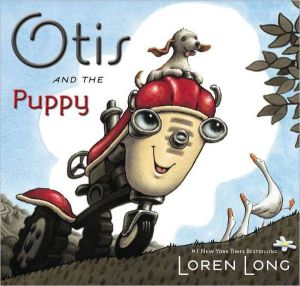 Spring is a time of rebirth: a time of budding trees, sprouting seeds, and birthday parties. As for the last, you’re in luck, because there is a brand new Otis story on the shelves! Whether or not you’re familiar with Loren Long’s stunningly illustrated and action-packed picture books about Otis (see previous posts here), a happy-go-lucky tractor who always comes through for his friends, the new Otis and the Puppy (Ages 3-6) is a slam-dunk. Get your local bookstore to wrap up a copy for every one of your spring birthday parties; and don’t worry about whether the recipient has read the original Otis or Otis and the Tornado because, like its predecessors, Otis and the Puppy stands alone.
This new book has it all: heart, empathy, heroism, and a doe-eyed, playful-eared puppy. When the puppy arrives on the farm, he develops an immediate fondness for the tractor; he eagerly joins in Otis’ games of Hide and Seek and sleeps each night against the purring tractor. Otis quickly learns that the puppy and him have something in common: they’re both afraid of the dark. So when the puppy strays too far from the farm one afternoon and is not recovered by bedtime, Otis’ “heart ached deep inside his engine. He knew how scared of the dark his new friend was and…he knew his friend needed him.” But can Otis muster up the courage to leave the safety of the barn to search for his friend in the dark?
March’s Hot-Off-the-Press Birthday Pick
March 6, 2013 Comments Off on March’s Hot-Off-the-Press Birthday Pick
 This one goes out to all the little girls out there—or rather, to their little friends who have spring birthdays. Debut author-illustrator You Byun’s brand new Dream Friends (Ages 2.5-6) is full of the stuff of little girls’ dreams. I’m talking about sugar and spice and everything nice—or, more specifically, bunny rabbits and tea parties and baby chicks and Santa Claus and cupcakes and flowers and, of course, friendship.
Melody has a friend, a best friend, only he’s not your typical friend: for starters, he’s big and white and furry (an ambiguous but lovable dog-cat-raccoon looking thing that my daughter has taken to kissing on the nose each time he makes an appearance). The bigger problem is that this magical friend only visits the little girl in her dreams (although these dreams are filled with such delights as dancing on flower-shaped clouds or watching fireworks explode in the shape of ice cream cones and lollipops).
January’s Birthday Pick
January 8, 2013 § 1 Comment
 For this month’s birthday pick, I’m doing something a little different: 1) I’m focusing on the youngest ages for a change; 2) I’ve chosen not one but two books (which make a perfect pairing); and 3) I’m encouraging you to throw caution to the wind and take a chance on books that aren’t brand new but are commonly unknown.
In short, the next time you are headed to a birthday party for a one or two year old, you’re in luck. I Took the Moon for a Walk (Ages 1-4) and Listen, Listen (Ages 1-4) are both illustrated by the supremely talented Alison Jay, whose praises I have sung here before. With their over-sized 9” by 9” format, these hefty board books mirror another favorite by Jay, her ABC: A Child’s First Alphabet Book (which tends to be well known and for good reason: it may just be the best alphabet book ever illustrated).
Alison Jay’s books are the ultimate gift. Packed with hidden surprises, layered with detail, and shimmering in vivid colors underneath a “crackle” finish, Jay’s paintings beg to be poured over again and again.
The Best Reason to Read Fairy Tales?
August 30, 2012 Comments Off on The Best Reason to Read Fairy Tales?
 I’ve always felt a bit ambivalent about traditional fairy tales. True, I buy into the argument made by many literary and child development scholars that our children are reassured by seeing young heroes and heroines persevere through creepy, frightening situations. True, out of the hundreds of books I loved as a kid, it was a fairy tale—Hansel and Gretel, to be precise—that made the most lasting impression on me. And yet, with the sheer wealth of original, high quality children’s books being published today, I tend to forget about reading fairy tales to my kids.
Until I remember what may be the very best reason to read them: if your kids don’t know the original stories, how will they appreciate all the fantastic fractured versions that have popped up in recent years? My new favorite is one that was actually discovered by my husband (that’s right, he recently took the kids to a bookstore and managed to buy a book that I didn’t know about—and a brilliant one at that!).
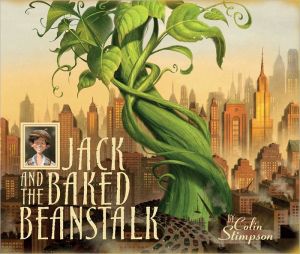
Hot off the presses, it’s an urbanized retelling of Jack and the Beanstalk, titled Jack and the Baked Beanstalk, by Colin Stimpson (Ages 4-8). This debut author-illustrator is a Brit (like him already) and a former art director for Walt Disney; the latter is relevant because his impressive cinematic illustrations combine the grittiness of a cityscape with a Disney-esque glossiness.
Imagination Turbo Edition
July 3, 2012 Comments Off on Imagination Turbo Edition
 When you watch your children practicing yoga moves in their kiddie pool, it’s easy to be struck by how differently today’s children entertain themselves than when we were growing up (yoga?). But then there are the things that never change from one generation to the next—like kids’ uncanny ability to lose themselves in imaginary play, especially if there are action figures involved.
That’s why you can’t go wrong by gifting one of Mini Grey’s picture books about a combat-boots-sporting action figure named Traction Man. In the hands and imagination of one little boy, Traction Man embarks on daring missions with the help of his trusty sidekick Scrubbing Brush. The latest installment in this original series, Traction Man and the Beach Odyssey (Ages 4-7), has just been published and is perfect for your summer birthday gifts (although why not bundle it with the original Traction Man for the Best Gift Ever?).
Quiet Time Was Never So Quiet
June 10, 2012 § 5 Comments
 Let’s face it: there are times when you can’t submit to the chants of “Read to me! Read to me!” Perhaps you’ve just had a second baby and you’re looking for something to occupy the first. Maybe you’ve got a preschooler who is starting to give up her nap, but you’re still (desperately) hoping to institute Quiet Time. Or maybe your child is not quite reading but wants to feel like he is.
Whatever your motive, there is hope: it is possible to get your non-reader to engage in quiet, independent time with books. Of course, there are some books that are more likely to succeed than others. And, as a bonus, these also tend to be the books that bore you to tears if you do have to read them aloud. You know the type: books whose illustrations are jam-packed with detail; books whose pages your child wants to pour over at such length that it seems like you’ll be stuck in his room reading to him forever. Take yourself out of the equation, and these books become—not your worst enemy—but your greatest asset.
Spring is Here!
April 21, 2012 § 1 Comment
 Perhaps at no other time in our lives than when we are parenting young children are we more attuned to the changing of the seasons. Seen through our children’s eyes, it’s positively magical, nature unfolding in all sorts of surprising ways. Regardless of our “mild” winter, on March 1 our family had a March into Spring around our living room, started giddily discussing planting vegetables and riding bikes to school without jackets–and started reading Spring Books. In my opinion, a picture book about spring should capture the anticipation, the wonder, the thrill, and the hope we feel at the beginning of the season.
Get ready to open your hearts to And Then It’s Spring (Ages 3-6), a 2012 picture book by newcomer poet Julie Fogliano and one of my favorite contemporary illustrators Erin E. Stead (side note: if you don’t already own her zoo-animal masterpiece A Sick Day for Amos McGee, do not delay a second longer). And Then It’s Spring is one of those perfect marriages of words and pictures, where the end result is more than the sum of its parts. Without any illustrations, it’s simply a lovely free verse poem about “first you have brown/ all around you have brown/ then there are seeds/ and a wish for rain” and more waiting and “you worry about those seeds” but it’s still brown—until you wake up one morning and suddenly “it’s green/all around you have green.” Now add to this verse subtly stunning pencil and woodblock illustrations, and suddenly you have a little boy, his dog, a bunny, a bird, and a turtle (sporting a red wool cap)—all moving around a backyard that gets a little less brown every day.
 What to Read to Your Kids