Mischief Making
September 4, 2014 § 2 Comments
 Every spring and fall, there are a few weekends where my husband and I become so absorbed in the Giant Time Suck that is yard work, that we essentially ignore our children. Going into these weekends, I always envision this picture of domestic bliss, where JP and Emily will be working alongside us, shoveling heaps of mulch into the flower beds, or hauling handfuls of leaves into bags (because aren’t kids supposed to relish any chance to be around dirt, not to mention dangerous tools?). Quickly, though, our kids tire of manual labor; their attention wanes, and they’ll announce, “We’re going inside,” where they will drag every toy into the center of the living room and play, largely unsupervised, for hours. I say largely unsupervised, because I don’t want you to think that I’m completely negligent. Sometimes I look in the window to discover that they have prepared themselves lunch (oh, is it that time already?).
But in all seriousness: isn’t it astounding how much we can get done when our children are off entertaining themselves? And yet, no good thing lasts forever, and there is that moment—it might come after three minutes, it might come after three hours—when it all goes to pot. When boredom begins to rear its ugly head, and the temptation to Make Mischief takes over. And when you’re a big brother, and you have at your disposal an unsuspecting little sister, this temptation is often too much to resist.
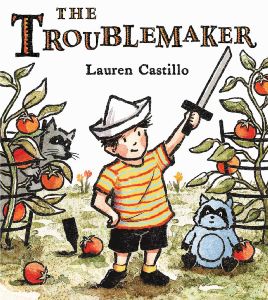
So it is perhaps no surprise that our entire family—especially the aforementioned little sister—has become fans of Lauren Castillo’s The Troublemaker (Ages 3-6). In this charming story, a boy and his stuffed raccoon surreptitiously kidnap the little sister’s stuffed rabbit and set it blindfolded and sailing across a pond, all while the parents are harvesting tomatoes (see, it’s not just me). « Read the rest of this entry »
Fueling Up With Poetry
April 29, 2014 § 3 Comments
 On the Monday morning following Easter, JP crawled into my bed with a new book and proudly announced, “Mommy, I am going to read you some poems. I have lots of favorites. Some of them are very funny. Also some of them are very weird. A few of them I don’t even understand!” And hence followed one of the most enjoyable 45 minutes that I’ve had in awhile. All thanks to J. Patrick Lewis and Douglas Florian’s new Poem-Mobiles: Crazy Car Poems (Ages 5-10).
“Children dive into poetry with the same natural ease as swimmers into water, climbers into trees, and sleepers into dreams…Poetry’s narrative, rhythm and vibrant imagery is the real language of childhood.” So begins a recent online article in The Guardian about a movement among educators and publishers to bring back children’s poetry from “near extinction.” Why, if poetry is so intuitive, so enticing, for children, is it in danger of dying out? The article points a finger at booksellers, many of whom (and I admit to being guilty of this at one time) struggle with how to display and shelve a hard-to-pin-down category. Not considered picture books, not considered chapter books, they end up in their own “poetry” section way off in No Man’s Land. When was the last time you sought out the poetry shelves at your bookstore? « Read the rest of this entry »
Sibling Play
April 11, 2014 § 1 Comment
 I’ll never forget the first time it happened. JP was four, Emily was a little over one, and I realized that 45 minutes had passed and there were still only happy voices in the other room. I called a friend: “The kids are playing together! ON THEIR OWN! For like a really long time! I’m just sitting here reading a book!” (Well, technically I was talking on the phone, but the point is that I could have been reading a book.) And that’s when it hit me: this is why some people have more than one kid (or more than one dog, cat, or fish).
Watching siblings play together is one of the most endearing and gratifying experiences for a parent. (Well, until it all goes south—which it inevitably does—usually right at the moment when you have finished the dishes, wiped down the lunch table, dust-bustered the floor, and finally sat down on the sofa to page through a magazine.) But when the stars do align, as they increasingly do with age, it is in these moments that I get the clearest glimpses of my children’s budding personalities, of the people they will someday become. I see tenderness and compromise in my now six and a half year old boy, amidst the bossiness and tendency to escalate play into some form of physical combat. And in my now three and a half year old daughter, I feel her excitement, her sheer pride, in the way she confidently prattles on after her brother agrees, “OK, you can be the mommy bird, and I’ll be the baby bird.” Because, really, is it not the best feeling in the world when that older brother whom you revere in every way decides to drop everything for you?
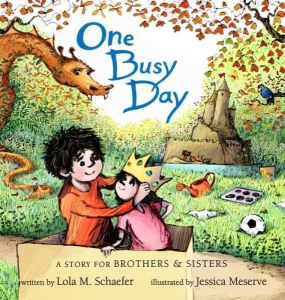
Imagination is the great equalizer in sibling play. In the world of pretend play, it doesn’t matter how old you are. Enter Lola M. Schaefer and Jessica Meserve’s latest picture book, One Busy Day: A Story for Big Brothers and Sisters (Ages 2-6), in some ways a sequel to their first book, One Special Day, about the moment in which a little boy becomes a big brother. « Read the rest of this entry »
A Tasty New Chapter Series (Sprinkles Included)
March 15, 2014 § 4 Comments
 Raise the roof! My favorite fast-talking pastry is back in the house! Now, before you look at me like I have three heads (or 135 sprinkles), I’m referring to Laurie Keller’s new early chapter book series, based on the naive, loquacious, loves-the-limelight chocolate doughnut from her 2003 picture book, Arnie the Doughnut (Ages 4-8). I still remember the hysterics that my staff and I fell into every time we flipped through that first book 11 years ago, about a doughnut who narrowly avoids the fate of being eaten and winds up an unlikely pet (a “doughnut-dog!”) to the lonely but kindly Mr. Bing.
I’ve often wondered why author-illustrator Keller doesn’t get more props from the media and, as a result, remains relatively unknown by parents. Her kooky story lines are peppered with chuckle-inducing sidebars and animated through energetic, googly-eyed sketches. But I have a particular fondness for her ability to keep us parents just as entertained as our children (think puns, references to pop culture, etc.). If you’re not reading Laurie Keller, the world is less fun. It’s as simple as that. (Other non-doughnut-related favorites by Keller are listed at the end of this post.) « Read the rest of this entry »
Friends Make Everything Better (A Pick for Valentine’s Day)
February 10, 2014 § 2 Comments
My family spent this past weekend holed up in the snowy hills of West Virginia with three other families. Once we adults began to block out the chatter and squeals of nine (mostly) happy children running circles around us, we were able to entertain some blissful grown-up time. And as I watched my children mature and transform across three full days of kid-on-kid time, I found myself feeling immensely grateful for friendships of both the tall and short kind. In this winter that has gone on too long, it is our friends that have put smiles on our faces, ideas in our head, and glasses of wine in our (adult) hands.
With Valentine’s Day shortly upon us, I’ve once again chosen a bit of a non-traditional path for my children’s gifts (and, gasp, I’ve even cheated and given the gifts early!). This new picture book—by a first-time author-illustrator—rises above the saccharine-sweet-mushy-gushy-dime-a-dozen stories out there by celebrating friendship in a unique, quirky, unforgettable way.
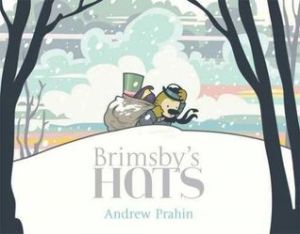
In Andrew Prahin’s Brimsby’s Hats (Ages 4-8), Brimsby, a hat maker by trade, already knows what it is like to have a best friend: someone with whom he shares his creations over tea, and “together, they have the most wonderful conversations.” But when the friend follows his dream to become a sea captain and sails away, Brimsby is left to pass the months away alone in his quiet cottage in the country, without so much as a single visitor.
Eye Candy in the Polar Vortex
January 25, 2014 § 1 Comment
 I’m a romantic when it comes to snow. Meaning that the idea of snow (fat, juicy snowflakes blanketing the world in white) is more appealing to me than the reality (school is closed AGAIN?!). The notion of snow days (flying down hills on sleds and decorating snowmen with friends) is always a bit different than the actuality (wait, it’s freezing out, and wait, did my daughter just pee through four layers of clothing and need to be changed on the side of this hill?). Don’t get me wrong: I love snow. It’s the very anticipation of snow that makes the dawning of winter bearable; that breaks up the monotony of short-lived, bare-branched days; that puts a glimmer of excitement in our children’s eyes when they think of what’s to come. But that’s why—more than anything—I love reading about snow. Because the snow in books is always billowy, soft, and pristine white. The snow in books is always perfect.
Last January, I wrote about my favorite snow books, each one conjuring up a romantic notion of snow. But this winter, in addition to having more snow on the ground, we’re living in a so-called Polar Vortex, a little thing that’s threatening the very core of our “we can handle winter” attitude (suddenly, our lives seem right out of the pages of Eileen Spinelli’s Cold Snap). Let’s say we could all use a dose of Eye Candy right now. I’m referring to Lindsay Ward’s Please Bring Balloons (Ages 2-5), which came out at the end of last year, and which I pulled out of my Secret Stash earlier this week (a secret stash which is rapidly dwindling in light of these snow days). Three of my daughter’s Favorite Things make an appearance in this book: carousels, balloons, and furry animals. Reminiscent of another 2013 favorite, Dream Friends, both books are about a make-believe adventure starring a girl and her four-legged friend. In Please Bring Balloons, this adventure is polar-bound. « Read the rest of this entry »
Holiday Gift Guide 2013: Illustrated Chapter Books for the Adventure Seeker
December 19, 2013 § 5 Comments
 Many of us remember the first novels we read, the ones that instilled in us a love of reading (off the top of my head: A Secret Garden, A Wrinkle in Time, anything written by Ruth Chew…). Earlier this year, the prolific writer, Neil Gaiman, wrote a beautiful defense of fiction, which I absolutely love. Fiction, he claims, is not only our best entry into literacy (the what-will-happen-next phenomenon being utterly addictive), but it teaches, above all, the power of empathy:
“When you watch TV or see a film, you are looking at things happening to other people. Prose fiction is something you build up from 26 letters and a handful of punctuation marks, and you, and you alone, using your imagination, create a world and people in it and look out through other eyes. You get to feel things, visit places and worlds you would never otherwise know. You learn that everyone else out there is a me, as well. You’re being someone else, and when you return to your own world, you’re going to be slightly changed.”
I’ve thought a lot about Gaiman’s words, as my six year old and I have been devouring some of the year’s newest chapter books. I’m hoping some of our favorites will find a way into your bedtime routines as well, beginning with Gaiman’s newest novel, Fortunately, the Milk (Ages 7-10, younger if reading aloud). This fantastically over-the-top book begs to be read aloud and is itself a kind of commentary on the power of storytelling. In an attempt to entertain his rambunctious children during their mother’s business trip, a father spins a fantastical tall tale (think pirates, piranhas, aliens, and singing dinosaurs all in the same breathlessly-paced story) about what happens when he goes to the store for a simple carton of milk. « Read the rest of this entry »
Holiday Gift Guide 2013: Bedtime Stories for the “Goodnight Gorilla”-Obsessed
December 12, 2013 § 1 Comment
 “How do I break the addiction to Goodnight Gorilla?!” a friend texted me the other day. Whether it’s Goodnight Gorilla, Goodnight Moon, or (my preference) Time for Bed, the lulling, reassuring refrains in these books become quick obsessions with little ones getting ready to tuck in for the night. And, let’s be honest, it can grow a wee bit tedious for the one doing the actual reading.
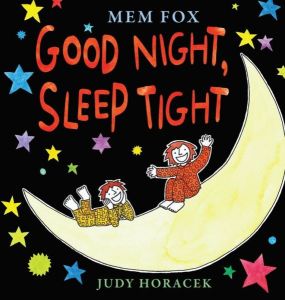
The good news is that, as your child’s attention span develops, you can start incorporating more involved bedtime stories into the mix. I’m not promising it will be love at first sight, and you may have to be a little sneaky (I’ve had great success with the “you pick one and I’ll pick one” approach as a way to introduce new titles). But help is on the way. 2013 has been a rich year for bedtime stories, beginning with Mem Fox’s Good Night, Sleep Tight (Ages 1-4), a small square hardcover illustrated by Judy Horacek—and an instant, no-tricks-necessary favorite with my Emily (the same team created the equally fabulous Where is the Green Sheep?). « Read the rest of this entry »
Holiday Gift Guide 2013: Stories of Perseverance for the Engineer
December 10, 2013 § 1 Comment
 If at first you don’t succeed, try, try again. That might be easy to say as a parent, but we have only to remember our own childhoods to know how hard it is to hear. Just the other night, my son was attempting to draw a human profile by following one of those step-by-step guidebooks. Diligently huddled over his paper, he suddenly threw the pencil across the room and yelled, “This isn’t working at all! It doesn’t even look like a person!” Actually, I thought, it does look like a person—just not like the one in the book. Oftentimes, we cannot see our triumphs for what they are.
The creative process—its ups, its downs, its just plain hard work—is wonderfully captured in Rosie Revere, Engineer (Ages 5-8), the newest venture by Andrea Beaty and David Roberts, the team that created one of my favorite picture books of all time: Iggy Peck Architect. What black-turtleneck-sporting Iggy Peck did for building designs, red-scarf-sporting Rosie Revere (yes, her namesake is Rosie the Riveter) does for engineering. She makes it look—well—cool. « Read the rest of this entry »
Holiday Gift Guide 2013: Other-Worldly Encounters For the Young Artist
December 8, 2013 § 4 Comments
 When I was young, one of my favorite picture books was Harold and the Purple Crayon, where a little boy makes his own adventures with the help of a single purple crayon. As a child, I loved to draw, but I think the greater appeal for me lay in Harold’s vivid imagination—an imagination that empowers him with an inner resourcefulness, that entertains him when he can’t fall asleep, that gets him out of any sticky situation (drowning? simply draw a boat).
This same spirit echoes across Aaron Becker’s Journey (Ages 4-8), easily the most stunning picture book of 2013 and an inspiration for young artists and adventure-seekers alike. Unlike Harold, a simple visual presentation of purple and white, Journey makes use of a broad palette, although weighted emphasis is given to red, the color of the crayon with which a girl begins her escape by drawing a door (after all, what else can you do when your mom is cooking, your dad is working, and your big sister is too busy?). « Read the rest of this entry »
What Was Santa Like as a Kid? (Two Favorite New Christmas Books)
December 4, 2013 § 4 Comments
 With every holiday season, there is a kind of magic in rediscovering old friends, old traditions, old stories. I have only to see the ecstasy on my children’s faces as we unpack our box of Christmas books each December to remember why I go through the trouble of packing them away in January, as opposed to stuffing them into our already stuffed bookshelves. As a parent, it’s magical for me as well: last night my eldest left us at the dinner table, voluntarily bathed himself, got into his PJs, brushed his teeth, and called downstairs, “I’m ready 20 minutes early so I can get some extra Christmas stories!” No wonder they call it the most wonderful time of the year.
Just because we only read them for one month a year doesn’t mean I can resist the temptation to add to our collection every single year (there are worse addictions, I’ve assured my husband). Last year was Alison Jay’s exquisite Christmastime, where clues of Christmas carols are embedded into a seek-and-find masterpiece. Previous years’ favorites are mentioned here and here. This year’s acquisitions include two new picture books, utterly different in style, but forever entwined in my mind, since my kids and I had the pleasure of meeting both author/illustrators at Hooray for Books (our fabulous independent bookstore) a few weeks ago. « Read the rest of this entry »
November’s Birthday Pick Battle
November 8, 2013 § 2 Comments
 Six year old boys live in a world of their own. Often, the only people who understand them are other six year old boys. Take this recent conversation I witnessed as I was driving JP and his buddy home from school:
Friend: “I think I just saw a box of dynamite on the side of the street.”
JP: “Cool! Imagine if you took an inflatable bouncy house and blasted dynamite underneath it, and the bouncy house exploded into Outer Space and caught fire to the moon!”
Friend: “Yes! And then the bouncy house would blast the moon to the sun where it would explode into a thousand pieces and turn to gas!”
JP: “And then that gas would get into the Earth’s atmosphere and poison the guts out of all the bad people!”
Friend: “And they’d all become zombies and their eyes would fall out of their heads!”
JP: “Look, my cheese stick is pooping!”
Friend: “Cool!”
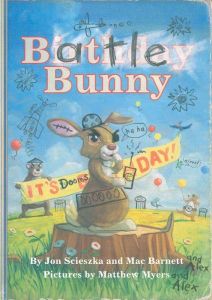
We as parents might not be able to compete with this level of engrossing conversation, but I’ll tell you who can: Jon Scieszka and Mac Barnett, whose Battle Bunny (Ages 5-9), is going to rock the world of every boy in the universe, guaranteed. « Read the rest of this entry »
Unlikely Companions
October 28, 2013 § 2 Comments
 Children form attachments to the oddest things. Take, for example, the dried out husk of a seed for which my six year old spent a recent afternoon constructing a shoebox house, complete with a toilet-paper-tube flag post and a felt blanket and pillow that he actually sewed himself. Did you get that? For a seed. There was also the time that he and his sister took their plastic straws from a restaurant to bed with them. These are not children who are hurting for baby dolls or stuffed animals; they simply choose to imprint on the less obvious choices.
So, is it any surprise that they would love Sophie’s Squash (Ages 3-7), a new picture book by Pat Zietlow Miller (fellow children’s book blogger), where a little girl develops a steadfast affection for a squash that her parents pick out at the farmers’ market and intend to cook for dinner? Sophie uses black marker to draw a face on the butternut squash; she names it Bernice (love); she wraps it in a baby blanket and rocks it to sleep; she takes it to story time at the library (double love); and she even organizes play dates for it with other squash (triple love). In other words—as her very patient parents soon realize—this squash is no dinner. « Read the rest of this entry »
The Rules of Play
October 10, 2013 § 2 Comments
 As parents, we are continually hounded by parenting experts about the importance of getting down on the floor and playing with our children. I’m fairly easily wooed when it comes to playing Candy Land or doing a giant floor puzzle or even painting alongside my kids; but when it comes to imaginative play, a little part of me wants to scream, “Please don’t make me do it!!!!” Why, you ask? Or maybe you don’t need to ask, because you already know about ALL THE RULES that our children arbitrarily force upon us from start to finish during these games. And nowhere is this more evident than when my daughter wants to play tea party.
E: “Mommy, let’s have a tea party!”
Me: “OK, where should I sit?” (I’ve learned better than to presume.)
E: “Right here”
Me. “OK’ (Sitting down.)
E: “No, you don’t sit like that! You have to cross your leg.”
Me: (making adjustments) “OK, I’m ready for my tea now.”
E: “No! First we are having a snack.”
Me: “OK, what’s for snack?”
E: “You don’t ask the question! You wait and I bring you the snack.”
Me (minutes later after being served a wooden egg and a plastic cucumber) “Mmmmm, thank you, this is so tasty!”
E: “MOMMY! It’s not time to eat yet! You have to wait for your tea!”
Me (an eternity later, when pretend tea is finally served): “Mmmmm, this tea is toasty warm.”
E: “It’s COLD tea!”
Me: “This tea is nice and refreshing. I think I’ll put some sugar in it.”
E: “That’s honey!”
Me: “I’m putting in some honey.”
E: “NO! You don’t pour it in, you have to use a SPPPOOOOOON!”
Thank you, but I will stick with Candy Land. « Read the rest of this entry »
Permission to Go a Little Wild
September 18, 2013 § 2 Comments
 The routines of back to school are upon us. I am slowly adjusting to weekday mornings without the kids (meaning that I’m nearly home from drop off before I realize that I’m still humming along to the Music Together CD in the car; before I realize, Wait. I don’t have to listen to this. Wait! I can listen to anything I want!).
At the same time that I’m shedding a little responsibility, my children are being asked to assume more. They have traded the creative liberty of summer dressing (JP pairing bright green shirts with bright green shorts) for the navy and khaki of school uniforms. Our leisurely mornings of PJs and drawn-out breakfasts have been traded for early wake up calls and a litany of come on, let’s move along, did you pack your lunch bag, please take off that cape, why on earth are you getting out the play dough, for crying out loud hurry up (yes, I have read the articles about how we’re ruining our children by saying “hurry up” all the time, and I’ve made a mental note to work on that in my next life). « Read the rest of this entry »
Growing Pains
September 10, 2013 § 3 Comments
 My youngest turns three today. Lately, everywhere I turn, I am reminded of how fast she is growing. “Mommy, Mommy, my toes are sticking out of my sandals!” she cried jubilantly one morning a few weeks ago; “I growed into a big girl!”
It’s no wonder, then, that she immediately fell in love with Alison Murray’s precious new picture book, Little Mouse (Ages 18 mos-4 yrs), where a little girl proclaims that she is no longer her Mommy’s “little mouse”; on the contrary, she is tall (like a giraffe), strong (like a bull), hungry (like a horse), and brave (in the face of a lion). On top of that, she can make her voice and her body do amazing things, from trumpeting (like an elephant) to pumping high on the big girl swing (like a bird). « Read the rest of this entry »
Biking for Beginners and Pros
July 5, 2013 Comments Off on Biking for Beginners and Pros
 We interrupt our Summer School Series for some good ‘ol fashioned outdoor play—and because there happens to be two seriously awesome new picture books about riding a two wheeler (the Ultimate Summer Challenge, really). The first book is for the I-Think-I-Can-Beginners; the second is for the experienced, daring, and creative bikers (especially those with a love for all things Space).
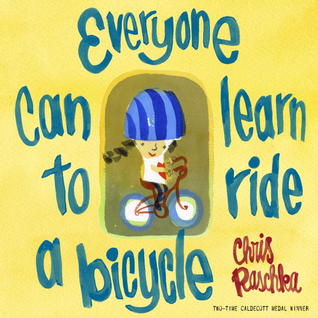
Chris Raschka’s Everyone Can Learn to Ride a Bicycle (Ages 3-6) is a simple but poignant “how to” look at mastering a two wheeler, first with training wheels and then without. Now, if I were going to write a step-by-step guide to teaching a five year old to ride a bike, it might go something like this:
Lug ten tons of second-hand steel to park, at the request of eager child.
Help eager child up into bike seat.
Become temporarily deaf by imminent screaming of “NOOOOOOO get me off get me off get me off!”
After much cajoling and pleading and promising for the 45th time that you are going to hold on the whole time, convince child to remount bike and begin pedaling forward.
After 10 minutes, whereby you are still holding fast to the training-wheeled bike and said bike has moved exactly 10 feet, suggest that he try turning.
Feel an abrupt jerk as child slams on the breaks (this, oddly, comes very naturally), jumps off bike, and announces that he is Most Definitely Not Doing This Right Now.
Lug ten tons of steel back home.
Fortunately, Everyone Can Learn to Ride a Bicycle paints a much rosier picture of a child learning to ride a bike, along with the help of her patient and gently encouraging father.
But, actually, what I love about this book is that things are not always smooth sailing: the little girl has lots of false starts, falls down again and again, and needs both hugs and Band-Aids. “Oops! You nearly had it,” the book coaches. “Don’t give up. You’ll get it. Find the courage to try it again, and again, again, and again, again, and again, and again, until by luck, grace, and determination, you are riding a bicycle!”
Rashchka’s signature watercolors, seemingly effortlessly executed with thick, breezy, rough strokes of paint, are perfectly suited to the subject at hand. Every single painting exudes movement—whether it’s the little girl pulling her father’s hand toward the bike shop, her sideways and backwards tumbles off the bike, the neighborhood kids zooming past her on their colorful two wheelers, or her triumphant forward-leaning fast-pedaling stance at the end.

Rashchka’s greatest gift has always been his ability to capture emotional expression with just a few brushstrokes; and it’s the determination, bewilderment, frustration, joy, and pride on the little girl’s face that will make this gem relatable for children—those struggling to ride and those who’ve newly mastered the skill. I’m not promising this book will work miracles, assuming there might be other parents out there who are having similar bicycling battles on the playground (please tell me I am not alone); but I can promise that your child will identify a kindred spirit on the page.
Moving on to mor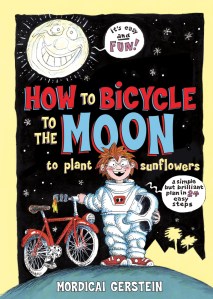 e advanced bicycling (and a longer, more sophisticated story), I fervently recommend How to Bicycle to the Moon to Plant Sunflowers: A Simple but Brilliant Plan in 24 Easy Steps, by Mordicai Gerstein (Ages 5-10). If the irreverent title alone hasn’t sold you, let me sing the praises of this most entertaining book, particularly for the kid who loves science, invention, numbers, the Moon, and bossing people around (that would be my son to a T, minus the bicycling).
First, when was the last time your child read a work of fiction that was laid out in steps? Each of this book’s 39 pages outlines a different step, numbered 1 through 24, many of them sub-categorized with letters (12a, 12b, 12c, 12d, etc.). Kids love this stuff; it’s exactly the way their mind works when they are bossing us around.
Secondly, there’s the very idea of bicycling into outer space, not to mention for the purpose of planting sunflowers to cheer up the Moon’s “big, sad clown face.” Thirdly, there’s the intricately involved and scientifically supported plan that the boy conjures up—a plan involving 2,000 used truck inner tubes, a 25-foot flagpole, a ship’s anchor, 238,900 miles of garden hoses wound tightly around a giant spool, a rented XS space suit from NASA, and various provisions, including “nourishing, flavored Glop, squirted through a straw in your space-helmet.”

Finally, there’s the climactic adventure itself, Boy On Bike, pedaling up miles of garden hoses that have been anchored into the Moon’s surface, stopping to wonder at “the trillions of stars.” Within the largely comic narrative, written in the boy’s instructive voice, there are also many clever descriptions, my favorite being the notion that the Moon looks “like a coloring book that hasn’t been colored yet.”
Gerstein’s pen and ink drawings have a comic-book feel, but the crudely colored line art is mixed with grace and subtlety (the Moon’s changing expressions are a particular delight). This is the same Gerstein who wrote and illustrated one of my (and my son’s) favorite books: The Man Who Walked Between the Towers (Ages 4-8), the true and serious story of Phillipe Petit’s dramatic tightrope walk between the World Trade Towers in 1974. The two books could not look or feel more different (a rare feat for a picture book artist); yet, oddly, they both involve moving atop a skinny, rope-like material suspended over great heights.
Gerstein writes books about dreams—about the mystery, wonder, and excitement in planning for and achieving those dreams. I have a dream that my children will both ride two wheelers some day, that they will taste the victory that comes from balancing up high on their own, and (as I vividly remember doing as a young girl) that they’ll speed around the block, dreaming and scheming and making their own Big Plans.
Learning from the Big Thinkers (Summer School Continues!)
June 30, 2013 § 2 Comments
 Albert Einstein said, “The important thing is not to stop questioning. Curiosity has its own reason for existing.” Then by this account, should we embrace the endless string of questions by our children throughout the day? A recent British study found that children ask on average 300 questions a day. I’m pretty sure that my almost six year old has this daily average beat by the thousands; and while there are many moments when I relish his curiosity, there are also times when I long for an “off” button. These last instances most frequently occur when we’re in the car, because there’s nothing like being locked in a metal box with your children to bring out their obsessions with a full, unadulterated intensity. “Why are the clouds moving that way? Is there going to be a storm? How do the weather people know there’s going to be a storm? What happens if lightning hits our car? Why does red have to mean stop?” (This last one as we pull up to a stoplight and I realize that I can’t expect his brain to pause just because the car does.)
I was driving back from the pool the other day (having been turned away by the threat of storm clouds), and I may or may not have erupted with “I can’t take it anymore!” But then, I had a rare flash of brilliance, and I declared, “It’s Mommy’s turn to ask questions.” I began my own litany of questions, only to discover that JP had answers waiting just as quickly as I could rattle them off. ‘”What are clouds made of?” (“Water droplets!”) “Why does a ball fall if you drop if in the air?” (“Gravity!”) “Why am I not hungry?” (“Because you probably ate enough lunch!”) “Wow,” I said, “you are just as good as answering questions as you are at asking them.” “That’s because I ask so many questions!” he roared, and he and his sister laughed their heads off for the next two minutes (I’ll take my breaks where I can get them).
I recently posted about the value of sharing picture book biographies with children, and I included a list focused on true stories of the Ordinary Doing Extraordinary. But, of course, we mustn’t neglect the born geniuses, the legendary minds, the Great Thinkers that are responsible for shaping our very understanding of the world. In recent years, a slew of exceptional artistic and richly informative picture books have emerged (see my list at the end of this post) to celebrate such minds as Leonardo da Vinci, Benjamin Franklin, and, most recently, Mr. Curiosity Himself: Albert Einstein.
Jennifer Berne’s On a Beam of Light: A Story of Albert Einstein (Ages 5-10) is the kind of book you’ll want to share with your kids when they’re five, six, seven, eight, nine, and ten. Berne’s highly approachable narrative voice speaks directly to children (she first won me over in Manfish: A Story of Jacques Cousteau). In Einstein’s case, she brings to life, not only Albert’s awe at the mysteries of the world, but also his many personality quirks—from his disruptive questioning in elementary school to the saggy, baggy clothes he always wore as an adult (“My feet are happier without socks!”). These quirks are further emphasized by Vladimir Radunksky’s loosely drawn pen, ink, and gouache drawings, at once frenetic and playful, serene and innocent, like little windows into Albert’s own ever-shifting imagination. In JP’s favorite spread, Albert imagines what it would be like to ride his bike up the beam of sunlight that’s shining down on the sidewalk in front of him. “And in his mind, right then and there, Albert was no longer on his bicycle, no longer on the country road…he was racing through space on a beam of light. It was the biggest, most exciting thought Albert had ever had. And it filled his mind with questions.”
I’m no physicist. In fact, I somehow managed to avoid taking a Physics class in both high school and college (I regret this now). I have never felt terribly confident talking about energy and heat and magnetism and motion with my children, and goodness knows what I’ll do when I have to help them with equations involving E = mc2. But here I am, reading this book—this beautiful literary depiction of these scientific concepts—and I think, “Why have I never realized that physics is everything?!” Like the searching, wondering eyes of our little ones, Albert sees everything as a question. How could “a lump of sugar dissolve and disappear into his hot tea?” How could the “smoke from his pipe…disappear into the air?” And, of course, what would happen if he traveled near the speed of light? (The answer: “Only minutes would pass for Albert, while years and years went by for the rest of us!”)
Albert “asked questions never asked before. Found answers never found before. And dreamed up ideas never dreamt before.” Because of him, we were able to build spaceships and travel to the moon (there’s a great afterward that gets into more detail about the repercussions of Einstein’s discoveries, along with a list of additional reading material). Naturally, there are many questions still at large about how the universe works—and, fittingly, the book’s dedication reads, “To the next Einstein, who is probably a child now.” If my son and his peers are any indication, there’s likely a whole crop of future Big Thinkers out there. Children who won’t let a mere stoplight slow them down from asking their questions, questions, questions.
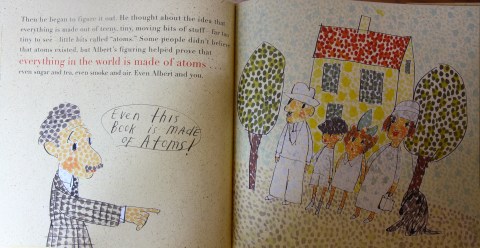
Here, kids are introduced to the idea that everything is made up of “teeny, tiny, moving bits of stuff—far too tiny to see—little bits called ‘atoms'” In a perfect marriage of text and illustration, Radunksky’s corresponding picture is broken up into hundreds of tiny dots (“Even this book is made of atoms!”).
Other Favorite Picture Books About Great Scientific Minds:
Odd Boy Out: Young Albert Einstein, by Don Brown (Ages 5-10)
Electric Ben: The Amazing Life and Times of Benjamin Franklin by Robert Byrd (Ages 6-12)
Noah Webster and His Words, by Jeri Chase Ferris (Ages 6-10)
I, Galileo, by Bonnie Christensen (Ages 7-12)
Leonardo: Beautiful Dreamer, by Robert Byrd (Ages 8-12)
The Tree of Life: Charles Darwin, by Peter Sis (Ages 8-12)
Beholding the Trees
April 17, 2013 § 1 Comment
 “I’m thankful for the trees,” my five year old blurted out last Thanksgiving, as we were going around the table giving thanks for the usual holiday stuff (togetherness, food, health, etc.). His comment was so unexpected that I’ll admit we all burst out laughing (being a child must feel like a thankless job at times). But for all its randomness, I believe his comment was 100% genuine. JP has always had a special place in his heart for trees (plus his favorite color has been green since he could talk—see last year’s post in honor of Earth Day).
I like to think that a tiny bit of his appreciation for these living, breathing, magnificent things, which line our streets and fill our forests, is owing to me. You see, as much as I want my children to grow up with the deepest love and appreciation for their planet, as much as I believe that the future of this planet lies heavily in the choices their generation will make, I can be lazy. I would like to be the kind of mom who plants a vegetable garden every summer with her children, who participates in volunteer days picking up litter at inner-city parks, who turns banana peels into compost. Instead, my kids get a single tomato plant and some herbs in planters on our deck.
March’s Hot-Off-the-Press Birthday Pick
March 6, 2013 Comments Off on March’s Hot-Off-the-Press Birthday Pick
 This one goes out to all the little girls out there—or rather, to their little friends who have spring birthdays. Debut author-illustrator You Byun’s brand new Dream Friends (Ages 2.5-6) is full of the stuff of little girls’ dreams. I’m talking about sugar and spice and everything nice—or, more specifically, bunny rabbits and tea parties and baby chicks and Santa Claus and cupcakes and flowers and, of course, friendship.
Melody has a friend, a best friend, only he’s not your typical friend: for starters, he’s big and white and furry (an ambiguous but lovable dog-cat-raccoon looking thing that my daughter has taken to kissing on the nose each time he makes an appearance). The bigger problem is that this magical friend only visits the little girl in her dreams (although these dreams are filled with such delights as dancing on flower-shaped clouds or watching fireworks explode in the shape of ice cream cones and lollipops).
 What to Read to Your Kids