Back to School With Monsters (of the Misunderstood Variety)
September 1, 2014 § 3 Comments
 One of my favorite books as a kid was James Marhsall’s Miss Nelson is Missing, a picture book about a smiley, mild-tempered teacher, who, fed up with the rude and rambunctious behavior of her students, dons a pointy nose, a wig, and a black dress to become the witchy, ultra-strict substitute named Viola Swamp; within a few weeks, the children have reformed their ways and are begging for Miss Nelson’s return. The story is a playful reminder that we’re not always grateful for what we have until it’s gone.
As a kid, though, my obsession with the book stemmed from the fact that Viola Swamp’s true identity eludes, not only her students, but us readers as well—that is, until the final page, when we get a glimpse of the familiar black dress hanging in Miss Nelson’s bedroom closet. Once we’re in on the secret, we can’t help but want to read the book again and again, picking up on clues that we missed the first time around, stunned that the truth was right in front of our eyes the whole time. If only we (alongside Miss Nelson’s students) hadn’t been so quick to settle for first impressions, we would have seen that Miss Nelson wasn’t just a sweet face, oblivious to the spitballs flying at her. Nor was Viola Swamp the monstrous outsider we assumed her to be.
Now, forty years after James Marshall published his book, Peter Brown again turns the conventional teacher-student relationship on its head in his infectiously-titled new picture book, My Teacher is a Monster! (No, I am Not.) (Ages 5-9). “Bobby had a big problem at school. Her name was Ms. Kirby.” « Read the rest of this entry »
Three “Beach Reads” I Should Have Told You About Earlier
August 18, 2014 Comments Off on Three “Beach Reads” I Should Have Told You About Earlier
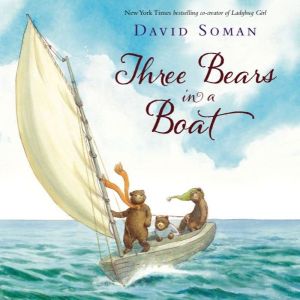 We have spent some fabulous time at the ocean this summer, and it seems almost cruel to deny my children their sand-worn feet and crab-catching nets, in exchange for the laced shoes and lunch bags of a rapidly-approaching new school year. It also seems a bit cruel to have waited until now to share with you our favorite beach reads of 2014. Then again, I’ve been too busy helping my children dig giant sand pits to bother with computers, and I suppose that counts for something, too.
Each time we read David Soman’s Three Bears in a Boat (Ages 3-6), the idyllic watercolor seascapes have me yearning for the New England coast, where icy waters crash on rocky shores, lighthouses guide fog-draped ships, and legends abound on the salty tongues of weathered fishermen. In this case, the high seas adventure features three energetic young bears (Dash, Theo, and a female Charlie), who accidentally shatter their mother’s prized blue seashell in a reckless moment of play. Fearing maternal wrath (“after all, [she] was a bear”), the scheming youngsters set off in a sailboat to find a replacement shell that they can put back before she returns. « Read the rest of this entry »
GOOOOOOAAAAAAAALLLLLLLL!
July 2, 2014 § 1 Comment
 We are not a sports-watching family (my husband jokes that he lost TV sports in marriage). But then came the World Cup. All four of us are possessed over the World Cup, and I can’t entirely explain it. I mean, it can’t just be the hotness of the players, the incredible headers that out of nowhere tip a speeding ball into the net; the non-stop, pinball-like passing. We scream at the TV (“Mommy, you are using your outside voice!” I’ve been reprimanded more than once); we jump up and down and hug each other over goals; we run into the backyard and kick the ball at halftime; and we despair when the US team fights the fight of its life and comes up short.
The World Cup will end, but I hope our family’s new love of soccer will not. Both kids are more excited than ever for their own soccer season this fall (although JP reports that he does not think he would like to be as good as the World Cup players, because “it looks very dangerous out there”). In the meantime, we will be reading some of the fantastic soccer-themed books that have popped up this year. Our favorite of these is Soccer Star (Ages 4-8), by Mina Javaherbin (illustrations by Renalto Alarcao), a picture book which not only exudes the excitement of soccer, but places it in a valuable cultural context. « Read the rest of this entry »
A Master Class in Art History (Without Leaving Your House)
June 16, 2014 § 2 Comments
 I don’t know how the rest of you are planning to get through a hot and steamy summer, but I am counting on a lot of time at the craft table. Especially good news for today’s parents is that we don’t have to live next door to an art museum to teach our kids about the great artists and artistic movements of the past. Last June, I kicked off a “summer school” series with a post about some of my favorite picture book biographies for elementary-aged children, a rich and growing subset of children’s literature. Nowhere is the picture book format better utilized than in biographies of famous artists. These aren’t the books of our past, which reproduce notable paintings aside dry critical analysis; rather, they are true and entertaining stories about formative artists who, beginning as children, overcame struggles, searched for inspiration, and broke down conventional barriers to define their unique artistic styles. As your child sits before a blank piece of paper, wouldn’t you love for him or her to channel the stories of Henri Matisse, Jackson Pollock, Henri Rousseau, and Vasily Kandinsky? (See my list of favorite books at the end.)
The latest of these gems, Barb Rosenstock’s The Noisy Paint Box: The Colors and Sounds of Kandinsky’s Abstract Art (Ages 6-12), strikes a particular chord with my family. At almost seven, JP loves to draw and paint, but while his peers are steering more and more towards realistic creations, JP still prefers abstraction. Some might call it scribbling, although to imply that it is rushed or without meaning would be misguided. JP (and now Emily, following in his footsteps) never stops talking—not for one second—while he draws. He narrates the action as it takes shape before him: comets blasting through the sky, submarines bursting into flames, houses pitched airborne towards a burning sun (the theme of explosion is strong with this one). I’m not exactly sure what he is working out on that paper—because there is clearly something cathartic going on—but when he is finished, his entire body is relaxed, his mind at peace. « Read the rest of this entry »
Counting Mania
June 14, 2014 Comments Off on Counting Mania
 My three year old is a counting fool. She counts the little green squares on her napkins (thank you, Target); she counts the steps up to her room; she counts everyone’s matches in our endless rounds of Go Fish. “I’m out of breath of counting!” she exclaimed the other day, after numerous laps around the house counting from 1 to 50. So, it only stands to follow that she would also want to read counting books, an especially robust subject matter in the world of children’s picture books (see my complete list of favorites at the end).
Emily’s current obsession is Steve Light’s new Have You Seen My Dragon? (Ages 2-5), which I knew would be a hit the instant I felt the green metallic foil dragon on the front (ooooooh, ahhhhhh). While most counting books can’t pretend to “teach” counting (with the exception of Anno’s Counting Book, the single best presentation of counting for children that I’ve ever seen), the good ones present clever ways to practice counting and to develop the finger control that goes along with it. « Read the rest of this entry »
The Story Behind the Gift (In Honor of Mother’s Day)
May 8, 2014 § 1 Comment
 Last year, at about this time, JP came home from school proudly toting a plastic grocery bag filled with the contents of his “work drawer.” I was nearly giddy with excitement at the prospect of getting a glimpse into his work over the past few months, endeavors in addition and subtraction, story writing, and cursive practice, about which I had heard only mumblings in response to my daily inquisition, “What did you do at school?” After we ate snack together and his sister had lost herself in a project, I sat down, folded my hands on the dining room table, and watched eagerly as JP began to unpack the bag’s contents. Not many “oohs” and “ahhs” had gone by, before I realized that most of papers bore the signatures of other children. Daphne. Josh. Helena. “But, honey, where’s the work that you did?” I finally asked. And, as if that was the silliest question in the world (duh), JP informed me: “I gave it away to my friends!”
It wasn’t but a few days later that I casually mentioned this exchange to JP’s teacher. I know Montessori is more about the process than the end result, I told her, but wouldn’t it be nice to see some tangible results of my tuition, ha ha ha? “It is ironic, isn’t it,” she replied. “We spend years hoping, pleading, begging our children to share. Then we complain when they want to give everything away.” How true! « Read the rest of this entry »
Sibling Play
April 11, 2014 § 1 Comment
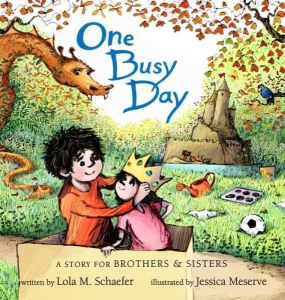 I’ll never forget the first time it happened. JP was four, Emily was a little over one, and I realized that 45 minutes had passed and there were still only happy voices in the other room. I called a friend: “The kids are playing together! ON THEIR OWN! For like a really long time! I’m just sitting here reading a book!” (Well, technically I was talking on the phone, but the point is that I could have been reading a book.) And that’s when it hit me: this is why some people have more than one kid (or more than one dog, cat, or fish).
Watching siblings play together is one of the most endearing and gratifying experiences for a parent. (Well, until it all goes south—which it inevitably does—usually right at the moment when you have finished the dishes, wiped down the lunch table, dust-bustered the floor, and finally sat down on the sofa to page through a magazine.) But when the stars do align, as they increasingly do with age, it is in these moments that I get the clearest glimpses of my children’s budding personalities, of the people they will someday become. I see tenderness and compromise in my now six and a half year old boy, amidst the bossiness and tendency to escalate play into some form of physical combat. And in my now three and a half year old daughter, I feel her excitement, her sheer pride, in the way she confidently prattles on after her brother agrees, “OK, you can be the mommy bird, and I’ll be the baby bird.” Because, really, is it not the best feeling in the world when that older brother whom you revere in every way decides to drop everything for you?
Imagination is the great equalizer in sibling play. In the world of pretend play, it doesn’t matter how old you are. Enter Lola M. Schaefer and Jessica Meserve’s latest picture book, One Busy Day: A Story for Big Brothers and Sisters (Ages 2-6), in some ways a sequel to their first book, One Special Day, about the moment in which a little boy becomes a big brother. « Read the rest of this entry »
Friends Make Everything Better (A Pick for Valentine’s Day)
February 10, 2014 § 2 Comments
My family spent this past weekend holed up in the snowy hills of West Virginia with three other families. Once we adults began to block out the chatter and squeals of nine (mostly) happy children running circles around us, we were able to entertain some blissful grown-up time. And as I watched my children mature and transform across three full days of kid-on-kid time, I found myself feeling immensely grateful for friendships of both the tall and short kind. In this winter that has gone on too long, it is our friends that have put smiles on our faces, ideas in our head, and glasses of wine in our (adult) hands.
With Valentine’s Day shortly upon us, I’ve once again chosen a bit of a non-traditional path for my children’s gifts (and, gasp, I’ve even cheated and given the gifts early!). This new picture book—by a first-time author-illustrator—rises above the saccharine-sweet-mushy-gushy-dime-a-dozen stories out there by celebrating friendship in a unique, quirky, unforgettable way.
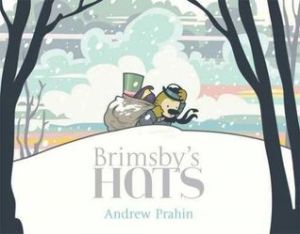
In Andrew Prahin’s Brimsby’s Hats (Ages 4-8), Brimsby, a hat maker by trade, already knows what it is like to have a best friend: someone with whom he shares his creations over tea, and “together, they have the most wonderful conversations.” But when the friend follows his dream to become a sea captain and sails away, Brimsby is left to pass the months away alone in his quiet cottage in the country, without so much as a single visitor.
Digging for Mummies
January 15, 2014 § 1 Comment
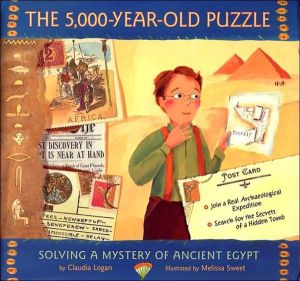 While my son and I were on the subject of excavating fossils, it seemed it might be logical to jump from paleontology to archaeology. It didn’t hurt that, over winter break, JP’s teacher had emailed me about tracking down some good books about Ancient Egypt (see list at the end). And so, one snowy night, JP and I sat down on the couch to read the Treasure Trove that is The 5,000-Year-Puzzle-Old Puzzle: Solving a Mystery of Ancient Egypt (Ages 6-12), by Claudia Logan, illustrated by Melissa Sweet.
An hour later, we were still reading it, my daughter and husband had joined us, and I almost couldn’t tear myself away to meet my girlfriends for a scheduled drink. Almost. I can’t think of a better introduction, not only to Ancient Egypt, but also to the painstaking role that archaeologists play in unearthing clues about ancient life. While the American boy and his father in the book are fictitious, they join an actual historic dig, led by a Harvard team of scientists, which occurred in 1924 at the Egyptian site of Giza 7000X, where a secret and unusually well-preserved tomb was discovered. Through a combination of actual historic records and the young boy’s first-person narrative, we learn about the team’s efforts to excavate this ancient site over the course of a year—including their continual revisions to hypotheses over whose tomb it was and why it was constructed in such a way. « Read the rest of this entry »
Holiday Gift Guide 2013: Illustrated Chapter Books for the Adventure Seeker
December 19, 2013 § 5 Comments
 Many of us remember the first novels we read, the ones that instilled in us a love of reading (off the top of my head: A Secret Garden, A Wrinkle in Time, anything written by Ruth Chew…). Earlier this year, the prolific writer, Neil Gaiman, wrote a beautiful defense of fiction, which I absolutely love. Fiction, he claims, is not only our best entry into literacy (the what-will-happen-next phenomenon being utterly addictive), but it teaches, above all, the power of empathy:
“When you watch TV or see a film, you are looking at things happening to other people. Prose fiction is something you build up from 26 letters and a handful of punctuation marks, and you, and you alone, using your imagination, create a world and people in it and look out through other eyes. You get to feel things, visit places and worlds you would never otherwise know. You learn that everyone else out there is a me, as well. You’re being someone else, and when you return to your own world, you’re going to be slightly changed.”
I’ve thought a lot about Gaiman’s words, as my six year old and I have been devouring some of the year’s newest chapter books. I’m hoping some of our favorites will find a way into your bedtime routines as well, beginning with Gaiman’s newest novel, Fortunately, the Milk (Ages 7-10, younger if reading aloud). This fantastically over-the-top book begs to be read aloud and is itself a kind of commentary on the power of storytelling. In an attempt to entertain his rambunctious children during their mother’s business trip, a father spins a fantastical tall tale (think pirates, piranhas, aliens, and singing dinosaurs all in the same breathlessly-paced story) about what happens when he goes to the store for a simple carton of milk. « Read the rest of this entry »
Holiday Gift Guide 2013: Other-Worldly Encounters For the Young Artist
December 8, 2013 § 4 Comments
 When I was young, one of my favorite picture books was Harold and the Purple Crayon, where a little boy makes his own adventures with the help of a single purple crayon. As a child, I loved to draw, but I think the greater appeal for me lay in Harold’s vivid imagination—an imagination that empowers him with an inner resourcefulness, that entertains him when he can’t fall asleep, that gets him out of any sticky situation (drowning? simply draw a boat).
This same spirit echoes across Aaron Becker’s Journey (Ages 4-8), easily the most stunning picture book of 2013 and an inspiration for young artists and adventure-seekers alike. Unlike Harold, a simple visual presentation of purple and white, Journey makes use of a broad palette, although weighted emphasis is given to red, the color of the crayon with which a girl begins her escape by drawing a door (after all, what else can you do when your mom is cooking, your dad is working, and your big sister is too busy?). « Read the rest of this entry »
November’s Birthday Pick Battle
November 8, 2013 § 2 Comments
 Six year old boys live in a world of their own. Often, the only people who understand them are other six year old boys. Take this recent conversation I witnessed as I was driving JP and his buddy home from school:
Friend: “I think I just saw a box of dynamite on the side of the street.”
JP: “Cool! Imagine if you took an inflatable bouncy house and blasted dynamite underneath it, and the bouncy house exploded into Outer Space and caught fire to the moon!”
Friend: “Yes! And then the bouncy house would blast the moon to the sun where it would explode into a thousand pieces and turn to gas!”
JP: “And then that gas would get into the Earth’s atmosphere and poison the guts out of all the bad people!”
Friend: “And they’d all become zombies and their eyes would fall out of their heads!”
JP: “Look, my cheese stick is pooping!”
Friend: “Cool!”
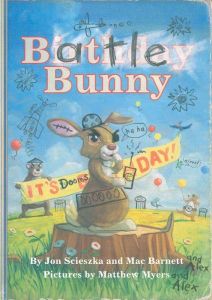
We as parents might not be able to compete with this level of engrossing conversation, but I’ll tell you who can: Jon Scieszka and Mac Barnett, whose Battle Bunny (Ages 5-9), is going to rock the world of every boy in the universe, guaranteed. « Read the rest of this entry »
Would Your Life Story Fit In a Box? What We Learn From Our Ancestors
October 3, 2013 § 1 Comment
 Our month of Birthday Mania was bound to have some fall out. Last night, after a particularly exhausting day for my kids (school followed by swim lessons followed by dinner out with friends), I finished putting Emily down and walked into JP’s room to begin his story time. I found my newly-turned six year old curled up in a ball on his bed, sobbing into the deflated husk of his bright green birthday balloon, a remnant from last weekend’s party. “My buh-buh-buh-buh-llllooooon!” he convulsed. “It’s all I have left from my bestest day evvvvvvv-errrrrrrr!” And then he looked at me with lion eyes: “I want a new balloon RIGHT NOW!”
As parents, we’ve all been here. Missed that window to leave the park, to leave the restaurant, to get into bed. So. Far. Gone. I tried the parenting-with-empathy approach: “It’s hard when something so fun comes to an end, huh?” But the wailing continued, accompanied now by a strange rocking of the shriveled green mass. I need to get this poor kid in bed. “Wait! I know!” I offered. “We can save it and put it in your memory box!” JP eyed me suspiciously. “Not that box that you keep, Mommy. I’m going to start my own memory box and make a special pillow in it for my balloon stub.”
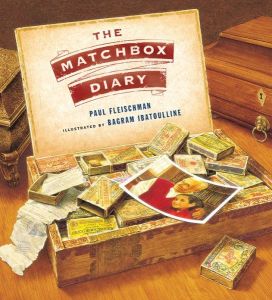
Just a few weeks earlier, JP and I had been discussing the concept of “memory boxes,” after reading Paul Fleischman’s extraordinary and deeply moving new picture book, The Matchbox Diary (Ages 6-10). The book chronicles the life story of an Italian-American boy, who sailed with his family to Ellis Island in search of a better life. « Read the rest of this entry »
Digging in the Backyard: Summer School Wraps Up!
August 22, 2013 § 1 Comment
 Earlier this summer, the kids and I were on a morning walk—JP in the lead on foot, Emily trailing on her scooter, and me bringing up the rear. It had rained most of the night before, and the sidewalks were still damp. Abruptly, JP let out one of his characteristic ear-splitting screeches (at almost six, the boy still has no regard for volume control): “STOOOOOOP, EMILY!” Before I could launch into my characteristic lecture about not screaming into people’s faces, especially when that sweet face belongs to your little sister, JP followed it up with, “MOMMY, EMILY WAS ABOUT TO RUN OVER A WORM!” I looked down and, sure enough, the sidewalk was covered in worms, evidently displaced from the previous night’s storm. Is it wrong that I immediately assumed JP’s reaction was based on the grossness factor of squashing a worm between one’s scooter’s wheels? I’ll admit I felt slightly guilty when, once everyone calmed down (by now Emily was screaming nonsensically about worms as well), JP explained, “We have to be so, so careful not to hurt these worms. They need to go back into the dirt to make the plants grow!” I wasn’t going to tell him that these worms didn’t look like they were going anywhere ever again; Emily and I simply followed in tow as he went first and pointed out any worms that we should steer around.
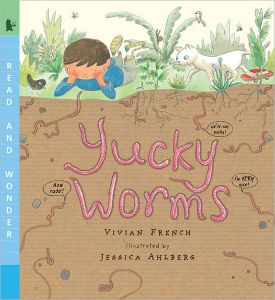
It’s moments like these—rare, fleeting moments—when I wonder if maybe I’ve done something right as a parent. That somehow in all my blabbing on about trees and seeds and caterpillars, my kids have begun to develop an appreciation for the natural world that surrounds them. I would have to credit any success I’ve had to books like Yucky Worms (Ages 4-8), by Vivian French and Jessica Ahlberg, which is part of a fantastic Read and Wonder Series published by Candlewick Press. This is natural science for young kids at its best: fictional stories packed with scientific facts that are woven accessibly into the narrative. In Yucky Worms, a boy gets a lesson in Wormology from his green-thumbed grandmother (perhaps it’s no coincidence that I was first introduced to spiders and butterflies by my two grandmothers?).
Quick to exclaim “Yuck! Throw it away!” when his grandmother digs up a “slimy, slithery, wiggly worm,” the boy in the story gets schooled on the different parts of the worm, how it tunnels through the ground, what it eats, and how its poop enriches the soil. It turns out that worm poop—white curly forms called “casts”—are very plentiful in our backyard. It also turns out that most earthworms do not regenerate when accidentally cut in half by a gardening spade (I now get schooled regularly on this by my “backseat gardeners”). There is much to love about this book, from the sweet relationship between grandmother and grandson, to the hand-drawn diagrams of the worm’s anatomy, to the answers to questions kids don’t even know they have, like what happens to worms in the winter. But perhaps the biggest appeal for kids are the word bubbles that occasionally come out of the mouths of the worms themselves, reinforcing the lessons in the book while adding some enticing humor. What is it about worms that seem to invite speech bubbles? Doreen Cronin and Harry Bliss incorporate a similar technique in their hilarious series, Diary of a Worm (more fun than fact but still surprisingly illuminating about these creatures). Worms have a lot to say, evidently, as they dodge predators or feast on moldy fruit.

Here, the story continues on the side, while the worms take front stage with their tunnels and word bubbles.
I have tried my darndest this summer to get my kids out into nature. When it comes time to make dinner, it’s all I can do to resist the temptation to turn on the TV, shooing them instead into the backyard. Inevitably, I am called out moments later to settle some dispute over an ancient half-broken toy that has been unearthed from the shed and is suddenly the Only Thing Worth Playing With. But, in time, they settle into the rhythm of things and begin to take closer notice of their surroundings. Once again, my dinner making is interrupted by yelling: “Mommy, come out here RIGHT NOW!” I trudge outside more than a little exasperated, only to find the kids, not fighting over toys, but instead huddled over a corner of the deck. I bend down to see a spider’s web glistening from drops of water that have fallen out of the just-watered planters above. “It’s just like the one in the book!” JP exclaims, referring to Helen Frost’s stunning photograph of a dew-covered spider’s web in Step Gently Out, which we had just been reading that morning. “Only it’s even more beautiful,” he adds. “Yes,” Emily pipes in. “It’s sooooo boootiful.”
Other Favorites About Backyard Critters:
Step Gently Out, by Helen Frost (Ages 3-6)
Where Butterflies Grow and The Snail’s Spell by Joanne Ryder & Lynne Cherry (Ages 3-6)
The Honeybee Man, by Lela Nargi (Ages 4-8)
Diary of a Worm, Diary of a Spider, & Diary of a Fly, by Doreen Cronin & Harry Bliss (Ages 4-8)
Insect Detective: Read and Wonder, by Steve Voake & Charlotte Voake (Ages 4-8)
Seeds, Bees, Butterflies & More: Poems for Two Voices, by Carole Gerber & Eugene Yelchin (Ages 5-10)
Plus these favs mentioned in a previous post about Young Naturalists!
Potty Break
August 1, 2013 § 2 Comments
 Once again, I find myself singing the praises of Mo Willems, whose Time to Pee! (Ages 1-4) proved just what my daughter needed to get her potty training on. For those of you who have navigated these murky waters before, you will agree that there are VERY FEW decent potty-related books for kids. There are useless books about princesses sitting on potties. There are patronizing books that suggest you’re only a big kid if you use the potty. But there are far too few that are clever and helpful, fun and functional. But that’s OK. Because all you really need is one great book—and, lucky for us, there’s Time to Pee!
Truth be told, I had been dreading potty training my youngest. I had it too easy with my firstborn. If I told you about how he emphatically decided upon turning two that he wanted to poop on the potty and never looked back, you would hate me. Except that you can’t hate me, because I literally had nothing to do with it (JP has always been a child to take matters into his own hands, skeptical that his parents don’t really know what they are doing and not entirely incorrect much of the time). So when my daughter turned two and showed ZERO interest in anything having to do with the potty, I simply told myself that she wasn’t ready. But then, yikes, almost an entire year passed, and here we are just a few short weeks from her joining her brother in Montessori, where she’ll be expected to do things like wear underwear and wipe her own butt; suddenly, “I no interested in the potty!” seemed like a recipe for disaster. So we took the plunge, gave away all remaining diapers (this tip from the parenting book, Diaper-Free Before 3, a fantastic recommendation from our Montessori director), and casually placed Time to Pee! on the top of a reading pile in the bathroom.
Now, I’m obviously not going to tell you that a children’s book (even one by the brilliant Mo Willems) was the single factor in Emily’s fairly quick and painless transition to the potty (much of the heavy lifting was in fact done by Big Brother). But what I can tell you is that the language in Time to Pee! repeatedly crops up when Em is talking about using the potty. At face value, the book reads like a straightforward (never patronizing) instruction manual, illustrated with Mo’s signature black-outlined doodles: you get “that funny feeling” while playing; you tell a grown-up that you have to go; you march yourself down the hall and into the bathroom, where you pull down your undies, do the deed, and get back to playing. Done. No problem. All the important logistics are covered, like waiting until you are done before grabbing for toilet paper (thank you, Mo) and washing hands afterwards. But then, because it’s Mo Willems, and because he is so darn perceptive about how kids’ minds work and what they are thinking (and obsessing and worrying) about, the book is loaded with humorous touches. “Please don’t ignore it!” (next to a boy with crossed eyes and legs). “Now is your chance to show how BIG you are!” And my favorite: “Everything will still be right where it was” (as the child returns to her tea party).
But the real unsung heroes here are the mice. Yes, that’s right, the hundreds of enthusiastic mice delivering each message, rolling out the red carpet and hoisting up the flags, serenading the potty goer and giving the thumbs up with a coy, “Go for it dude.” Three days into potty training, I tried to follow Emily into the bathroom after she announced that she had to pee. “No, Mommy! You don’t come in! I’m having a party with the mice.” And just like that, I found myself once again singing the praises of Mo Willems.
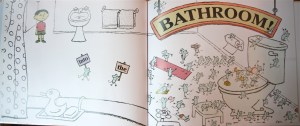
The aforementioned mouse party in the bathroom!
Other Favorite Potty Stories for Kids:
Even Firefighters Go to the Potty: A Potty Training Lift-the-Flap Story, by Wendy A. Wax, Naomi Wax, & Stephen Gilpin (long after JP was potty trained he still requested this book 10 times a day for two years)
Everyone Poops, by Taro Gomi (yes it’s weird, yes it’s kinda gross, but it’s actually quite effective (and my kids love the camel’s “two hump poop”))
A Potty for Me, by Karen Katz
Pip and Posy: The Little Puddle, by Axel Scheffler (my daughter loves this sweet, simple series about two friends—and, lo and behold, they have a potty story about an accident during a playdate)
Biking for Beginners and Pros
July 5, 2013 Comments Off on Biking for Beginners and Pros
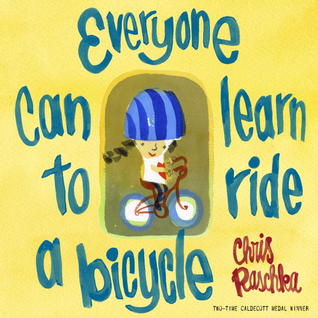 We interrupt our Summer School Series for some good ‘ol fashioned outdoor play—and because there happens to be two seriously awesome new picture books about riding a two wheeler (the Ultimate Summer Challenge, really). The first book is for the I-Think-I-Can-Beginners; the second is for the experienced, daring, and creative bikers (especially those with a love for all things Space).
Chris Raschka’s Everyone Can Learn to Ride a Bicycle (Ages 3-6) is a simple but poignant “how to” look at mastering a two wheeler, first with training wheels and then without. Now, if I were going to write a step-by-step guide to teaching a five year old to ride a bike, it might go something like this:
Lug ten tons of second-hand steel to park, at the request of eager child.
Help eager child up into bike seat.
Become temporarily deaf by imminent screaming of “NOOOOOOO get me off get me off get me off!”
After much cajoling and pleading and promising for the 45th time that you are going to hold on the whole time, convince child to remount bike and begin pedaling forward.
After 10 minutes, whereby you are still holding fast to the training-wheeled bike and said bike has moved exactly 10 feet, suggest that he try turning.
Feel an abrupt jerk as child slams on the breaks (this, oddly, comes very naturally), jumps off bike, and announces that he is Most Definitely Not Doing This Right Now.
Lug ten tons of steel back home.
Fortunately, Everyone Can Learn to Ride a Bicycle paints a much rosier picture of a child learning to ride a bike, along with the help of her patient and gently encouraging father.
But, actually, what I love about this book is that things are not always smooth sailing: the little girl has lots of false starts, falls down again and again, and needs both hugs and Band-Aids. “Oops! You nearly had it,” the book coaches. “Don’t give up. You’ll get it. Find the courage to try it again, and again, again, and again, again, and again, and again, until by luck, grace, and determination, you are riding a bicycle!”
Rashchka’s signature watercolors, seemingly effortlessly executed with thick, breezy, rough strokes of paint, are perfectly suited to the subject at hand. Every single painting exudes movement—whether it’s the little girl pulling her father’s hand toward the bike shop, her sideways and backwards tumbles off the bike, the neighborhood kids zooming past her on their colorful two wheelers, or her triumphant forward-leaning fast-pedaling stance at the end.

Rashchka’s greatest gift has always been his ability to capture emotional expression with just a few brushstrokes; and it’s the determination, bewilderment, frustration, joy, and pride on the little girl’s face that will make this gem relatable for children—those struggling to ride and those who’ve newly mastered the skill. I’m not promising this book will work miracles, assuming there might be other parents out there who are having similar bicycling battles on the playground (please tell me I am not alone); but I can promise that your child will identify a kindred spirit on the page.
Moving on to mor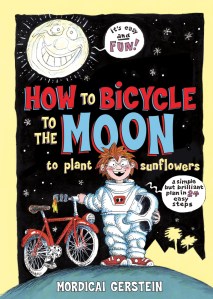 e advanced bicycling (and a longer, more sophisticated story), I fervently recommend How to Bicycle to the Moon to Plant Sunflowers: A Simple but Brilliant Plan in 24 Easy Steps, by Mordicai Gerstein (Ages 5-10). If the irreverent title alone hasn’t sold you, let me sing the praises of this most entertaining book, particularly for the kid who loves science, invention, numbers, the Moon, and bossing people around (that would be my son to a T, minus the bicycling).
First, when was the last time your child read a work of fiction that was laid out in steps? Each of this book’s 39 pages outlines a different step, numbered 1 through 24, many of them sub-categorized with letters (12a, 12b, 12c, 12d, etc.). Kids love this stuff; it’s exactly the way their mind works when they are bossing us around.
Secondly, there’s the very idea of bicycling into outer space, not to mention for the purpose of planting sunflowers to cheer up the Moon’s “big, sad clown face.” Thirdly, there’s the intricately involved and scientifically supported plan that the boy conjures up—a plan involving 2,000 used truck inner tubes, a 25-foot flagpole, a ship’s anchor, 238,900 miles of garden hoses wound tightly around a giant spool, a rented XS space suit from NASA, and various provisions, including “nourishing, flavored Glop, squirted through a straw in your space-helmet.”

Finally, there’s the climactic adventure itself, Boy On Bike, pedaling up miles of garden hoses that have been anchored into the Moon’s surface, stopping to wonder at “the trillions of stars.” Within the largely comic narrative, written in the boy’s instructive voice, there are also many clever descriptions, my favorite being the notion that the Moon looks “like a coloring book that hasn’t been colored yet.”
Gerstein’s pen and ink drawings have a comic-book feel, but the crudely colored line art is mixed with grace and subtlety (the Moon’s changing expressions are a particular delight). This is the same Gerstein who wrote and illustrated one of my (and my son’s) favorite books: The Man Who Walked Between the Towers (Ages 4-8), the true and serious story of Phillipe Petit’s dramatic tightrope walk between the World Trade Towers in 1974. The two books could not look or feel more different (a rare feat for a picture book artist); yet, oddly, they both involve moving atop a skinny, rope-like material suspended over great heights.
Gerstein writes books about dreams—about the mystery, wonder, and excitement in planning for and achieving those dreams. I have a dream that my children will both ride two wheelers some day, that they will taste the victory that comes from balancing up high on their own, and (as I vividly remember doing as a young girl) that they’ll speed around the block, dreaming and scheming and making their own Big Plans.
Learning from the Big Thinkers (Summer School Continues!)
June 30, 2013 § 2 Comments
 Albert Einstein said, “The important thing is not to stop questioning. Curiosity has its own reason for existing.” Then by this account, should we embrace the endless string of questions by our children throughout the day? A recent British study found that children ask on average 300 questions a day. I’m pretty sure that my almost six year old has this daily average beat by the thousands; and while there are many moments when I relish his curiosity, there are also times when I long for an “off” button. These last instances most frequently occur when we’re in the car, because there’s nothing like being locked in a metal box with your children to bring out their obsessions with a full, unadulterated intensity. “Why are the clouds moving that way? Is there going to be a storm? How do the weather people know there’s going to be a storm? What happens if lightning hits our car? Why does red have to mean stop?” (This last one as we pull up to a stoplight and I realize that I can’t expect his brain to pause just because the car does.)
I was driving back from the pool the other day (having been turned away by the threat of storm clouds), and I may or may not have erupted with “I can’t take it anymore!” But then, I had a rare flash of brilliance, and I declared, “It’s Mommy’s turn to ask questions.” I began my own litany of questions, only to discover that JP had answers waiting just as quickly as I could rattle them off. ‘”What are clouds made of?” (“Water droplets!”) “Why does a ball fall if you drop if in the air?” (“Gravity!”) “Why am I not hungry?” (“Because you probably ate enough lunch!”) “Wow,” I said, “you are just as good as answering questions as you are at asking them.” “That’s because I ask so many questions!” he roared, and he and his sister laughed their heads off for the next two minutes (I’ll take my breaks where I can get them).
I recently posted about the value of sharing picture book biographies with children, and I included a list focused on true stories of the Ordinary Doing Extraordinary. But, of course, we mustn’t neglect the born geniuses, the legendary minds, the Great Thinkers that are responsible for shaping our very understanding of the world. In recent years, a slew of exceptional artistic and richly informative picture books have emerged (see my list at the end of this post) to celebrate such minds as Leonardo da Vinci, Benjamin Franklin, and, most recently, Mr. Curiosity Himself: Albert Einstein.
Jennifer Berne’s On a Beam of Light: A Story of Albert Einstein (Ages 5-10) is the kind of book you’ll want to share with your kids when they’re five, six, seven, eight, nine, and ten. Berne’s highly approachable narrative voice speaks directly to children (she first won me over in Manfish: A Story of Jacques Cousteau). In Einstein’s case, she brings to life, not only Albert’s awe at the mysteries of the world, but also his many personality quirks—from his disruptive questioning in elementary school to the saggy, baggy clothes he always wore as an adult (“My feet are happier without socks!”). These quirks are further emphasized by Vladimir Radunksky’s loosely drawn pen, ink, and gouache drawings, at once frenetic and playful, serene and innocent, like little windows into Albert’s own ever-shifting imagination. In JP’s favorite spread, Albert imagines what it would be like to ride his bike up the beam of sunlight that’s shining down on the sidewalk in front of him. “And in his mind, right then and there, Albert was no longer on his bicycle, no longer on the country road…he was racing through space on a beam of light. It was the biggest, most exciting thought Albert had ever had. And it filled his mind with questions.”
I’m no physicist. In fact, I somehow managed to avoid taking a Physics class in both high school and college (I regret this now). I have never felt terribly confident talking about energy and heat and magnetism and motion with my children, and goodness knows what I’ll do when I have to help them with equations involving E = mc2. But here I am, reading this book—this beautiful literary depiction of these scientific concepts—and I think, “Why have I never realized that physics is everything?!” Like the searching, wondering eyes of our little ones, Albert sees everything as a question. How could “a lump of sugar dissolve and disappear into his hot tea?” How could the “smoke from his pipe…disappear into the air?” And, of course, what would happen if he traveled near the speed of light? (The answer: “Only minutes would pass for Albert, while years and years went by for the rest of us!”)
Albert “asked questions never asked before. Found answers never found before. And dreamed up ideas never dreamt before.” Because of him, we were able to build spaceships and travel to the moon (there’s a great afterward that gets into more detail about the repercussions of Einstein’s discoveries, along with a list of additional reading material). Naturally, there are many questions still at large about how the universe works—and, fittingly, the book’s dedication reads, “To the next Einstein, who is probably a child now.” If my son and his peers are any indication, there’s likely a whole crop of future Big Thinkers out there. Children who won’t let a mere stoplight slow them down from asking their questions, questions, questions.
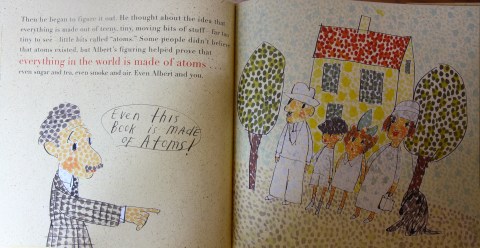
Here, kids are introduced to the idea that everything is made up of “teeny, tiny, moving bits of stuff—far too tiny to see—little bits called ‘atoms'” In a perfect marriage of text and illustration, Radunksky’s corresponding picture is broken up into hundreds of tiny dots (“Even this book is made of atoms!”).
Other Favorite Picture Books About Great Scientific Minds:
Odd Boy Out: Young Albert Einstein, by Don Brown (Ages 5-10)
Electric Ben: The Amazing Life and Times of Benjamin Franklin by Robert Byrd (Ages 6-12)
Noah Webster and His Words, by Jeri Chase Ferris (Ages 6-10)
I, Galileo, by Bonnie Christensen (Ages 7-12)
Leonardo: Beautiful Dreamer, by Robert Byrd (Ages 8-12)
The Tree of Life: Charles Darwin, by Peter Sis (Ages 8-12)
Saving the Trees
April 22, 2013 § 2 Comments
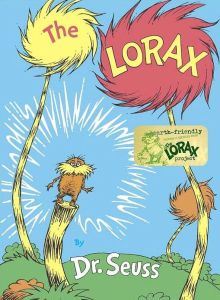 Earlier today, in honor of Earth Day, I shared Dr. Seuss’ The Lorax (Ages 5-10) with the elementary children at my son’s Montessori school. While most people associate Dr. Seuss with the nonsensical but catchy I-Can-Read titles, like Green Eggs and Ham, I would argue that his narrative poems—his longer, more complex, often moralistic stories—were actually his greatest gift to children. Not only do these stories showcase a mastery of rhyme that is virtually unmatched in contemporary children’s literature, but many of them also serve as cautionary tales, introducing children to the dangers of things like running away from your problems (I Had Trouble in Getting to Solla Sollew), or prejudice (The Sneetches), or, as in the case of The Lorax, industrialization at the expense of natural resources.
The Lorax, a “brownish,” “mossy,” raspy-voiced creature, who famously utters, “I speak for the trees for the trees have no tongues,” may have been conjured up by Dr. Seuss in 1971, but his environmental message resonates just as clearly today. And yet, there’s a second hero in this story, one with greater power than The Lorax himself. I’m referring to the unnamed child, who appears at the beginning and the end of the story—the one to whom the Once-ler relates (and repents) his decision to knit every last Truffula Tree into an ambiguous but allegedly multipurpose Thneed, “which everyone, EVERYONE, EVERYONE needs.” This child, to whom the Once-ler entrusts the very last Truffula seed, along with instructions to nurture it with water and clean air, literally holds the future of the planet in his hands; he is the reader’s hope for a happy ending. « Read the rest of this entry »
“Use Your Words” (MLK Jr. Style)
January 17, 2013 § 1 Comment
 In a few days, our country will celebrate Martin Luther King, Jr.’s birthday and a presidential inauguration. Whatever our political views, whatever our race or gender or religion or socioeconomic background, we can do our children a great service by talking to them about Dr. King’s vision of justice and peace, his commitment to respecting the dignity of every human being.
I’ve found that parents, especially us white Americans, are reluctant to broach the subject of race relations with preschoolers or even young elementary students. Ashamed of our country’s past afflictions, it’s as if we can pretend they never existed if we don’t talk about them. But child development specialists and sociologists (like Po Bronson and Ashley Merryman, authors of NurtureShock) have pointed out that children naturally notice differences in appearances, and that if we don’t have these conversations with them from an early age, they will begin to draw their own conclusions—and, even worse, begin to view the subject as taboo—which does nothing to advance our nation’s long and still arduous progression toward equality. And, let’s be honest, have you ever met a five or seven or ten year old that isn’t obsessed with the notion of fairness? For that matter, how many times a day do we as parents plead with our children, “Use your words!” (say, when said children yank something out of their sibling’s hands or push a peer on the school playground)?
January’s Birthday Pick
January 8, 2013 § 1 Comment
 For this month’s birthday pick, I’m doing something a little different: 1) I’m focusing on the youngest ages for a change; 2) I’ve chosen not one but two books (which make a perfect pairing); and 3) I’m encouraging you to throw caution to the wind and take a chance on books that aren’t brand new but are commonly unknown.
In short, the next time you are headed to a birthday party for a one or two year old, you’re in luck. I Took the Moon for a Walk (Ages 1-4) and Listen, Listen (Ages 1-4) are both illustrated by the supremely talented Alison Jay, whose praises I have sung here before. With their over-sized 9” by 9” format, these hefty board books mirror another favorite by Jay, her ABC: A Child’s First Alphabet Book (which tends to be well known and for good reason: it may just be the best alphabet book ever illustrated).
Alison Jay’s books are the ultimate gift. Packed with hidden surprises, layered with detail, and shimmering in vivid colors underneath a “crackle” finish, Jay’s paintings beg to be poured over again and again.
 What to Read to Your Kids