August’s Birthday Pick
August 8, 2013 Comments Off on August’s Birthday Pick
 Sometimes we need a Crowd Pleaser. How many times have we rushed to the store (on the morning of the birthday party, no less) and stared at the shelves, thinking “What do I even know about this child, this person in my daughter’s class whose name I’d never heard until last week?” Our children are often no help: “Ummm, I don’t know, he likes Star Wars, I think…” And then there’s the latest trend in birthday parties—the book exchange—which, naturally, I find charming and all, except that now we have the additional challenge of finding a book that will appeal to any one of the number of children at the party. Enter the Crowd Pleaser: a book that’s guaranteed to make boy, girl, preschooler, first grader laugh; a book they can listen to or read themselves or read to their siblings; and, of course, a book that’s Brand New and Off the Beaten Path and all that good stuff.
Now enter Monkeys. Because if there’s any animal that’s universally loved by children (and their parents) it’s the monkey. We all call our children monkeys; we all think of them as little monkeys (incidentally, we also think that this comparison is an entirely novel notion). Anyway, monkeys are good. Monkeys are safe.
Now enter Mac Barnett, one of the most original and—conveniently, in our quest for a Crowd Pleaser—one of the funniest picture book creators around. Last year, along with the talented Adam Rex, he wrote Chloe and the Lion (Ages 4-8), a hilarious (and surprisingly educational) look at the process of writing and illustrating a picture book, whereby Barnett and Rex essentially “argue” the book into creation. This year, he teams up with Kevin Cornell to lend his deconstructionist approach to Count the Monkeys (Ages 3-7), another book that appears to take form right before our eyes. The book begins with a simple premise: “Hey, kids! Time to count the monkeys! It’s fun. It’s easy. All you have to do is turn the page…” Except that the monkeys are nowhere to be found, scared away by a king cobra, who in turn is scared away by two mongooses (“or is that 2 mongeese?”), who in turn are scared away by three crocodiles…and you get the picture.
The genius of Count the Monkeys, apart from Cornell’s irresistibly mischievous drawings of gluttonous grizzly bears and “polka-dotted rhinoceroses with bagpipes and bad breath,” is the invitation for children to interact with every page. If you’ve ever read Herve Tullet’s groundbreaking Press Here to your children (and if you haven’t, please proceed immediately to your nearest independent bookstore), you are already familiar with this now trendy trick of modern picture book artists. These are books that invite children, not only into the reading process, but into the creation process as well. They make children feel like they themselves are driving the direction of the story. On every page in Count the Monkeys, the narrator (still obsessed with getting back those elusive monkeys) asks us to perform various tasks to get rid of the imposter: tell the lumberjacks to “scram” (“Say it even louder!”); don’t look the wolves in the eyes (“In fact, cover your eyes while you turn the page”); move your hand in a zigzag to “confuse” the crocodiles; etc. I triple dare any child (heck, I dare any parent) to refrain from doing any of the things Barnett demands; it’s simply too much fun to take a backseat on this one. And that, ladies and gentlemen, is a Crowd Pleaser.
Keeping Cool Under the Sea
July 26, 2013 Comments Off on Keeping Cool Under the Sea
 I know, I know, I’ve left you high and dry without reading material for nearly a month (vacation will do that); plus, I neglected to give you a birthday pick for July’s parties. So, in order to make it up to you, I am not only going to recommend a fabulous, brand-spanking-new book that you can give to everyone celebrating a birthday this summer, but I’m going to end with an EXTRA-LONG LIST OF THEMATICALLY SIMILAR BOOKS for you to read to your own kids (heck, you could even bundle some for an extra-special gift, like I did for a friend earlier this month). Are you ready?
Much like reading about snow in the winter, one of my favorite things about summertime reading is the excuse to read books about the sea (it’s no coincidence that I featured an octopus story for last summer’s birthday pick as well). Whether you’re spending time on the beach or simply looking for a mental escape from the heat, summer is the perfect time to introduce children to underwater worlds: landscapes so different from ours that they have their own inhabitants and laws, their own colors and sounds, their own unique set of experiences and problems. And yet, much of the best sea-themed fiction immerses kids in these foreign worlds while at the same time drawing parallels between their own emotional lives and the lives of the fishy dwellers within.
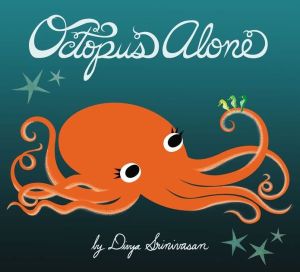
Trust me, you will want to dive straight into the pages of Divya Srinivasan’s Octopus Alone (Ages 3-6), where a bright orange octopus is set against an enticing palette of turquoise, seafoam green, and bright pink. I first fell in love with Srinivasan’s unique stylized graphics in Little Owl’s Night (reviewed here). Now, in the much longer Octopus Alone, we are treated to a more involved plot alongside her vivid art. I can’t say that Srinivasan’s narrative voice is as strong or coherent as her illustrations; and yet, the story’s theme—venturing outside one’s comfort level and finding the reward of new friendships—resonated loudly with both my kids. Any child who has felt overwhelmed walking into a preschool classroom or has stood on the periphery watching older kids at the playground will see a little of herself in the bashful octopus, who is so uncomfortable around the outgoing seahorses that she initially retreats from the coral reef into the deeper, darker, lonelier waters. Any child who often stands silently amidst others (but doesn’t shut up at home) will see a little of herself in the octopus, who imitates the dancing moves of the seahorses in private before allowing herself to see how much fun it might be to dance with others.
Like any great sea-themed book, there are countless opportunities for underwater discovery in Octopus Alone. Our family’s favorite would have to be the indisputably charming endpapers, which label (in cursive!) each of the sea creatures that make an appearance in the book (my son is prone to the “puffer fish,” while my daughter’s finger goes straight to the “butterfly fish”). My kids giggle every time Octopus releases her ink to “hide her blushing” or to escape the hungry eel, a nice reminder of aquatic adaptation. The book even makes some (albeit subtle) references to the complex ecosystem of coral reefs, like cleaner shrimp eating algae off the back of a nurse shark or baby dominoes playing hide and seek in the “swaying anemones.” (Older kids can build on these with Jason Chin’s equally stunning and richly informative non-fiction picture book, Coral Reefs…sorry, couldn’t wait until the end to plug that one.)
Our oceans and lakes, our sandy tide pools and rocky bluffs, can be a source of endless fascination for our kids. We have the power to channel this fascination into imagination, education, and hopefully even conservation. So go ahead: dip their toes in the water and start reading.
Other Favorite Under-the-Sea Stories (from youngest to oldest ages):
Over in the Ocean: In a Coral Reef, by Marianne Berkes & Jeanette Canyon (Ages 1-3; board book)
I’m the Biggest Thing in the Ocean! by Kevin Sherry (Ages 1-4)
The Snail and the Whale, by Julia Donaldson & Axel Scheffler (Ages 3-6; ONE OF MY ALL TIME FAVS)
The Pout Pout Fish, by Deborah Diesen & Daniel X. Hanna (Ages 3-6; best read in the style of the blues!)
Swimmy, by Leo Lionni (Ages 3-6)
Big Al, by Andrew Clements & Yoshi (Ages 4-7)
If You Want to See a Whale, by Julie Fogliano & Erin Stead (Ages 4-7; also brand new)
Kermit the Hermit, by Bill Peet (Ages 4-8)
Jangles: A Fish Story, by David Shannon (Ages 4-8)
Some Favorite Sea-Themed Non-Fiction Picture Books:
The Voyage of Turtle Rex, by Kurt Cyrus (Ages 4-8)
Coral Reefs, by Jason Chin (Ages 5-10)
Island: A Story of the Galapagos, by Jason Chin (Ages 6-12)
Life in the Ocean: The Story of Oceanographer Sylvia Earle, by Claire A. Nivola (Ages 5-10)
Manfish: A Story of Jacques Cousteau, by Jennifer Berne (Ages 5-10)
Ocean Sunlight: How Tiny Plants Feed the Seas, by Molly Bang (Ages 6-12)
The Human Body (Summer School Continues!)
June 12, 2013 § 1 Comment
 Summer is naturally a time for children to sharpen their senses and take notice of their bodies. Running barefoot through the freshly cut grass; relishing the pure silence underwater at the pool; feeling the sweat beads on the back of their necks; hearing the crack of thunder that sends them tearing for the house; stretching out on the earth’s back to gaze at a sky full of stars: this is what summer looks, sounds, and feels like to our children. So why not turn these grass-stained knees into a chance to study the human body? And what if we take these bodily lessons further; what if we create an awareness in our children that their bodies aren’t just little planets unto themselves but are connected to the mysteries of the greater universe?
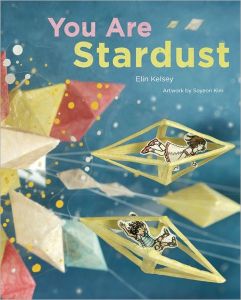
I have long been puzzled by the lack of children’s books that bridge the scientific and natural worlds, so I was thrilled to discover a little gem published last year, written by Elin Kelsey. You Are Stardust (Ages 4-8) is that rare blend of scientific fact and poetic wonder. Beginning with the premise that “every tiny atom in your body came from a star that exploded long before you were born,” the book goes on to draw parallels between humans, animals, the earth, and the universe, from the salt water that flows through our tears like it flows through the ocean to the electricity that powers our thoughts like it powers the lightning in the sky. Every fact and connection is intended to shock and awe (and is backed up by scientific evidence). Did you know that the water we drink today is the same water that the dinosaurs drank? Or that “each time you blow a kiss to the world, you spread pollen that might grow to be a new plant?” (Both of these questions got an audible response from my son: “Is that seriously true?”)
One of my favorite things about sharing books with children is that you can never predict exactly what will rock their world. I would never have supposed that the fact which made the greatest impression upon JP was one having to do with continual renewal—specifically, that “you’ll replace your skin 100 times by the time you turn ten.” When he first heard this, JP threw back his head and roared, “I’m not a snake! Kids don’t shed their skin; that’s ridiculous!” “Not all in one piece like a snake, but in little bits at a time,” I told him, and we went on to discuss things like scrapes, sunburn, and dry skin. For the past week, he has now taken to brushing his hand across his arm 10 times a day, while declaring to his sister that “you can’t see it, but my skin is shedding RIGHT NOW!”
Prior to discovering You Are Stardust, my favorite “metaphysical” book for kids, although on a much simpler, toddler-targeted level, has been Molly Bang’s All of Me: A Book of Thanks (Ages 2-4). With loving, economical text, Bang pays tribute first to a child’s body (“thank you, hands, for gripping and throwing and patting and holding”); then to his senses (“my mouth tastes all my food before it slides down here, into my tummy”); then to his feelings (“today I felt curious, and excited, and angry, and brave…”); and, finally, to the way in which he is part of “this whole wide world…and this whole universe is inside…all of me!”).
What All of Me starts, You Are Stardust expands on for the older child, grounding wondrous observations about the body-universe connection with scientific data (the book’s afterward also cites a website for those who want to learn more about the science behind the book). Perhaps not just coincidentally, both Bang and Kelsey’s books are illustrated with collage, a fitting medium for a lesson on how we are greater than the sum of our parts. The collages in You Are Stardust, done by Soyeon Kim, are actually dioramas, combining rocks, dried flowers, painted leaves, string, tissue paper, and watercolor cut-outs to create a tactile, three-dimensional effect. The illustrations feel youthful and free-form, and I think my son immediately connected with them as something he could approximate with materials gathered from our backyard. I would love for my children (as the author similarly wishes in her afterward) to cart this book outside all summer long, to read it by flashlight in their tee-pee or while propped up on their elbows in the grass. I would like for them to look at the trees and the birds and the snails and the clouds—and to feel their own heartbeat answering back.

“You, me, birds flying through the rainforest. We are all connected. We are all nature.”
Other Favorites for a More In-Depth Study of the Human Body (and with a more traditionally fact-based presentation):
The Skeleton Inside You; Why I Sneeze, Shiver, Hiccup and Yawn; A Drop of Blood; Hear Your Heart; My Five Senses, all part of the wonderful Let’s-Read-And-Find-Out Science Series (Ages 4-8)
See Inside Your Body, by Usborne Publishing (Ages 5-10)
First Human Body Encyclopedia, by DK Pubishing (Ages 6-12)
Bones: Skeletons and How They Work, by Steve Jenkins (Ages 6-12)
Picture This! Human Body, by Margaret Hynes (Ages 8-14)
The Best Chapter Books Talk to the Heart
May 17, 2013 § 3 Comments
 I’m often asked to recommend chapter books that lend themselves to reading aloud, either for a classroom setting or for a parent reading to an elementary-aged child. This is no small order: you need something where the subject matter isn’t too frightening or mature for the 5-8 year old set; you need something that’s going to engage the adult reader as much as the child (there’s no law that says this can’t be enjoyable for us!); and you need something that transcends the plot-driven, early-reader books that kids are reading on their own and helps them develop a taste for the kind of diverse language and emotionally-rich storytelling that will hopefully influence their reading choices in the future. This past winter, we read to my son the classic Little House on the Prairie series, which I adored as a child and whose themes feel just as timeless and important as ever (family values, the rewards of hard work, celebrating the non-material joys in life). But Laura Ingalls Wilder’s writing can also be quite tedious to read aloud, packed with lengthy explanations (twenty pages devoted to smoking a pig?) and repetitive sentence structures. There were moments when I could feel JP’s attention wandering, despite his avid assurance each night that he wanted to read more, more, more.
But then we finished that series and began Marion Dane Bauer’s stand-alone novel Little Dog, Lost (Ages 8-12, younger if reading aloud), published just last year, and it felt like a breath of fresh air. Here’s a book where not a single word is wasted, a book whose text flows off the tongue with such buttery smoothness that most of the time I couldn’t bring myself to stop when I got to the end of a chapter (that’s right, I was actually choosing in those moments to delay bedtime). Bauer achieves this incredible richness of language by breaking with a major narrative tradition: she writes her novel in free verse, creating chapters out of short, staccato poems, which loosely string together and sometimes even repeat words and phrases, all the while telling a very clear and cohesive story. There are 44 of these untitled poem-chapters; and they switch off narrating from the viewpoints of children, adults, and animals—all of whom live in a small contemporary town called Erthly and whose lives are forever touched by an incident involving a lost dog searching for someone to love him.
Freed from the confines of conventional narration, Bauer is able to cut straight to the emotional core of her characters—and the result is a story that children will feel deep in their hearts. Animal stories inherently engender sympathy from children (not coincidentally, some of JP’s favorite moments in the Little House books revolve around the Ingalls’ faithful dog, Jack). At the center of Little Dog, Lost is Buddy, an orphaned dog with “ears like airplane wings,” who “dances” along the sidewalk, longing for a home with “chasing balls,/ ear scratches,/ kisses.” Children will easily relate to Mark, a young boy “who had wanted a dog for as long as he could remember./ He had asked for a dog./ He had begged for a dog./ He had pleaded and prayed and whined for a dog./ Once he’d even tried barking for a dog.” And who wouldn’t be intrigued by a mysterious old man named Charles Larue, who lives alone in a pointy-towered mansion and never speaks to anyone? Throughout the story’s suspenseful twists and turns, even amidst the humorous touches (many coming from a bossy tabby cat who thinks he’s a dog), the story never strays from the hopes and dreams of its relatable, big-hearted characters. It’s fair to say that my son had a full-body experience while listening to this book. He chuckled, gasped, and emitted little exasperated grunts; he covered his eyes and held his breath; he beat his fists on the bed; he cheered; he hugged my arm to pieces; and he shed more than a tear or two (as he says, “I have a little water in my eyes right now because I’m so happy.”). Now that’s a chapter book.
Other Favorite Read-Aloud Chapter Books With Animals & Lots of Heart:
The Cricket in Times Square, by George Selden (Ages 5 & up*)
Charlotte’s Web, by E.B. White (Ages 5 & up)
The Trumpet of the Swan, by E.B. White (Ages 5 & up)
Mr. Popper’s Penguins, by Richard Atwater (Ages 5 & up)
Ginger Pye, by Eleanor Estes (Ages 6 & up)
The One and Only Ivan, by Katherine Applegate & Patricia Castelao (Ages 6 & up)
*Please note that these ages are assuming the reading is being done by an adult. For a child reading independently, the age range would be closer to eight and up.
A Story to Grow Up On
May 7, 2013 Comments Off on A Story to Grow Up On
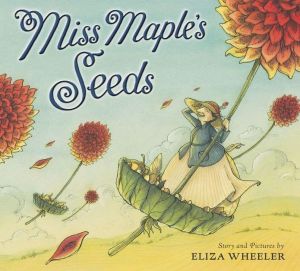 If you’re big into symbolism (or if you, like me, tear up when inscribing books for gifts), then you’re going to want to give Miss Maple’s Seeds to all the young seedlings celebrating birthdays this spring. There are lots of wonderful picture books about seeds (Jean Richards’ A Fruit is a Suitcase for Seeds and Bonnie Christensen’s Plant a Little Seed are two favorites), but none have the magical realism of Miss Maple’s Seeds (Ages 3-7), written and illustrated by newcomer Eliza Wheeler.
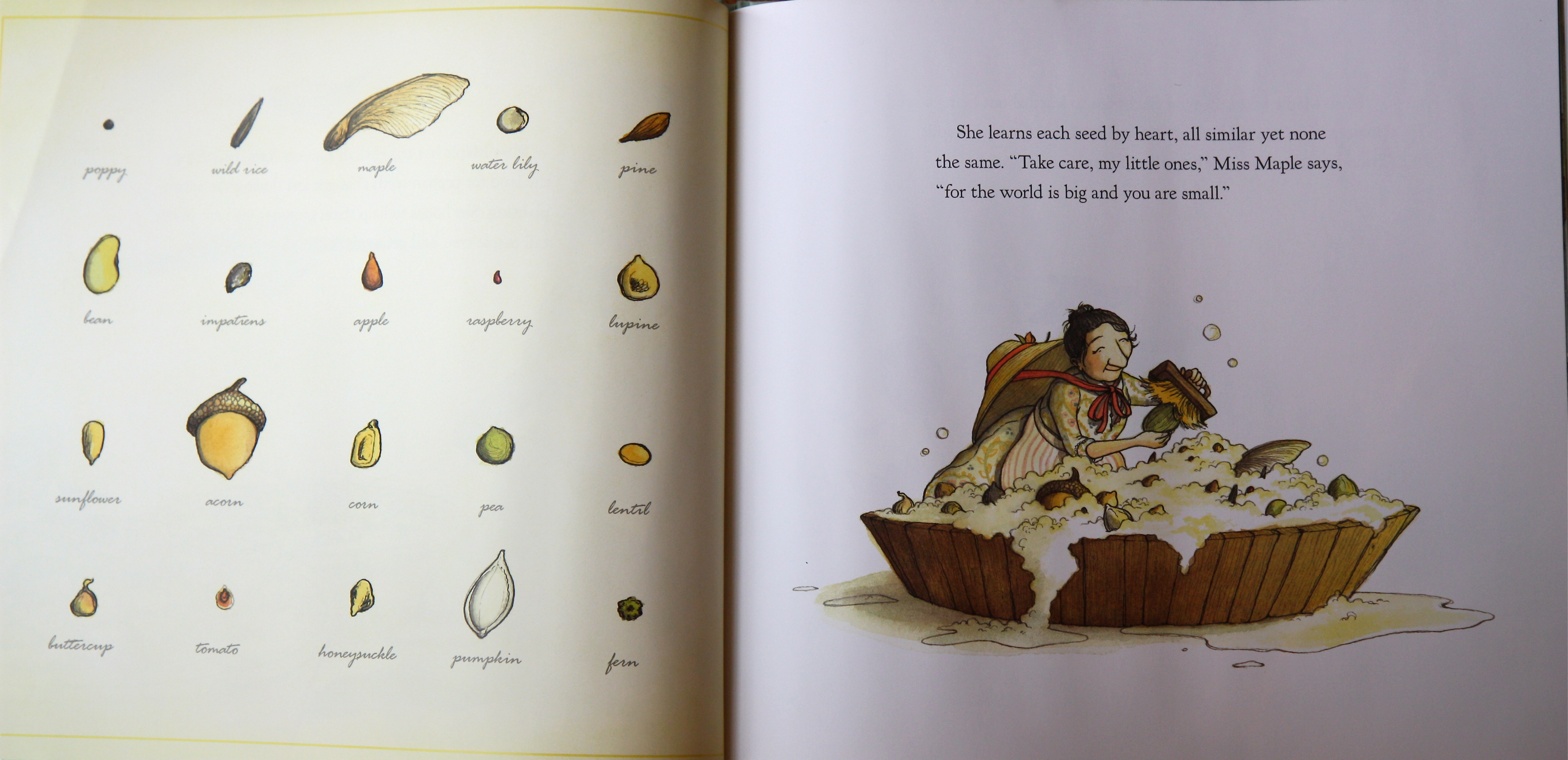
Miss Maple is an eccentric, not-quite-of-this-world sort (a bit like my neighbor, who converses with chipmunks in her backyard). Out of her home inside a hundred-year-old Maple tree, she runs a kind of orphanage for lost seeds, dividing her time between searching for “seeds that got lost during the spring planting” and caring for those seeds until they’re strong enough to lay down roots of their own. “‘Take care, my little ones…for the world is big and you are small,’” she continually reminds her seeds—all the while bathing them, taking them on educational outings to learn about different soil types, reading to them “by firefly light,” and giving them chances to practice “burrowing down into the muddy ground” during thunderstorms. “She’s taking care of them like they’re her babies!” my son was quick to point out, an observation that quickly captured the attention of his younger, doll-obsessed sister.
The story’s prose is unquestionably beautiful: lyrical, concise, and easy to connect back to our own children and the figures (parents, relatives, teachers) who so lovingly and carefully nurture their growth. But it is Wheeler’s ink-and-watercolor illustrations, light and airy and with just a touch of whimsy, which make this gem soar. Sporting a willow weed hat, pointed nose, and delicate slit eyes, Miss Maple epitomizes tenderness in all that she does, whether sweeping her hearth to welcome new seeds or bidding each one farewell as she sends them down the river in lantern-lit leaf boats to find new homes.
One of our favorite illustrations looks like something out of a naturalist’s guide, depicting twenty seeds with their species’ names captioned below in cursive writing (presumably from the hand of Miss Maple). From the fat acorn to the oval pumpkin seed to the single grain of wild rice, the page exhibits not only the visual diversity of nature’s seeds but also the magic which seems to lie within (a giant sunflower grows out of THAT minuscule thing?).
We could all use some of Miss Maple’s tenderness in our own relationship with the Earth, just like our own children need the reassurance that “even the grandest of trees once had to grow up from the smallest of seeds.” I dare you not to tear up when you copy that quote inside the cover of this book for your next gift.
Saving the Trees
April 22, 2013 § 2 Comments
 Earlier today, in honor of Earth Day, I shared Dr. Seuss’ The Lorax (Ages 5-10) with the elementary children at my son’s Montessori school. While most people associate Dr. Seuss with the nonsensical but catchy I-Can-Read titles, like Green Eggs and Ham, I would argue that his narrative poems—his longer, more complex, often moralistic stories—were actually his greatest gift to children. Not only do these stories showcase a mastery of rhyme that is virtually unmatched in contemporary children’s literature, but many of them also serve as cautionary tales, introducing children to the dangers of things like running away from your problems (I Had Trouble in Getting to Solla Sollew), or prejudice (The Sneetches), or, as in the case of The Lorax, industrialization at the expense of natural resources.
The Lorax, a “brownish,” “mossy,” raspy-voiced creature, who famously utters, “I speak for the trees for the trees have no tongues,” may have been conjured up by Dr. Seuss in 1971, but his environmental message resonates just as clearly today. And yet, there’s a second hero in this story, one with greater power than The Lorax himself. I’m referring to the unnamed child, who appears at the beginning and the end of the story—the one to whom the Once-ler relates (and repents) his decision to knit every last Truffula Tree into an ambiguous but allegedly multipurpose Thneed, “which everyone, EVERYONE, EVERYONE needs.” This child, to whom the Once-ler entrusts the very last Truffula seed, along with instructions to nurture it with water and clean air, literally holds the future of the planet in his hands; he is the reader’s hope for a happy ending. « Read the rest of this entry »
April’s Birthday Pick
April 14, 2013 § 1 Comment
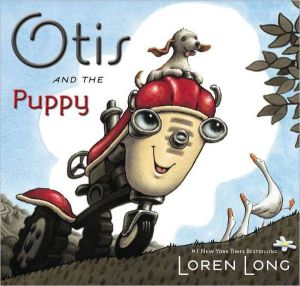 Spring is a time of rebirth: a time of budding trees, sprouting seeds, and birthday parties. As for the last, you’re in luck, because there is a brand new Otis story on the shelves! Whether or not you’re familiar with Loren Long’s stunningly illustrated and action-packed picture books about Otis (see previous posts here), a happy-go-lucky tractor who always comes through for his friends, the new Otis and the Puppy (Ages 3-6) is a slam-dunk. Get your local bookstore to wrap up a copy for every one of your spring birthday parties; and don’t worry about whether the recipient has read the original Otis or Otis and the Tornado because, like its predecessors, Otis and the Puppy stands alone.
This new book has it all: heart, empathy, heroism, and a doe-eyed, playful-eared puppy. When the puppy arrives on the farm, he develops an immediate fondness for the tractor; he eagerly joins in Otis’ games of Hide and Seek and sleeps each night against the purring tractor. Otis quickly learns that the puppy and him have something in common: they’re both afraid of the dark. So when the puppy strays too far from the farm one afternoon and is not recovered by bedtime, Otis’ “heart ached deep inside his engine. He knew how scared of the dark his new friend was and…he knew his friend needed him.” But can Otis muster up the courage to leave the safety of the barn to search for his friend in the dark?
Seeing the World in Color
March 23, 2013 § 3 Comments
 “It’s bud season! It’s bud season!” chanted my children earlier this week, after some long-awaited warm sunshine had beckoned us into the backyard. Thankfully, they were referring not to the beer (although my son’s soccer team does call themselves the Silver Bullets), but rather to the discovery of tiny little green bursts on the ends of our hydrangea bushes and crape myrtles. Since this is the first spring in our new house, our backyard is full of surprises, including yellow daffodils and purple crocuses and little red berries, all of which the children were delighted to point out to me as they raced back and forth across the lawn.
This springtime exuberance is exactly why I love Ashley Wolff’s Baby Bear Sees Blue (Ages 1-4), about a baby bear venturing forth from his den to discover the colors of the world. “Who is warming me, Mama?” asks Baby Bear. “That is the sun,” Mama says, as Baby Bear steps into a pool of brilliant yellow; “Baby Bear sees yellow.” And so begins a series of introductions to different colors, from the blue of the jays to the red of the strawberries to the grey of an approaching storm cloud. For months now, I have been trying (and failing) to teach my two year old her colors; at two and a half, she knows the names of all the colors and loves to exclaim “that’s purple!” or “that’s red!” for things that are, in fact, green or blue. I’m not obsessing about this, having drunk the Montessori Kool-Aid that she’ll learn on her own time (either that or someone will eventually tell me she’s color blind). But I figured it couldn’t hurt to start reading her books about colors, a rich topic in children’s literature (see my complete list of favorites at the end of this post).
Sometimes Reality Trumps Fiction
March 19, 2013 Comments Off on Sometimes Reality Trumps Fiction
 For the past year, my five year old has been obsessed with sorting out fiction from fact. “But did that really happen?” is a common question when we are reading stories, delivered with a furrowed brow and a skeptical tone (as if we as parents are deliberately trying to dupe him with our choice of fictitious books). “Swans can’t really talk and that’s how I know that this story did not really happen,” he announced with confidence at the dinner table one night, after fervently recounting the chapter his class had read that afternoon from The Trumpet of the Swan.
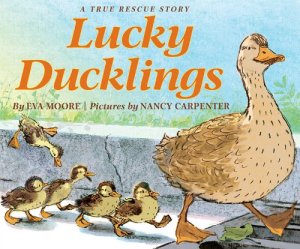
More and more, it would seem, JP has decided that stories are synonymous with make-believe. So, in an effort to challenge his thinking (and because it’s fun to blow his mind), I have been on the hunt for seemingly far-fetched stories that are actually based on real events. Lucky for us—and for our daughter who is obsessed with ducks right now—Eva Moore and Nancy Carpenter’s new Lucky Ducklings (Ages 2.5-6) is just such a story—and an actual rescue story at that.
March’s Hot-Off-the-Press Birthday Pick
March 6, 2013 Comments Off on March’s Hot-Off-the-Press Birthday Pick
 This one goes out to all the little girls out there—or rather, to their little friends who have spring birthdays. Debut author-illustrator You Byun’s brand new Dream Friends (Ages 2.5-6) is full of the stuff of little girls’ dreams. I’m talking about sugar and spice and everything nice—or, more specifically, bunny rabbits and tea parties and baby chicks and Santa Claus and cupcakes and flowers and, of course, friendship.
Melody has a friend, a best friend, only he’s not your typical friend: for starters, he’s big and white and furry (an ambiguous but lovable dog-cat-raccoon looking thing that my daughter has taken to kissing on the nose each time he makes an appearance). The bigger problem is that this magical friend only visits the little girl in her dreams (although these dreams are filled with such delights as dancing on flower-shaped clouds or watching fireworks explode in the shape of ice cream cones and lollipops).
Year of the Snake
February 21, 2013 § 4 Comments
 Let me be clear: I am not a snake person. Just ask my husband about the time our former neighbor’s grandson misplaced his yellow and black striped rubber snake in our driveway. My hysteria, combined with the Internet, had half the street convinced that a rare and deadly species of snake (I believe we had landed on the Eastern King Snake) had invaded our DC suburb. My husband finds this an enlightening story about my disposition to overreact (I prefer to think of it as strong survival instincts).
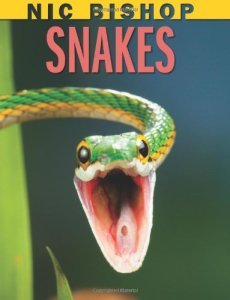
All this is to say that if I am telling you that Nic Bishop’s Snakes (Ages 5-12) is not only A-MA-ZING but that I have been volunteering to read this book to my son, then you should take me very, very seriously. You should march straight out to your local bookstore and buy this book (actually, you should buy all the books in Bishop’s series, even those about tamer animals like butterflies and frogs).
January’s Birthday Pick
January 8, 2013 § 1 Comment
 For this month’s birthday pick, I’m doing something a little different: 1) I’m focusing on the youngest ages for a change; 2) I’ve chosen not one but two books (which make a perfect pairing); and 3) I’m encouraging you to throw caution to the wind and take a chance on books that aren’t brand new but are commonly unknown.
In short, the next time you are headed to a birthday party for a one or two year old, you’re in luck. I Took the Moon for a Walk (Ages 1-4) and Listen, Listen (Ages 1-4) are both illustrated by the supremely talented Alison Jay, whose praises I have sung here before. With their over-sized 9” by 9” format, these hefty board books mirror another favorite by Jay, her ABC: A Child’s First Alphabet Book (which tends to be well known and for good reason: it may just be the best alphabet book ever illustrated).
Alison Jay’s books are the ultimate gift. Packed with hidden surprises, layered with detail, and shimmering in vivid colors underneath a “crackle” finish, Jay’s paintings beg to be poured over again and again.
The Year That Lies Ahead
January 3, 2013 § 2 Comments
On the morning of January 1, my five year old crawled into our bed and asked with great solemnity, “Is the year of Christmas over?” I’m not entirely sure what he was getting at; did he mean to say month? or season? or was he actually inquiring as to whether the Year of the Great Christmas of 2012 had ended? I’ll never know exactly what was ruminating in his little head, but it was a sweet reminder of how bewildering the concept of time is to children—even to a five year old who has plenty of memories of past years.
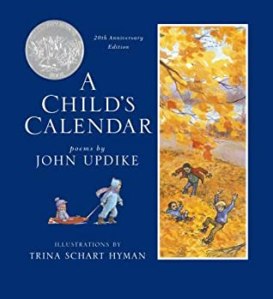
We as adults take for granted our assurance about the cyclical nature of time: that all seasons, all holidays, all of nature’s dramatic transformations, will occur again and again with each passing year. It will probably come as no surprise that my instinctual reaction to JP’s question on New Year’s morning was to send him downstairs to fetch some relevant reading material. One of my all-time favorite children’s books (a book so precious to me that it actually resides on the “adult” shelves of our living room library) is A Child’s Calendar (Ages 5-10), a 1965 treasure of poems by John Updike that was later given a ’90s makeover with the addition of award-winning illustrations by Trina Schart Hyman.
« Read the rest of this entry »Holiday Gift Guide 2012 (No. 3): Books for Future Zoologists
December 13, 2012 § 1 Comment
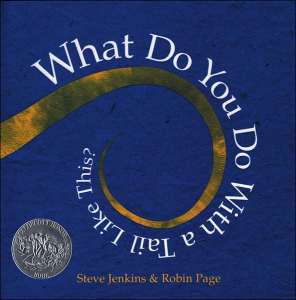 If you have an animal lover in your life, allow me to introduce you to the amazing Steve Jenkins, whose stunning paper collages are the basis for highly engaging and informative books about animals. Why do these books make great gifts? For starters, most parents don’t know about them! Jenkins’ books are more likely to end up on the non-fiction shelves of bookstores and libraries than in places where parents would be likely to bump into them; and while they are technically non-fiction, these gems read like picture books.
The other reason they make great gifts is because they play directly into children’s inherent curiosity about the world around them. Jenkins uses the animal kingdom as a vehicle through which to introduce all kinds of scientific topics—and he does so while keeping kids as absorbed as if they were listening to stories featuring animal characters. He tackles all the obvious themes, like anatomy, food chains, adaptations, symbiotic relationships, and basic survival. But he also tackles more abstract concepts, like time, proportion, and scale—all through gorgeous spreads of animals and fascinating tidbits (see my complete list of favorite Jenkins titles below, including some for younger and older audiences).
Holiday Gift Guide 2012 (No. 1): Books Worth Their Weight
December 6, 2012 § 3 Comments
 When it comes to picking gifts this holiday season, it’s no surprise I vote books all the way (and I’ll have posts all month long with recommendations for everyone on your list). But I thought I’d kick off my Holiday Gift Guide with a more unusual approach.
What about making an impact through sheer weight? I’m talking about reference books: those meaty treasures filled with mind-blowing facts, stunning photography, and encyclopedia-rich knowledge. We normally associate these books with schools, while we focus on stocking our shelves at home with storybooks (why clutter up our houses with reference books when we have the Internet?). But there’s a reason that educational philosophies like Montessori and Waldorf advocate strongly for encouraging children to find answers the old-fashioned way (after all, you learn nothing about alphabetization when you look up a definition on dictionary.com).
A good dictionary or atlas or encyclopedia can grow with your child for years and years. It will make your child a better student, and it will make you a better teacher (come on, we can’t let our children get smarter than us!).
The “Perfect” Christmas Tree
December 3, 2012 § 4 Comments
 This past weekend, we partook in one of our favorite family traditions: chopping down our Christmas tree and driving it home to trim. We started this tradition five years ago, when JP was one year old. I like the idea of my children understanding where their Christmas tree comes from; plus I enjoy supporting the family-owned tree farms in our area; plus, well, we all know that I love any excuse to unleash my urban children on a farm.
By now, the excursion has become fairy predictable. JP (eager to get his hands on a saw) begins by pointing to the first tree he sees and announcing, “This is the perfect one!” I meander deep into the fields, weaving in and out of the rows, sizing up each possibility and muttering oohs and ahhs. And my husband (who has carefully measured our nook at home and tried to set appropriate expectations before we left the house) rushes after me, chastising, “That one is too big! It won’t fit! You promised this year you’d be reasonable!” He has a point, my husband, but I can’t help myself. Something overcomes me out there in the crisp open air, beautifully manicured trees stretching out on all sides of me, and I WANT BIG.
I guess in this way I’m a lot like Mr. Willowby, the mustached tycoon in one of my favorite Christmas stories to read aloud to my kids (or, in the case of last week, to my son’s preschool class). Originally published in 1963, Robert Barry’s Mr. Willowby’s Christmas Tree (Ages 3-8) was reissued last year with newly colorized pen-and-ink sketches that brim with delight. Mr. Willowby’s Christmas tree comes straight off the hills—“full and fresh and glistening green—/The biggest tree he had ever seen.”
Now Please Go to Sleep
November 29, 2012 § 1 Comment
 The best parenting advice I ever received—and didn’t listen to—came when I was in the throes of sleep training my six month old. The advice was: “Make sure you pick a short bedtime ritual, because you’ll be doing it for a long time.” Of course, when you’re knee-deep in sleep deprivation, it’s not easy to see into the future and predict that five years later, your son will still expect a book, water, two songs (one being a made-up “Curious George” song, don’t ask), a hug, a kiss, and a very involved tucking in of the covers every single night.
We all get wiser the second time around; and consequently, I have a five year old who takes 45 minutes to put to bed, and a two year old who takes 45 seconds. But one thing remains the same: I love a good bedtime story.
The best bedtime stories are filled with gentle, lulling rhymes; jewel-toned illustrations; and ample opportunities for whispers and kisses (see my full list at the end of this post). The witching hours of dinner and bath time behind us, pajamas donned and teeth brushed, our collective bodies relax as the first words are read. No matter what madness has just transpired in the moments leading up to this one, peace is now restored; those big juicy bonds of love can flow freely once more (because, let’s face it, it’s almost over).
Things That Go Bump in the Night
September 23, 2012 § 3 Comments
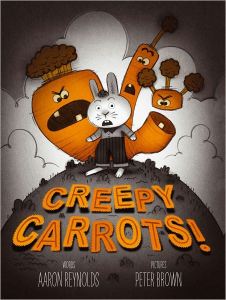 There’s no better time than the fall for reading spooky stories! Now, before you start worrying, let me preface by saying that my almost five year old is the ultimate Nervous Nelly; so, if he’s not scared by these stories (and actually demands to read them again and again), rest assured that your kids won’t be either. In fact, if you have a child that’s scared of the dark, even better: books like these can be an invaluable tool for empathizing with kids about their own nervousness (and helping them understand the role their imagination plays).
Without further ado, I give you my favorite new spooky story of the fall: Creepy Carrots! (Ages 4-7), by Aaron Reynolds, with illustrations by Peter Brown. I have loved everything Peter Brown has ever done, beginning with his first book, Flight of the Dodo, which is a quirky story about bird poop (remember: my son has a thing for poop books). What impresses me most about Brown is that none of his books feel derivative: for each story, he perfectly tailors his illustrative style to the topic at hand. In Creepy Carrots!, he sets his witty, cartoon-like drawings against a backdrop reminiscent of film noir, invoking a Hitchcockian play of black and white frames accented by splashes of orange.
Advanced Apple Picking: Part Two of Two
September 14, 2012 § 1 Comment
 In addition to making little botanists out of your children (see my previous post), apple picking can inspire some fascinating historical and cultural discussions, especially for the older set. As a quintessentially American pastime dating back to frontier life, apple picking speaks to some of our country’s core values.
Enter Johnny Appleseed, that larger-than-life figure who was allegedly responsible for planting and distributing the seeds for many of our country’s apple trees (that’s right, boys and girls, that apple you’re eating might have descended from a seed this guy planted!). September 26 marks the birth of Johnny Appleseed (whose real name was John Chapman). Last year at this time, I searched the libraries for a book about Chapman to bring to JP’s school; but while there are no shortage of kids books written on this topic, most struck me as inaccessible—a portrait of an historical figure presented without any meaningful context.
This fall, however, the topic has gotten a facelift by Esme Raji Codell and Lynne Rae Perkins, in their newly published and utterly captivating Seed by Seed: The Legend and Legacy of John “Appleseed” Chapman (Ages 5-10). What Seed by Seed does that no one has thought to do before is to set the stage by giving kids an up-close-and-personal account of the sights, smells, and sounds of early frontier life.
Hot-Off-the-Press for August’s Birthday Parties
August 14, 2012 § 2 Comments
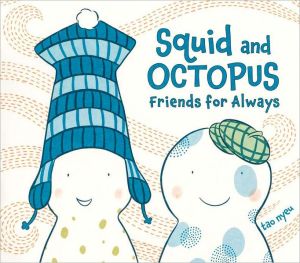 I’m a bit late with my pick for August birthday parties, but this gift will work equally well heading into the school year, because it’s a book about friendship! In Squid and Octopus: Friends for Always (Ages 4-8), Tao Nyeu is following a great literary legacy of Dynamic Duos (Frog and Toad, George and Martha, to name two favorites from my own childhood). Like her predecessors, Nyeu has packed her stories (there are four, organized as “mini-chapters” in the one picture book) with that winning combination of humor and heart. Squid and Octopus bear a particular resemblance to my son JP and his best buddy Willem: like all great friends, they argue about who is right, they make up by deciding they’re both right, they make each other laugh with silliness no parent can hope to understand, and they give each other lung-compressing squeezes that are supposed to resemble hugs.
What makes Nyeu’s book sing are her fantastical illustrations: pattern-studded silk screens made from water-based ink and colored pencils set against a simple white background. For a book about two cephalopods, living in an underwater universe complete with flower gardens, soup stands, and swing sets, one would expect backgrounds in dizzying shades of blue; but by setting her drawings on white, Nyeu focuses children’s attention on the irresistible quirkiness of the characters themselves. (I won’t say that I’m not totally attracted to the Jonathan Adler-esque color scheme of turquoise and orange as well.) As I was getting ready to write this post, I asked JP what his favorite thing about the book was. Instead of one, I got five enthusiastic points:
 What to Read to Your Kids