Holiday Gift Guide 2013: Stories of Perseverance for the Engineer
December 10, 2013 § 1 Comment
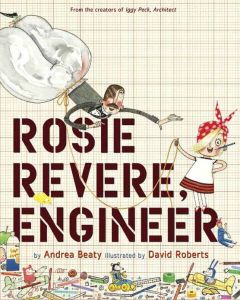 If at first you don’t succeed, try, try again. That might be easy to say as a parent, but we have only to remember our own childhoods to know how hard it is to hear. Just the other night, my son was attempting to draw a human profile by following one of those step-by-step guidebooks. Diligently huddled over his paper, he suddenly threw the pencil across the room and yelled, “This isn’t working at all! It doesn’t even look like a person!” Actually, I thought, it does look like a person—just not like the one in the book. Oftentimes, we cannot see our triumphs for what they are.
The creative process—its ups, its downs, its just plain hard work—is wonderfully captured in Rosie Revere, Engineer (Ages 5-8), the newest venture by Andrea Beaty and David Roberts, the team that created one of my favorite picture books of all time: Iggy Peck Architect. What black-turtleneck-sporting Iggy Peck did for building designs, red-scarf-sporting Rosie Revere (yes, her namesake is Rosie the Riveter) does for engineering. She makes it look—well—cool. « Read the rest of this entry »
Holiday Gift Guide 2013: Other-Worldly Encounters For the Young Artist
December 8, 2013 § 4 Comments
 When I was young, one of my favorite picture books was Harold and the Purple Crayon, where a little boy makes his own adventures with the help of a single purple crayon. As a child, I loved to draw, but I think the greater appeal for me lay in Harold’s vivid imagination—an imagination that empowers him with an inner resourcefulness, that entertains him when he can’t fall asleep, that gets him out of any sticky situation (drowning? simply draw a boat).
This same spirit echoes across Aaron Becker’s Journey (Ages 4-8), easily the most stunning picture book of 2013 and an inspiration for young artists and adventure-seekers alike. Unlike Harold, a simple visual presentation of purple and white, Journey makes use of a broad palette, although weighted emphasis is given to red, the color of the crayon with which a girl begins her escape by drawing a door (after all, what else can you do when your mom is cooking, your dad is working, and your big sister is too busy?). « Read the rest of this entry »
What Was Santa Like as a Kid? (Two Favorite New Christmas Books)
December 4, 2013 § 4 Comments
 With every holiday season, there is a kind of magic in rediscovering old friends, old traditions, old stories. I have only to see the ecstasy on my children’s faces as we unpack our box of Christmas books each December to remember why I go through the trouble of packing them away in January, as opposed to stuffing them into our already stuffed bookshelves. As a parent, it’s magical for me as well: last night my eldest left us at the dinner table, voluntarily bathed himself, got into his PJs, brushed his teeth, and called downstairs, “I’m ready 20 minutes early so I can get some extra Christmas stories!” No wonder they call it the most wonderful time of the year.
Just because we only read them for one month a year doesn’t mean I can resist the temptation to add to our collection every single year (there are worse addictions, I’ve assured my husband). Last year was Alison Jay’s exquisite Christmastime, where clues of Christmas carols are embedded into a seek-and-find masterpiece. Previous years’ favorites are mentioned here and here. This year’s acquisitions include two new picture books, utterly different in style, but forever entwined in my mind, since my kids and I had the pleasure of meeting both author/illustrators at Hooray for Books (our fabulous independent bookstore) a few weeks ago. « Read the rest of this entry »
“Our Trees are Coming!” “Our Trees are Coming!”
November 21, 2013 Comments Off on “Our Trees are Coming!” “Our Trees are Coming!”
 I’m completely obsessed with trees right now. I know what you’re thinking: this is not news. And, you’re right, I’ve written about my love for trees (and stories featuring trees) here, here, here and here. But I’m really, really obsessed with trees right now—and that’s because I have recently been tree shopping. When my kids were baptized last spring, their grandmother offered to buy each of them a tree to grow up alongside. So, earlier this fall, the kids and I did what we do best: we walked, we scooted, and we drove around our neighborhood looking at trees. How had we missed so many of these beauties before? “How about we get one of each?” my son ventured.
Eventually, we narrowed down our choices, but then there was the question of how and where to buy the trees. I initially thought, I’ll look for a deal on the Internet. But then my gardening friend reproached me: you need to see a tree before you buy it, need to study its form, need to find one that speaks to you. This is why, one crystal clear November morning, I found myself standing in a wholesale nursery an hour away in Maryland, surrounded by 600 different varieties of trees. I was walking up and down rows of trees, examining curves of trunks and canopy shapes, paying way too many people to follow me around offering their opinions, and starting to feel like I was going to have a hard time explaining to my husband how this simple decision to buy two trees had gotten totally out of hand. Did I mention how much fun I was having? « Read the rest of this entry »
November’s Birthday Pick Battle
November 8, 2013 § 2 Comments
 Six year old boys live in a world of their own. Often, the only people who understand them are other six year old boys. Take this recent conversation I witnessed as I was driving JP and his buddy home from school:
Friend: “I think I just saw a box of dynamite on the side of the street.”
JP: “Cool! Imagine if you took an inflatable bouncy house and blasted dynamite underneath it, and the bouncy house exploded into Outer Space and caught fire to the moon!”
Friend: “Yes! And then the bouncy house would blast the moon to the sun where it would explode into a thousand pieces and turn to gas!”
JP: “And then that gas would get into the Earth’s atmosphere and poison the guts out of all the bad people!”
Friend: “And they’d all become zombies and their eyes would fall out of their heads!”
JP: “Look, my cheese stick is pooping!”
Friend: “Cool!”
We as parents might not be able to compete with this level of engrossing conversation, but I’ll tell you who can: Jon Scieszka and Mac Barnett, whose Battle Bunny (Ages 5-9), is going to rock the world of every boy in the universe, guaranteed. « Read the rest of this entry »
Unlikely Companions
October 28, 2013 § 2 Comments
 Children form attachments to the oddest things. Take, for example, the dried out husk of a seed for which my six year old spent a recent afternoon constructing a shoebox house, complete with a toilet-paper-tube flag post and a felt blanket and pillow that he actually sewed himself. Did you get that? For a seed. There was also the time that he and his sister took their plastic straws from a restaurant to bed with them. These are not children who are hurting for baby dolls or stuffed animals; they simply choose to imprint on the less obvious choices.
So, is it any surprise that they would love Sophie’s Squash (Ages 3-7), a new picture book by Pat Zietlow Miller (fellow children’s book blogger), where a little girl develops a steadfast affection for a squash that her parents pick out at the farmers’ market and intend to cook for dinner? Sophie uses black marker to draw a face on the butternut squash; she names it Bernice (love); she wraps it in a baby blanket and rocks it to sleep; she takes it to story time at the library (double love); and she even organizes play dates for it with other squash (triple love). In other words—as her very patient parents soon realize—this squash is no dinner. « Read the rest of this entry »
Bang! Crash! Interstellar Collisions!
October 18, 2013 § 2 Comments
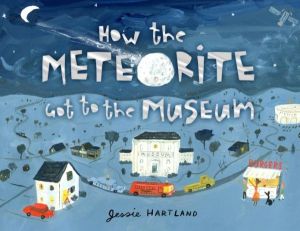 I may have given an audible little yelp the other day when I discovered that Jessie Hartland had published a new title in her “museum” series, but it was nothing like the squeal of joy that my six year old emitted when I brought it home and gave it to him. You see, How the Dinosaur Got to the Museum (Ages 4-8) and How the Sphinx Got to the Museum (Ages 5-10) are among our All Time Favorites, rivaled only by Hartland’s newest addition to the series, How the Meteorite Got to the Museum (Ages 5-10). All three books are brilliantly simple slices of science and history; they introduce children to paleontology, Egyptology, and now astronomy by following a specific artifact from its discovery in the field to its place in the exhibition hall of a museum.
Most great science books take their inspiration from true historical events. Here’s an especially awesome one: on a clear night in October of 1992, a meteor that had been predictably orbiting the sun for four billion years suddenly and inexplicably changed course, entered the Earth’s atmosphere, flew over Kentucky, West Virginia, and Pennsylvania, and crashed into the trunk of a Chevy Malibu parked outside a house in Peekskill, New York (that’s right, crashed—as in, totaled the back of the car and sprung a leak in the fuel tank and precipitated a 911 call to police and fire fighters—pretty much the coolest thing my six year old has ever conceived of). « Read the rest of this entry »
Counting Down to Halloween
October 12, 2013 Comments Off on Counting Down to Halloween
 Our decorations are up, the kids’ costumes are ordered, and earlier this week, right on cue, a streak of stormy weather moved in. All in all, the perfect time for getting out our Halloween-themed books and sharing tales of ghosts and goblins with my revved up trick-or-treaters (it’s not just about the sugar, my sugars). Honestly, I’ve been a bit underwhelmed by this year’s Halloween offerings. Of course, last year was particularly exceptional: we were treated to Creepy Carrots, The Monsters’ Monster, and Vampirina Ballerina—all three brilliant and all three enjoyed (since none actually mention Halloween) long past pumpkin-carving season. But speaking of pumpkins, it has been a long time since a great pumpkin book has entered the scene, and this year of slim pickings has at least given us that.
Stephen Savage’s Ten Orange Pumpkins (Ages 2-6) is billed as a counting book—and it’s true that there are opportunities to count on every page, as ten pumpkins become nine, become eight, and so on. But the “trick” of the book lies in how each pumpkin disappears, and the answers are (often quite subtly) revealed in the striking illustrations. « Read the rest of this entry »
The Rules of Play
October 10, 2013 § 2 Comments
 As parents, we are continually hounded by parenting experts about the importance of getting down on the floor and playing with our children. I’m fairly easily wooed when it comes to playing Candy Land or doing a giant floor puzzle or even painting alongside my kids; but when it comes to imaginative play, a little part of me wants to scream, “Please don’t make me do it!!!!” Why, you ask? Or maybe you don’t need to ask, because you already know about ALL THE RULES that our children arbitrarily force upon us from start to finish during these games. And nowhere is this more evident than when my daughter wants to play tea party.
E: “Mommy, let’s have a tea party!”
Me: “OK, where should I sit?” (I’ve learned better than to presume.)
E: “Right here”
Me. “OK’ (Sitting down.)
E: “No, you don’t sit like that! You have to cross your leg.”
Me: (making adjustments) “OK, I’m ready for my tea now.”
E: “No! First we are having a snack.”
Me: “OK, what’s for snack?”
E: “You don’t ask the question! You wait and I bring you the snack.”
Me (minutes later after being served a wooden egg and a plastic cucumber) “Mmmmm, thank you, this is so tasty!”
E: “MOMMY! It’s not time to eat yet! You have to wait for your tea!”
Me (an eternity later, when pretend tea is finally served): “Mmmmm, this tea is toasty warm.”
E: “It’s COLD tea!”
Me: “This tea is nice and refreshing. I think I’ll put some sugar in it.”
E: “That’s honey!”
Me: “I’m putting in some honey.”
E: “NO! You don’t pour it in, you have to use a SPPPOOOOOON!”
Thank you, but I will stick with Candy Land. « Read the rest of this entry »
Would Your Life Story Fit In a Box? What We Learn From Our Ancestors
October 3, 2013 § 1 Comment
 Our month of Birthday Mania was bound to have some fall out. Last night, after a particularly exhausting day for my kids (school followed by swim lessons followed by dinner out with friends), I finished putting Emily down and walked into JP’s room to begin his story time. I found my newly-turned six year old curled up in a ball on his bed, sobbing into the deflated husk of his bright green birthday balloon, a remnant from last weekend’s party. “My buh-buh-buh-buh-llllooooon!” he convulsed. “It’s all I have left from my bestest day evvvvvvv-errrrrrrr!” And then he looked at me with lion eyes: “I want a new balloon RIGHT NOW!”
As parents, we’ve all been here. Missed that window to leave the park, to leave the restaurant, to get into bed. So. Far. Gone. I tried the parenting-with-empathy approach: “It’s hard when something so fun comes to an end, huh?” But the wailing continued, accompanied now by a strange rocking of the shriveled green mass. I need to get this poor kid in bed. “Wait! I know!” I offered. “We can save it and put it in your memory box!” JP eyed me suspiciously. “Not that box that you keep, Mommy. I’m going to start my own memory box and make a special pillow in it for my balloon stub.”
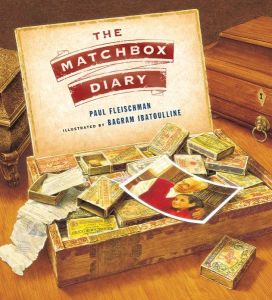
Just a few weeks earlier, JP and I had been discussing the concept of “memory boxes,” after reading Paul Fleischman’s extraordinary and deeply moving new picture book, The Matchbox Diary (Ages 6-10). The book chronicles the life story of an Italian-American boy, who sailed with his family to Ellis Island in search of a better life. « Read the rest of this entry »
Party Planning Angst
September 24, 2013 § 2 Comments
 JP turned six today. As you may recall, we are All About Birthdays this month, having just celebrated my daughter’s third birthday two weeks ago. At some point over the summer, my kids realized that their birthdays were (sort of) approaching, and many of their conversations turned to what kind of parties they wanted to have (“Snakes and a pinata!” from JP; “Balloons and flowers!” from Emily) and whom they wanted to invite.
This latter debate became increasingly complicated for my youngest, because in addition to her now having a few similarly aged friends, she still claims most of her brother’s friends as her own (having been toted around to his play dates for three years). Back when JP turned three, we had exactly three children over for a nice, contained party. When Emily turned three, we found ourselves with 25 kids running around our backyard. Throw in a giant inflatable bounce house, a craft station, and soccer goals, and it would appear that my husband and I have finally embraced this moving-to-the-‘burbs thing. But I digress. « Read the rest of this entry »
Permission to Go a Little Wild
September 18, 2013 § 2 Comments
 The routines of back to school are upon us. I am slowly adjusting to weekday mornings without the kids (meaning that I’m nearly home from drop off before I realize that I’m still humming along to the Music Together CD in the car; before I realize, Wait. I don’t have to listen to this. Wait! I can listen to anything I want!).
At the same time that I’m shedding a little responsibility, my children are being asked to assume more. They have traded the creative liberty of summer dressing (JP pairing bright green shirts with bright green shorts) for the navy and khaki of school uniforms. Our leisurely mornings of PJs and drawn-out breakfasts have been traded for early wake up calls and a litany of come on, let’s move along, did you pack your lunch bag, please take off that cape, why on earth are you getting out the play dough, for crying out loud hurry up (yes, I have read the articles about how we’re ruining our children by saying “hurry up” all the time, and I’ve made a mental note to work on that in my next life). « Read the rest of this entry »
Growing Pains
September 10, 2013 § 3 Comments
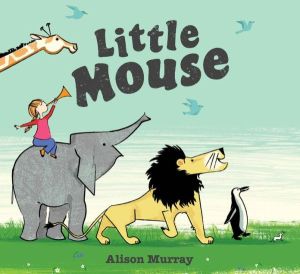 My youngest turns three today. Lately, everywhere I turn, I am reminded of how fast she is growing. “Mommy, Mommy, my toes are sticking out of my sandals!” she cried jubilantly one morning a few weeks ago; “I growed into a big girl!”
It’s no wonder, then, that she immediately fell in love with Alison Murray’s precious new picture book, Little Mouse (Ages 18 mos-4 yrs), where a little girl proclaims that she is no longer her Mommy’s “little mouse”; on the contrary, she is tall (like a giraffe), strong (like a bull), hungry (like a horse), and brave (in the face of a lion). On top of that, she can make her voice and her body do amazing things, from trumpeting (like an elephant) to pumping high on the big girl swing (like a bird). « Read the rest of this entry »
Digging in the Backyard: Summer School Wraps Up!
August 22, 2013 § 1 Comment
 Earlier this summer, the kids and I were on a morning walk—JP in the lead on foot, Emily trailing on her scooter, and me bringing up the rear. It had rained most of the night before, and the sidewalks were still damp. Abruptly, JP let out one of his characteristic ear-splitting screeches (at almost six, the boy still has no regard for volume control): “STOOOOOOP, EMILY!” Before I could launch into my characteristic lecture about not screaming into people’s faces, especially when that sweet face belongs to your little sister, JP followed it up with, “MOMMY, EMILY WAS ABOUT TO RUN OVER A WORM!” I looked down and, sure enough, the sidewalk was covered in worms, evidently displaced from the previous night’s storm. Is it wrong that I immediately assumed JP’s reaction was based on the grossness factor of squashing a worm between one’s scooter’s wheels? I’ll admit I felt slightly guilty when, once everyone calmed down (by now Emily was screaming nonsensically about worms as well), JP explained, “We have to be so, so careful not to hurt these worms. They need to go back into the dirt to make the plants grow!” I wasn’t going to tell him that these worms didn’t look like they were going anywhere ever again; Emily and I simply followed in tow as he went first and pointed out any worms that we should steer around.
It’s moments like these—rare, fleeting moments—when I wonder if maybe I’ve done something right as a parent. That somehow in all my blabbing on about trees and seeds and caterpillars, my kids have begun to develop an appreciation for the natural world that surrounds them. I would have to credit any success I’ve had to books like Yucky Worms (Ages 4-8), by Vivian French and Jessica Ahlberg, which is part of a fantastic Read and Wonder Series published by Candlewick Press. This is natural science for young kids at its best: fictional stories packed with scientific facts that are woven accessibly into the narrative. In Yucky Worms, a boy gets a lesson in Wormology from his green-thumbed grandmother (perhaps it’s no coincidence that I was first introduced to spiders and butterflies by my two grandmothers?).
Quick to exclaim “Yuck! Throw it away!” when his grandmother digs up a “slimy, slithery, wiggly worm,” the boy in the story gets schooled on the different parts of the worm, how it tunnels through the ground, what it eats, and how its poop enriches the soil. It turns out that worm poop—white curly forms called “casts”—are very plentiful in our backyard. It also turns out that most earthworms do not regenerate when accidentally cut in half by a gardening spade (I now get schooled regularly on this by my “backseat gardeners”). There is much to love about this book, from the sweet relationship between grandmother and grandson, to the hand-drawn diagrams of the worm’s anatomy, to the answers to questions kids don’t even know they have, like what happens to worms in the winter. But perhaps the biggest appeal for kids are the word bubbles that occasionally come out of the mouths of the worms themselves, reinforcing the lessons in the book while adding some enticing humor. What is it about worms that seem to invite speech bubbles? Doreen Cronin and Harry Bliss incorporate a similar technique in their hilarious series, Diary of a Worm (more fun than fact but still surprisingly illuminating about these creatures). Worms have a lot to say, evidently, as they dodge predators or feast on moldy fruit.

Here, the story continues on the side, while the worms take front stage with their tunnels and word bubbles.
I have tried my darndest this summer to get my kids out into nature. When it comes time to make dinner, it’s all I can do to resist the temptation to turn on the TV, shooing them instead into the backyard. Inevitably, I am called out moments later to settle some dispute over an ancient half-broken toy that has been unearthed from the shed and is suddenly the Only Thing Worth Playing With. But, in time, they settle into the rhythm of things and begin to take closer notice of their surroundings. Once again, my dinner making is interrupted by yelling: “Mommy, come out here RIGHT NOW!” I trudge outside more than a little exasperated, only to find the kids, not fighting over toys, but instead huddled over a corner of the deck. I bend down to see a spider’s web glistening from drops of water that have fallen out of the just-watered planters above. “It’s just like the one in the book!” JP exclaims, referring to Helen Frost’s stunning photograph of a dew-covered spider’s web in Step Gently Out, which we had just been reading that morning. “Only it’s even more beautiful,” he adds. “Yes,” Emily pipes in. “It’s sooooo boootiful.”
Other Favorites About Backyard Critters:
Step Gently Out, by Helen Frost (Ages 3-6)
Where Butterflies Grow and The Snail’s Spell by Joanne Ryder & Lynne Cherry (Ages 3-6)
The Honeybee Man, by Lela Nargi (Ages 4-8)
Diary of a Worm, Diary of a Spider, & Diary of a Fly, by Doreen Cronin & Harry Bliss (Ages 4-8)
Insect Detective: Read and Wonder, by Steve Voake & Charlotte Voake (Ages 4-8)
Seeds, Bees, Butterflies & More: Poems for Two Voices, by Carole Gerber & Eugene Yelchin (Ages 5-10)
Plus these favs mentioned in a previous post about Young Naturalists!
August’s Birthday Pick
August 8, 2013 Comments Off on August’s Birthday Pick
 Sometimes we need a Crowd Pleaser. How many times have we rushed to the store (on the morning of the birthday party, no less) and stared at the shelves, thinking “What do I even know about this child, this person in my daughter’s class whose name I’d never heard until last week?” Our children are often no help: “Ummm, I don’t know, he likes Star Wars, I think…” And then there’s the latest trend in birthday parties—the book exchange—which, naturally, I find charming and all, except that now we have the additional challenge of finding a book that will appeal to any one of the number of children at the party. Enter the Crowd Pleaser: a book that’s guaranteed to make boy, girl, preschooler, first grader laugh; a book they can listen to or read themselves or read to their siblings; and, of course, a book that’s Brand New and Off the Beaten Path and all that good stuff.
Now enter Monkeys. Because if there’s any animal that’s universally loved by children (and their parents) it’s the monkey. We all call our children monkeys; we all think of them as little monkeys (incidentally, we also think that this comparison is an entirely novel notion). Anyway, monkeys are good. Monkeys are safe.
Now enter Mac Barnett, one of the most original and—conveniently, in our quest for a Crowd Pleaser—one of the funniest picture book creators around. Last year, along with the talented Adam Rex, he wrote Chloe and the Lion (Ages 4-8), a hilarious (and surprisingly educational) look at the process of writing and illustrating a picture book, whereby Barnett and Rex essentially “argue” the book into creation. This year, he teams up with Kevin Cornell to lend his deconstructionist approach to Count the Monkeys (Ages 3-7), another book that appears to take form right before our eyes. The book begins with a simple premise: “Hey, kids! Time to count the monkeys! It’s fun. It’s easy. All you have to do is turn the page…” Except that the monkeys are nowhere to be found, scared away by a king cobra, who in turn is scared away by two mongooses (“or is that 2 mongeese?”), who in turn are scared away by three crocodiles…and you get the picture.
The genius of Count the Monkeys, apart from Cornell’s irresistibly mischievous drawings of gluttonous grizzly bears and “polka-dotted rhinoceroses with bagpipes and bad breath,” is the invitation for children to interact with every page. If you’ve ever read Herve Tullet’s groundbreaking Press Here to your children (and if you haven’t, please proceed immediately to your nearest independent bookstore), you are already familiar with this now trendy trick of modern picture book artists. These are books that invite children, not only into the reading process, but into the creation process as well. They make children feel like they themselves are driving the direction of the story. On every page in Count the Monkeys, the narrator (still obsessed with getting back those elusive monkeys) asks us to perform various tasks to get rid of the imposter: tell the lumberjacks to “scram” (“Say it even louder!”); don’t look the wolves in the eyes (“In fact, cover your eyes while you turn the page”); move your hand in a zigzag to “confuse” the crocodiles; etc. I triple dare any child (heck, I dare any parent) to refrain from doing any of the things Barnett demands; it’s simply too much fun to take a backseat on this one. And that, ladies and gentlemen, is a Crowd Pleaser.
Potty Break
August 1, 2013 § 2 Comments
 Once again, I find myself singing the praises of Mo Willems, whose Time to Pee! (Ages 1-4) proved just what my daughter needed to get her potty training on. For those of you who have navigated these murky waters before, you will agree that there are VERY FEW decent potty-related books for kids. There are useless books about princesses sitting on potties. There are patronizing books that suggest you’re only a big kid if you use the potty. But there are far too few that are clever and helpful, fun and functional. But that’s OK. Because all you really need is one great book—and, lucky for us, there’s Time to Pee!
Truth be told, I had been dreading potty training my youngest. I had it too easy with my firstborn. If I told you about how he emphatically decided upon turning two that he wanted to poop on the potty and never looked back, you would hate me. Except that you can’t hate me, because I literally had nothing to do with it (JP has always been a child to take matters into his own hands, skeptical that his parents don’t really know what they are doing and not entirely incorrect much of the time). So when my daughter turned two and showed ZERO interest in anything having to do with the potty, I simply told myself that she wasn’t ready. But then, yikes, almost an entire year passed, and here we are just a few short weeks from her joining her brother in Montessori, where she’ll be expected to do things like wear underwear and wipe her own butt; suddenly, “I no interested in the potty!” seemed like a recipe for disaster. So we took the plunge, gave away all remaining diapers (this tip from the parenting book, Diaper-Free Before 3, a fantastic recommendation from our Montessori director), and casually placed Time to Pee! on the top of a reading pile in the bathroom.
Now, I’m obviously not going to tell you that a children’s book (even one by the brilliant Mo Willems) was the single factor in Emily’s fairly quick and painless transition to the potty (much of the heavy lifting was in fact done by Big Brother). But what I can tell you is that the language in Time to Pee! repeatedly crops up when Em is talking about using the potty. At face value, the book reads like a straightforward (never patronizing) instruction manual, illustrated with Mo’s signature black-outlined doodles: you get “that funny feeling” while playing; you tell a grown-up that you have to go; you march yourself down the hall and into the bathroom, where you pull down your undies, do the deed, and get back to playing. Done. No problem. All the important logistics are covered, like waiting until you are done before grabbing for toilet paper (thank you, Mo) and washing hands afterwards. But then, because it’s Mo Willems, and because he is so darn perceptive about how kids’ minds work and what they are thinking (and obsessing and worrying) about, the book is loaded with humorous touches. “Please don’t ignore it!” (next to a boy with crossed eyes and legs). “Now is your chance to show how BIG you are!” And my favorite: “Everything will still be right where it was” (as the child returns to her tea party).
But the real unsung heroes here are the mice. Yes, that’s right, the hundreds of enthusiastic mice delivering each message, rolling out the red carpet and hoisting up the flags, serenading the potty goer and giving the thumbs up with a coy, “Go for it dude.” Three days into potty training, I tried to follow Emily into the bathroom after she announced that she had to pee. “No, Mommy! You don’t come in! I’m having a party with the mice.” And just like that, I found myself once again singing the praises of Mo Willems.
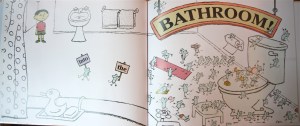
The aforementioned mouse party in the bathroom!
Other Favorite Potty Stories for Kids:
Even Firefighters Go to the Potty: A Potty Training Lift-the-Flap Story, by Wendy A. Wax, Naomi Wax, & Stephen Gilpin (long after JP was potty trained he still requested this book 10 times a day for two years)
Everyone Poops, by Taro Gomi (yes it’s weird, yes it’s kinda gross, but it’s actually quite effective (and my kids love the camel’s “two hump poop”))
A Potty for Me, by Karen Katz
Pip and Posy: The Little Puddle, by Axel Scheffler (my daughter loves this sweet, simple series about two friends—and, lo and behold, they have a potty story about an accident during a playdate)
Keeping Cool Under the Sea
July 26, 2013 Comments Off on Keeping Cool Under the Sea
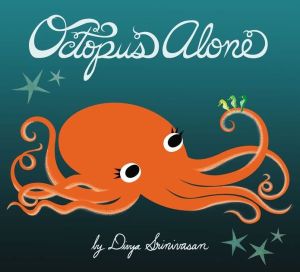 I know, I know, I’ve left you high and dry without reading material for nearly a month (vacation will do that); plus, I neglected to give you a birthday pick for July’s parties. So, in order to make it up to you, I am not only going to recommend a fabulous, brand-spanking-new book that you can give to everyone celebrating a birthday this summer, but I’m going to end with an EXTRA-LONG LIST OF THEMATICALLY SIMILAR BOOKS for you to read to your own kids (heck, you could even bundle some for an extra-special gift, like I did for a friend earlier this month). Are you ready?
Much like reading about snow in the winter, one of my favorite things about summertime reading is the excuse to read books about the sea (it’s no coincidence that I featured an octopus story for last summer’s birthday pick as well). Whether you’re spending time on the beach or simply looking for a mental escape from the heat, summer is the perfect time to introduce children to underwater worlds: landscapes so different from ours that they have their own inhabitants and laws, their own colors and sounds, their own unique set of experiences and problems. And yet, much of the best sea-themed fiction immerses kids in these foreign worlds while at the same time drawing parallels between their own emotional lives and the lives of the fishy dwellers within.
Trust me, you will want to dive straight into the pages of Divya Srinivasan’s Octopus Alone (Ages 3-6), where a bright orange octopus is set against an enticing palette of turquoise, seafoam green, and bright pink. I first fell in love with Srinivasan’s unique stylized graphics in Little Owl’s Night (reviewed here). Now, in the much longer Octopus Alone, we are treated to a more involved plot alongside her vivid art. I can’t say that Srinivasan’s narrative voice is as strong or coherent as her illustrations; and yet, the story’s theme—venturing outside one’s comfort level and finding the reward of new friendships—resonated loudly with both my kids. Any child who has felt overwhelmed walking into a preschool classroom or has stood on the periphery watching older kids at the playground will see a little of herself in the bashful octopus, who is so uncomfortable around the outgoing seahorses that she initially retreats from the coral reef into the deeper, darker, lonelier waters. Any child who often stands silently amidst others (but doesn’t shut up at home) will see a little of herself in the octopus, who imitates the dancing moves of the seahorses in private before allowing herself to see how much fun it might be to dance with others.
Like any great sea-themed book, there are countless opportunities for underwater discovery in Octopus Alone. Our family’s favorite would have to be the indisputably charming endpapers, which label (in cursive!) each of the sea creatures that make an appearance in the book (my son is prone to the “puffer fish,” while my daughter’s finger goes straight to the “butterfly fish”). My kids giggle every time Octopus releases her ink to “hide her blushing” or to escape the hungry eel, a nice reminder of aquatic adaptation. The book even makes some (albeit subtle) references to the complex ecosystem of coral reefs, like cleaner shrimp eating algae off the back of a nurse shark or baby dominoes playing hide and seek in the “swaying anemones.” (Older kids can build on these with Jason Chin’s equally stunning and richly informative non-fiction picture book, Coral Reefs…sorry, couldn’t wait until the end to plug that one.)
Our oceans and lakes, our sandy tide pools and rocky bluffs, can be a source of endless fascination for our kids. We have the power to channel this fascination into imagination, education, and hopefully even conservation. So go ahead: dip their toes in the water and start reading.
Other Favorite Under-the-Sea Stories (from youngest to oldest ages):
Over in the Ocean: In a Coral Reef, by Marianne Berkes & Jeanette Canyon (Ages 1-3; board book)
I’m the Biggest Thing in the Ocean! by Kevin Sherry (Ages 1-4)
The Snail and the Whale, by Julia Donaldson & Axel Scheffler (Ages 3-6; ONE OF MY ALL TIME FAVS)
The Pout Pout Fish, by Deborah Diesen & Daniel X. Hanna (Ages 3-6; best read in the style of the blues!)
Swimmy, by Leo Lionni (Ages 3-6)
Big Al, by Andrew Clements & Yoshi (Ages 4-7)
If You Want to See a Whale, by Julie Fogliano & Erin Stead (Ages 4-7; also brand new)
Kermit the Hermit, by Bill Peet (Ages 4-8)
Jangles: A Fish Story, by David Shannon (Ages 4-8)
Some Favorite Sea-Themed Non-Fiction Picture Books:
The Voyage of Turtle Rex, by Kurt Cyrus (Ages 4-8)
Coral Reefs, by Jason Chin (Ages 5-10)
Island: A Story of the Galapagos, by Jason Chin (Ages 6-12)
Life in the Ocean: The Story of Oceanographer Sylvia Earle, by Claire A. Nivola (Ages 5-10)
Manfish: A Story of Jacques Cousteau, by Jennifer Berne (Ages 5-10)
Ocean Sunlight: How Tiny Plants Feed the Seas, by Molly Bang (Ages 6-12)
Biking for Beginners and Pros
July 5, 2013 Comments Off on Biking for Beginners and Pros
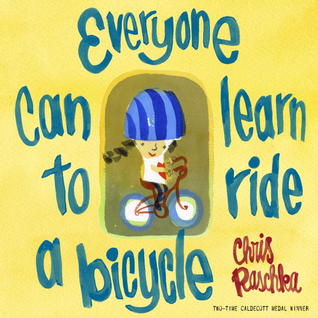 We interrupt our Summer School Series for some good ‘ol fashioned outdoor play—and because there happens to be two seriously awesome new picture books about riding a two wheeler (the Ultimate Summer Challenge, really). The first book is for the I-Think-I-Can-Beginners; the second is for the experienced, daring, and creative bikers (especially those with a love for all things Space).
Chris Raschka’s Everyone Can Learn to Ride a Bicycle (Ages 3-6) is a simple but poignant “how to” look at mastering a two wheeler, first with training wheels and then without. Now, if I were going to write a step-by-step guide to teaching a five year old to ride a bike, it might go something like this:
Lug ten tons of second-hand steel to park, at the request of eager child.
Help eager child up into bike seat.
Become temporarily deaf by imminent screaming of “NOOOOOOO get me off get me off get me off!”
After much cajoling and pleading and promising for the 45th time that you are going to hold on the whole time, convince child to remount bike and begin pedaling forward.
After 10 minutes, whereby you are still holding fast to the training-wheeled bike and said bike has moved exactly 10 feet, suggest that he try turning.
Feel an abrupt jerk as child slams on the breaks (this, oddly, comes very naturally), jumps off bike, and announces that he is Most Definitely Not Doing This Right Now.
Lug ten tons of steel back home.
Fortunately, Everyone Can Learn to Ride a Bicycle paints a much rosier picture of a child learning to ride a bike, along with the help of her patient and gently encouraging father.
But, actually, what I love about this book is that things are not always smooth sailing: the little girl has lots of false starts, falls down again and again, and needs both hugs and Band-Aids. “Oops! You nearly had it,” the book coaches. “Don’t give up. You’ll get it. Find the courage to try it again, and again, again, and again, again, and again, and again, until by luck, grace, and determination, you are riding a bicycle!”
Rashchka’s signature watercolors, seemingly effortlessly executed with thick, breezy, rough strokes of paint, are perfectly suited to the subject at hand. Every single painting exudes movement—whether it’s the little girl pulling her father’s hand toward the bike shop, her sideways and backwards tumbles off the bike, the neighborhood kids zooming past her on their colorful two wheelers, or her triumphant forward-leaning fast-pedaling stance at the end.
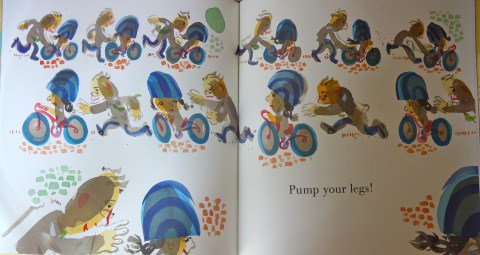
Rashchka’s greatest gift has always been his ability to capture emotional expression with just a few brushstrokes; and it’s the determination, bewilderment, frustration, joy, and pride on the little girl’s face that will make this gem relatable for children—those struggling to ride and those who’ve newly mastered the skill. I’m not promising this book will work miracles, assuming there might be other parents out there who are having similar bicycling battles on the playground (please tell me I am not alone); but I can promise that your child will identify a kindred spirit on the page.
Moving on to mor e advanced bicycling (and a longer, more sophisticated story), I fervently recommend How to Bicycle to the Moon to Plant Sunflowers: A Simple but Brilliant Plan in 24 Easy Steps, by Mordicai Gerstein (Ages 5-10). If the irreverent title alone hasn’t sold you, let me sing the praises of this most entertaining book, particularly for the kid who loves science, invention, numbers, the Moon, and bossing people around (that would be my son to a T, minus the bicycling).
First, when was the last time your child read a work of fiction that was laid out in steps? Each of this book’s 39 pages outlines a different step, numbered 1 through 24, many of them sub-categorized with letters (12a, 12b, 12c, 12d, etc.). Kids love this stuff; it’s exactly the way their mind works when they are bossing us around.
Secondly, there’s the very idea of bicycling into outer space, not to mention for the purpose of planting sunflowers to cheer up the Moon’s “big, sad clown face.” Thirdly, there’s the intricately involved and scientifically supported plan that the boy conjures up—a plan involving 2,000 used truck inner tubes, a 25-foot flagpole, a ship’s anchor, 238,900 miles of garden hoses wound tightly around a giant spool, a rented XS space suit from NASA, and various provisions, including “nourishing, flavored Glop, squirted through a straw in your space-helmet.”
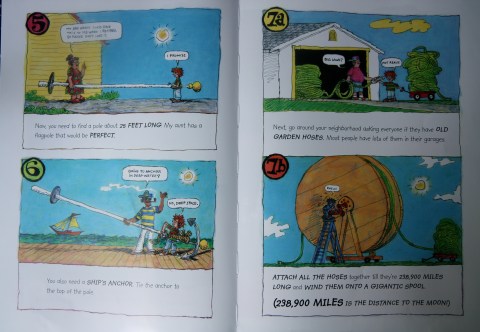
Finally, there’s the climactic adventure itself, Boy On Bike, pedaling up miles of garden hoses that have been anchored into the Moon’s surface, stopping to wonder at “the trillions of stars.” Within the largely comic narrative, written in the boy’s instructive voice, there are also many clever descriptions, my favorite being the notion that the Moon looks “like a coloring book that hasn’t been colored yet.”
Gerstein’s pen and ink drawings have a comic-book feel, but the crudely colored line art is mixed with grace and subtlety (the Moon’s changing expressions are a particular delight). This is the same Gerstein who wrote and illustrated one of my (and my son’s) favorite books: The Man Who Walked Between the Towers (Ages 4-8), the true and serious story of Phillipe Petit’s dramatic tightrope walk between the World Trade Towers in 1974. The two books could not look or feel more different (a rare feat for a picture book artist); yet, oddly, they both involve moving atop a skinny, rope-like material suspended over great heights.
Gerstein writes books about dreams—about the mystery, wonder, and excitement in planning for and achieving those dreams. I have a dream that my children will both ride two wheelers some day, that they will taste the victory that comes from balancing up high on their own, and (as I vividly remember doing as a young girl) that they’ll speed around the block, dreaming and scheming and making their own Big Plans.
Learning from the Big Thinkers (Summer School Continues!)
June 30, 2013 § 2 Comments
 Albert Einstein said, “The important thing is not to stop questioning. Curiosity has its own reason for existing.” Then by this account, should we embrace the endless string of questions by our children throughout the day? A recent British study found that children ask on average 300 questions a day. I’m pretty sure that my almost six year old has this daily average beat by the thousands; and while there are many moments when I relish his curiosity, there are also times when I long for an “off” button. These last instances most frequently occur when we’re in the car, because there’s nothing like being locked in a metal box with your children to bring out their obsessions with a full, unadulterated intensity. “Why are the clouds moving that way? Is there going to be a storm? How do the weather people know there’s going to be a storm? What happens if lightning hits our car? Why does red have to mean stop?” (This last one as we pull up to a stoplight and I realize that I can’t expect his brain to pause just because the car does.)
I was driving back from the pool the other day (having been turned away by the threat of storm clouds), and I may or may not have erupted with “I can’t take it anymore!” But then, I had a rare flash of brilliance, and I declared, “It’s Mommy’s turn to ask questions.” I began my own litany of questions, only to discover that JP had answers waiting just as quickly as I could rattle them off. ‘”What are clouds made of?” (“Water droplets!”) “Why does a ball fall if you drop if in the air?” (“Gravity!”) “Why am I not hungry?” (“Because you probably ate enough lunch!”) “Wow,” I said, “you are just as good as answering questions as you are at asking them.” “That’s because I ask so many questions!” he roared, and he and his sister laughed their heads off for the next two minutes (I’ll take my breaks where I can get them).
I recently posted about the value of sharing picture book biographies with children, and I included a list focused on true stories of the Ordinary Doing Extraordinary. But, of course, we mustn’t neglect the born geniuses, the legendary minds, the Great Thinkers that are responsible for shaping our very understanding of the world. In recent years, a slew of exceptional artistic and richly informative picture books have emerged (see my list at the end of this post) to celebrate such minds as Leonardo da Vinci, Benjamin Franklin, and, most recently, Mr. Curiosity Himself: Albert Einstein.
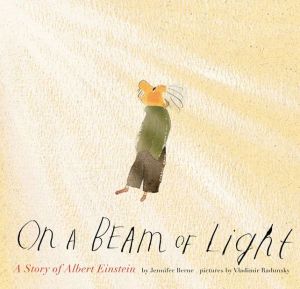
Jennifer Berne’s On a Beam of Light: A Story of Albert Einstein (Ages 5-10) is the kind of book you’ll want to share with your kids when they’re five, six, seven, eight, nine, and ten. Berne’s highly approachable narrative voice speaks directly to children (she first won me over in Manfish: A Story of Jacques Cousteau). In Einstein’s case, she brings to life, not only Albert’s awe at the mysteries of the world, but also his many personality quirks—from his disruptive questioning in elementary school to the saggy, baggy clothes he always wore as an adult (“My feet are happier without socks!”). These quirks are further emphasized by Vladimir Radunksky’s loosely drawn pen, ink, and gouache drawings, at once frenetic and playful, serene and innocent, like little windows into Albert’s own ever-shifting imagination. In JP’s favorite spread, Albert imagines what it would be like to ride his bike up the beam of sunlight that’s shining down on the sidewalk in front of him. “And in his mind, right then and there, Albert was no longer on his bicycle, no longer on the country road…he was racing through space on a beam of light. It was the biggest, most exciting thought Albert had ever had. And it filled his mind with questions.”
I’m no physicist. In fact, I somehow managed to avoid taking a Physics class in both high school and college (I regret this now). I have never felt terribly confident talking about energy and heat and magnetism and motion with my children, and goodness knows what I’ll do when I have to help them with equations involving E = mc2. But here I am, reading this book—this beautiful literary depiction of these scientific concepts—and I think, “Why have I never realized that physics is everything?!” Like the searching, wondering eyes of our little ones, Albert sees everything as a question. How could “a lump of sugar dissolve and disappear into his hot tea?” How could the “smoke from his pipe…disappear into the air?” And, of course, what would happen if he traveled near the speed of light? (The answer: “Only minutes would pass for Albert, while years and years went by for the rest of us!”)
Albert “asked questions never asked before. Found answers never found before. And dreamed up ideas never dreamt before.” Because of him, we were able to build spaceships and travel to the moon (there’s a great afterward that gets into more detail about the repercussions of Einstein’s discoveries, along with a list of additional reading material). Naturally, there are many questions still at large about how the universe works—and, fittingly, the book’s dedication reads, “To the next Einstein, who is probably a child now.” If my son and his peers are any indication, there’s likely a whole crop of future Big Thinkers out there. Children who won’t let a mere stoplight slow them down from asking their questions, questions, questions.
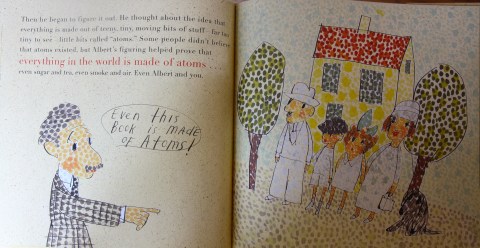
Here, kids are introduced to the idea that everything is made up of “teeny, tiny, moving bits of stuff—far too tiny to see—little bits called ‘atoms'” In a perfect marriage of text and illustration, Radunksky’s corresponding picture is broken up into hundreds of tiny dots (“Even this book is made of atoms!”).
Other Favorite Picture Books About Great Scientific Minds:
Odd Boy Out: Young Albert Einstein, by Don Brown (Ages 5-10)
Electric Ben: The Amazing Life and Times of Benjamin Franklin by Robert Byrd (Ages 6-12)
Noah Webster and His Words, by Jeri Chase Ferris (Ages 6-10)
I, Galileo, by Bonnie Christensen (Ages 7-12)
Leonardo: Beautiful Dreamer, by Robert Byrd (Ages 8-12)
The Tree of Life: Charles Darwin, by Peter Sis (Ages 8-12)
The Human Body (Summer School Continues!)
June 12, 2013 § 1 Comment
 Summer is naturally a time for children to sharpen their senses and take notice of their bodies. Running barefoot through the freshly cut grass; relishing the pure silence underwater at the pool; feeling the sweat beads on the back of their necks; hearing the crack of thunder that sends them tearing for the house; stretching out on the earth’s back to gaze at a sky full of stars: this is what summer looks, sounds, and feels like to our children. So why not turn these grass-stained knees into a chance to study the human body? And what if we take these bodily lessons further; what if we create an awareness in our children that their bodies aren’t just little planets unto themselves but are connected to the mysteries of the greater universe?
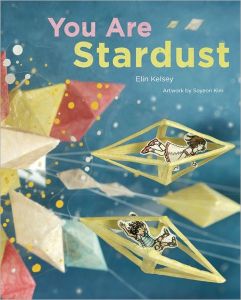
I have long been puzzled by the lack of children’s books that bridge the scientific and natural worlds, so I was thrilled to discover a little gem published last year, written by Elin Kelsey. You Are Stardust (Ages 4-8) is that rare blend of scientific fact and poetic wonder. Beginning with the premise that “every tiny atom in your body came from a star that exploded long before you were born,” the book goes on to draw parallels between humans, animals, the earth, and the universe, from the salt water that flows through our tears like it flows through the ocean to the electricity that powers our thoughts like it powers the lightning in the sky. Every fact and connection is intended to shock and awe (and is backed up by scientific evidence). Did you know that the water we drink today is the same water that the dinosaurs drank? Or that “each time you blow a kiss to the world, you spread pollen that might grow to be a new plant?” (Both of these questions got an audible response from my son: “Is that seriously true?”)
One of my favorite things about sharing books with children is that you can never predict exactly what will rock their world. I would never have supposed that the fact which made the greatest impression upon JP was one having to do with continual renewal—specifically, that “you’ll replace your skin 100 times by the time you turn ten.” When he first heard this, JP threw back his head and roared, “I’m not a snake! Kids don’t shed their skin; that’s ridiculous!” “Not all in one piece like a snake, but in little bits at a time,” I told him, and we went on to discuss things like scrapes, sunburn, and dry skin. For the past week, he has now taken to brushing his hand across his arm 10 times a day, while declaring to his sister that “you can’t see it, but my skin is shedding RIGHT NOW!”
Prior to discovering You Are Stardust, my favorite “metaphysical” book for kids, although on a much simpler, toddler-targeted level, has been Molly Bang’s All of Me: A Book of Thanks (Ages 2-4). With loving, economical text, Bang pays tribute first to a child’s body (“thank you, hands, for gripping and throwing and patting and holding”); then to his senses (“my mouth tastes all my food before it slides down here, into my tummy”); then to his feelings (“today I felt curious, and excited, and angry, and brave…”); and, finally, to the way in which he is part of “this whole wide world…and this whole universe is inside…all of me!”).
What All of Me starts, You Are Stardust expands on for the older child, grounding wondrous observations about the body-universe connection with scientific data (the book’s afterward also cites a website for those who want to learn more about the science behind the book). Perhaps not just coincidentally, both Bang and Kelsey’s books are illustrated with collage, a fitting medium for a lesson on how we are greater than the sum of our parts. The collages in You Are Stardust, done by Soyeon Kim, are actually dioramas, combining rocks, dried flowers, painted leaves, string, tissue paper, and watercolor cut-outs to create a tactile, three-dimensional effect. The illustrations feel youthful and free-form, and I think my son immediately connected with them as something he could approximate with materials gathered from our backyard. I would love for my children (as the author similarly wishes in her afterward) to cart this book outside all summer long, to read it by flashlight in their tee-pee or while propped up on their elbows in the grass. I would like for them to look at the trees and the birds and the snails and the clouds—and to feel their own heartbeat answering back.

“You, me, birds flying through the rainforest. We are all connected. We are all nature.”
Other Favorites for a More In-Depth Study of the Human Body (and with a more traditionally fact-based presentation):
The Skeleton Inside You; Why I Sneeze, Shiver, Hiccup and Yawn; A Drop of Blood; Hear Your Heart; My Five Senses, all part of the wonderful Let’s-Read-And-Find-Out Science Series (Ages 4-8)
See Inside Your Body, by Usborne Publishing (Ages 5-10)
First Human Body Encyclopedia, by DK Pubishing (Ages 6-12)
Bones: Skeletons and How They Work, by Steve Jenkins (Ages 6-12)
Picture This! Human Body, by Margaret Hynes (Ages 8-14)
 What to Read to Your Kids