Taking Cues from Mother Nature
June 30, 2014 § 4 Comments
 JP has decorated his summer journal and is ready to record our adventures (here’s hoping his motivation extends past the first week). Many of these adventures will take us into nature, where there are always metaphors to be discovered about life. Take, for example, our vegetable garden: each morning we wake to budding strawberries, and each evening we return to discover that they have been devoured by the squirrels and cardinals (how dare the latter betray me after I sung their praises right here?!). There’s a lesson somewhere in there about patience and not expecting to get things right the first time. And so we return to bed with renewed hope.
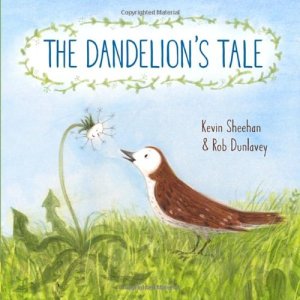
The Dandelion’s Tale (Ages 4-8), a new picture book by Kevin Sheehan and Rob Dunlavey, offers us another metaphor, this one about the fleeting, cyclical nature of life. This gem of a book takes what can be a heavy subject and delivers it in such a subtle, eloquent, kind, and accessible way, that children won’t realize they’re being taught a Great Lesson. Of course, it doesn’t hurt that it stars a dandelion. You’d be hard pressed to find a child that isn’t obsessed with dandelions. A yellow flower that I can pick with no adult getting mad (not to mention wind into chains, tuck behind my ear, or proudly proffer to whatever grown-up happens to be standing near)? A billowy white flower with such delicate seeds that the tiniest puff of breath sends them sailing across the grass? Yes, a child’s love for dandelions runs deep. « Read the rest of this entry »
Let’s Hear it for the Birds
May 15, 2014 § 1 Comment
 We’re all about birds this spring. Well, to be fair, I’m all about birds, but I’m filling my kids’ baskets with bird-related books, in hopes that they will catch on, too. I can’t help myself. There’s something about Spring Fever that drives me to obsess about some natural wonder alive and transforming outside my window (see past years’ obsessions with trees and worms). And what better way to drag my children along on this journey than through non-fiction picture books, which pair beautiful illustrations and poetic text with fascinating information?
I didn’t exactly choose birds as this year’s subject matter. They chose me. They chose me by waking me up at 4:30am with their frantic, high-pitched chirping. They chose me by making a nest between our roof and my bedroom ceiling, fast and furious work that sounded as if a much larger animal was ripping down sheets of metal. They chose me by distracting my children over breakfast, encouraging bowls of oatmeal to sit half-eaten, in favor of watching a pair of cardinals dancing in the dogwood outside our dining room window (my children are convinced that “Buddy” and “Lady Buddy” followed us two years ago when we moved up the hill to our current house). Let’s just say that the time seemed ripe to learn a thing or ten about the busy birds around us.
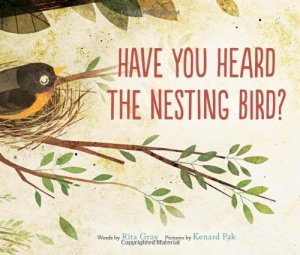
What I discovered was a treasure trove of non-fiction picture books starring birds, many published in recent years. I’ve shared my complete list of favorites at the end (with picks through age 10), but I had so much trouble choosing one to focus on here, that I have to expound on two. The first is Rita Gray’s Have You Heard the Nesting Bird? (Ages 3-6), illustrated by Kenard Pak. This is one of those deceptively simple picture books that educates as it delights. « Read the rest of this entry »
Fueling Up With Poetry
April 29, 2014 § 3 Comments
 On the Monday morning following Easter, JP crawled into my bed with a new book and proudly announced, “Mommy, I am going to read you some poems. I have lots of favorites. Some of them are very funny. Also some of them are very weird. A few of them I don’t even understand!” And hence followed one of the most enjoyable 45 minutes that I’ve had in awhile. All thanks to J. Patrick Lewis and Douglas Florian’s new Poem-Mobiles: Crazy Car Poems (Ages 5-10).
“Children dive into poetry with the same natural ease as swimmers into water, climbers into trees, and sleepers into dreams…Poetry’s narrative, rhythm and vibrant imagery is the real language of childhood.” So begins a recent online article in The Guardian about a movement among educators and publishers to bring back children’s poetry from “near extinction.” Why, if poetry is so intuitive, so enticing, for children, is it in danger of dying out? The article points a finger at booksellers, many of whom (and I admit to being guilty of this at one time) struggle with how to display and shelve a hard-to-pin-down category. Not considered picture books, not considered chapter books, they end up in their own “poetry” section way off in No Man’s Land. When was the last time you sought out the poetry shelves at your bookstore? « Read the rest of this entry »
Seasonal Inspiration from a Zen Master
March 7, 2014 § 3 Comments
 Normally, I’m all for aspiring to live in the moment. But not right now. Not this week. Because, it’s March, people, and the ground is once again covered in snow; we’ve lost another two days of school; it’s grey and cold and, frankly, there’s nothing to be gained from living in this moment.
Instead, our family is busy making plans for the future—and living in the delicious anticipation of those plans. My kids are dreaming up the giant sandcastles they intend to make on our upcoming trip to Florida (I am dreaming up the cocktails I intend to make). We are gazing out the window at the trees we planted last fall, wondering what they are going to look like with new, green leaves. JP is plotting how much money he might make selling freshly-squeezed lemonade on the hottest of summer days. And, because September is only six months away, both kids are beginning the daily debate about what their birthday parties should entail. Normally, I might interject a dismissive, “well, we’ll have lots of time to discuss that when it’s closer to the date”; but, right now, what else do I have to do? Sure, let’s talk about how the cake needs to have your name on it (“so everyone knows it’s my birthday”) and how the balloons need to be tied down just right so that they don’t blow away (“like that one time”). Bring it.
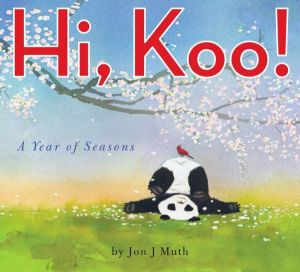
I’m betting that others are in the same boat. And that’s why I’m betting that Jon J. Muth’s brand new Hi, Koo!: A Year of Seasons (Ages 3-8) will be a sure bet for anyone in need of some assurance that spring (and summer) are just around the corner. « Read the rest of this entry »
Holiday Gift Guide 2013: Compelling Non-Fiction For the Animal Lover
December 16, 2013 § 1 Comment
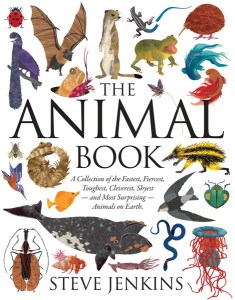 Last year around this time (equally last minute), I did a post about “books worth their weight” (great-looking reference books), as well as one about picture books by Steve Jenkins, a.k.a. Children’s Master of All Things Animal. This year, we can kill two birds with one stone when we buy Steve Jenkins’ new, overstuffed, and absolutely phenomenal The Animal Book: A Collection of the Fastest, Fiercest, Toughest, Cleverest, Shyest—and Most Surprising—Animals on Earth (Ages 6-12).
Over 300 fascinating animals are presented in sections like Family (chapters include “The Mating Dance” and “Bringing Up Baby”); Defenses (e.g. “Copycats” and “Bodily Fluids”); and The Story of Life (yes, Jenkins tackles evolution and, boy, does he succeed). I’m normally not a big fan of fact-centered non-fiction, preferring a more narrative approach that strengthens children’s attention spans and reading comprehension. But I make a BIG exception for Jenkins, whose presentation is as visually enticing (brilliant paper collages amidst an extraordinary use of white space) as it is factually addictive. I could look at this book for hours. I have looked at this book for hours (yes, I am hoarding it from my kids). « Read the rest of this entry »
Digging in the Backyard: Summer School Wraps Up!
August 22, 2013 § 1 Comment
 Earlier this summer, the kids and I were on a morning walk—JP in the lead on foot, Emily trailing on her scooter, and me bringing up the rear. It had rained most of the night before, and the sidewalks were still damp. Abruptly, JP let out one of his characteristic ear-splitting screeches (at almost six, the boy still has no regard for volume control): “STOOOOOOP, EMILY!” Before I could launch into my characteristic lecture about not screaming into people’s faces, especially when that sweet face belongs to your little sister, JP followed it up with, “MOMMY, EMILY WAS ABOUT TO RUN OVER A WORM!” I looked down and, sure enough, the sidewalk was covered in worms, evidently displaced from the previous night’s storm. Is it wrong that I immediately assumed JP’s reaction was based on the grossness factor of squashing a worm between one’s scooter’s wheels? I’ll admit I felt slightly guilty when, once everyone calmed down (by now Emily was screaming nonsensically about worms as well), JP explained, “We have to be so, so careful not to hurt these worms. They need to go back into the dirt to make the plants grow!” I wasn’t going to tell him that these worms didn’t look like they were going anywhere ever again; Emily and I simply followed in tow as he went first and pointed out any worms that we should steer around.
It’s moments like these—rare, fleeting moments—when I wonder if maybe I’ve done something right as a parent. That somehow in all my blabbing on about trees and seeds and caterpillars, my kids have begun to develop an appreciation for the natural world that surrounds them. I would have to credit any success I’ve had to books like Yucky Worms (Ages 4-8), by Vivian French and Jessica Ahlberg, which is part of a fantastic Read and Wonder Series published by Candlewick Press. This is natural science for young kids at its best: fictional stories packed with scientific facts that are woven accessibly into the narrative. In Yucky Worms, a boy gets a lesson in Wormology from his green-thumbed grandmother (perhaps it’s no coincidence that I was first introduced to spiders and butterflies by my two grandmothers?).
Quick to exclaim “Yuck! Throw it away!” when his grandmother digs up a “slimy, slithery, wiggly worm,” the boy in the story gets schooled on the different parts of the worm, how it tunnels through the ground, what it eats, and how its poop enriches the soil. It turns out that worm poop—white curly forms called “casts”—are very plentiful in our backyard. It also turns out that most earthworms do not regenerate when accidentally cut in half by a gardening spade (I now get schooled regularly on this by my “backseat gardeners”). There is much to love about this book, from the sweet relationship between grandmother and grandson, to the hand-drawn diagrams of the worm’s anatomy, to the answers to questions kids don’t even know they have, like what happens to worms in the winter. But perhaps the biggest appeal for kids are the word bubbles that occasionally come out of the mouths of the worms themselves, reinforcing the lessons in the book while adding some enticing humor. What is it about worms that seem to invite speech bubbles? Doreen Cronin and Harry Bliss incorporate a similar technique in their hilarious series, Diary of a Worm (more fun than fact but still surprisingly illuminating about these creatures). Worms have a lot to say, evidently, as they dodge predators or feast on moldy fruit.

Here, the story continues on the side, while the worms take front stage with their tunnels and word bubbles.
I have tried my darndest this summer to get my kids out into nature. When it comes time to make dinner, it’s all I can do to resist the temptation to turn on the TV, shooing them instead into the backyard. Inevitably, I am called out moments later to settle some dispute over an ancient half-broken toy that has been unearthed from the shed and is suddenly the Only Thing Worth Playing With. But, in time, they settle into the rhythm of things and begin to take closer notice of their surroundings. Once again, my dinner making is interrupted by yelling: “Mommy, come out here RIGHT NOW!” I trudge outside more than a little exasperated, only to find the kids, not fighting over toys, but instead huddled over a corner of the deck. I bend down to see a spider’s web glistening from drops of water that have fallen out of the just-watered planters above. “It’s just like the one in the book!” JP exclaims, referring to Helen Frost’s stunning photograph of a dew-covered spider’s web in Step Gently Out, which we had just been reading that morning. “Only it’s even more beautiful,” he adds. “Yes,” Emily pipes in. “It’s sooooo boootiful.”
Other Favorites About Backyard Critters:
Step Gently Out, by Helen Frost (Ages 3-6)
Where Butterflies Grow and The Snail’s Spell by Joanne Ryder & Lynne Cherry (Ages 3-6)
The Honeybee Man, by Lela Nargi (Ages 4-8)
Diary of a Worm, Diary of a Spider, & Diary of a Fly, by Doreen Cronin & Harry Bliss (Ages 4-8)
Insect Detective: Read and Wonder, by Steve Voake & Charlotte Voake (Ages 4-8)
Seeds, Bees, Butterflies & More: Poems for Two Voices, by Carole Gerber & Eugene Yelchin (Ages 5-10)
Plus these favs mentioned in a previous post about Young Naturalists!
Seeing the World in Color
March 23, 2013 § 3 Comments
 “It’s bud season! It’s bud season!” chanted my children earlier this week, after some long-awaited warm sunshine had beckoned us into the backyard. Thankfully, they were referring not to the beer (although my son’s soccer team does call themselves the Silver Bullets), but rather to the discovery of tiny little green bursts on the ends of our hydrangea bushes and crape myrtles. Since this is the first spring in our new house, our backyard is full of surprises, including yellow daffodils and purple crocuses and little red berries, all of which the children were delighted to point out to me as they raced back and forth across the lawn.
This springtime exuberance is exactly why I love Ashley Wolff’s Baby Bear Sees Blue (Ages 1-4), about a baby bear venturing forth from his den to discover the colors of the world. “Who is warming me, Mama?” asks Baby Bear. “That is the sun,” Mama says, as Baby Bear steps into a pool of brilliant yellow; “Baby Bear sees yellow.” And so begins a series of introductions to different colors, from the blue of the jays to the red of the strawberries to the grey of an approaching storm cloud. For months now, I have been trying (and failing) to teach my two year old her colors; at two and a half, she knows the names of all the colors and loves to exclaim “that’s purple!” or “that’s red!” for things that are, in fact, green or blue. I’m not obsessing about this, having drunk the Montessori Kool-Aid that she’ll learn on her own time (either that or someone will eventually tell me she’s color blind). But I figured it couldn’t hurt to start reading her books about colors, a rich topic in children’s literature (see my complete list of favorites at the end of this post).
January’s Birthday Pick
January 8, 2013 § 1 Comment
 For this month’s birthday pick, I’m doing something a little different: 1) I’m focusing on the youngest ages for a change; 2) I’ve chosen not one but two books (which make a perfect pairing); and 3) I’m encouraging you to throw caution to the wind and take a chance on books that aren’t brand new but are commonly unknown.
In short, the next time you are headed to a birthday party for a one or two year old, you’re in luck. I Took the Moon for a Walk (Ages 1-4) and Listen, Listen (Ages 1-4) are both illustrated by the supremely talented Alison Jay, whose praises I have sung here before. With their over-sized 9” by 9” format, these hefty board books mirror another favorite by Jay, her ABC: A Child’s First Alphabet Book (which tends to be well known and for good reason: it may just be the best alphabet book ever illustrated).
Alison Jay’s books are the ultimate gift. Packed with hidden surprises, layered with detail, and shimmering in vivid colors underneath a “crackle” finish, Jay’s paintings beg to be poured over again and again.
Holiday Gift Guide 2012 (No. 3): Books for Future Zoologists
December 13, 2012 § 1 Comment
 If you have an animal lover in your life, allow me to introduce you to the amazing Steve Jenkins, whose stunning paper collages are the basis for highly engaging and informative books about animals. Why do these books make great gifts? For starters, most parents don’t know about them! Jenkins’ books are more likely to end up on the non-fiction shelves of bookstores and libraries than in places where parents would be likely to bump into them; and while they are technically non-fiction, these gems read like picture books.
The other reason they make great gifts is because they play directly into children’s inherent curiosity about the world around them. Jenkins uses the animal kingdom as a vehicle through which to introduce all kinds of scientific topics—and he does so while keeping kids as absorbed as if they were listening to stories featuring animal characters. He tackles all the obvious themes, like anatomy, food chains, adaptations, symbiotic relationships, and basic survival. But he also tackles more abstract concepts, like time, proportion, and scale—all through gorgeous spreads of animals and fascinating tidbits (see my complete list of favorite Jenkins titles below, including some for younger and older audiences).
Your Budding Naturalist
April 28, 2012 Comments Off on Your Budding Naturalist
 Right now in preschools across the country, little eyes are glued to screened containers perched on shelves, waiting to behold one of nature’s most wondrous life cycles: the caterpillar’s transformation into a butterfly. (“Mommy, when the chrysalis shakes, that’s how you know there’s a lot of action going on inside!”)
I grew up reading Eric Carle’s The Very Hungry Caterpillar (and really, who doesn’t love a book with holes for sticking tiny fingers through?); but in my opinion, Ten Little Caterpillars (Ages 2-6), written by Bill Martin Jr. and illustrated by the great collage artist Lois Ehlert, has topped this subject matter.
Apart from its stunning visual feast for the eyes, the book speaks to children on a multitude of levels. First, there’s the simple rhyme, each double-page spread focusing on a single caterpillar’s unique journey: “The first little caterpillar crawled into a bower./ The second little caterpillar wriggled up a flower.” A few of the caterpillars don’t fare so well (it’s a dog-eat-dog world, after all): one meets with a “hungry wren,” another is “frightened by a hen.” It’s the tenth caterpillar that we get to watch hang patiently among the apple blossoms for three pages, until her chrysalis hatches to reveal a stunning orange-and-black “tiger swallowtail.”
 What to Read to Your Kids