Gift Guide 2014 (No. 2): Three Books for the Linguist (Ages 6-12)
November 25, 2014 § 1 Comment
Children have an inherent drive towards language. As infants, they hang on our every word. Once they begin to speak, they never tire of the sound of their own voice; and, as they develop more self-control, they relish in the discovery of expressing themselves (“Use your words!”) to get what they want. But it’s in the elementary years, when our kids are at last reading and writing on their own, that they become most keenly aware of the power of words, not only to shape and alter meaning, but also to connect them to the world.
Of course, it can’t hurt to nudge an awareness of the nuance of language into the forefront of our children’s minds. (We have to believe our kids are capable of more than “It was fine,” when asked about their day.) It just so happens that 2014 has given us three exceptional books (one picture book and two middle-grade chapter books) that showcase the power of language.
 Jen Bryant and Melissa Sweet’s The Right Word: Roget and His Thesaurus (Ages 6-12) introduces children to the notion that, in the vast archives of the English language, there is a “right” word to express a precise meaning. Bryant and Sweet have become masters of picture book biographies in recent years (remember this post?); but their portrait of the man who invented the thesaurus is their most magnificent to date. The story of Dr. Peter Roget’s life is narrated beautifully for a young audience; but it is the way in which Sweet has visualized Roget’s fascination with language that truly captivates the reader. Like the thesaurus itself (which comes from the Greek word meaning “treasure house”), this is a book that’s impossible to absorb in one—or ten, or twenty—sittings. Visual feasts of collage beckon the eye on every page. « Read the rest of this entry »
Connecting Through Diversity
March 25, 2014 § 1 Comment
 A rousing op-ed piece by acclaimed children’s author Walter Dean Myers, recently appearing in The New York Times, poses the uncomfortable question: “Where Are the People of Color in Children’s Books?” The startling statistic cited at the beginning reveals that of the 3,200 children’s books published in 2013, only 93 were about black people. Myers later compares this statistic to the 40% of public school students nationwide who are black or Latino. As a black boy growing up in Harlem, Myers’ initial love affair with reading quickly turned to disinterest, as he discovered the glaring lack of literary characters who looked and lived like him. As an adult, Myers has dedicated his career to writing prolifically about inner-city youth, calling his novels “a validation of their existence as human beings.” But it’s about more than providing validation to people with color, he notes. It’s also about how these individuals are seen by the rest of us:
Books transmit values. They explore our common humanity. What is the message when some children are not represented in those books?
As someone who sold picture books for many years, what often strikes me about today’s offerings for young people is not the lack of books featuring people of color (that is clearly a fact), but how quickly a book with a black figure on its cover almost always signifies a story about a “race issue,” be it a story about a slave traversing the Underground Railroad or one about a contemporary black girl overcoming her classmates’ prejudice to star in the school play. Many of these are beautiful, powerful picture books—but they are also ones that, too often, only end up seeing the light of day during calendar events like Black History Month. Especially among white families, they are treated more like “teaching tools” for the classroom and less like the books we purchase and leave strewn around our house, hoping for our children to discover and devour them. « Read the rest of this entry »
“Life, Liberty, and the Pursuit of Happiness”
February 17, 2014 § 1 Comment
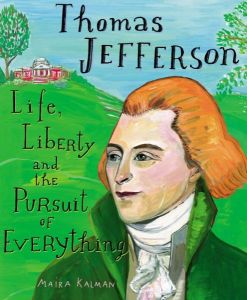 My wish has come true: the exquisite Maira Kalman has graced us with another presidential picture book! Last year, she gave us Looking at Lincoln, which I’ve gifted to more people than I can count (read why here). This year, she introduces our children to Monticello, the Declaration of Independence, and the brilliant, curious, and at times hypocritical Thomas Jefferson, in her just-published Thomas Jefferson: Life, Liberty, and the Pursuit of Everything (Ages 6-12).
Instead of beginning, as we might expect, with chronological details of Jefferson’s life, Kalman’s biography takes us straight to the heart of her subject—or, rather, to his mind. The book opens with Jefferson’s love of books (“I cannot live without books,” he said—a man after my own heart); manners (he could say “please” in seven languages); vegetables (his gardens sported nine varieties of peas, his favorite); and “light and air” (he constantly changed Monticello’s architecture to let in both). « Read the rest of this entry »
Changing the World Through Song: A Post for MLK Jr. Day
January 19, 2014 § 1 Comment
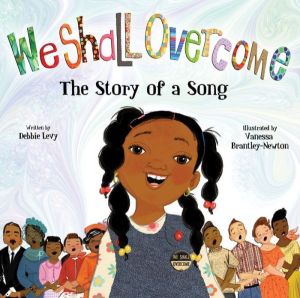 Last year’s post, in honor of Martin Luther King Jr’s birthday, continues to be one of my most read and shared posts. I don’t think there’s any way to top Kadir Nelson’s moving picture book biography of King, so I thought I’d talk this year, not about the leader of the Civil Rights Movement, but about his followers—the ones who marched, the ones who stood up for what they believed, the ones who sang. I was giddy with excitement to discover Debbie Levy’s new picture book, We Shall Overcome: The Story of a Song (Ages 5-10)—one, because I have always loved that song (it crops up at surprising times, like when I’m hiding in the bathroom in an attempt to keep from screaming at my children); and two, because music has recently taken our house by a storm. « Read the rest of this entry »
Holiday Gift Guide 2013: Stories of Perseverance for the Engineer
December 10, 2013 § 1 Comment
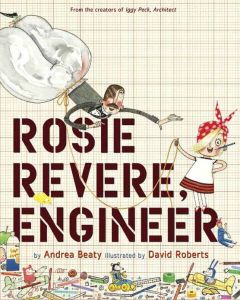 If at first you don’t succeed, try, try again. That might be easy to say as a parent, but we have only to remember our own childhoods to know how hard it is to hear. Just the other night, my son was attempting to draw a human profile by following one of those step-by-step guidebooks. Diligently huddled over his paper, he suddenly threw the pencil across the room and yelled, “This isn’t working at all! It doesn’t even look like a person!” Actually, I thought, it does look like a person—just not like the one in the book. Oftentimes, we cannot see our triumphs for what they are.
The creative process—its ups, its downs, its just plain hard work—is wonderfully captured in Rosie Revere, Engineer (Ages 5-8), the newest venture by Andrea Beaty and David Roberts, the team that created one of my favorite picture books of all time: Iggy Peck Architect. What black-turtleneck-sporting Iggy Peck did for building designs, red-scarf-sporting Rosie Revere (yes, her namesake is Rosie the Riveter) does for engineering. She makes it look—well—cool. « Read the rest of this entry »
“Our Trees are Coming!” “Our Trees are Coming!”
November 21, 2013 Comments Off on “Our Trees are Coming!” “Our Trees are Coming!”
 I’m completely obsessed with trees right now. I know what you’re thinking: this is not news. And, you’re right, I’ve written about my love for trees (and stories featuring trees) here, here, here and here. But I’m really, really obsessed with trees right now—and that’s because I have recently been tree shopping. When my kids were baptized last spring, their grandmother offered to buy each of them a tree to grow up alongside. So, earlier this fall, the kids and I did what we do best: we walked, we scooted, and we drove around our neighborhood looking at trees. How had we missed so many of these beauties before? “How about we get one of each?” my son ventured.
Eventually, we narrowed down our choices, but then there was the question of how and where to buy the trees. I initially thought, I’ll look for a deal on the Internet. But then my gardening friend reproached me: you need to see a tree before you buy it, need to study its form, need to find one that speaks to you. This is why, one crystal clear November morning, I found myself standing in a wholesale nursery an hour away in Maryland, surrounded by 600 different varieties of trees. I was walking up and down rows of trees, examining curves of trunks and canopy shapes, paying way too many people to follow me around offering their opinions, and starting to feel like I was going to have a hard time explaining to my husband how this simple decision to buy two trees had gotten totally out of hand. Did I mention how much fun I was having? « Read the rest of this entry »
Would Your Life Story Fit In a Box? What We Learn From Our Ancestors
October 3, 2013 § 1 Comment
 Our month of Birthday Mania was bound to have some fall out. Last night, after a particularly exhausting day for my kids (school followed by swim lessons followed by dinner out with friends), I finished putting Emily down and walked into JP’s room to begin his story time. I found my newly-turned six year old curled up in a ball on his bed, sobbing into the deflated husk of his bright green birthday balloon, a remnant from last weekend’s party. “My buh-buh-buh-buh-llllooooon!” he convulsed. “It’s all I have left from my bestest day evvvvvvv-errrrrrrr!” And then he looked at me with lion eyes: “I want a new balloon RIGHT NOW!”
As parents, we’ve all been here. Missed that window to leave the park, to leave the restaurant, to get into bed. So. Far. Gone. I tried the parenting-with-empathy approach: “It’s hard when something so fun comes to an end, huh?” But the wailing continued, accompanied now by a strange rocking of the shriveled green mass. I need to get this poor kid in bed. “Wait! I know!” I offered. “We can save it and put it in your memory box!” JP eyed me suspiciously. “Not that box that you keep, Mommy. I’m going to start my own memory box and make a special pillow in it for my balloon stub.”
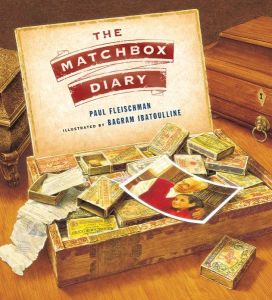
Just a few weeks earlier, JP and I had been discussing the concept of “memory boxes,” after reading Paul Fleischman’s extraordinary and deeply moving new picture book, The Matchbox Diary (Ages 6-10). The book chronicles the life story of an Italian-American boy, who sailed with his family to Ellis Island in search of a better life. « Read the rest of this entry »
Learning From History’s Many Heroes
May 30, 2013 § 3 Comments
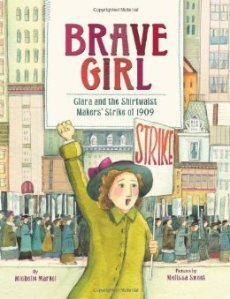 Just because the school year ends shortly doesn’t mean that our children’s minds have to shrivel up like apples left out too long in the sun. Last week, I gave some ideas for great read-aloud novels to share with your kids. Now, I’m going to encourage you to add some non-fiction into the mix—specifically, historical biographies posing as picture books. In previous posts about Martin Luther King Jr. and Abraham Lincoln, I’ve hailed the rise of today’s picture book biographies, which (unlike the static, black-and-white books of our school days) read like interesting, action-packed stories accompanied by vibrant paintings and intriguing designs. But I’m not merely talking about the Most Obvious Historical Figures; there are lesser known but equally captivating true stories of ordinary boys and girls, men and women, who shaped the world with extraordinary acts of courage, defiance, or creativity.
Where picture book biographies are concerned, contemporary illustrator Melissa Sweet has been on a roll, creating the art for several of my favorite non-fiction books in recent years. Although these biographies are written by different authors, they are unified by Sweet’s signature style—at once instantly recognizable but also entirely unexpected for the historical genre. In place of photographic-like paintings in somber tones, Sweet uses fun colors, whimsical patterns, and collage elements specific to the person whose story she is bringing to life. In Jen Bryant’s A River of Words: The Story of William Carlos Williams (Ages 7-12), Sweet peppers her background collages with excerpts from Williams’ poems, opening up kids’ eyes to these words and thoughts as an art form unto itself. In Alicia Potter’s Mrs. Harkness and the Panda (Ages 5-8), an account of the first person to capture a wild panda in China and bring it to an American zoo for study, Sweet creates frames for her watercolors out of authentic Chinese decorative papers, lending an other-wordly, almost mystical charm to this already fascinating story.
One of Sweet’s most recent triumphs is even more captivating for its portrayal not of an adult but of a young girl. Michelle Markel’s Brave Girl: Clara and the Shirtwaist Makers’ Strike of 1909 (Ages 6-10) tells the mind-boggling story of a Jewish immigrant girl, forced to endure long hours, harsh treatment, and poor pay, while sewing alongside hundreds of other girls in factories (her family’s only hope of putting food on the table.) Clara Lemlich’s “got grit,” and she “knows in her bones what is right and what is wrong”; ultimately, she leads the largest walkout of women workers in American history, inspiring thousands of male and female workers across the country to strike for better working conditions and the right to organize unions. « Read the rest of this entry »
Eyes on Abraham Lincoln
February 12, 2013 Comments Off on Eyes on Abraham Lincoln
 You might expect that my children, living so close to Washington DC, have many opportunities to learn about our nation’s history. But mere proximity does not a future scholar make. The Lincoln Memorial, for example, is consistently celebrated by my five year old as “the place where we picnic in the summer!” If you ask him the name of the president that sits in stone behind him during said picnics, he is likely to throw you a disinterested look and recommence staring out the car window, pointing out other landmarks whose names he boasts correctly but whose significance he understands not. Which begs the question: How do we get our kids to care about the past presidents that have shaped our country?
The biographies we read as kids were filled with dry facts and black-and-white photographs that made their content feel all too disconnected from our daily lives; too often we were encouraged to memorize names and dates for tests, only to forget them a week later. Thankfully, our own kids have access to a whole new generation of fresh reading material, including picture books that breathe colorful new life into historic periods and events.
“Use Your Words” (MLK Jr. Style)
January 17, 2013 § 1 Comment
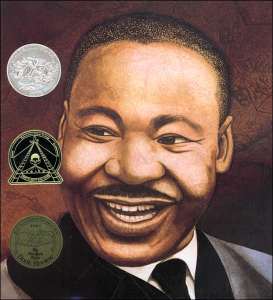 In a few days, our country will celebrate Martin Luther King, Jr.’s birthday and a presidential inauguration. Whatever our political views, whatever our race or gender or religion or socioeconomic background, we can do our children a great service by talking to them about Dr. King’s vision of justice and peace, his commitment to respecting the dignity of every human being.
I’ve found that parents, especially us white Americans, are reluctant to broach the subject of race relations with preschoolers or even young elementary students. Ashamed of our country’s past afflictions, it’s as if we can pretend they never existed if we don’t talk about them. But child development specialists and sociologists (like Po Bronson and Ashley Merryman, authors of NurtureShock) have pointed out that children naturally notice differences in appearances, and that if we don’t have these conversations with them from an early age, they will begin to draw their own conclusions—and, even worse, begin to view the subject as taboo—which does nothing to advance our nation’s long and still arduous progression toward equality. And, let’s be honest, have you ever met a five or seven or ten year old that isn’t obsessed with the notion of fairness? For that matter, how many times a day do we as parents plead with our children, “Use your words!” (say, when said children yank something out of their sibling’s hands or push a peer on the school playground)?
Holiday Gift Guide 2012 (No. 4): Books For the Hero Within
December 18, 2012 § 1 Comment
 Benjamin Franklin once penned: “If you would not be forgotten/ As soon as you are dead and rotten,/ Either write things worth reading,/ Or do things worth the writing.” OK, that might not be a quote we need to read aloud to our young children, but its sentiment can and should inform the books we choose to share with them.
The genre of biographies written for children is taking off like never before; it seems not only are parents and educators seizing the chance to inspire our young ones with tales of historical figures, but kids themselves are embracing these literary opportunities to inform their own choices, to pave their own paths worth living. And it’s no accident that many of this past year’s biographies are picture books: against a backdrop of beautiful art and poetic text, stories about scientists, writers, inventors, artists, and peacemakers become that much more gripping. The books listed at the end of this post are treasures worth giving and owning; their artistic caliber alone makes them a far cry from the dry, fact-filled paperbacks that we once suffered through for school reports.
Holiday Gift Guide 2012 (No. 1): Books Worth Their Weight
December 6, 2012 § 3 Comments
 When it comes to picking gifts this holiday season, it’s no surprise I vote books all the way (and I’ll have posts all month long with recommendations for everyone on your list). But I thought I’d kick off my Holiday Gift Guide with a more unusual approach.
What about making an impact through sheer weight? I’m talking about reference books: those meaty treasures filled with mind-blowing facts, stunning photography, and encyclopedia-rich knowledge. We normally associate these books with schools, while we focus on stocking our shelves at home with storybooks (why clutter up our houses with reference books when we have the Internet?). But there’s a reason that educational philosophies like Montessori and Waldorf advocate strongly for encouraging children to find answers the old-fashioned way (after all, you learn nothing about alphabetization when you look up a definition on dictionary.com).
A good dictionary or atlas or encyclopedia can grow with your child for years and years. It will make your child a better student, and it will make you a better teacher (come on, we can’t let our children get smarter than us!).
Advanced Apple Picking: Part Two of Two
September 14, 2012 § 1 Comment
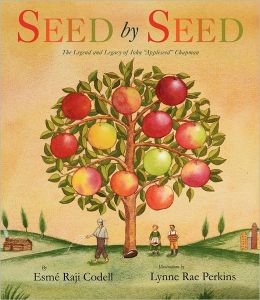 In addition to making little botanists out of your children (see my previous post), apple picking can inspire some fascinating historical and cultural discussions, especially for the older set. As a quintessentially American pastime dating back to frontier life, apple picking speaks to some of our country’s core values.
Enter Johnny Appleseed, that larger-than-life figure who was allegedly responsible for planting and distributing the seeds for many of our country’s apple trees (that’s right, boys and girls, that apple you’re eating might have descended from a seed this guy planted!). September 26 marks the birth of Johnny Appleseed (whose real name was John Chapman). Last year at this time, I searched the libraries for a book about Chapman to bring to JP’s school; but while there are no shortage of kids books written on this topic, most struck me as inaccessible—a portrait of an historical figure presented without any meaningful context.
This fall, however, the topic has gotten a facelift by Esme Raji Codell and Lynne Rae Perkins, in their newly published and utterly captivating Seed by Seed: The Legend and Legacy of John “Appleseed” Chapman (Ages 5-10). What Seed by Seed does that no one has thought to do before is to set the stage by giving kids an up-close-and-personal account of the sights, smells, and sounds of early frontier life.
 What to Read to Your Kids