January’s Birthday Pick
January 8, 2013 § 1 Comment
 For this month’s birthday pick, I’m doing something a little different: 1) I’m focusing on the youngest ages for a change; 2) I’ve chosen not one but two books (which make a perfect pairing); and 3) I’m encouraging you to throw caution to the wind and take a chance on books that aren’t brand new but are commonly unknown.
In short, the next time you are headed to a birthday party for a one or two year old, you’re in luck. I Took the Moon for a Walk (Ages 1-4) and Listen, Listen (Ages 1-4) are both illustrated by the supremely talented Alison Jay, whose praises I have sung here before. With their over-sized 9” by 9” format, these hefty board books mirror another favorite by Jay, her ABC: A Child’s First Alphabet Book (which tends to be well known and for good reason: it may just be the best alphabet book ever illustrated).
Alison Jay’s books are the ultimate gift. Packed with hidden surprises, layered with detail, and shimmering in vivid colors underneath a “crackle” finish, Jay’s paintings beg to be poured over again and again.
The Year That Lies Ahead
January 3, 2013 § 2 Comments
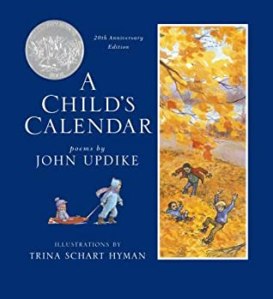
On the morning of January 1, my five year old crawled into our bed and asked with great solemnity, “Is the year of Christmas over?” I’m not entirely sure what he was getting at; did he mean to say month? or season? or was he actually inquiring as to whether the Year of the Great Christmas of 2012 had ended? I’ll never know exactly what was ruminating in his little head, but it was a sweet reminder of how bewildering the concept of time is to children—even to a five year old who has plenty of memories of past years.
We as adults take for granted our assurance about the cyclical nature of time: that all seasons, all holidays, all of nature’s dramatic transformations, will occur again and again with each passing year. It will probably come as no surprise that my instinctual reaction to JP’s question on New Year’s morning was to send him downstairs to fetch some relevant reading material. One of my all-time favorite children’s books (a book so precious to me that it actually resides on the “adult” shelves of our living room library) is A Child’s Calendar (Ages 5-10), a 1965 treasure of poems by John Updike that was later given a ’90s makeover with the addition of award-winning illustrations by Trina Schart Hyman.
« Read the rest of this entry »Holiday Gift Guide 2012 (No. 3): Books for Future Zoologists
December 13, 2012 § 1 Comment
 If you have an animal lover in your life, allow me to introduce you to the amazing Steve Jenkins, whose stunning paper collages are the basis for highly engaging and informative books about animals. Why do these books make great gifts? For starters, most parents don’t know about them! Jenkins’ books are more likely to end up on the non-fiction shelves of bookstores and libraries than in places where parents would be likely to bump into them; and while they are technically non-fiction, these gems read like picture books.
The other reason they make great gifts is because they play directly into children’s inherent curiosity about the world around them. Jenkins uses the animal kingdom as a vehicle through which to introduce all kinds of scientific topics—and he does so while keeping kids as absorbed as if they were listening to stories featuring animal characters. He tackles all the obvious themes, like anatomy, food chains, adaptations, symbiotic relationships, and basic survival. But he also tackles more abstract concepts, like time, proportion, and scale—all through gorgeous spreads of animals and fascinating tidbits (see my complete list of favorite Jenkins titles below, including some for younger and older audiences).
The Leaves, They Are a-Falling
October 24, 2012 Comments Off on The Leaves, They Are a-Falling
 To young children, fall can be a time of bewilderment (what is happening to the leaves on my trees?!). As they get older and can remember previous falls, some of that mystery transforms into magic: soon fall becomes a season to embrace for the very changeability that was once so puzzling.
My two children are on opposite ends of this spectrum of discovery. On the one hand, there’s two-year-old Emily, who at times can’t refrain from picking up and examining every leaf she comes across. On our walks to school, I’ll point out a magnificent crimson maple leaf lying on the ground, freshly fallen and perfectly preserved in its flatness and shape: “Look at that huge red leaf—let’s grab it!” I’ll encourage. But she’ll stop short and pick up part of a shriveled brown leaf, holey from bugs and tinged with black spots. She’ll gaze at it with a furrowed brow before proudly handing it to me and demanding that I put it in her backpack. On the other hand, there’s five-year-old JP, whose seasoned eye searches out only the most unusual spectacles: “Whoa, that tree is totally orange! It looks like fire exploding out of a rocket ship!”
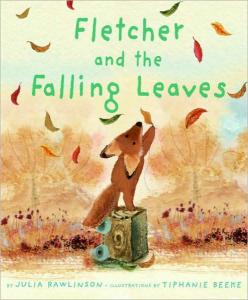
Regardless of where they fall on the spectrum, their excitement about fall is contagious. Tonight, the kids and I curled up together in our jammies to read my all-time favorite picture book about fall: Fletcher and the Falling Leaves (Ages 2.5-6), with text by Julia Rawlinson and watercolors by Tiphanie Beeke (side note: if you fall deeply in love with this book, as I know you will, make sure to get your hands on the sequels, Fletcher and the Snowflake Christmas and Fletcher and the Springtime Blossoms, which are equally captivating).
Advanced Apple Picking: Part Two of Two
September 14, 2012 § 1 Comment
 In addition to making little botanists out of your children (see my previous post), apple picking can inspire some fascinating historical and cultural discussions, especially for the older set. As a quintessentially American pastime dating back to frontier life, apple picking speaks to some of our country’s core values.
Enter Johnny Appleseed, that larger-than-life figure who was allegedly responsible for planting and distributing the seeds for many of our country’s apple trees (that’s right, boys and girls, that apple you’re eating might have descended from a seed this guy planted!). September 26 marks the birth of Johnny Appleseed (whose real name was John Chapman). Last year at this time, I searched the libraries for a book about Chapman to bring to JP’s school; but while there are no shortage of kids books written on this topic, most struck me as inaccessible—a portrait of an historical figure presented without any meaningful context.
This fall, however, the topic has gotten a facelift by Esme Raji Codell and Lynne Rae Perkins, in their newly published and utterly captivating Seed by Seed: The Legend and Legacy of John “Appleseed” Chapman (Ages 5-10). What Seed by Seed does that no one has thought to do before is to set the stage by giving kids an up-close-and-personal account of the sights, smells, and sounds of early frontier life.
Apple Picking for Beginners: Part One of Two
September 11, 2012 § 3 Comments
 In our family—more than back-to-school, more than lightweight jackets, even more than colorful leaves—fall means apple picking! I’ve already established my obsession with using farms as a classroom for my children. Now add to that curriculum some apple picking (complete with wagon rides, ladders, and pie), and you’ve got a hands-on opportunity for kids to participate in the selection of their own food—while at the same time learning where that food comes from.
When JP turned one, we had his birthday party at an apple orchard outside Chicago. I can still envision him gripping the top of our full basket on his wobbly little legs, removing one apple at a time, taking a bite, returning it to the basket with a single set of teeth marks, and then picking up another and another—until he’d put his teeth on nearly every apple he could reach. We lost a lot of apples that year, but it seemed a small price to pay for a love of apples that has stayed with him since.
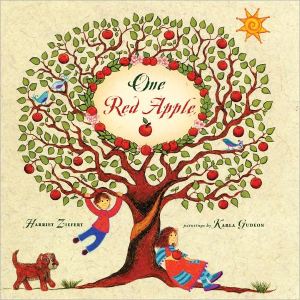
For the youngest apple pickers, my favorite introduction to the topic is One Red Apple (Ages 2-4), by Harriet Ziefert, with evocative paintings by Karla Gudeon. The book begins with a single red apple, ripe on the branch of the fall apple tree; it goes on to trace its life cycle, as it’s picked, eaten, dropped, and released back into the earth to sprout a new tree. Children are drawn into the action, as each of the single sentences comprising each page begins with an active verb: “Pick a red apple from a tree.” “Leave an apple core for the birds to eat.” “Watch tiny apple seeds scatter in the wind.” “See small sprouts peek out from the earth.”
Siblings Being Siblings
June 26, 2012 Comments Off on Siblings Being Siblings
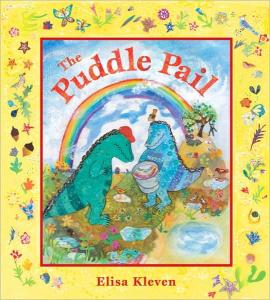 It wasn’t until I had more than one child of my own that I began experiencing what I’d so often heard other parents remark upon: that children raised in the same family, under seemingly identical conditions, can have completely different personalities. These differences in personality—and the interesting dynamic they create in the relationship between the siblings themselves—is beautifully captured in The Puddle Pail (Ages 3-6). This book was published in the late 90s by the supremely talented and often-overlooked author-artist Elisa Kleven (who also wrote my favorite picture book of all time: The Lion and the Little Red Bird).
Far too few children’s books showcase the natural, everyday interactions between siblings—or, more poignantly, the surprising discoveries that can emerge even amidst the competitive banter and indignant bossiness. The Puddle Pail stars two young crocodile brothers who set off for the beach, armed with empty pails. Sol, the older brother, might as well be my almost five-year-old son, JP. Both are realists and see the world in precise, everything-in-its-place terms. When it comes to filling his pail, Sol (a.k.a. JP) can’t pass up a shell or a feather or a rock without dropping it into his pail for one of his “collections” (currently in our house the window ledges are piled high with JP’s rocks, which seem less like a discriminating collection of stones and more like a dumping ground for any grey rock he steps over on the street).
Quiet Time Was Never So Quiet
June 10, 2012 § 5 Comments
 Let’s face it: there are times when you can’t submit to the chants of “Read to me! Read to me!” Perhaps you’ve just had a second baby and you’re looking for something to occupy the first. Maybe you’ve got a preschooler who is starting to give up her nap, but you’re still (desperately) hoping to institute Quiet Time. Or maybe your child is not quite reading but wants to feel like he is.
Whatever your motive, there is hope: it is possible to get your non-reader to engage in quiet, independent time with books. Of course, there are some books that are more likely to succeed than others. And, as a bonus, these also tend to be the books that bore you to tears if you do have to read them aloud. You know the type: books whose illustrations are jam-packed with detail; books whose pages your child wants to pour over at such length that it seems like you’ll be stuck in his room reading to him forever. Take yourself out of the equation, and these books become—not your worst enemy—but your greatest asset.
Food: Not Just for Eating
June 1, 2012 Comments Off on Food: Not Just for Eating
 What do you get the kid who has everything (including an extensive library filled with storybooks)? How about a brand new book that’s unlike any other, a rhyme-filled romp through magical lands made entirely out of—wait for it—FOOD! Carol Warner, a London-based still-life photographer, has created a clever and engaging picture book, titled A World of Food (Ages 2.5-8).
I like food. My kids like food. Really now, who doesn’t like looking at gorgeous photographs of food? Organized by color, each double-page spread reveals a fantastical scene where watermelons become boats (with asparagus as masts), dried cornflakes resemble falling foliage, chocolate KitKat bars stand in for train tracks, and pork ribs morph into jagged mountains (OK, you might want to pass this up for your vegetarian friends).
Your Budding Naturalist
April 28, 2012 Comments Off on Your Budding Naturalist
 Right now in preschools across the country, little eyes are glued to screened containers perched on shelves, waiting to behold one of nature’s most wondrous life cycles: the caterpillar’s transformation into a butterfly. (“Mommy, when the chrysalis shakes, that’s how you know there’s a lot of action going on inside!”)
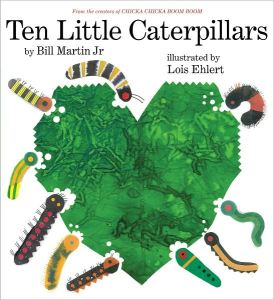
I grew up reading Eric Carle’s The Very Hungry Caterpillar (and really, who doesn’t love a book with holes for sticking tiny fingers through?); but in my opinion, Ten Little Caterpillars (Ages 2-6), written by Bill Martin Jr. and illustrated by the great collage artist Lois Ehlert, has topped this subject matter.
Apart from its stunning visual feast for the eyes, the book speaks to children on a multitude of levels. First, there’s the simple rhyme, each double-page spread focusing on a single caterpillar’s unique journey: “The first little caterpillar crawled into a bower./ The second little caterpillar wriggled up a flower.” A few of the caterpillars don’t fare so well (it’s a dog-eat-dog world, after all): one meets with a “hungry wren,” another is “frightened by a hen.” It’s the tenth caterpillar that we get to watch hang patiently among the apple blossoms for three pages, until her chrysalis hatches to reveal a stunning orange-and-black “tiger swallowtail.”
 What to Read to Your Kids