Learning From History’s Many Heroes
May 30, 2013 § 3 Comments
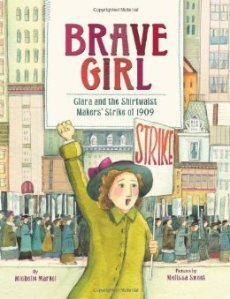 Just because the school year ends shortly doesn’t mean that our children’s minds have to shrivel up like apples left out too long in the sun. Last week, I gave some ideas for great read-aloud novels to share with your kids. Now, I’m going to encourage you to add some non-fiction into the mix—specifically, historical biographies posing as picture books. In previous posts about Martin Luther King Jr. and Abraham Lincoln, I’ve hailed the rise of today’s picture book biographies, which (unlike the static, black-and-white books of our school days) read like interesting, action-packed stories accompanied by vibrant paintings and intriguing designs. But I’m not merely talking about the Most Obvious Historical Figures; there are lesser known but equally captivating true stories of ordinary boys and girls, men and women, who shaped the world with extraordinary acts of courage, defiance, or creativity.
Where picture book biographies are concerned, contemporary illustrator Melissa Sweet has been on a roll, creating the art for several of my favorite non-fiction books in recent years. Although these biographies are written by different authors, they are unified by Sweet’s signature style—at once instantly recognizable but also entirely unexpected for the historical genre. In place of photographic-like paintings in somber tones, Sweet uses fun colors, whimsical patterns, and collage elements specific to the person whose story she is bringing to life. In Jen Bryant’s A River of Words: The Story of William Carlos Williams (Ages 7-12), Sweet peppers her background collages with excerpts from Williams’ poems, opening up kids’ eyes to these words and thoughts as an art form unto itself. In Alicia Potter’s Mrs. Harkness and the Panda (Ages 5-8), an account of the first person to capture a wild panda in China and bring it to an American zoo for study, Sweet creates frames for her watercolors out of authentic Chinese decorative papers, lending an other-wordly, almost mystical charm to this already fascinating story.
One of Sweet’s most recent triumphs is even more captivating for its portrayal not of an adult but of a young girl. Michelle Markel’s Brave Girl: Clara and the Shirtwaist Makers’ Strike of 1909 (Ages 6-10) tells the mind-boggling story of a Jewish immigrant girl, forced to endure long hours, harsh treatment, and poor pay, while sewing alongside hundreds of other girls in factories (her family’s only hope of putting food on the table.) Clara Lemlich’s “got grit,” and she “knows in her bones what is right and what is wrong”; ultimately, she leads the largest walkout of women workers in American history, inspiring thousands of male and female workers across the country to strike for better working conditions and the right to organize unions. « Read the rest of this entry »
Eyes on Abraham Lincoln
February 12, 2013 Comments Off on Eyes on Abraham Lincoln
 You might expect that my children, living so close to Washington DC, have many opportunities to learn about our nation’s history. But mere proximity does not a future scholar make. The Lincoln Memorial, for example, is consistently celebrated by my five year old as “the place where we picnic in the summer!” If you ask him the name of the president that sits in stone behind him during said picnics, he is likely to throw you a disinterested look and recommence staring out the car window, pointing out other landmarks whose names he boasts correctly but whose significance he understands not. Which begs the question: How do we get our kids to care about the past presidents that have shaped our country?
The biographies we read as kids were filled with dry facts and black-and-white photographs that made their content feel all too disconnected from our daily lives; too often we were encouraged to memorize names and dates for tests, only to forget them a week later. Thankfully, our own kids have access to a whole new generation of fresh reading material, including picture books that breathe colorful new life into historic periods and events.
“Use Your Words” (MLK Jr. Style)
January 17, 2013 § 1 Comment
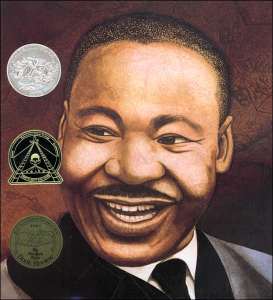 In a few days, our country will celebrate Martin Luther King, Jr.’s birthday and a presidential inauguration. Whatever our political views, whatever our race or gender or religion or socioeconomic background, we can do our children a great service by talking to them about Dr. King’s vision of justice and peace, his commitment to respecting the dignity of every human being.
I’ve found that parents, especially us white Americans, are reluctant to broach the subject of race relations with preschoolers or even young elementary students. Ashamed of our country’s past afflictions, it’s as if we can pretend they never existed if we don’t talk about them. But child development specialists and sociologists (like Po Bronson and Ashley Merryman, authors of NurtureShock) have pointed out that children naturally notice differences in appearances, and that if we don’t have these conversations with them from an early age, they will begin to draw their own conclusions—and, even worse, begin to view the subject as taboo—which does nothing to advance our nation’s long and still arduous progression toward equality. And, let’s be honest, have you ever met a five or seven or ten year old that isn’t obsessed with the notion of fairness? For that matter, how many times a day do we as parents plead with our children, “Use your words!” (say, when said children yank something out of their sibling’s hands or push a peer on the school playground)?
Advanced Apple Picking: Part Two of Two
September 14, 2012 § 1 Comment
 In addition to making little botanists out of your children (see my previous post), apple picking can inspire some fascinating historical and cultural discussions, especially for the older set. As a quintessentially American pastime dating back to frontier life, apple picking speaks to some of our country’s core values.
Enter Johnny Appleseed, that larger-than-life figure who was allegedly responsible for planting and distributing the seeds for many of our country’s apple trees (that’s right, boys and girls, that apple you’re eating might have descended from a seed this guy planted!). September 26 marks the birth of Johnny Appleseed (whose real name was John Chapman). Last year at this time, I searched the libraries for a book about Chapman to bring to JP’s school; but while there are no shortage of kids books written on this topic, most struck me as inaccessible—a portrait of an historical figure presented without any meaningful context.
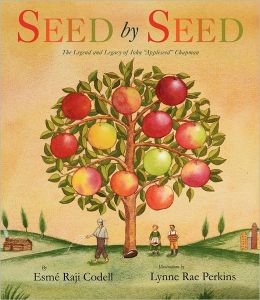
This fall, however, the topic has gotten a facelift by Esme Raji Codell and Lynne Rae Perkins, in their newly published and utterly captivating Seed by Seed: The Legend and Legacy of John “Appleseed” Chapman (Ages 5-10). What Seed by Seed does that no one has thought to do before is to set the stage by giving kids an up-close-and-personal account of the sights, smells, and sounds of early frontier life.
Elevating the Poop Talk
August 1, 2012 § 1 Comment
 As previously noted, we recently spent a week on the Canadian side of Lake Erie, where the beach isn’t exactly the soft white expanse of the Caribbean. But there’s an as-of-yet-unmentioned benefit to such dark, coarse, and oily sand if you’re an almost five-year-old boy: when wet, it bears a striking resemblance to poop. Cue hours of enjoyment for my son, and lots of averted trying-to-seem-oblivious glances from me. It never mattered how things began (“Mommy, I’m building a series of canals!”), they always ended at poop (“Mommy, now these canals are full of POOP!”)
During the 10 hour drive home at the end of the week, I had a revelation: if you can’t beat ‘em, join ‘em. Or rather, how could I direct this obsession into something educational?
I decided to get my hands on The Truth About Poop, by Susan E. Goodman (Ages 5-10), a mature picture-chapter book packed with biological, zoological, historical, and geographical facts about, yes, poop. There have actually been quite a few expertly executed books on this topic over the past 10 years, and they were always big hits at my shop (“You’re telling me your seven-year-old son isn’t interested in reading? Have you tried giving him a book about poop?”). I figured it was high time to bring one home for JP.
 What to Read to Your Kids