Embracing Ordinariness
February 26, 2014 § 6 Comments
 The lovely new picture book, ExtraOrdinary Jane (Ages 3-100), by first time author-illustrator Hannah E. Harrison, has me all fired up—but in a good way. Jane, a fluffy little white circus dog, “was ordinary, in a world that was extraordinary.” She isn’t “mighty” like her elephant-lifting father, or “graceful” like her ballerina mother. She isn’t “daring” enough to be shot out of a cannon like her six canine brothers. Try as she does to “find her special talent,” she encounters either mediocrity (her paintings lack “pizzazz”) or failure (her musical renditions send others running).
While the book may be set in a circus, its poignant, carefully worded message is clearly intended to transcend the Big Top. Recently, I’ve been thinking a lot about what it means to be ordinary in our increasingly supercharged, achievement-obsessed society. Bringing up kids today means confronting talent at seemingly every turn: the athlete that tears down the soccer field; the six year old who is already in her third year of violin; the kid who reads at three grade levels above her peers. It’s not enough for children to be good at something; they are expected to be the best. When I was growing up, it wasn’t until I was applying to college that I was asked to think about the concept of “expertise.” Today, the question is on preschool applications: “What special skills/talents does your child have?” « Read the rest of this entry »
Friends Make Everything Better (A Pick for Valentine’s Day)
February 10, 2014 § 2 Comments
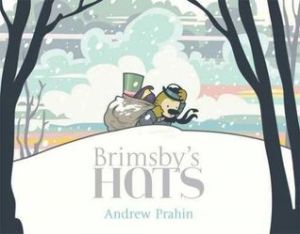
My family spent this past weekend holed up in the snowy hills of West Virginia with three other families. Once we adults began to block out the chatter and squeals of nine (mostly) happy children running circles around us, we were able to entertain some blissful grown-up time. And as I watched my children mature and transform across three full days of kid-on-kid time, I found myself feeling immensely grateful for friendships of both the tall and short kind. In this winter that has gone on too long, it is our friends that have put smiles on our faces, ideas in our head, and glasses of wine in our (adult) hands.
With Valentine’s Day shortly upon us, I’ve once again chosen a bit of a non-traditional path for my children’s gifts (and, gasp, I’ve even cheated and given the gifts early!). This new picture book—by a first-time author-illustrator—rises above the saccharine-sweet-mushy-gushy-dime-a-dozen stories out there by celebrating friendship in a unique, quirky, unforgettable way.
In Andrew Prahin’s Brimsby’s Hats (Ages 4-8), Brimsby, a hat maker by trade, already knows what it is like to have a best friend: someone with whom he shares his creations over tea, and “together, they have the most wonderful conversations.” But when the friend follows his dream to become a sea captain and sails away, Brimsby is left to pass the months away alone in his quiet cottage in the country, without so much as a single visitor.
Groundhog Day (& Other Books About the Weather)
January 29, 2014 § 3 Comments
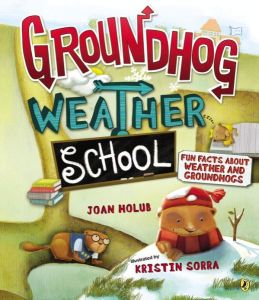 My six year old doesn’t understand why Groundhog Day isn’t a school holiday. I tried to explain that, with February 2 being a Sunday this year, it’s sort of a moot point. “But it’s not always on a weekend, Mommy.” So then I tried to explain that the government only picks a few of the most important people in our history (ahem, George Washington, Martin Luther King Jr.) to honor with a school holiday—and that contrary to what he might think with ALL THESE SNOW DAYS, kids are supposed to be IN SCHOOL, learning stuff that their parents don’t have the patience to teach them. “Well, Punxsutawney Phil IS very important because he can PREDICT THE WEATHER.” This is a fair, if debatable, point.
The children’s books on the subject of this Very Important Holiday tend to be either factually straightforward (Gail Gibbons’ Groundhog Day! is usually the teacher’s favorite) or purely fictional (read: silly and unhelpful). But this year, I stumbled upon a find that combines fact, fiction, and An All-Around Good Time: a book titled Groundhog Weather School: Fun Facts About Weather and Groundhogs (Ages 5-9), by Joan Holub, with illustrations by Kristin Sorra. This is precisely the type of book I knew JP would enjoy reading by himself (and, as parents of newly independent readers know, we’re always on the hunt for “that book”). « Read the rest of this entry »
Holiday Gift Guide 2013: Illustrated Chapter Books for the Adventure Seeker
December 19, 2013 § 5 Comments
 Many of us remember the first novels we read, the ones that instilled in us a love of reading (off the top of my head: A Secret Garden, A Wrinkle in Time, anything written by Ruth Chew…). Earlier this year, the prolific writer, Neil Gaiman, wrote a beautiful defense of fiction, which I absolutely love. Fiction, he claims, is not only our best entry into literacy (the what-will-happen-next phenomenon being utterly addictive), but it teaches, above all, the power of empathy:
“When you watch TV or see a film, you are looking at things happening to other people. Prose fiction is something you build up from 26 letters and a handful of punctuation marks, and you, and you alone, using your imagination, create a world and people in it and look out through other eyes. You get to feel things, visit places and worlds you would never otherwise know. You learn that everyone else out there is a me, as well. You’re being someone else, and when you return to your own world, you’re going to be slightly changed.”
I’ve thought a lot about Gaiman’s words, as my six year old and I have been devouring some of the year’s newest chapter books. I’m hoping some of our favorites will find a way into your bedtime routines as well, beginning with Gaiman’s newest novel, Fortunately, the Milk (Ages 7-10, younger if reading aloud). This fantastically over-the-top book begs to be read aloud and is itself a kind of commentary on the power of storytelling. In an attempt to entertain his rambunctious children during their mother’s business trip, a father spins a fantastical tall tale (think pirates, piranhas, aliens, and singing dinosaurs all in the same breathlessly-paced story) about what happens when he goes to the store for a simple carton of milk. « Read the rest of this entry »
Holiday Gift Guide 2013: Stories of Perseverance for the Engineer
December 10, 2013 § 1 Comment
 If at first you don’t succeed, try, try again. That might be easy to say as a parent, but we have only to remember our own childhoods to know how hard it is to hear. Just the other night, my son was attempting to draw a human profile by following one of those step-by-step guidebooks. Diligently huddled over his paper, he suddenly threw the pencil across the room and yelled, “This isn’t working at all! It doesn’t even look like a person!” Actually, I thought, it does look like a person—just not like the one in the book. Oftentimes, we cannot see our triumphs for what they are.
The creative process—its ups, its downs, its just plain hard work—is wonderfully captured in Rosie Revere, Engineer (Ages 5-8), the newest venture by Andrea Beaty and David Roberts, the team that created one of my favorite picture books of all time: Iggy Peck Architect. What black-turtleneck-sporting Iggy Peck did for building designs, red-scarf-sporting Rosie Revere (yes, her namesake is Rosie the Riveter) does for engineering. She makes it look—well—cool. « Read the rest of this entry »
November’s Birthday Pick Battle
November 8, 2013 § 2 Comments
 Six year old boys live in a world of their own. Often, the only people who understand them are other six year old boys. Take this recent conversation I witnessed as I was driving JP and his buddy home from school:
Friend: “I think I just saw a box of dynamite on the side of the street.”
JP: “Cool! Imagine if you took an inflatable bouncy house and blasted dynamite underneath it, and the bouncy house exploded into Outer Space and caught fire to the moon!”
Friend: “Yes! And then the bouncy house would blast the moon to the sun where it would explode into a thousand pieces and turn to gas!”
JP: “And then that gas would get into the Earth’s atmosphere and poison the guts out of all the bad people!”
Friend: “And they’d all become zombies and their eyes would fall out of their heads!”
JP: “Look, my cheese stick is pooping!”
Friend: “Cool!”
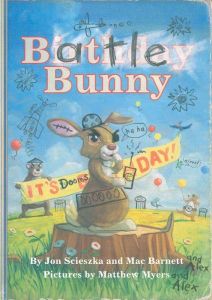
We as parents might not be able to compete with this level of engrossing conversation, but I’ll tell you who can: Jon Scieszka and Mac Barnett, whose Battle Bunny (Ages 5-9), is going to rock the world of every boy in the universe, guaranteed. « Read the rest of this entry »
The Rules of Play
October 10, 2013 § 2 Comments
 As parents, we are continually hounded by parenting experts about the importance of getting down on the floor and playing with our children. I’m fairly easily wooed when it comes to playing Candy Land or doing a giant floor puzzle or even painting alongside my kids; but when it comes to imaginative play, a little part of me wants to scream, “Please don’t make me do it!!!!” Why, you ask? Or maybe you don’t need to ask, because you already know about ALL THE RULES that our children arbitrarily force upon us from start to finish during these games. And nowhere is this more evident than when my daughter wants to play tea party.
E: “Mommy, let’s have a tea party!”
Me: “OK, where should I sit?” (I’ve learned better than to presume.)
E: “Right here”
Me. “OK’ (Sitting down.)
E: “No, you don’t sit like that! You have to cross your leg.”
Me: (making adjustments) “OK, I’m ready for my tea now.”
E: “No! First we are having a snack.”
Me: “OK, what’s for snack?”
E: “You don’t ask the question! You wait and I bring you the snack.”
Me (minutes later after being served a wooden egg and a plastic cucumber) “Mmmmm, thank you, this is so tasty!”
E: “MOMMY! It’s not time to eat yet! You have to wait for your tea!”
Me (an eternity later, when pretend tea is finally served): “Mmmmm, this tea is toasty warm.”
E: “It’s COLD tea!”
Me: “This tea is nice and refreshing. I think I’ll put some sugar in it.”
E: “That’s honey!”
Me: “I’m putting in some honey.”
E: “NO! You don’t pour it in, you have to use a SPPPOOOOOON!”
Thank you, but I will stick with Candy Land. « Read the rest of this entry »
Party Planning Angst
September 24, 2013 § 2 Comments
 JP turned six today. As you may recall, we are All About Birthdays this month, having just celebrated my daughter’s third birthday two weeks ago. At some point over the summer, my kids realized that their birthdays were (sort of) approaching, and many of their conversations turned to what kind of parties they wanted to have (“Snakes and a pinata!” from JP; “Balloons and flowers!” from Emily) and whom they wanted to invite.
This latter debate became increasingly complicated for my youngest, because in addition to her now having a few similarly aged friends, she still claims most of her brother’s friends as her own (having been toted around to his play dates for three years). Back when JP turned three, we had exactly three children over for a nice, contained party. When Emily turned three, we found ourselves with 25 kids running around our backyard. Throw in a giant inflatable bounce house, a craft station, and soccer goals, and it would appear that my husband and I have finally embraced this moving-to-the-‘burbs thing. But I digress. « Read the rest of this entry »
August’s Birthday Pick
August 8, 2013 Comments Off on August’s Birthday Pick
 Sometimes we need a Crowd Pleaser. How many times have we rushed to the store (on the morning of the birthday party, no less) and stared at the shelves, thinking “What do I even know about this child, this person in my daughter’s class whose name I’d never heard until last week?” Our children are often no help: “Ummm, I don’t know, he likes Star Wars, I think…” And then there’s the latest trend in birthday parties—the book exchange—which, naturally, I find charming and all, except that now we have the additional challenge of finding a book that will appeal to any one of the number of children at the party. Enter the Crowd Pleaser: a book that’s guaranteed to make boy, girl, preschooler, first grader laugh; a book they can listen to or read themselves or read to their siblings; and, of course, a book that’s Brand New and Off the Beaten Path and all that good stuff.
Now enter Monkeys. Because if there’s any animal that’s universally loved by children (and their parents) it’s the monkey. We all call our children monkeys; we all think of them as little monkeys (incidentally, we also think that this comparison is an entirely novel notion). Anyway, monkeys are good. Monkeys are safe.
Now enter Mac Barnett, one of the most original and—conveniently, in our quest for a Crowd Pleaser—one of the funniest picture book creators around. Last year, along with the talented Adam Rex, he wrote Chloe and the Lion (Ages 4-8), a hilarious (and surprisingly educational) look at the process of writing and illustrating a picture book, whereby Barnett and Rex essentially “argue” the book into creation. This year, he teams up with Kevin Cornell to lend his deconstructionist approach to Count the Monkeys (Ages 3-7), another book that appears to take form right before our eyes. The book begins with a simple premise: “Hey, kids! Time to count the monkeys! It’s fun. It’s easy. All you have to do is turn the page…” Except that the monkeys are nowhere to be found, scared away by a king cobra, who in turn is scared away by two mongooses (“or is that 2 mongeese?”), who in turn are scared away by three crocodiles…and you get the picture.
The genius of Count the Monkeys, apart from Cornell’s irresistibly mischievous drawings of gluttonous grizzly bears and “polka-dotted rhinoceroses with bagpipes and bad breath,” is the invitation for children to interact with every page. If you’ve ever read Herve Tullet’s groundbreaking Press Here to your children (and if you haven’t, please proceed immediately to your nearest independent bookstore), you are already familiar with this now trendy trick of modern picture book artists. These are books that invite children, not only into the reading process, but into the creation process as well. They make children feel like they themselves are driving the direction of the story. On every page in Count the Monkeys, the narrator (still obsessed with getting back those elusive monkeys) asks us to perform various tasks to get rid of the imposter: tell the lumberjacks to “scram” (“Say it even louder!”); don’t look the wolves in the eyes (“In fact, cover your eyes while you turn the page”); move your hand in a zigzag to “confuse” the crocodiles; etc. I triple dare any child (heck, I dare any parent) to refrain from doing any of the things Barnett demands; it’s simply too much fun to take a backseat on this one. And that, ladies and gentlemen, is a Crowd Pleaser.
Potty Break
August 1, 2013 § 2 Comments
 Once again, I find myself singing the praises of Mo Willems, whose Time to Pee! (Ages 1-4) proved just what my daughter needed to get her potty training on. For those of you who have navigated these murky waters before, you will agree that there are VERY FEW decent potty-related books for kids. There are useless books about princesses sitting on potties. There are patronizing books that suggest you’re only a big kid if you use the potty. But there are far too few that are clever and helpful, fun and functional. But that’s OK. Because all you really need is one great book—and, lucky for us, there’s Time to Pee!
Truth be told, I had been dreading potty training my youngest. I had it too easy with my firstborn. If I told you about how he emphatically decided upon turning two that he wanted to poop on the potty and never looked back, you would hate me. Except that you can’t hate me, because I literally had nothing to do with it (JP has always been a child to take matters into his own hands, skeptical that his parents don’t really know what they are doing and not entirely incorrect much of the time). So when my daughter turned two and showed ZERO interest in anything having to do with the potty, I simply told myself that she wasn’t ready. But then, yikes, almost an entire year passed, and here we are just a few short weeks from her joining her brother in Montessori, where she’ll be expected to do things like wear underwear and wipe her own butt; suddenly, “I no interested in the potty!” seemed like a recipe for disaster. So we took the plunge, gave away all remaining diapers (this tip from the parenting book, Diaper-Free Before 3, a fantastic recommendation from our Montessori director), and casually placed Time to Pee! on the top of a reading pile in the bathroom.
Now, I’m obviously not going to tell you that a children’s book (even one by the brilliant Mo Willems) was the single factor in Emily’s fairly quick and painless transition to the potty (much of the heavy lifting was in fact done by Big Brother). But what I can tell you is that the language in Time to Pee! repeatedly crops up when Em is talking about using the potty. At face value, the book reads like a straightforward (never patronizing) instruction manual, illustrated with Mo’s signature black-outlined doodles: you get “that funny feeling” while playing; you tell a grown-up that you have to go; you march yourself down the hall and into the bathroom, where you pull down your undies, do the deed, and get back to playing. Done. No problem. All the important logistics are covered, like waiting until you are done before grabbing for toilet paper (thank you, Mo) and washing hands afterwards. But then, because it’s Mo Willems, and because he is so darn perceptive about how kids’ minds work and what they are thinking (and obsessing and worrying) about, the book is loaded with humorous touches. “Please don’t ignore it!” (next to a boy with crossed eyes and legs). “Now is your chance to show how BIG you are!” And my favorite: “Everything will still be right where it was” (as the child returns to her tea party).
But the real unsung heroes here are the mice. Yes, that’s right, the hundreds of enthusiastic mice delivering each message, rolling out the red carpet and hoisting up the flags, serenading the potty goer and giving the thumbs up with a coy, “Go for it dude.” Three days into potty training, I tried to follow Emily into the bathroom after she announced that she had to pee. “No, Mommy! You don’t come in! I’m having a party with the mice.” And just like that, I found myself once again singing the praises of Mo Willems.
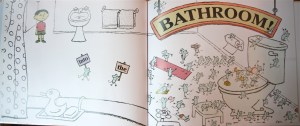
The aforementioned mouse party in the bathroom!
Other Favorite Potty Stories for Kids:
Even Firefighters Go to the Potty: A Potty Training Lift-the-Flap Story, by Wendy A. Wax, Naomi Wax, & Stephen Gilpin (long after JP was potty trained he still requested this book 10 times a day for two years)
Everyone Poops, by Taro Gomi (yes it’s weird, yes it’s kinda gross, but it’s actually quite effective (and my kids love the camel’s “two hump poop”))
A Potty for Me, by Karen Katz
Pip and Posy: The Little Puddle, by Axel Scheffler (my daughter loves this sweet, simple series about two friends—and, lo and behold, they have a potty story about an accident during a playdate)
Biking for Beginners and Pros
July 5, 2013 Comments Off on Biking for Beginners and Pros
 We interrupt our Summer School Series for some good ‘ol fashioned outdoor play—and because there happens to be two seriously awesome new picture books about riding a two wheeler (the Ultimate Summer Challenge, really). The first book is for the I-Think-I-Can-Beginners; the second is for the experienced, daring, and creative bikers (especially those with a love for all things Space).
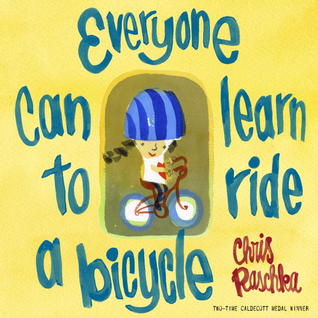
Chris Raschka’s Everyone Can Learn to Ride a Bicycle (Ages 3-6) is a simple but poignant “how to” look at mastering a two wheeler, first with training wheels and then without. Now, if I were going to write a step-by-step guide to teaching a five year old to ride a bike, it might go something like this:
Lug ten tons of second-hand steel to park, at the request of eager child.
Help eager child up into bike seat.
Become temporarily deaf by imminent screaming of “NOOOOOOO get me off get me off get me off!”
After much cajoling and pleading and promising for the 45th time that you are going to hold on the whole time, convince child to remount bike and begin pedaling forward.
After 10 minutes, whereby you are still holding fast to the training-wheeled bike and said bike has moved exactly 10 feet, suggest that he try turning.
Feel an abrupt jerk as child slams on the breaks (this, oddly, comes very naturally), jumps off bike, and announces that he is Most Definitely Not Doing This Right Now.
Lug ten tons of steel back home.
Fortunately, Everyone Can Learn to Ride a Bicycle paints a much rosier picture of a child learning to ride a bike, along with the help of her patient and gently encouraging father.
But, actually, what I love about this book is that things are not always smooth sailing: the little girl has lots of false starts, falls down again and again, and needs both hugs and Band-Aids. “Oops! You nearly had it,” the book coaches. “Don’t give up. You’ll get it. Find the courage to try it again, and again, again, and again, again, and again, and again, until by luck, grace, and determination, you are riding a bicycle!”
Rashchka’s signature watercolors, seemingly effortlessly executed with thick, breezy, rough strokes of paint, are perfectly suited to the subject at hand. Every single painting exudes movement—whether it’s the little girl pulling her father’s hand toward the bike shop, her sideways and backwards tumbles off the bike, the neighborhood kids zooming past her on their colorful two wheelers, or her triumphant forward-leaning fast-pedaling stance at the end.

Rashchka’s greatest gift has always been his ability to capture emotional expression with just a few brushstrokes; and it’s the determination, bewilderment, frustration, joy, and pride on the little girl’s face that will make this gem relatable for children—those struggling to ride and those who’ve newly mastered the skill. I’m not promising this book will work miracles, assuming there might be other parents out there who are having similar bicycling battles on the playground (please tell me I am not alone); but I can promise that your child will identify a kindred spirit on the page.
Moving on to mor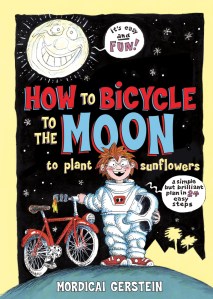 e advanced bicycling (and a longer, more sophisticated story), I fervently recommend How to Bicycle to the Moon to Plant Sunflowers: A Simple but Brilliant Plan in 24 Easy Steps, by Mordicai Gerstein (Ages 5-10). If the irreverent title alone hasn’t sold you, let me sing the praises of this most entertaining book, particularly for the kid who loves science, invention, numbers, the Moon, and bossing people around (that would be my son to a T, minus the bicycling).
First, when was the last time your child read a work of fiction that was laid out in steps? Each of this book’s 39 pages outlines a different step, numbered 1 through 24, many of them sub-categorized with letters (12a, 12b, 12c, 12d, etc.). Kids love this stuff; it’s exactly the way their mind works when they are bossing us around.
Secondly, there’s the very idea of bicycling into outer space, not to mention for the purpose of planting sunflowers to cheer up the Moon’s “big, sad clown face.” Thirdly, there’s the intricately involved and scientifically supported plan that the boy conjures up—a plan involving 2,000 used truck inner tubes, a 25-foot flagpole, a ship’s anchor, 238,900 miles of garden hoses wound tightly around a giant spool, a rented XS space suit from NASA, and various provisions, including “nourishing, flavored Glop, squirted through a straw in your space-helmet.”

Finally, there’s the climactic adventure itself, Boy On Bike, pedaling up miles of garden hoses that have been anchored into the Moon’s surface, stopping to wonder at “the trillions of stars.” Within the largely comic narrative, written in the boy’s instructive voice, there are also many clever descriptions, my favorite being the notion that the Moon looks “like a coloring book that hasn’t been colored yet.”
Gerstein’s pen and ink drawings have a comic-book feel, but the crudely colored line art is mixed with grace and subtlety (the Moon’s changing expressions are a particular delight). This is the same Gerstein who wrote and illustrated one of my (and my son’s) favorite books: The Man Who Walked Between the Towers (Ages 4-8), the true and serious story of Phillipe Petit’s dramatic tightrope walk between the World Trade Towers in 1974. The two books could not look or feel more different (a rare feat for a picture book artist); yet, oddly, they both involve moving atop a skinny, rope-like material suspended over great heights.
Gerstein writes books about dreams—about the mystery, wonder, and excitement in planning for and achieving those dreams. I have a dream that my children will both ride two wheelers some day, that they will taste the victory that comes from balancing up high on their own, and (as I vividly remember doing as a young girl) that they’ll speed around the block, dreaming and scheming and making their own Big Plans.
Making A Mess of the Alphabet
March 11, 2013 § 3 Comments
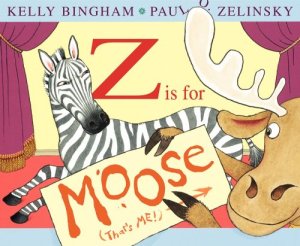 I was wrong. Occasionally, this happens. (My husband would probably debate the word “occasionally,” but this isn’t his blog and, besides, I am usually right when it comes to books.) Shortly after Kelly Bingham and Paul O. Zelinsky’s Z is for Moose (Ages 4-8) was published last year, I hastily thumbed through it at a bookstore and thought, “Another alphabet book…rudimentary drawings…simplistic-seeming text…a Bullwinkle-style moose…I’ll pass.”
Then, in January, right after the Caldecott winners were announced, the Internet was suddenly abuzz about this book: top children’s book critics were outraged that Zelinsky’s book got passed up for an award, and some went so far as to argue that it was the most revolutionary book published in 2012. “Huh?” I thought.
So ,when I happened to come across the book a second time (this time at our local library), I picked it up, brought it home, and read it to my kids. I’ll say it again: I was wrong. In my haste to judge a book by its cover, I completely blew past its cleverness, its hilarity, and its brilliant way of turning conventional alphabet books on their head.
The “Perfect” Christmas Tree
December 3, 2012 § 4 Comments
 This past weekend, we partook in one of our favorite family traditions: chopping down our Christmas tree and driving it home to trim. We started this tradition five years ago, when JP was one year old. I like the idea of my children understanding where their Christmas tree comes from; plus I enjoy supporting the family-owned tree farms in our area; plus, well, we all know that I love any excuse to unleash my urban children on a farm.
By now, the excursion has become fairy predictable. JP (eager to get his hands on a saw) begins by pointing to the first tree he sees and announcing, “This is the perfect one!” I meander deep into the fields, weaving in and out of the rows, sizing up each possibility and muttering oohs and ahhs. And my husband (who has carefully measured our nook at home and tried to set appropriate expectations before we left the house) rushes after me, chastising, “That one is too big! It won’t fit! You promised this year you’d be reasonable!” He has a point, my husband, but I can’t help myself. Something overcomes me out there in the crisp open air, beautifully manicured trees stretching out on all sides of me, and I WANT BIG.
I guess in this way I’m a lot like Mr. Willowby, the mustached tycoon in one of my favorite Christmas stories to read aloud to my kids (or, in the case of last week, to my son’s preschool class). Originally published in 1963, Robert Barry’s Mr. Willowby’s Christmas Tree (Ages 3-8) was reissued last year with newly colorized pen-and-ink sketches that brim with delight. Mr. Willowby’s Christmas tree comes straight off the hills—“full and fresh and glistening green—/The biggest tree he had ever seen.”
My Good Pal Mo (I Like to Pretend We’re On a First Name Basis)
November 10, 2012 § 1 Comment
 No one gets straight to the heart of kids like Mo Willems. It seems almost criminal that I’ve been at this blog for several months now and have yet to sing the praises of one of the most original author-illustrators of all time. While he’s best known for the Don’t Let the Pigeon Drive the Bus series (which, despite its popularity, is not my or my children’s favorite), Mo is at his best with one-off masterpieces, like Edwina, the Dinosaur Who Didn’t Know She Was Extinct and Leonardo the Terrible Monster (see my complete list at the end). And now we get to add his newest creation, Goldilocks and the Three Dinosaurs (Ages 4-8), in which three scheming dinosaurs lure Goldilocks into the wrong fairy tale in an effort to make “chocolate-filled-little-girl-bonbons” out of her.
During the 46 times that I’ve been asked by my son to read this book in the past month, I’ve started to put my finger on what it is that unites Mo’s seemingly disparate stories. Mo gives children A LOT of credit (probably more than us parents do). He doesn’t employ traditional literary devices (in fact, in Goldilocks he actually turns them on their head), and he offers few explanations; instead, he writes with the expectation that kids will pick up on the subtlety, the irony, the little side jokes, and the sophisticated vocabulary through their repeated readings. Over the years, I’ve had more than one person ask me whether Mo’s multi-layered storytelling is accessible enough to children or simply intended to amuse the parent who’s reading it. In response, let me give you an account of how my five year old experienced Goldilocks and the Three Dinosaurs:
Monsters With Manners
October 11, 2012 Comments Off on Monsters With Manners
 I recently asked my five-year-old son: “What do you think monsters are like?” His answer: “They have big teeth and sharp claws and they eat little kids.” Oh. Well, the good news is that there’s a new(ish) genre afoot in children’s literature: not-too-scary scary stories (my recent posts on Creepy Carrots and Vampirina Ballerina are great examples). There are also some fantastic monster-themed books, featuring a new generation of what I will call Funny Monsters.
What makes kids find the monsters in these books so funny? Precisely because our little ones, occasionally monstrous themselves, can identify with these monsters’ unpredictable bursts of rage and destruction. On some level, they recognize a shared vulnerability, a shared quest to fit in and make sense of a complex world.
Author and illustrator Patrick McDonnell (best known for his Mutts comic strip) has a knack for creating deceptively simple picture books that get right to the heart of what it means to be human. In the beginning of his brand new The Monsters’ Monster (Ages 3-7), we are introduced to three tiny nay-saying monsters, named Grouch, Grump, and little Gloom ‘n’ Doom (how can you not immediately love this book?). The trio relishes their job of being monsters: they have tantrums, their favorite word is “NO,” and they love crashing, smashing, and bashing (sound familiar yet?).
The Best Reason to Read Fairy Tales?
August 30, 2012 Comments Off on The Best Reason to Read Fairy Tales?
 I’ve always felt a bit ambivalent about traditional fairy tales. True, I buy into the argument made by many literary and child development scholars that our children are reassured by seeing young heroes and heroines persevere through creepy, frightening situations. True, out of the hundreds of books I loved as a kid, it was a fairy tale—Hansel and Gretel, to be precise—that made the most lasting impression on me. And yet, with the sheer wealth of original, high quality children’s books being published today, I tend to forget about reading fairy tales to my kids.
Until I remember what may be the very best reason to read them: if your kids don’t know the original stories, how will they appreciate all the fantastic fractured versions that have popped up in recent years? My new favorite is one that was actually discovered by my husband (that’s right, he recently took the kids to a bookstore and managed to buy a book that I didn’t know about—and a brilliant one at that!).
Hot off the presses, it’s an urbanized retelling of Jack and the Beanstalk, titled Jack and the Baked Beanstalk, by Colin Stimpson (Ages 4-8). This debut author-illustrator is a Brit (like him already) and a former art director for Walt Disney; the latter is relevant because his impressive cinematic illustrations combine the grittiness of a cityscape with a Disney-esque glossiness.
Hot-Off-the-Press for August’s Birthday Parties
August 14, 2012 § 2 Comments
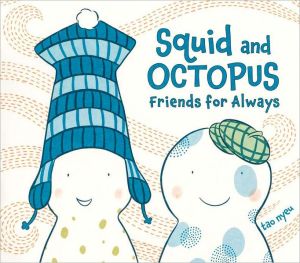 I’m a bit late with my pick for August birthday parties, but this gift will work equally well heading into the school year, because it’s a book about friendship! In Squid and Octopus: Friends for Always (Ages 4-8), Tao Nyeu is following a great literary legacy of Dynamic Duos (Frog and Toad, George and Martha, to name two favorites from my own childhood). Like her predecessors, Nyeu has packed her stories (there are four, organized as “mini-chapters” in the one picture book) with that winning combination of humor and heart. Squid and Octopus bear a particular resemblance to my son JP and his best buddy Willem: like all great friends, they argue about who is right, they make up by deciding they’re both right, they make each other laugh with silliness no parent can hope to understand, and they give each other lung-compressing squeezes that are supposed to resemble hugs.
What makes Nyeu’s book sing are her fantastical illustrations: pattern-studded silk screens made from water-based ink and colored pencils set against a simple white background. For a book about two cephalopods, living in an underwater universe complete with flower gardens, soup stands, and swing sets, one would expect backgrounds in dizzying shades of blue; but by setting her drawings on white, Nyeu focuses children’s attention on the irresistible quirkiness of the characters themselves. (I won’t say that I’m not totally attracted to the Jonathan Adler-esque color scheme of turquoise and orange as well.) As I was getting ready to write this post, I asked JP what his favorite thing about the book was. Instead of one, I got five enthusiastic points:
Putting Dad to Bed
June 15, 2012 Comments Off on Putting Dad to Bed
 This Sunday is Father’s Day, so Dad deserves a break. Maybe he should go to bed early. But what if he starts doing cartwheels and runs around the house yelling, “No, no no, I won’t go to sleep!” What if he tries to negotiate one more story (after he has already had two) and then needs to be tucked in just right and then calls you back to leave the hall light on—until you realize: “A Dad who doesn’t want to go to sleep is exhausting!”
This is exactly what goes down in the delightful new picture book (originally published in France), titled My Dad is Big and Strong, BUT…: A Bedtime Story (Ages 3-6), by Coralie Saudo, illustrated by Kris DiGiacomo. A little boy tell us: “My Dad is big and strong, but every night it’s the same old story. And this is how it begins: ‘I don’t want to go to bed!’” The ordeal that follows, turning a classic parent-child struggle on its head, will have both boys and girls in stitches.
Getting Up the Giggles
May 22, 2012 § 2 Comments
 Let’s face it: being a parent can sometimes feel like a thankless job (does he realize I’m missing precious minutes of “American Idol” while I’m washing his uniform for tomorrow, composing a creative note for his lunchbox, and picking crumbs off the floor so it will stop looking like the inside of a barn—all while he is hollering from upstairs about “one last drink of water”?).
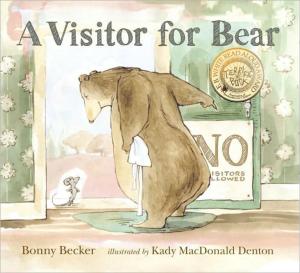
Suffice it to say that we parents will take an Ego Boost where we can get one. And that’s why I love reading books like A Visitor for Bear (Ages 3-6), the first of the delightful Bear and Mouse books by Bonny Becker, with illustrations by Kady MacDonald Denton. Now, I could love this book because of the witty banter between the two strangers-turned-friends, or because Mouse speaks in a decidedly British accent, or because a bear dressed in an apron is just so darn cute. But, on those rare occasions when JP allows me to choose his bedtime book, the reason I run to grab this gem off the shelf, is because it makes him LAUGH OUT LOUD.
 What to Read to Your Kids