Potty Break
August 1, 2013 § 2 Comments
 Once again, I find myself singing the praises of Mo Willems, whose Time to Pee! (Ages 1-4) proved just what my daughter needed to get her potty training on. For those of you who have navigated these murky waters before, you will agree that there are VERY FEW decent potty-related books for kids. There are useless books about princesses sitting on potties. There are patronizing books that suggest you’re only a big kid if you use the potty. But there are far too few that are clever and helpful, fun and functional. But that’s OK. Because all you really need is one great book—and, lucky for us, there’s Time to Pee!
Truth be told, I had been dreading potty training my youngest. I had it too easy with my firstborn. If I told you about how he emphatically decided upon turning two that he wanted to poop on the potty and never looked back, you would hate me. Except that you can’t hate me, because I literally had nothing to do with it (JP has always been a child to take matters into his own hands, skeptical that his parents don’t really know what they are doing and not entirely incorrect much of the time). So when my daughter turned two and showed ZERO interest in anything having to do with the potty, I simply told myself that she wasn’t ready. But then, yikes, almost an entire year passed, and here we are just a few short weeks from her joining her brother in Montessori, where she’ll be expected to do things like wear underwear and wipe her own butt; suddenly, “I no interested in the potty!” seemed like a recipe for disaster. So we took the plunge, gave away all remaining diapers (this tip from the parenting book, Diaper-Free Before 3, a fantastic recommendation from our Montessori director), and casually placed Time to Pee! on the top of a reading pile in the bathroom.
Now, I’m obviously not going to tell you that a children’s book (even one by the brilliant Mo Willems) was the single factor in Emily’s fairly quick and painless transition to the potty (much of the heavy lifting was in fact done by Big Brother). But what I can tell you is that the language in Time to Pee! repeatedly crops up when Em is talking about using the potty. At face value, the book reads like a straightforward (never patronizing) instruction manual, illustrated with Mo’s signature black-outlined doodles: you get “that funny feeling” while playing; you tell a grown-up that you have to go; you march yourself down the hall and into the bathroom, where you pull down your undies, do the deed, and get back to playing. Done. No problem. All the important logistics are covered, like waiting until you are done before grabbing for toilet paper (thank you, Mo) and washing hands afterwards. But then, because it’s Mo Willems, and because he is so darn perceptive about how kids’ minds work and what they are thinking (and obsessing and worrying) about, the book is loaded with humorous touches. “Please don’t ignore it!” (next to a boy with crossed eyes and legs). “Now is your chance to show how BIG you are!” And my favorite: “Everything will still be right where it was” (as the child returns to her tea party).
But the real unsung heroes here are the mice. Yes, that’s right, the hundreds of enthusiastic mice delivering each message, rolling out the red carpet and hoisting up the flags, serenading the potty goer and giving the thumbs up with a coy, “Go for it dude.” Three days into potty training, I tried to follow Emily into the bathroom after she announced that she had to pee. “No, Mommy! You don’t come in! I’m having a party with the mice.” And just like that, I found myself once again singing the praises of Mo Willems.
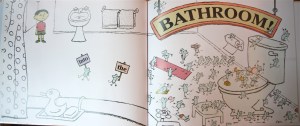
The aforementioned mouse party in the bathroom!
Other Favorite Potty Stories for Kids:
Even Firefighters Go to the Potty: A Potty Training Lift-the-Flap Story, by Wendy A. Wax, Naomi Wax, & Stephen Gilpin (long after JP was potty trained he still requested this book 10 times a day for two years)
Everyone Poops, by Taro Gomi (yes it’s weird, yes it’s kinda gross, but it’s actually quite effective (and my kids love the camel’s “two hump poop”))
A Potty for Me, by Karen Katz
Pip and Posy: The Little Puddle, by Axel Scheffler (my daughter loves this sweet, simple series about two friends—and, lo and behold, they have a potty story about an accident during a playdate)
Biking for Beginners and Pros
July 5, 2013 Comments Off on Biking for Beginners and Pros
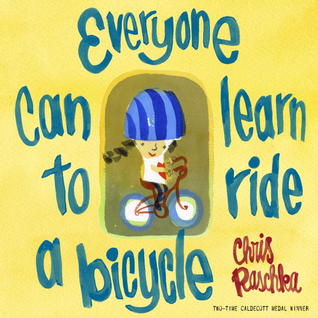 We interrupt our Summer School Series for some good ‘ol fashioned outdoor play—and because there happens to be two seriously awesome new picture books about riding a two wheeler (the Ultimate Summer Challenge, really). The first book is for the I-Think-I-Can-Beginners; the second is for the experienced, daring, and creative bikers (especially those with a love for all things Space).
Chris Raschka’s Everyone Can Learn to Ride a Bicycle (Ages 3-6) is a simple but poignant “how to” look at mastering a two wheeler, first with training wheels and then without. Now, if I were going to write a step-by-step guide to teaching a five year old to ride a bike, it might go something like this:
Lug ten tons of second-hand steel to park, at the request of eager child.
Help eager child up into bike seat.
Become temporarily deaf by imminent screaming of “NOOOOOOO get me off get me off get me off!”
After much cajoling and pleading and promising for the 45th time that you are going to hold on the whole time, convince child to remount bike and begin pedaling forward.
After 10 minutes, whereby you are still holding fast to the training-wheeled bike and said bike has moved exactly 10 feet, suggest that he try turning.
Feel an abrupt jerk as child slams on the breaks (this, oddly, comes very naturally), jumps off bike, and announces that he is Most Definitely Not Doing This Right Now.
Lug ten tons of steel back home.
Fortunately, Everyone Can Learn to Ride a Bicycle paints a much rosier picture of a child learning to ride a bike, along with the help of her patient and gently encouraging father.
But, actually, what I love about this book is that things are not always smooth sailing: the little girl has lots of false starts, falls down again and again, and needs both hugs and Band-Aids. “Oops! You nearly had it,” the book coaches. “Don’t give up. You’ll get it. Find the courage to try it again, and again, again, and again, again, and again, and again, until by luck, grace, and determination, you are riding a bicycle!”
Rashchka’s signature watercolors, seemingly effortlessly executed with thick, breezy, rough strokes of paint, are perfectly suited to the subject at hand. Every single painting exudes movement—whether it’s the little girl pulling her father’s hand toward the bike shop, her sideways and backwards tumbles off the bike, the neighborhood kids zooming past her on their colorful two wheelers, or her triumphant forward-leaning fast-pedaling stance at the end.
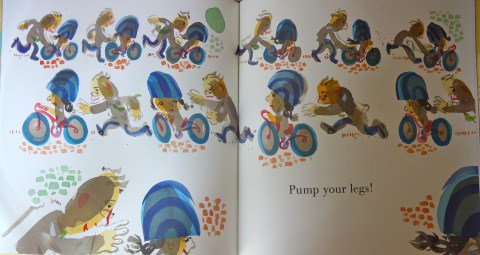
Rashchka’s greatest gift has always been his ability to capture emotional expression with just a few brushstrokes; and it’s the determination, bewilderment, frustration, joy, and pride on the little girl’s face that will make this gem relatable for children—those struggling to ride and those who’ve newly mastered the skill. I’m not promising this book will work miracles, assuming there might be other parents out there who are having similar bicycling battles on the playground (please tell me I am not alone); but I can promise that your child will identify a kindred spirit on the page.
Moving on to mor e advanced bicycling (and a longer, more sophisticated story), I fervently recommend How to Bicycle to the Moon to Plant Sunflowers: A Simple but Brilliant Plan in 24 Easy Steps, by Mordicai Gerstein (Ages 5-10). If the irreverent title alone hasn’t sold you, let me sing the praises of this most entertaining book, particularly for the kid who loves science, invention, numbers, the Moon, and bossing people around (that would be my son to a T, minus the bicycling).
First, when was the last time your child read a work of fiction that was laid out in steps? Each of this book’s 39 pages outlines a different step, numbered 1 through 24, many of them sub-categorized with letters (12a, 12b, 12c, 12d, etc.). Kids love this stuff; it’s exactly the way their mind works when they are bossing us around.
Secondly, there’s the very idea of bicycling into outer space, not to mention for the purpose of planting sunflowers to cheer up the Moon’s “big, sad clown face.” Thirdly, there’s the intricately involved and scientifically supported plan that the boy conjures up—a plan involving 2,000 used truck inner tubes, a 25-foot flagpole, a ship’s anchor, 238,900 miles of garden hoses wound tightly around a giant spool, a rented XS space suit from NASA, and various provisions, including “nourishing, flavored Glop, squirted through a straw in your space-helmet.”
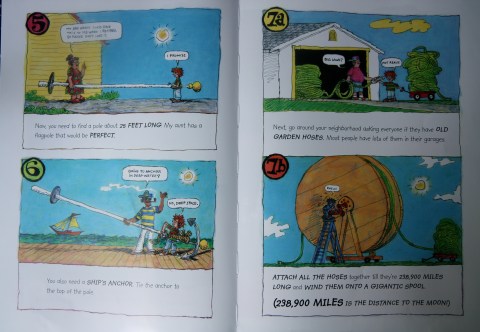
Finally, there’s the climactic adventure itself, Boy On Bike, pedaling up miles of garden hoses that have been anchored into the Moon’s surface, stopping to wonder at “the trillions of stars.” Within the largely comic narrative, written in the boy’s instructive voice, there are also many clever descriptions, my favorite being the notion that the Moon looks “like a coloring book that hasn’t been colored yet.”
Gerstein’s pen and ink drawings have a comic-book feel, but the crudely colored line art is mixed with grace and subtlety (the Moon’s changing expressions are a particular delight). This is the same Gerstein who wrote and illustrated one of my (and my son’s) favorite books: The Man Who Walked Between the Towers (Ages 4-8), the true and serious story of Phillipe Petit’s dramatic tightrope walk between the World Trade Towers in 1974. The two books could not look or feel more different (a rare feat for a picture book artist); yet, oddly, they both involve moving atop a skinny, rope-like material suspended over great heights.
Gerstein writes books about dreams—about the mystery, wonder, and excitement in planning for and achieving those dreams. I have a dream that my children will both ride two wheelers some day, that they will taste the victory that comes from balancing up high on their own, and (as I vividly remember doing as a young girl) that they’ll speed around the block, dreaming and scheming and making their own Big Plans.
Learning From History’s Many Heroes
May 30, 2013 § 3 Comments
 Just because the school year ends shortly doesn’t mean that our children’s minds have to shrivel up like apples left out too long in the sun. Last week, I gave some ideas for great read-aloud novels to share with your kids. Now, I’m going to encourage you to add some non-fiction into the mix—specifically, historical biographies posing as picture books. In previous posts about Martin Luther King Jr. and Abraham Lincoln, I’ve hailed the rise of today’s picture book biographies, which (unlike the static, black-and-white books of our school days) read like interesting, action-packed stories accompanied by vibrant paintings and intriguing designs. But I’m not merely talking about the Most Obvious Historical Figures; there are lesser known but equally captivating true stories of ordinary boys and girls, men and women, who shaped the world with extraordinary acts of courage, defiance, or creativity.
Where picture book biographies are concerned, contemporary illustrator Melissa Sweet has been on a roll, creating the art for several of my favorite non-fiction books in recent years. Although these biographies are written by different authors, they are unified by Sweet’s signature style—at once instantly recognizable but also entirely unexpected for the historical genre. In place of photographic-like paintings in somber tones, Sweet uses fun colors, whimsical patterns, and collage elements specific to the person whose story she is bringing to life. In Jen Bryant’s A River of Words: The Story of William Carlos Williams (Ages 7-12), Sweet peppers her background collages with excerpts from Williams’ poems, opening up kids’ eyes to these words and thoughts as an art form unto itself. In Alicia Potter’s Mrs. Harkness and the Panda (Ages 5-8), an account of the first person to capture a wild panda in China and bring it to an American zoo for study, Sweet creates frames for her watercolors out of authentic Chinese decorative papers, lending an other-wordly, almost mystical charm to this already fascinating story.
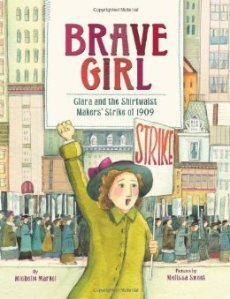
One of Sweet’s most recent triumphs is even more captivating for its portrayal not of an adult but of a young girl. Michelle Markel’s Brave Girl: Clara and the Shirtwaist Makers’ Strike of 1909 (Ages 6-10) tells the mind-boggling story of a Jewish immigrant girl, forced to endure long hours, harsh treatment, and poor pay, while sewing alongside hundreds of other girls in factories (her family’s only hope of putting food on the table.) Clara Lemlich’s “got grit,” and she “knows in her bones what is right and what is wrong”; ultimately, she leads the largest walkout of women workers in American history, inspiring thousands of male and female workers across the country to strike for better working conditions and the right to organize unions. « Read the rest of this entry »
A Story to Grow Up On
May 7, 2013 Comments Off on A Story to Grow Up On
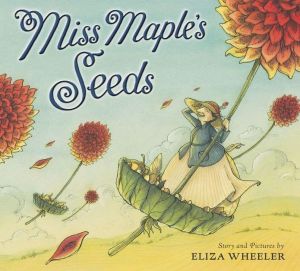 If you’re big into symbolism (or if you, like me, tear up when inscribing books for gifts), then you’re going to want to give Miss Maple’s Seeds to all the young seedlings celebrating birthdays this spring. There are lots of wonderful picture books about seeds (Jean Richards’ A Fruit is a Suitcase for Seeds and Bonnie Christensen’s Plant a Little Seed are two favorites), but none have the magical realism of Miss Maple’s Seeds (Ages 3-7), written and illustrated by newcomer Eliza Wheeler.
Miss Maple is an eccentric, not-quite-of-this-world sort (a bit like my neighbor, who converses with chipmunks in her backyard). Out of her home inside a hundred-year-old Maple tree, she runs a kind of orphanage for lost seeds, dividing her time between searching for “seeds that got lost during the spring planting” and caring for those seeds until they’re strong enough to lay down roots of their own. “‘Take care, my little ones…for the world is big and you are small,’” she continually reminds her seeds—all the while bathing them, taking them on educational outings to learn about different soil types, reading to them “by firefly light,” and giving them chances to practice “burrowing down into the muddy ground” during thunderstorms. “She’s taking care of them like they’re her babies!” my son was quick to point out, an observation that quickly captured the attention of his younger, doll-obsessed sister.
The story’s prose is unquestionably beautiful: lyrical, concise, and easy to connect back to our own children and the figures (parents, relatives, teachers) who so lovingly and carefully nurture their growth. But it is Wheeler’s ink-and-watercolor illustrations, light and airy and with just a touch of whimsy, which make this gem soar. Sporting a willow weed hat, pointed nose, and delicate slit eyes, Miss Maple epitomizes tenderness in all that she does, whether sweeping her hearth to welcome new seeds or bidding each one farewell as she sends them down the river in lantern-lit leaf boats to find new homes.
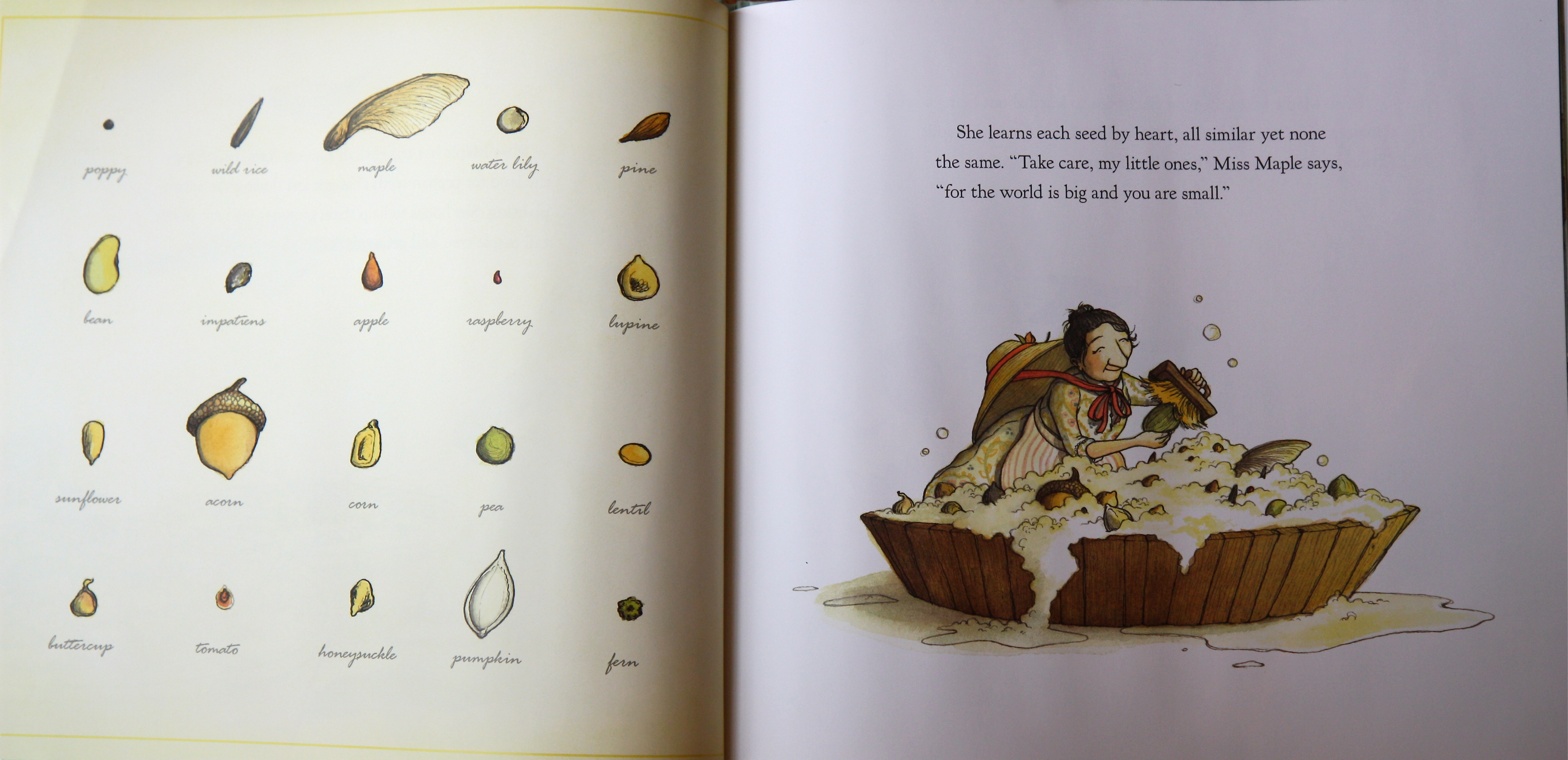
One of our favorite illustrations looks like something out of a naturalist’s guide, depicting twenty seeds with their species’ names captioned below in cursive writing (presumably from the hand of Miss Maple). From the fat acorn to the oval pumpkin seed to the single grain of wild rice, the page exhibits not only the visual diversity of nature’s seeds but also the magic which seems to lie within (a giant sunflower grows out of THAT minuscule thing?).
We could all use some of Miss Maple’s tenderness in our own relationship with the Earth, just like our own children need the reassurance that “even the grandest of trees once had to grow up from the smallest of seeds.” I dare you not to tear up when you copy that quote inside the cover of this book for your next gift.
March’s Hot-Off-the-Press Birthday Pick
March 6, 2013 Comments Off on March’s Hot-Off-the-Press Birthday Pick
 This one goes out to all the little girls out there—or rather, to their little friends who have spring birthdays. Debut author-illustrator You Byun’s brand new Dream Friends (Ages 2.5-6) is full of the stuff of little girls’ dreams. I’m talking about sugar and spice and everything nice—or, more specifically, bunny rabbits and tea parties and baby chicks and Santa Claus and cupcakes and flowers and, of course, friendship.
Melody has a friend, a best friend, only he’s not your typical friend: for starters, he’s big and white and furry (an ambiguous but lovable dog-cat-raccoon looking thing that my daughter has taken to kissing on the nose each time he makes an appearance). The bigger problem is that this magical friend only visits the little girl in her dreams (although these dreams are filled with such delights as dancing on flower-shaped clouds or watching fireworks explode in the shape of ice cream cones and lollipops).
Eyes on Abraham Lincoln
February 12, 2013 Comments Off on Eyes on Abraham Lincoln
 You might expect that my children, living so close to Washington DC, have many opportunities to learn about our nation’s history. But mere proximity does not a future scholar make. The Lincoln Memorial, for example, is consistently celebrated by my five year old as “the place where we picnic in the summer!” If you ask him the name of the president that sits in stone behind him during said picnics, he is likely to throw you a disinterested look and recommence staring out the car window, pointing out other landmarks whose names he boasts correctly but whose significance he understands not. Which begs the question: How do we get our kids to care about the past presidents that have shaped our country?
The biographies we read as kids were filled with dry facts and black-and-white photographs that made their content feel all too disconnected from our daily lives; too often we were encouraged to memorize names and dates for tests, only to forget them a week later. Thankfully, our own kids have access to a whole new generation of fresh reading material, including picture books that breathe colorful new life into historic periods and events.
Thinking Outside the Box This Valentine’s Day
February 5, 2013 § 4 Comments
 Is there a better way to shower our children with love this Valentine’s Day than by snuggling under a blanket with them and sharing a new story? And yet, I’m never thrilled with the list of books that the media typically puts forth as gift ideas for V-Day. Chances are you already have your fair share of books about parental affection (the Guess How Much I love You? sort). If I’m being totally honest, I feel a tad exploited by these lovey-dovey books about hugging and kissing and eternal love; too often they’re lacking in imagination and art and feel instead like a cheap move by publishers to go after our vulnerability as parents (I’ll get off my soapbox now). There are some wonderful classics, like Judith Viorst’s Rosie and Michael and Sandal Stoddard Warbug’s I Like You, but their content is arguably more appropriate for grown-ups to give one another.
So when it comes to Valentine’s Day, I like to think outside the box. In the past, I’ve given my son the glorious Red Sings from the Treetops (hey, there’s red in the title) and The Jolly Postman (Valentines are like letters, right?). But this year, I have an especially good one pegged for my two-year-old daughter; I’ve been hiding it under my bed since it came out last fall and biding my time to spring it on her.
Snow Days
January 24, 2013 Comments Off on Snow Days
 Last night, as I was falling asleep, I wished for snow. Not for the parent in me (who dreads school closures); not for the adult in me (who has never been terribly coordinated at navigating icy pathways); but for my children. In the two and a half years since our family moved to Virginia from the Midwest (land of bountiful blizzards), snow has been something that my kids talk about, dream about, but rarely, if ever, experience. I must admit I find it a bit alarming that my son, so nostalgic for the snow of his earliest years, has taken to listing shoveling among his top five favorite activities. It just doesn’t seem fair that my kids have to go through the daily chore of putting on puffy coats and woolen hats and fleece mittens—without the reward of some billowy white stuff to play in.
So last night, oddly without even realizing snow was in the forecast, I wished for it. And when I woke up this morning, the quiet hush outside (where was the garbage truck?) and a flurry of school emails on my phone sent me flying to my window, where I could hardly wait to broadcast my discovery.
As Cynthia Rylant’s beautiful and celebratory Snow (ages 3-8) begins, “The best snow is the snow that comes softly in the night, like a shy friend, afraid to knock, so she thinks she’ll just wait in the yard until you see her.”
My Good Pal Mo (I Like to Pretend We’re On a First Name Basis)
November 10, 2012 § 1 Comment
 No one gets straight to the heart of kids like Mo Willems. It seems almost criminal that I’ve been at this blog for several months now and have yet to sing the praises of one of the most original author-illustrators of all time. While he’s best known for the Don’t Let the Pigeon Drive the Bus series (which, despite its popularity, is not my or my children’s favorite), Mo is at his best with one-off masterpieces, like Edwina, the Dinosaur Who Didn’t Know She Was Extinct and Leonardo the Terrible Monster (see my complete list at the end). And now we get to add his newest creation, Goldilocks and the Three Dinosaurs (Ages 4-8), in which three scheming dinosaurs lure Goldilocks into the wrong fairy tale in an effort to make “chocolate-filled-little-girl-bonbons” out of her.
During the 46 times that I’ve been asked by my son to read this book in the past month, I’ve started to put my finger on what it is that unites Mo’s seemingly disparate stories. Mo gives children A LOT of credit (probably more than us parents do). He doesn’t employ traditional literary devices (in fact, in Goldilocks he actually turns them on their head), and he offers few explanations; instead, he writes with the expectation that kids will pick up on the subtlety, the irony, the little side jokes, and the sophisticated vocabulary through their repeated readings. Over the years, I’ve had more than one person ask me whether Mo’s multi-layered storytelling is accessible enough to children or simply intended to amuse the parent who’s reading it. In response, let me give you an account of how my five year old experienced Goldilocks and the Three Dinosaurs:
Anyone Can Learn to Dance
October 3, 2012 Comments Off on Anyone Can Learn to Dance
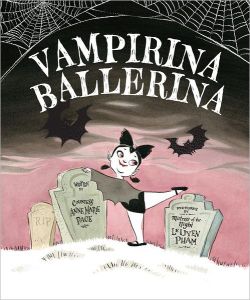 Calling all wannabe ballerinas! If you’re headed to a girl’s birthday party this month, you must give this irresistibly charming (and seasonally appropriate) new book, Vampirina Ballerina (Ages 3-7), by Anne Marie Pace, with pictures by LeUyen Pham. This book has everything ballerinas-in-the-making (and their supportive parents) would want in a book: tutus, pirouettes, a Swan Lake-inspired recital, encouragements about practice and effort (as opposed to perfection), and a subtle but poignant message about accepting someone who looks different.
In addition, this book has something most people don’t associate with ballet: a family of vampires. That’s right, Pace’s text reads like a “how to succeed in ballet” handbook, only it’s directed at a young vampire girl, who is eager and nervous to begin her ballet education alongside a troupe of human girls and their instructing Madame. Along with some predictable directives about form and style (“a true ballerina is always on pointe” and “always move with your head held high”), our young Vampirina is given some important life lessons: “Whatever happens, don’t be discouraged. The road to ballerinadom can be bumpy.”
Every Day is Pizza Day
August 26, 2012 § 1 Comment
 My having eaten a slice of pizza every day for lunch while I was pregnant may have something to do with the fact that my nearly two-year-old daughter is very, very obsessed with Pizza at Sally’s (Ages 2-4), by Monica Wellington. But given that my son was equally obsessed at age two with Truck Driver Tom, by the same author, it’s perhaps more probable that Wellington knows a thing or two about how to talk to kids.
At first glance, Wellington’s books might be quickly dismissed: the gouache, brightly-colored, and largely two-dimensional paintings could come off as a bit juvenile, perhaps not of the same artistic caliber as what I normally review here. But it would be a mistake to pass up these books. At closer inspection, the illustrations are packed with visual gems, including (in the case of Pizza at Sally’s) tiny photographs pasted in for fresh ingredients and even for the finished slices of pizza themselves.
Show Me the Moon
June 28, 2012 § 1 Comment
 “Moon” was one of the very first words uttered by both of my children. When they’re playing outside at dusk, they will shriek at the top of their lungs—“MOOOOOOON!”—upon catching sight of it emerging in the still-blue sky.
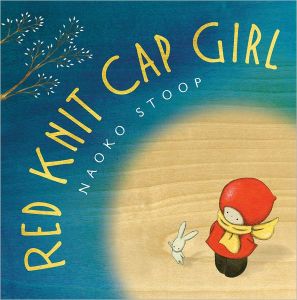
If the sheer volume of children’s storybooks dedicated to this subject is any indication, my children are not alone in their enthrallment with the moon. It’s nearly impossible for me to choose one favorite story to profile here (see my lengthy list below), so I will simply go with the newest addition to this already impressive repertoire: Red Knit Cap Girl (Ages 2-5), written by first-time author Naoko Stoop. I’ve mentioned before my weakness for Japanese-influenced picture books; and, like so many of her predecessors, Stoop (who grew up in Japan and now lives in Brooklyn) has created a work that holds together like a perfectly wrapped present: each word is chosen with the utmost care, each picture serves a clear purpose. In a wholly original move, Stoop’s expressive, whimsical watercolors of a little girl and her woodland friends, on a quest to speak to the moon, are painted on pieces of plywood; children can actually see the grain of the wood shining through the paintings, an effect which is especially fitting for a story set in the forest.
The Lure of the Balloon
June 3, 2012 Comments Off on The Lure of the Balloon
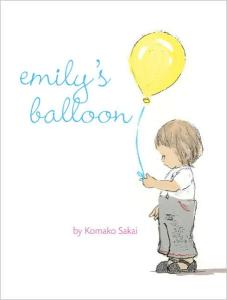 At 20 months, my daughter is starting to move away from board books and into short, simple picture books; consequently, she (and I) have fallen in love with Emily’s Balloon (Ages 18 mos-3 yrs), by Japanese author-artist Komako Sakai. I know, I know, you’re thinking that we’re partial to this book because my daughter’s name also happens to be Emily. But before I even had kids, I used to sell gobs of this book when it first came out in 2006; customers would only have to page through the gorgeous charcoal-and-wash pages to fall in love.
Some of my favorite children’s books have been imported from Japan; their illustrative style so beautifully transports us back to the carefree days of our own youth, when making dandelion crowns for a balloon might easily occupy an afternoon. What is it with toddlers and balloons? Balloons have a buoyancy that seems fascinating in its unpredictability, yet non-threatening in its softness; but, most significantly, its perfect sphere-like shape is just the right size for little eyes to track.
Rain, Rain, Here for a Day (Or Two…)
May 14, 2012 § 1 Comment
 As a mom of young children, I will admit to feeling a little dread, even a touch of panic, when I wake up and it’s raining. Trapped inside with my kids? Anything but that! Naturally, my kids think it is a treat, since they have activities reserved for rainy days (“Pillows off the couch! Pillows off the couch!”). Over time, I’ve discovered that if I can live in the moment and give in to the calm and quiet of a rainy day (and, yes, the subsequent moments of cooped-up mania), then there is much to be gained for me as well.
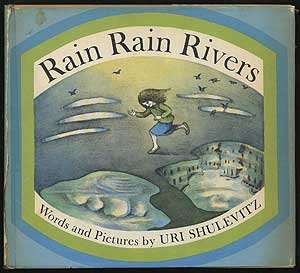
And if not, well, there are always rainy day books to read inside our blanket forts! A good rain book should make you feel wet and cozy at the same time. Uri Shulevitz does this to perfection in his 1969 gem Rain Rain Rivers (Ages 2-6), where pen and ink drawings mix with watercolors in an almost haunting monochromatic exhibit of rain, first falling outside a little girl’s bedroom window, then (as she imagines it) trailing through the city streets, out into the countryside, and into the open, swelling oceans.
You Thought You Could Talk on the Phone?
May 10, 2012 § 1 Comment
 It’s a situation we moms know all too well: The kids are playing nicely together; it’s quiet, even harmonious. You tiptoe to the other end of the house to make a “quick phone call.” As soon as the person on the other end answers the phone, there’s a tug on your leg. Suddenly, someone needs milk. Another someone is stepping over you trying to pull the scissors down to open a Zappos box (didn’t you leave that package on the porch)? Another someone has decided now is an opportune time to start poking his sister’s eyes. Another someone (or is it the same someone?) would like dinner and would like dinner NOW but not broccoli no way not eating that and why can’t we have mac ‘n cheese like so-and-so does every night and blah blah blah.
So, it’s no surprise that we sympathize with the mom in While Mama Had a Quick Little Chat (Ages 3-6), by newcomers Amy Reichert and Alexandra Boiger (pub. 2012). Bedtime is approaching, so Mama asks her daughter (think Eloise with red hair): “Rose, dear, please get ready for bed while I have a quick chat with your Uncle Fred. Brush your teeth. Wash your face. It’s getting late! I want you in bed by half past eight.” Naturally, Rose is well intentioned and would go straight to bed (truly), but what’s one to do when the doorbell rings and your mom doesn’t hear it and so you open the door and in bursts a team of men with party supplies for a party you didn’t know you were throwing?
Alison Jay, Cloud Creator
April 25, 2012 § 3 Comments
 If you haven’t discovered the amazing British children’s artist Alison Jay, you’re in for a real treat. Or, if you’re as obsessed with her as I am, you’ll love her latest masterpiece, a fairy tale of sorts titled The Cloud Spinner (Ages 3-6), by Michael Catchpool (a fellow Brit).
The Brits have an unparalleled knack for creating books that feel Quintessentially Childlike, seamlessly blending fantasy with realism, and sprinkling on a quirkiness that makes these stories memorable for a lifetime. Alison Jay’s artistic signature, which she employs in all her work, is a “crackle finish” layered over her paintings, a technique which gives them a vintage look. In contrast, her animals, landscapes, and people feel anything but old-fashioned (here’s where that endearing quirkiness comes into play).
It seems that Jay’s artistic style has not gone unnoticed by JP, my four year old. Our favorite alphabet book is Jay’s ABC: A Child’s First Alphabet Book, which I’ve been reading to him since he was a baby (and which is jam packed with hidden surprises), along with a handful of her other storybooks (see my list at the end). A few months ago, while perusing the shelves at our local library, JP stumbled upon an Alison Jay book he’d never seen before (William and the Night Train), and he called out, “Look Mommy, it’s one of those books with the crazy clouds!” I had never thought of it that way before, but he was right: Alison Jay does have a very specific way of painting clouds.
 What to Read to Your Kids