Holiday Gift Guide 2013: Other-Worldly Encounters For the Young Artist
December 8, 2013 § 4 Comments
 When I was young, one of my favorite picture books was Harold and the Purple Crayon, where a little boy makes his own adventures with the help of a single purple crayon. As a child, I loved to draw, but I think the greater appeal for me lay in Harold’s vivid imagination—an imagination that empowers him with an inner resourcefulness, that entertains him when he can’t fall asleep, that gets him out of any sticky situation (drowning? simply draw a boat).
This same spirit echoes across Aaron Becker’s Journey (Ages 4-8), easily the most stunning picture book of 2013 and an inspiration for young artists and adventure-seekers alike. Unlike Harold, a simple visual presentation of purple and white, Journey makes use of a broad palette, although weighted emphasis is given to red, the color of the crayon with which a girl begins her escape by drawing a door (after all, what else can you do when your mom is cooking, your dad is working, and your big sister is too busy?). « Read the rest of this entry »
Unlikely Companions
October 28, 2013 § 2 Comments
 Children form attachments to the oddest things. Take, for example, the dried out husk of a seed for which my six year old spent a recent afternoon constructing a shoebox house, complete with a toilet-paper-tube flag post and a felt blanket and pillow that he actually sewed himself. Did you get that? For a seed. There was also the time that he and his sister took their plastic straws from a restaurant to bed with them. These are not children who are hurting for baby dolls or stuffed animals; they simply choose to imprint on the less obvious choices.
So, is it any surprise that they would love Sophie’s Squash (Ages 3-7), a new picture book by Pat Zietlow Miller (fellow children’s book blogger), where a little girl develops a steadfast affection for a squash that her parents pick out at the farmers’ market and intend to cook for dinner? Sophie uses black marker to draw a face on the butternut squash; she names it Bernice (love); she wraps it in a baby blanket and rocks it to sleep; she takes it to story time at the library (double love); and she even organizes play dates for it with other squash (triple love). In other words—as her very patient parents soon realize—this squash is no dinner. « Read the rest of this entry »
The Rules of Play
October 10, 2013 § 2 Comments
 As parents, we are continually hounded by parenting experts about the importance of getting down on the floor and playing with our children. I’m fairly easily wooed when it comes to playing Candy Land or doing a giant floor puzzle or even painting alongside my kids; but when it comes to imaginative play, a little part of me wants to scream, “Please don’t make me do it!!!!” Why, you ask? Or maybe you don’t need to ask, because you already know about ALL THE RULES that our children arbitrarily force upon us from start to finish during these games. And nowhere is this more evident than when my daughter wants to play tea party.
E: “Mommy, let’s have a tea party!”
Me: “OK, where should I sit?” (I’ve learned better than to presume.)
E: “Right here”
Me. “OK’ (Sitting down.)
E: “No, you don’t sit like that! You have to cross your leg.”
Me: (making adjustments) “OK, I’m ready for my tea now.”
E: “No! First we are having a snack.”
Me: “OK, what’s for snack?”
E: “You don’t ask the question! You wait and I bring you the snack.”
Me (minutes later after being served a wooden egg and a plastic cucumber) “Mmmmm, thank you, this is so tasty!”
E: “MOMMY! It’s not time to eat yet! You have to wait for your tea!”
Me (an eternity later, when pretend tea is finally served): “Mmmmm, this tea is toasty warm.”
E: “It’s COLD tea!”
Me: “This tea is nice and refreshing. I think I’ll put some sugar in it.”
E: “That’s honey!”
Me: “I’m putting in some honey.”
E: “NO! You don’t pour it in, you have to use a SPPPOOOOOON!”
Thank you, but I will stick with Candy Land. « Read the rest of this entry »
Growing Pains
September 10, 2013 § 3 Comments
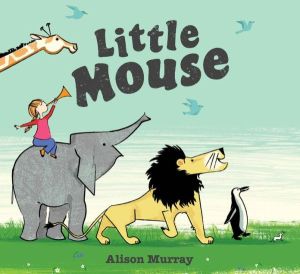 My youngest turns three today. Lately, everywhere I turn, I am reminded of how fast she is growing. “Mommy, Mommy, my toes are sticking out of my sandals!” she cried jubilantly one morning a few weeks ago; “I growed into a big girl!”
It’s no wonder, then, that she immediately fell in love with Alison Murray’s precious new picture book, Little Mouse (Ages 18 mos-4 yrs), where a little girl proclaims that she is no longer her Mommy’s “little mouse”; on the contrary, she is tall (like a giraffe), strong (like a bull), hungry (like a horse), and brave (in the face of a lion). On top of that, she can make her voice and her body do amazing things, from trumpeting (like an elephant) to pumping high on the big girl swing (like a bird). « Read the rest of this entry »
Biking for Beginners and Pros
July 5, 2013 Comments Off on Biking for Beginners and Pros
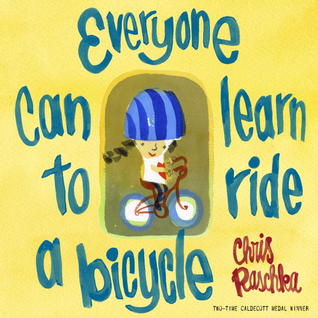 We interrupt our Summer School Series for some good ‘ol fashioned outdoor play—and because there happens to be two seriously awesome new picture books about riding a two wheeler (the Ultimate Summer Challenge, really). The first book is for the I-Think-I-Can-Beginners; the second is for the experienced, daring, and creative bikers (especially those with a love for all things Space).
Chris Raschka’s Everyone Can Learn to Ride a Bicycle (Ages 3-6) is a simple but poignant “how to” look at mastering a two wheeler, first with training wheels and then without. Now, if I were going to write a step-by-step guide to teaching a five year old to ride a bike, it might go something like this:
Lug ten tons of second-hand steel to park, at the request of eager child.
Help eager child up into bike seat.
Become temporarily deaf by imminent screaming of “NOOOOOOO get me off get me off get me off!”
After much cajoling and pleading and promising for the 45th time that you are going to hold on the whole time, convince child to remount bike and begin pedaling forward.
After 10 minutes, whereby you are still holding fast to the training-wheeled bike and said bike has moved exactly 10 feet, suggest that he try turning.
Feel an abrupt jerk as child slams on the breaks (this, oddly, comes very naturally), jumps off bike, and announces that he is Most Definitely Not Doing This Right Now.
Lug ten tons of steel back home.
Fortunately, Everyone Can Learn to Ride a Bicycle paints a much rosier picture of a child learning to ride a bike, along with the help of her patient and gently encouraging father.
But, actually, what I love about this book is that things are not always smooth sailing: the little girl has lots of false starts, falls down again and again, and needs both hugs and Band-Aids. “Oops! You nearly had it,” the book coaches. “Don’t give up. You’ll get it. Find the courage to try it again, and again, again, and again, again, and again, and again, until by luck, grace, and determination, you are riding a bicycle!”
Rashchka’s signature watercolors, seemingly effortlessly executed with thick, breezy, rough strokes of paint, are perfectly suited to the subject at hand. Every single painting exudes movement—whether it’s the little girl pulling her father’s hand toward the bike shop, her sideways and backwards tumbles off the bike, the neighborhood kids zooming past her on their colorful two wheelers, or her triumphant forward-leaning fast-pedaling stance at the end.
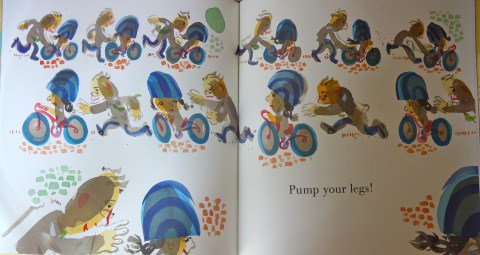
Rashchka’s greatest gift has always been his ability to capture emotional expression with just a few brushstrokes; and it’s the determination, bewilderment, frustration, joy, and pride on the little girl’s face that will make this gem relatable for children—those struggling to ride and those who’ve newly mastered the skill. I’m not promising this book will work miracles, assuming there might be other parents out there who are having similar bicycling battles on the playground (please tell me I am not alone); but I can promise that your child will identify a kindred spirit on the page.
Moving on to mor e advanced bicycling (and a longer, more sophisticated story), I fervently recommend How to Bicycle to the Moon to Plant Sunflowers: A Simple but Brilliant Plan in 24 Easy Steps, by Mordicai Gerstein (Ages 5-10). If the irreverent title alone hasn’t sold you, let me sing the praises of this most entertaining book, particularly for the kid who loves science, invention, numbers, the Moon, and bossing people around (that would be my son to a T, minus the bicycling).
First, when was the last time your child read a work of fiction that was laid out in steps? Each of this book’s 39 pages outlines a different step, numbered 1 through 24, many of them sub-categorized with letters (12a, 12b, 12c, 12d, etc.). Kids love this stuff; it’s exactly the way their mind works when they are bossing us around.
Secondly, there’s the very idea of bicycling into outer space, not to mention for the purpose of planting sunflowers to cheer up the Moon’s “big, sad clown face.” Thirdly, there’s the intricately involved and scientifically supported plan that the boy conjures up—a plan involving 2,000 used truck inner tubes, a 25-foot flagpole, a ship’s anchor, 238,900 miles of garden hoses wound tightly around a giant spool, a rented XS space suit from NASA, and various provisions, including “nourishing, flavored Glop, squirted through a straw in your space-helmet.”
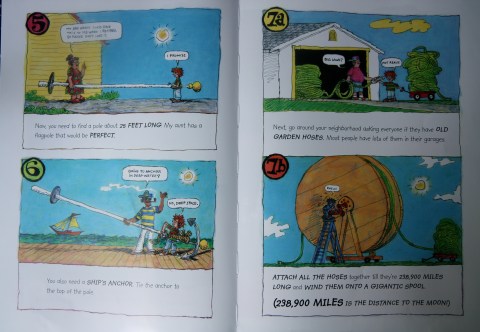
Finally, there’s the climactic adventure itself, Boy On Bike, pedaling up miles of garden hoses that have been anchored into the Moon’s surface, stopping to wonder at “the trillions of stars.” Within the largely comic narrative, written in the boy’s instructive voice, there are also many clever descriptions, my favorite being the notion that the Moon looks “like a coloring book that hasn’t been colored yet.”
Gerstein’s pen and ink drawings have a comic-book feel, but the crudely colored line art is mixed with grace and subtlety (the Moon’s changing expressions are a particular delight). This is the same Gerstein who wrote and illustrated one of my (and my son’s) favorite books: The Man Who Walked Between the Towers (Ages 4-8), the true and serious story of Phillipe Petit’s dramatic tightrope walk between the World Trade Towers in 1974. The two books could not look or feel more different (a rare feat for a picture book artist); yet, oddly, they both involve moving atop a skinny, rope-like material suspended over great heights.
Gerstein writes books about dreams—about the mystery, wonder, and excitement in planning for and achieving those dreams. I have a dream that my children will both ride two wheelers some day, that they will taste the victory that comes from balancing up high on their own, and (as I vividly remember doing as a young girl) that they’ll speed around the block, dreaming and scheming and making their own Big Plans.
March’s Hot-Off-the-Press Birthday Pick
March 6, 2013 Comments Off on March’s Hot-Off-the-Press Birthday Pick
 This one goes out to all the little girls out there—or rather, to their little friends who have spring birthdays. Debut author-illustrator You Byun’s brand new Dream Friends (Ages 2.5-6) is full of the stuff of little girls’ dreams. I’m talking about sugar and spice and everything nice—or, more specifically, bunny rabbits and tea parties and baby chicks and Santa Claus and cupcakes and flowers and, of course, friendship.
Melody has a friend, a best friend, only he’s not your typical friend: for starters, he’s big and white and furry (an ambiguous but lovable dog-cat-raccoon looking thing that my daughter has taken to kissing on the nose each time he makes an appearance). The bigger problem is that this magical friend only visits the little girl in her dreams (although these dreams are filled with such delights as dancing on flower-shaped clouds or watching fireworks explode in the shape of ice cream cones and lollipops).
In the Driver’s Seat
November 2, 2012 § 2 Comments
 If there’s something all kids can agree on, it’s the thrill of being in the driver’s seat. Getting their choice—heck, coming up with the choices in the first place—seeds the adrenaline that drives our little ones forward in their quest for independence and control. Perhaps no author-illustrator understands this better than Chris Van Dusen, who has a knack for knowing what kids (especially boys) want and serving it up in rollicking rhyme and neo-futuristic illustrations. Years ago, when If I Built a Car was published, it instantly became my shop’s “go to” book for anyone headed to a four or five year old’s birthday party; we only stopped stocking it when virtually every family in a 15-mile radius owned the book.
The good news is that Van Dusen has now written an equally captivating follow-up—and one with an arguably broader appeal (girls will dig this, too). In If I Built a House (Ages 3-6), a young boy named Jack describes with contagious enthusiasm his dream house. I challenge any child to come up with a TV show or video game with more allure than a house containing an anti-gravity room, an underwater chamber, an art room with walls made of drawing paper, a bedroom atop a high tower with the world’s longest spiraling tunnel slide for descent, and a jet-powered Plexiglass Playroom that detaches to fly around the neighborhood.
Imagination Turbo Edition
July 3, 2012 Comments Off on Imagination Turbo Edition
 When you watch your children practicing yoga moves in their kiddie pool, it’s easy to be struck by how differently today’s children entertain themselves than when we were growing up (yoga?). But then there are the things that never change from one generation to the next—like kids’ uncanny ability to lose themselves in imaginary play, especially if there are action figures involved.
That’s why you can’t go wrong by gifting one of Mini Grey’s picture books about a combat-boots-sporting action figure named Traction Man. In the hands and imagination of one little boy, Traction Man embarks on daring missions with the help of his trusty sidekick Scrubbing Brush. The latest installment in this original series, Traction Man and the Beach Odyssey (Ages 4-7), has just been published and is perfect for your summer birthday gifts (although why not bundle it with the original Traction Man for the Best Gift Ever?).
Putting Dad to Bed
June 15, 2012 Comments Off on Putting Dad to Bed
 This Sunday is Father’s Day, so Dad deserves a break. Maybe he should go to bed early. But what if he starts doing cartwheels and runs around the house yelling, “No, no no, I won’t go to sleep!” What if he tries to negotiate one more story (after he has already had two) and then needs to be tucked in just right and then calls you back to leave the hall light on—until you realize: “A Dad who doesn’t want to go to sleep is exhausting!”
This is exactly what goes down in the delightful new picture book (originally published in France), titled My Dad is Big and Strong, BUT…: A Bedtime Story (Ages 3-6), by Coralie Saudo, illustrated by Kris DiGiacomo. A little boy tell us: “My Dad is big and strong, but every night it’s the same old story. And this is how it begins: ‘I don’t want to go to bed!’” The ordeal that follows, turning a classic parent-child struggle on its head, will have both boys and girls in stitches.
The Lure of the Balloon
June 3, 2012 Comments Off on The Lure of the Balloon
 At 20 months, my daughter is starting to move away from board books and into short, simple picture books; consequently, she (and I) have fallen in love with Emily’s Balloon (Ages 18 mos-3 yrs), by Japanese author-artist Komako Sakai. I know, I know, you’re thinking that we’re partial to this book because my daughter’s name also happens to be Emily. But before I even had kids, I used to sell gobs of this book when it first came out in 2006; customers would only have to page through the gorgeous charcoal-and-wash pages to fall in love.
Some of my favorite children’s books have been imported from Japan; their illustrative style so beautifully transports us back to the carefree days of our own youth, when making dandelion crowns for a balloon might easily occupy an afternoon. What is it with toddlers and balloons? Balloons have a buoyancy that seems fascinating in its unpredictability, yet non-threatening in its softness; but, most significantly, its perfect sphere-like shape is just the right size for little eyes to track.
You Thought You Could Talk on the Phone?
May 10, 2012 § 1 Comment
 It’s a situation we moms know all too well: The kids are playing nicely together; it’s quiet, even harmonious. You tiptoe to the other end of the house to make a “quick phone call.” As soon as the person on the other end answers the phone, there’s a tug on your leg. Suddenly, someone needs milk. Another someone is stepping over you trying to pull the scissors down to open a Zappos box (didn’t you leave that package on the porch)? Another someone has decided now is an opportune time to start poking his sister’s eyes. Another someone (or is it the same someone?) would like dinner and would like dinner NOW but not broccoli no way not eating that and why can’t we have mac ‘n cheese like so-and-so does every night and blah blah blah.
So, it’s no surprise that we sympathize with the mom in While Mama Had a Quick Little Chat (Ages 3-6), by newcomers Amy Reichert and Alexandra Boiger (pub. 2012). Bedtime is approaching, so Mama asks her daughter (think Eloise with red hair): “Rose, dear, please get ready for bed while I have a quick chat with your Uncle Fred. Brush your teeth. Wash your face. It’s getting late! I want you in bed by half past eight.” Naturally, Rose is well intentioned and would go straight to bed (truly), but what’s one to do when the doorbell rings and your mom doesn’t hear it and so you open the door and in bursts a team of men with party supplies for a party you didn’t know you were throwing?
Ce N’est Pas Un Box
April 23, 2012 § 2 Comments
 For adults, the worst part about moving is cardboard boxes. For kids, the best part about moving is cardboard boxes! We managed to save a giant wardrobe box from our last move, and we bring it out on rainy days. It’s the Mother of All Boxes. Don’t get me wrong: they also love playing with diaper boxes, amazon.com boxes, and wine boxes (that these seem to be the predominant boxes around our house at any given time probably says much about our priorities). Our “house rule,” when a new box shows up, is that the kids get it for one week—and then (because Mom can’t take it any longer) it’s dumped in the recycling bin, regardless of how beautifully decorated it is by then. But that wardrobe box is still kicking around some 18 months later, because, well, it’s just THAT AWESOME.
One of the more originally executed children’s books of the past decade is Not a Box (Ages 3-5), by Antoinette Portis. The book deceives: at first glance, its sparse text and simple graphics appear to be designed for a very young child. In fact, the perfect audience for this book is the precocious preschooler, who’s just beginning to forage into Imaginary Play.
 What to Read to Your Kids