All the World’s a Stage
February 25, 2016 § 2 Comments
 As much as I try not to influence my children with my own prejudices (yes, my angel, what a beautiful spider you have crawling on your arm), I have always drawn the line at vermin. Especially possums. (I realize that possums are technically marsupials, but can we agree that in urban settings they are non-technically classified as vermin?) My exuberance one spring, upon trapping the possum that insisted on carrying her babies up and down the side of our house every night, could have been heard five blocks away. Ditto to the blood-curdling scream that erupted out of my mouth one evening, when one of those naked-looking creatures with the pink hairless tails scurried in front of my car.
Now, author Holly Goldberg Sloan has come along, and—with the help of Gary A. Rosen’s surprisingly adorable pencil sketches—given the world Appleblossom the Possum, a fictional chapter book (Ages 7-10, younger if reading aloud) that might forever change the way my kids and I view this nocturnal species. « Read the rest of this entry »
Toys as Neurotic as Us
January 20, 2016 § 3 Comments
 If my children are playing nicely together (sound the trumpets!), chances are high that they’re in the company of stuffed animals. Once a stuffed animal enters our house and is given a name, it assumes an infallible place in JP and Emily’s communal imagination, albeit in an ever-changing litany of roles, from pet to circus performer. My kids crochet leashes for their animals; they bury them in boxes of peanuts and push them around the house; they string them from ceiling fans. They emerge from their respective bedrooms on weekend mornings, eyes partly open, with half a dozen animals tucked under their arms, ready for action.
Two tigers (Hobbies and Hobbies Jr.), a giant panda in a bellman uniform (Cookie), two doughnuts (Sprinkles and Sprinkles 2), and a monogrammed pillow (named, for whatever nonsensical reason when JP was two, Bag of Worms) are just a few of the soft friends that make frequent appearances in my children’s play. Still, as JP and Emily are quick to remind me, the life of a stuffed animal doesn’t begin and end at the hands of a child. The more exciting question is: what shenanigans do these toys get up to when their children are asleep or away? « Read the rest of this entry »
The Villain We Love to Hate
January 14, 2016 § 4 Comments
 In preparation for taking my kids to the Kennedy Center last week to see the national tour of Matilda the Musical, I spent the final day of winter break reading Roald Dahl’s beloved novel to them. That’s right. Seven and a half hours of reading out loud (with a break to bike to lunch and back). It was my maternal Swan Song, a last hurrah before depositing my kids at the front door of their school the next morning and returning home to a (blissfully) quiet house.
It was actually their second time listening to Matilda—the first time was during a car trip last summer—and I almost didn’t opt for a second round. But, in the end, I wanted it to be fresh in all of our minds before we took our seats in the theater (plus, it made for one of the best family dinners later that night, picking apart the differences between the book and the play). But, really, who would pass up a chance to re-read one of the greatest children’s books ever written? « Read the rest of this entry »
Finding the Christmas Spirit (in a 1952 Classic)
December 17, 2015 § 4 Comments
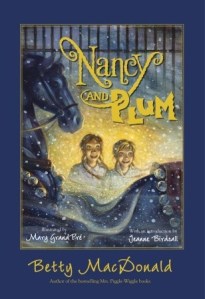 One of my favorite memories of last December (read my post here) was reading Winterfrost to my children. Amidst the hustle and bustle and never-ending to-dos of the holiday season, the three of us set aside time each night to savor the enchanting story of a child kidnapped by a nisse (Danish “house gnome”) on Christmas night and the sister who goes off to rescue her.
This December, I wanted to re-create that holiday magic with my children. I wanted something that called us away from the overt materialism of the holiday season, that tapped into feelings of love and togetherness, of gratitude for what we have and generosity of spirit.
I took a stab in the dark and grabbed Betty MacDonald’s 1952 novel, Nancy and Plum (Ages 8-12, younger if reading aloud), off the shelf at the library.
Holy holiday wonderfulness. A BETTER BOOK I COULD NOT HAVE CHOSEN. « Read the rest of this entry »
Sequel Roundup: From Rebels to Robots
November 12, 2015 Comments Off on Sequel Roundup: From Rebels to Robots
 Is there anything sweeter than watching your child’s face light up like the Fourth of July when he or she discovers a sequel to a beloved book? I don’t typically devote much space on this blog to reviewing sequels, but the past weeks have delivered so many much-anticipated sequels (that is, much-anticipated in our house!), that I found myself lying awake the other night, worrying that perhaps you didn’t know about them. We need to change that.
Last month—cue high-pitched hysteria—saw the release of the sequel to Shannon Hale, Dean Hale, and LeUyen Pham’s wildly popular The Princess in Black. If I had a penny for every message I’ve received asking me to recommend an early chapter book as captivating as The Princess in Black, I would be a rich Book Mommy. Sadly, little comes close. PIB seems to have revolutionized the early chapter book market overnight (wait, an early reader can be this engrossing, this humorous, and this exquisitely illustrated?). I’m not ashamed to admit that I waited in line for hours to get an advance copy of the sequel last May.
Arthropods and Art Heists
October 29, 2015 § 2 Comments
 In preparation for our recent trip to New York City, I wanted to select a chapter book to read to my eight year old that would inspire our itinerary. Last year, you might remember that we read two fantastic books which took us straight to The Metropolitan Museum of Art. It was amazing to watch JP anticipate what he would find in the museum, based on what he had read—and then to leave a few hours later with a skip in his step and an entirely different experience from what he had expected. This is the power of art: to transform, to surprise, to delight.
I was secretly hoping I could convince JP to go back to The Met this fall, so I scrounged up another novel set in and around the museum. Beginning a few days before we left and concluding on the train ride home (where the woman sitting behind us remarked, as we were getting off, “Thank you for that delightful story!”), I read aloud Elise Broach’s moving and riveting Masterpiece (Ages 9-12), which features a boy, a beetle, and an art heist staged around a masterpiece on loan to The Met.
Fairies (Not Just for Girls)
June 4, 2015 § 4 Comments
 “Mommy, can we plant some chives in our garden this summer?” my son asked me earlier this spring. “You know, for the fairies. It turns out they really, really like them.”
This was how I discovered that my seven year old had been spending his recess time, alongside several of his classmates, building fairy houses out of twigs, stones, moss, leaves, and mud; filling them with wild onion stems; and then returning the next day to discover with delight that things were not exactly as they’d left them. This obsession with fairy houses would later move into our own backyard (with the addition of miniature serving plates fashioned from the caps of milk bottles), and the momentum seems only to be building.
I don’t live under a rock, so I’m aware that fairies are EXTREMELY POPULAR. I was just a bit surprised that my skeptical and scientifically-minded son, the same being who reminds me that there is no such thing as witches, wizards, monsters, and dragons; who loves to do a magic trick and then immediately reveal the technique behind it; who appears (with the exception of Santa Claus and the Easter Bunny) to have his two feet squarely rooted in reality—that this person would suddenly talk about fairies as if they were as ordinary an occurrence as the postal workers walking through our neighborhood. “I don’t have to see a fairy to know they’re real,” he told me. “Just look outside—there are signs everywhere.”
Don’t get me wrong. JP’s belief in fairy magic, in the idea of miniature people living miniature lives amidst the trees and leaves and grass, makes me bubble over with happiness. (Yes! Let’s believe in what we cannot see! Yes! Let’s find more reasons to play in the dirt!). But the best part? My son’s new-found interest presented the perfect excuse to purchase a book that I (shame on me) had been saving for when my daughter got a little bit older.
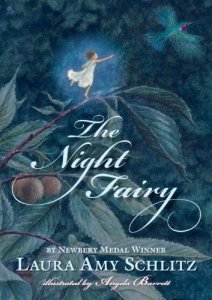
I’m frequently asked by parents for recommendations of fairy-themed chapter books. This isn’t just because fairy lore is undergoing a kind of comeback (or maybe it never left?). It’s also because, despite the high demand, there is a surprising dearth of quality literary offerings. Yes, I know your daughter is obsessed with the Rainbow Fairies series, for its colorful covers and overtly girly content, but have you tried reading one of those awkwardly-constructed, downright-insipid books aloud? Bleh. Let her read those on her own if she must. In the meantime, do both of you a favor and get your hands on Laura Amy Schlitz’s The Night Fairy, which is EVERYTHING A FAIRY BOOK SHOULD BE. This is reading aloud at its best.
Since it came out in 2010, The Night Fairy (Ages 5-10, if reading aloud) has become one of my favorite books to give as a gift. Hold the 117-page hardcover in your hands, and you know you are dealing with something special. It’s petite (as a book about a fairy should be); its pages are thick and glossy; and it features exquisite watercolor plates by British illustrator Angela Barrett. But here’s the clincher: the writing is absolutely exquisite. The descriptive passages soar. The action is tight. The multidimensional characters tug at our heartstrings. And—drum roll please—the story is steeped in the natural world, in the world right outside our front door. « Read the rest of this entry »
A Chapter Series Which Calls Us Home
March 12, 2015 § 6 Comments
 “Mommy, I like you during the day. But I really love you at night when you read to me.” My son, six years old at the time and still feeling the high of the previous evening’s story time, uttered these words last summer at breakfast. (Yes, it was the Best Breakfast Ever; and no, our mealtimes are not normally this sweet).
JP’s comment came at a time when we were halfway through devouring George Selden’s seven chapter books about a cricket named Chester and his friends, Harry Cat and Tucker Mouse. For years, I had been singing the praises to parents of the 1960 novel, The Cricket in Times Square (Ages 9-13, younger if reading aloud), as a perfect read-aloud chapter book for those eager to follow longer, more complex stories—but not yet in possession of the reading ability to get there themselves. It can be tricky among contemporary literature to find poignant, beautifully written stories that don’t come at the expense of innocent, age-appropriate content. For this age group, The Cricket in Time’s Square stands alongside other wonderful classics like Charlie and the Chocolate Factory, The Trumpet of the Swan, and Charlotte’s Web (let’s face it: Charlotte’s death—that of a spider at the end of her life—is about as heavy as many people want when reading to their six or seven year old.). « Read the rest of this entry »
Roald Dahl’s Antidote to Screen Time
February 5, 2015 § 10 Comments
 Last month, we had six mornings where school was delayed because of weather (in Virginia, this translates as a dusting of snow, a threat of snow, or some ice spotted on a road). It will come as no surprise that I spent all six of these mornings reading to my kids. This is equal parts good parenting and pure laziness. When my kids storm my bedroom at 7am and learn that school is delayed by two hours (AGAIN), I want nothing less than to climb out of bed and make them breakfast. Truth be told, I don’t want to do much of anything; but I will happily settle for two soft bodies nestling into either side of me. And, building on our December success, it seems I am on a winning streak of choosing chapter books that appeal to both my four and seven year old.
I decided to begin the year with a Roald Dahl marathon, and we’ve kicked off with Charlie and the Chocolate Factory. I ask you this: is there a more entertaining read-aloud chapter book?
I mean, it’s quite possibly THE MOST FUN BOOK EVER. « Read the rest of this entry »
The Book That Saved December
December 31, 2014 § 7 Comments
 Reading to our children can sometimes be the best way to slow down and live in the moment; to see the world through the wonder of young eyes and to have our own faith restored. Never has this been truer for me than in the past month. This December, reading threw me a lifeline. And boy, did I need it.
What is normally a time of sweet anticipation (cutting down our Christmas tree! driving the kids around to look at decorations! shopping for the perfect wrapping paper!), felt this year like an insurmountable list of to dos. The word drudgery came to mind on more than a few occasions. With my husband traveling for much of the month, I was exhausted. With every step, it felt like my legs were at risk of crumpling, of reducing me to a cast-aside pile of expired Christmas lights. The rain didn’t help (because who enjoys tromping around a Christmas tree farm in the pouring rain?). No matter how many times I scaled back my expectations (the teachers will get store-bought gifts this year!), I never felt the burden lighten.
I don’t have to tell you what our stress level does to our ability to parent with patience. As my daughter erupted into yet another round of crocodile-tear hysterics (over, at one point, a hypothetical snowball fight with her brother), I began to have fantasies of walking into the neighbor’s mass of giant inflatable Santas and Frostys and never coming out. « Read the rest of this entry »
At Last, Something for the Youngest Sibling
November 6, 2014 § 1 Comment
 One book that all the Book People will be talking about this holiday season is Abby Hanlon’s Dory Fantasmagory (Ages 5-9), an illustrated early-chapter book featuring one of the spunkiest, most imaginative, most genuinely real six-year-old girls to grace the pages of children’s literature. (After all, it was written by a former first-grade teacher.) If you really want to impress people with how in the know you are, you should buy the book this month, instead of waiting until next month, and then you should give it to everyone you know—regardless of whether it’s their birthday or not. Just a thought.
It’s possible that I’ve lost perspective on this 153-page gem, because I have, by request, read it upwards of ten times to my four year old in the past month (and don’t think that her seven-year-old brother doesn’t listen in at every chance he gets). I’m beginning to feel like Dory (nicknamed Rascal) and Emily are actually the same person (wait, are they?). Both talk to themselves incessantly, invent wild fantasies in their play, wear strange things around the house, and will stop at nothing to get the attention of their older siblings. I don’t think that Emily has a bearded fairy godmother named Mr. Nugget, or that she believes there are at least seven (mostly) hospitable monsters living in our house…but then again, I can’t be sure. « Read the rest of this entry »
The Best Chapter Books Talk to the Heart
May 17, 2013 § 3 Comments
 I’m often asked to recommend chapter books that lend themselves to reading aloud, either for a classroom setting or for a parent reading to an elementary-aged child. This is no small order: you need something where the subject matter isn’t too frightening or mature for the 5-8 year old set; you need something that’s going to engage the adult reader as much as the child (there’s no law that says this can’t be enjoyable for us!); and you need something that transcends the plot-driven, early-reader books that kids are reading on their own and helps them develop a taste for the kind of diverse language and emotionally-rich storytelling that will hopefully influence their reading choices in the future. This past winter, we read to my son the classic Little House on the Prairie series, which I adored as a child and whose themes feel just as timeless and important as ever (family values, the rewards of hard work, celebrating the non-material joys in life). But Laura Ingalls Wilder’s writing can also be quite tedious to read aloud, packed with lengthy explanations (twenty pages devoted to smoking a pig?) and repetitive sentence structures. There were moments when I could feel JP’s attention wandering, despite his avid assurance each night that he wanted to read more, more, more.
But then we finished that series and began Marion Dane Bauer’s stand-alone novel Little Dog, Lost (Ages 8-12, younger if reading aloud), published just last year, and it felt like a breath of fresh air. Here’s a book where not a single word is wasted, a book whose text flows off the tongue with such buttery smoothness that most of the time I couldn’t bring myself to stop when I got to the end of a chapter (that’s right, I was actually choosing in those moments to delay bedtime). Bauer achieves this incredible richness of language by breaking with a major narrative tradition: she writes her novel in free verse, creating chapters out of short, staccato poems, which loosely string together and sometimes even repeat words and phrases, all the while telling a very clear and cohesive story. There are 44 of these untitled poem-chapters; and they switch off narrating from the viewpoints of children, adults, and animals—all of whom live in a small contemporary town called Erthly and whose lives are forever touched by an incident involving a lost dog searching for someone to love him.
Freed from the confines of conventional narration, Bauer is able to cut straight to the emotional core of her characters—and the result is a story that children will feel deep in their hearts. Animal stories inherently engender sympathy from children (not coincidentally, some of JP’s favorite moments in the Little House books revolve around the Ingalls’ faithful dog, Jack). At the center of Little Dog, Lost is Buddy, an orphaned dog with “ears like airplane wings,” who “dances” along the sidewalk, longing for a home with “chasing balls,/ ear scratches,/ kisses.” Children will easily relate to Mark, a young boy “who had wanted a dog for as long as he could remember./ He had asked for a dog./ He had begged for a dog./ He had pleaded and prayed and whined for a dog./ Once he’d even tried barking for a dog.” And who wouldn’t be intrigued by a mysterious old man named Charles Larue, who lives alone in a pointy-towered mansion and never speaks to anyone? Throughout the story’s suspenseful twists and turns, even amidst the humorous touches (many coming from a bossy tabby cat who thinks he’s a dog), the story never strays from the hopes and dreams of its relatable, big-hearted characters. It’s fair to say that my son had a full-body experience while listening to this book. He chuckled, gasped, and emitted little exasperated grunts; he covered his eyes and held his breath; he beat his fists on the bed; he cheered; he hugged my arm to pieces; and he shed more than a tear or two (as he says, “I have a little water in my eyes right now because I’m so happy.”). Now that’s a chapter book.
Other Favorite Read-Aloud Chapter Books With Animals & Lots of Heart:
The Cricket in Times Square, by George Selden (Ages 5 & up*)
Charlotte’s Web, by E.B. White (Ages 5 & up)
The Trumpet of the Swan, by E.B. White (Ages 5 & up)
Mr. Popper’s Penguins, by Richard Atwater (Ages 5 & up)
Ginger Pye, by Eleanor Estes (Ages 6 & up)
The One and Only Ivan, by Katherine Applegate & Patricia Castelao (Ages 6 & up)
*Please note that these ages are assuming the reading is being done by an adult. For a child reading independently, the age range would be closer to eight and up.
Chapter-a-Night Adventure
May 4, 2012 § 2 Comments
 How do chewing gum, hair ribbons, and six magnifying glasses help a little boy rescue an enslaved baby dragon on a wild island of ferocious talking animals? There are few early chapter books written with as much wit, cleverness, and heart as Ruth Stiles Gannett’s beloved trilogy, first published over 60 years ago: My Father’s Dragon, Elmer and the Dragon, & The Dragons of Blueland (Ages 4-9). With short digestible chapters, about 200 words per page, and enchanting black-and-white sketches peppered throughout, they are perfect for reading aloud.
JP and I started these books on a recent train ride to New York and finished them a few days later, only to start them over again. At the heart of the stories is the relationship between Elmer and his dragon, an evolving friendship that brings out the best in both parties. But the real draw for kids is the adventure (no shortage of “close-calls”) and the magic (who doesn’t love thinking about riding on the back of a flying dragon?).
 What to Read to Your Kids