Earth Day! New Non-Fiction Celebrating Our Planet
April 22, 2021 Comments Off on Earth Day! New Non-Fiction Celebrating Our Planet
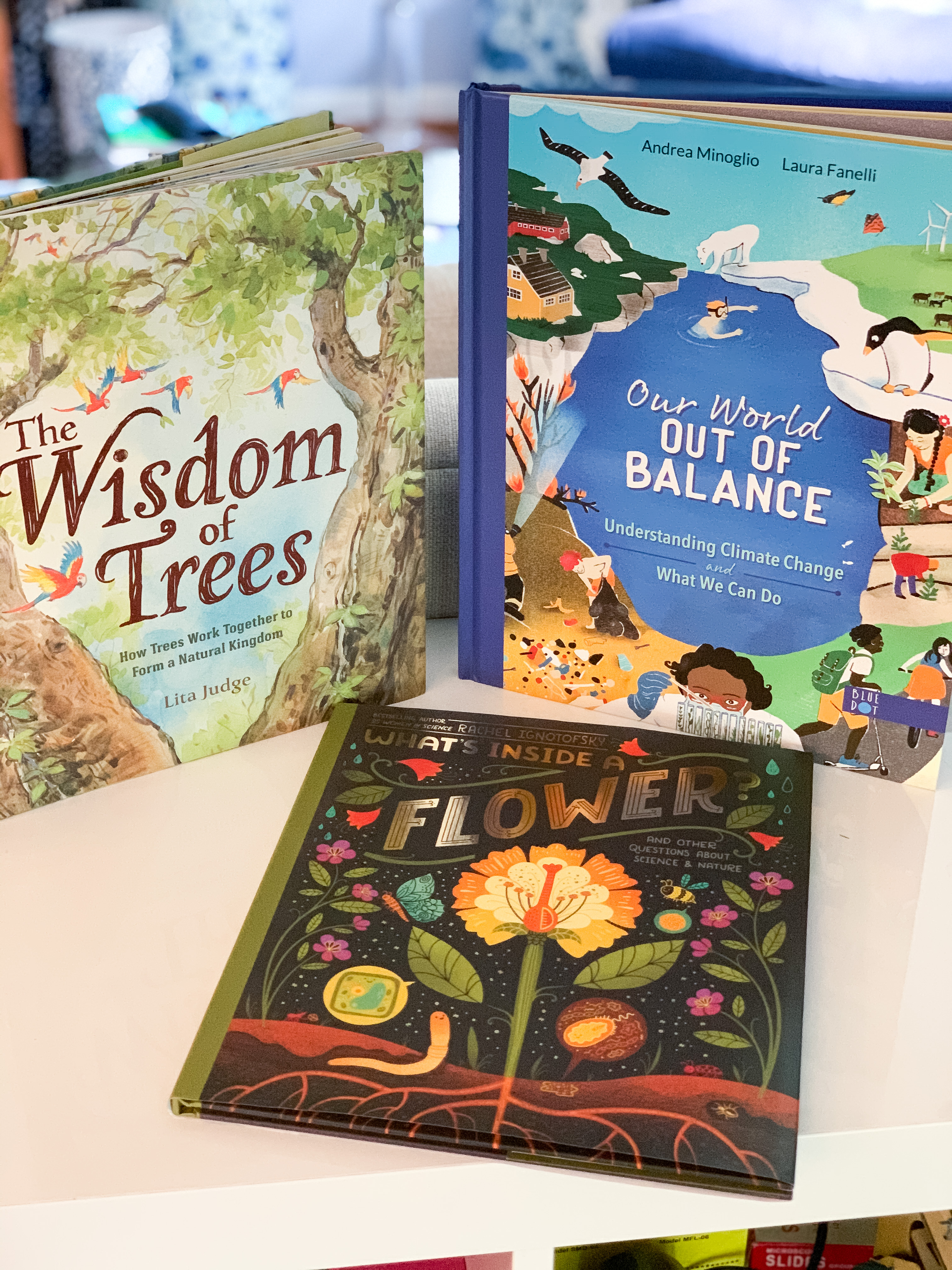
Every year on Earth Day, I smile thinking about my son at age four, who looked up at me with his big brown eyes and asked, “Mommy, aren’t we supposed to care about the Earth every day?” Yes, my boy. Same with Black history and women’s history and all the rest of these annual celebrations. But it sure is nice, now and then, to be nudged to think about our home libraries, about how we might freshen them up in a way that leads to better, richer dialogues with our children. After all, books bring with them such marvelous reminders of what a special, precious gift this planet is.
Today, I’m sharing three new non-fiction titles, targeting a range of ages. Each delivers a wealth of information—be it flowers, trees, or climate change—in clever, arresting, beautiful presentations. These aren’t the non-fiction books of our childhood, with tiny type and dizzying details. They’re a testament to a new way of presenting scientific content to kids, one which doesn’t sacrifice visual ingenuity or narrative appeal. They’re books we parents won’t get tired reading. In fact, we’re likely to learn things alongside our children. What better way to model caring for our planet than showcasing our own curiosity and discovery?
« Read the rest of this entry »Saving the Trees
April 22, 2013 § 2 Comments
 Earlier today, in honor of Earth Day, I shared Dr. Seuss’ The Lorax (Ages 5-10) with the elementary children at my son’s Montessori school. While most people associate Dr. Seuss with the nonsensical but catchy I-Can-Read titles, like Green Eggs and Ham, I would argue that his narrative poems—his longer, more complex, often moralistic stories—were actually his greatest gift to children. Not only do these stories showcase a mastery of rhyme that is virtually unmatched in contemporary children’s literature, but many of them also serve as cautionary tales, introducing children to the dangers of things like running away from your problems (I Had Trouble in Getting to Solla Sollew), or prejudice (The Sneetches), or, as in the case of The Lorax, industrialization at the expense of natural resources.
The Lorax, a “brownish,” “mossy,” raspy-voiced creature, who famously utters, “I speak for the trees for the trees have no tongues,” may have been conjured up by Dr. Seuss in 1971, but his environmental message resonates just as clearly today. And yet, there’s a second hero in this story, one with greater power than The Lorax himself. I’m referring to the unnamed child, who appears at the beginning and the end of the story—the one to whom the Once-ler relates (and repents) his decision to knit every last Truffula Tree into an ambiguous but allegedly multipurpose Thneed, “which everyone, EVERYONE, EVERYONE needs.” This child, to whom the Once-ler entrusts the very last Truffula seed, along with instructions to nurture it with water and clean air, literally holds the future of the planet in his hands; he is the reader’s hope for a happy ending. « Read the rest of this entry »
 What to Read to Your Kids