Remembering 9/11 with Five Books for Different Ages
September 2, 2021 § 4 Comments
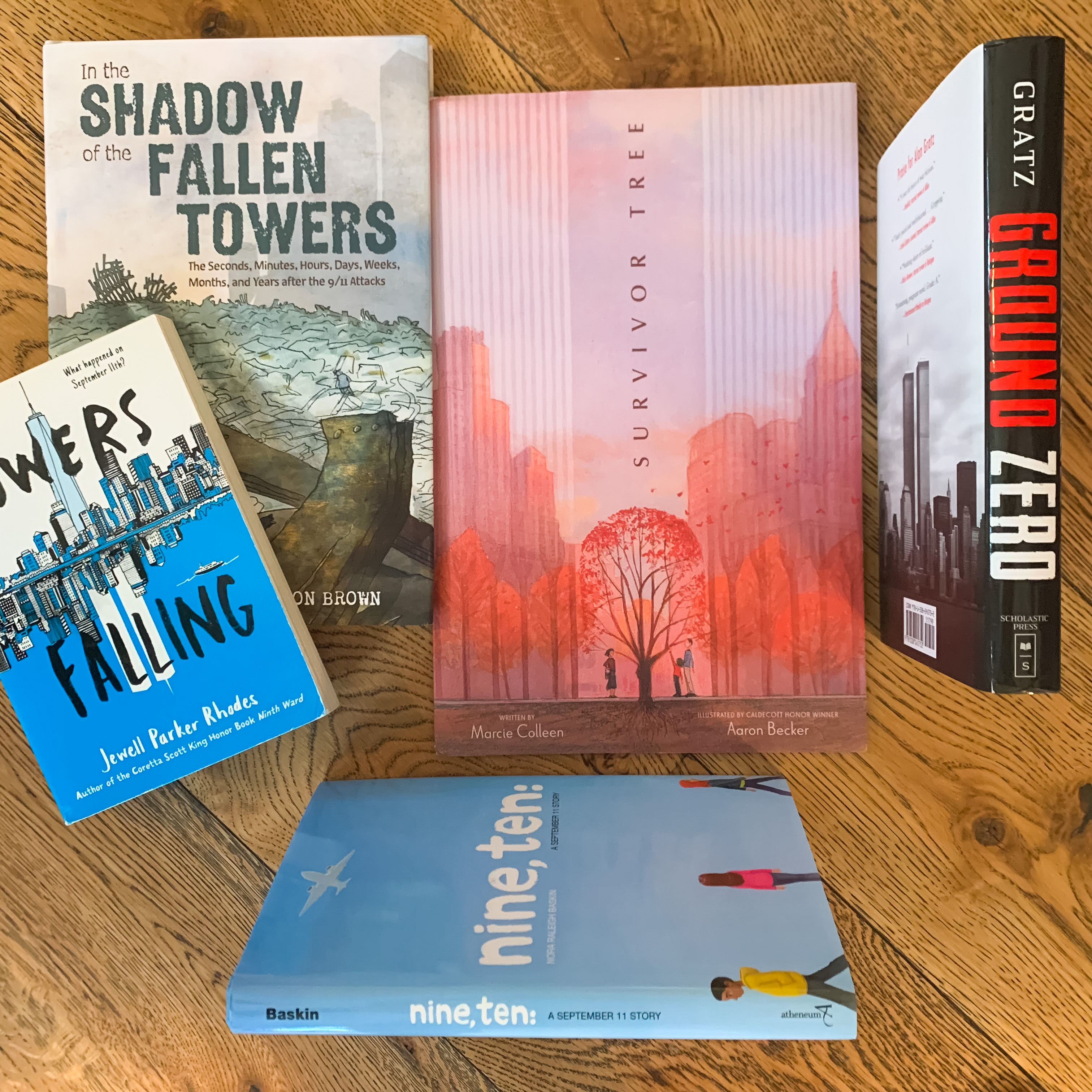
Everyone has a story about where they were on 9/11, and if you tell yours, you’ll almost certainly be interrupted by someone eager to share theirs. And yet, for stories so easily accessed—seemingly lying in wait on the tip of our tongue—we go to great lengths to keep them from leaking out into mainstream conversation, or even into the privacy of our own homes, without explicit invitation. This is especially true with our children.
Twenty years have passed, but talking about 9/11 with children—especially young children—continues to makes many parents and teachers uncomfortable. I cannot begin to appreciate the trauma of those directly impacted by the horrific events of that day, but even those of us physically distanced from the attacks felt a profound terror course through our veins as we attempted to make sense of what we were seeing on our television screens, as we scrambled to contact loved ones in New York or Washington DC, as we passed subsequent days under eerily silent skies. It was a fear unprecedented for many of us, and it represented a before-and-after moment we can never un-see. Many of us would rather avoid the topic altogether, or gloss over the horrifying details, than pass along that fear to our children.
And yet, our children have spent their entire lives in a post-9/11 world—in the “after,” so to speak. The safety precautions that started in its wake are the only ones our kids have ever known. I let my ten-year-old daughter read Alan Gratz’s Ground Zero (discussed below) earlier this year after she begged, and I waited for her to set it down, to tell me it was too scary, that she never wanted to take an elevator or get on a plane again. But that didn’t happen. She absorbed the horrors in those pages as she had those in The War That Saved My Life, a gorgeous but also heavy novel about World War Two. I might say she hungered for it.
I’ve come to see that my children want us to talk about that day. They want to understand what led to our longest war in history, the tragic aftermath of which is playing out right now. They want to understand the terror we felt. They want, as I do each time I visit my mom in Manhattan, to stand in front of the reflecting pools at the 9/11 Memorial and marvel at the names, to contemplate the absence that the rushing water dies into.
I’ve come to see the value in unburdening this history—both for them and for us. We don’t know exactly where 9/11 will land in history, but we do know that our democracy was attacked that day, that our power structures were undermined, and that we were forced to take stock of the values we hold most dear. The events of that day are not only part of our cultural consciousness, they’re a reminder that we must work every day to uphold the freedom that paves the way for a more just and equitable world. (I had my own 9/11 reckoning earlier this year, when I listened to the astounding audio production of Garrett M. Graff’s The Only Plane in the Sky.)
I’ve come to see the value that good, careful literature offers in imparting this history—and in pointing us towards hope. In the face of egregious violence and horror and loss on 9/11, there were countless narratives of resilience. Of coming together. Of helping and sacrificing and supporting. Of courage in the most unlikely places. As author Jewell Parker Rhodes recently said on a Little Brown panel, “Narrative takes pain and chaos and helps us make sense of it in a way that allows us to move toward healing.”
Children’s books have a universally honored obligation to end with hope, no matter the subject. It’s what makes them so sacred. The books I discuss below—some a few years old and some published to commemorate the twentieth anniversary of 9/11—take the trauma of that day and transform it into history with grace and beauty. There’s an immensely moving and uplifting picture book that allows the smallest child to connect with the absence and loss surrounding 9/11—I would not hesitate to read it to a four year old, nor to any age for that matter—and there are chapter books that approach the subject from various angles (and with various levels of violence). There’s an outstanding graphic novel that manages a comprehensive study of the subject in just over 100 pages. As always, I provide age ranges below each title.
« Read the rest of this entry »Fall is Looking Good: Middle-Grade Round Up
November 7, 2019 Comments Off on Fall is Looking Good: Middle-Grade Round Up
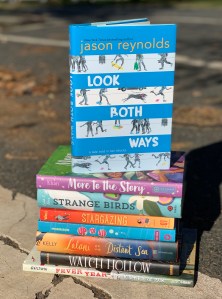 Of the dozens of middle-grade books I’ve read so far this fall (and I see no reason to stop anytime soon), here are the ones that have risen to the top. All except one I’ve featured on Instagram in recent weeks, but it seemed like a good time to round them up here. Publishers often save their best titles for fall, and this fall is proving pretty spectacular. May your children take advantage of the dwindling daylight to curl up with one of these gems. Perhaps they’ll find their people. Perhaps they’ll re-frame what it means to be an American. Perhaps they’ll even get closer to answering the question on the back of Jason Reynolds’ newest contribution to the tween psyche: How you gon’ change the world?
(Oh, and should you need something for yourself or your older teen, you’ll just have to get on the ‘gram to see this review. It’s only my favorite read of the fall.)
Learning from the Big Thinkers (Summer School Continues!)
June 30, 2013 § 2 Comments
 Albert Einstein said, “The important thing is not to stop questioning. Curiosity has its own reason for existing.” Then by this account, should we embrace the endless string of questions by our children throughout the day? A recent British study found that children ask on average 300 questions a day. I’m pretty sure that my almost six year old has this daily average beat by the thousands; and while there are many moments when I relish his curiosity, there are also times when I long for an “off” button. These last instances most frequently occur when we’re in the car, because there’s nothing like being locked in a metal box with your children to bring out their obsessions with a full, unadulterated intensity. “Why are the clouds moving that way? Is there going to be a storm? How do the weather people know there’s going to be a storm? What happens if lightning hits our car? Why does red have to mean stop?” (This last one as we pull up to a stoplight and I realize that I can’t expect his brain to pause just because the car does.)
I was driving back from the pool the other day (having been turned away by the threat of storm clouds), and I may or may not have erupted with “I can’t take it anymore!” But then, I had a rare flash of brilliance, and I declared, “It’s Mommy’s turn to ask questions.” I began my own litany of questions, only to discover that JP had answers waiting just as quickly as I could rattle them off. ‘”What are clouds made of?” (“Water droplets!”) “Why does a ball fall if you drop if in the air?” (“Gravity!”) “Why am I not hungry?” (“Because you probably ate enough lunch!”) “Wow,” I said, “you are just as good as answering questions as you are at asking them.” “That’s because I ask so many questions!” he roared, and he and his sister laughed their heads off for the next two minutes (I’ll take my breaks where I can get them).
I recently posted about the value of sharing picture book biographies with children, and I included a list focused on true stories of the Ordinary Doing Extraordinary. But, of course, we mustn’t neglect the born geniuses, the legendary minds, the Great Thinkers that are responsible for shaping our very understanding of the world. In recent years, a slew of exceptional artistic and richly informative picture books have emerged (see my list at the end of this post) to celebrate such minds as Leonardo da Vinci, Benjamin Franklin, and, most recently, Mr. Curiosity Himself: Albert Einstein.
Jennifer Berne’s On a Beam of Light: A Story of Albert Einstein (Ages 5-10) is the kind of book you’ll want to share with your kids when they’re five, six, seven, eight, nine, and ten. Berne’s highly approachable narrative voice speaks directly to children (she first won me over in Manfish: A Story of Jacques Cousteau). In Einstein’s case, she brings to life, not only Albert’s awe at the mysteries of the world, but also his many personality quirks—from his disruptive questioning in elementary school to the saggy, baggy clothes he always wore as an adult (“My feet are happier without socks!”). These quirks are further emphasized by Vladimir Radunksky’s loosely drawn pen, ink, and gouache drawings, at once frenetic and playful, serene and innocent, like little windows into Albert’s own ever-shifting imagination. In JP’s favorite spread, Albert imagines what it would be like to ride his bike up the beam of sunlight that’s shining down on the sidewalk in front of him. “And in his mind, right then and there, Albert was no longer on his bicycle, no longer on the country road…he was racing through space on a beam of light. It was the biggest, most exciting thought Albert had ever had. And it filled his mind with questions.”
I’m no physicist. In fact, I somehow managed to avoid taking a Physics class in both high school and college (I regret this now). I have never felt terribly confident talking about energy and heat and magnetism and motion with my children, and goodness knows what I’ll do when I have to help them with equations involving E = mc2. But here I am, reading this book—this beautiful literary depiction of these scientific concepts—and I think, “Why have I never realized that physics is everything?!” Like the searching, wondering eyes of our little ones, Albert sees everything as a question. How could “a lump of sugar dissolve and disappear into his hot tea?” How could the “smoke from his pipe…disappear into the air?” And, of course, what would happen if he traveled near the speed of light? (The answer: “Only minutes would pass for Albert, while years and years went by for the rest of us!”)
Albert “asked questions never asked before. Found answers never found before. And dreamed up ideas never dreamt before.” Because of him, we were able to build spaceships and travel to the moon (there’s a great afterward that gets into more detail about the repercussions of Einstein’s discoveries, along with a list of additional reading material). Naturally, there are many questions still at large about how the universe works—and, fittingly, the book’s dedication reads, “To the next Einstein, who is probably a child now.” If my son and his peers are any indication, there’s likely a whole crop of future Big Thinkers out there. Children who won’t let a mere stoplight slow them down from asking their questions, questions, questions.
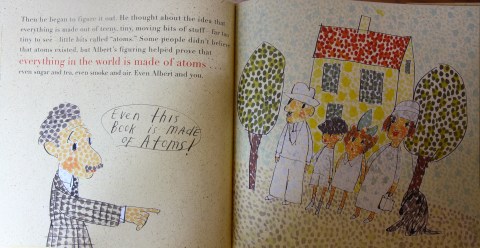
Here, kids are introduced to the idea that everything is made up of “teeny, tiny, moving bits of stuff—far too tiny to see—little bits called ‘atoms'” In a perfect marriage of text and illustration, Radunksky’s corresponding picture is broken up into hundreds of tiny dots (“Even this book is made of atoms!”).
Other Favorite Picture Books About Great Scientific Minds:
Odd Boy Out: Young Albert Einstein, by Don Brown (Ages 5-10)
Electric Ben: The Amazing Life and Times of Benjamin Franklin by Robert Byrd (Ages 6-12)
Noah Webster and His Words, by Jeri Chase Ferris (Ages 6-10)
I, Galileo, by Bonnie Christensen (Ages 7-12)
Leonardo: Beautiful Dreamer, by Robert Byrd (Ages 8-12)
The Tree of Life: Charles Darwin, by Peter Sis (Ages 8-12)
 What to Read to Your Kids