Roald Dahl’s Antidote to Screen Time
February 5, 2015 § 10 Comments
 Last month, we had six mornings where school was delayed because of weather (in Virginia, this translates as a dusting of snow, a threat of snow, or some ice spotted on a road). It will come as no surprise that I spent all six of these mornings reading to my kids. This is equal parts good parenting and pure laziness. When my kids storm my bedroom at 7am and learn that school is delayed by two hours (AGAIN), I want nothing less than to climb out of bed and make them breakfast. Truth be told, I don’t want to do much of anything; but I will happily settle for two soft bodies nestling into either side of me. And, building on our December success, it seems I am on a winning streak of choosing chapter books that appeal to both my four and seven year old.
I decided to begin the year with a Roald Dahl marathon, and we’ve kicked off with Charlie and the Chocolate Factory. I ask you this: is there a more entertaining read-aloud chapter book?
I mean, it’s quite possibly THE MOST FUN BOOK EVER. « Read the rest of this entry »
The Book That Saved December
December 31, 2014 § 7 Comments
 Reading to our children can sometimes be the best way to slow down and live in the moment; to see the world through the wonder of young eyes and to have our own faith restored. Never has this been truer for me than in the past month. This December, reading threw me a lifeline. And boy, did I need it.
What is normally a time of sweet anticipation (cutting down our Christmas tree! driving the kids around to look at decorations! shopping for the perfect wrapping paper!), felt this year like an insurmountable list of to dos. The word drudgery came to mind on more than a few occasions. With my husband traveling for much of the month, I was exhausted. With every step, it felt like my legs were at risk of crumpling, of reducing me to a cast-aside pile of expired Christmas lights. The rain didn’t help (because who enjoys tromping around a Christmas tree farm in the pouring rain?). No matter how many times I scaled back my expectations (the teachers will get store-bought gifts this year!), I never felt the burden lighten.
I don’t have to tell you what our stress level does to our ability to parent with patience. As my daughter erupted into yet another round of crocodile-tear hysterics (over, at one point, a hypothetical snowball fight with her brother), I began to have fantasies of walking into the neighbor’s mass of giant inflatable Santas and Frostys and never coming out. « Read the rest of this entry »
Gift Guide 2014 (No. 4): Three Books for the Scientist (Ages 5-12)
December 11, 2014 § 1 Comment
If I had a dollar for every time my children tell me they are doing a science experiment, I would be a rich Mama. Most of these experiments involve putting water in a cup with some household item and sticking it in the freezer (spoiler alert: it freezes). Sometimes, usually with the help of birthday gifts, they might raise their game by building baking-soda volcanoes or citrus-powered clocks.
Our children’s natural curiosity about the inner-workings of the world has been given extra-special treatment in books this year. Today, I’ll be singing the praises of two novels for the 9-12 crowd, which seamlessly weave science into the drama of middle-school life (one stars a boy, the other a girl). For the younger elementary child, a picture book biography on Carl Sagan will prove the perfect entrée into the mysteries of the cosmos. Without further ado, let us begin.
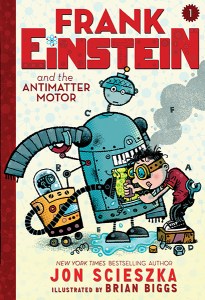 [Warning: this book may cause your child to talk like a robot well beyond the last page.] Author Jon Scieszka, long-time advocate for the reluctant boy reader (see his inspiring tips here), embarks on the ultimate Science is Cool chapter book series, with Frank Einstein and the Antimatter Motor (Ages 9-12; younger if reading aloud). Frank Einstein is a kid-genius inventor—with a special fondness for his Grampa Al, as well as for his Grampa Al’s Fix-It! Shop (“the greatest place in the world to test any invention you might think of”). Determined to win the Midville Science Prize and reap a large cash reward to pay off Grampa Al’s debts, Frank, his best-pal Watson, and two self-assembled artificial intelligence entities named Klink and Klank (my son’s new favorite literary characters), create a Fly Bike powered by an Antimatter Motor. Naturally, all this gets complicated by Frank’s arch-nemesis: the doomsday-plotting, idea-stealing, robot-napping T.Edison. « Read the rest of this entry »
Gift Guide 2014 (No. 2): Three Books for the Linguist (Ages 6-12)
November 25, 2014 § 1 Comment
Children have an inherent drive towards language. As infants, they hang on our every word. Once they begin to speak, they never tire of the sound of their own voice; and, as they develop more self-control, they relish in the discovery of expressing themselves (“Use your words!”) to get what they want. But it’s in the elementary years, when our kids are at last reading and writing on their own, that they become most keenly aware of the power of words, not only to shape and alter meaning, but also to connect them to the world.
Of course, it can’t hurt to nudge an awareness of the nuance of language into the forefront of our children’s minds. (We have to believe our kids are capable of more than “It was fine,” when asked about their day.) It just so happens that 2014 has given us three exceptional books (one picture book and two middle-grade chapter books) that showcase the power of language.
 Jen Bryant and Melissa Sweet’s The Right Word: Roget and His Thesaurus (Ages 6-12) introduces children to the notion that, in the vast archives of the English language, there is a “right” word to express a precise meaning. Bryant and Sweet have become masters of picture book biographies in recent years (remember this post?); but their portrait of the man who invented the thesaurus is their most magnificent to date. The story of Dr. Peter Roget’s life is narrated beautifully for a young audience; but it is the way in which Sweet has visualized Roget’s fascination with language that truly captivates the reader. Like the thesaurus itself (which comes from the Greek word meaning “treasure house”), this is a book that’s impossible to absorb in one—or ten, or twenty—sittings. Visual feasts of collage beckon the eye on every page. « Read the rest of this entry »
Morning at The Met (Courtesy of E.L. Konigsburg)
October 30, 2014 § 5 Comments
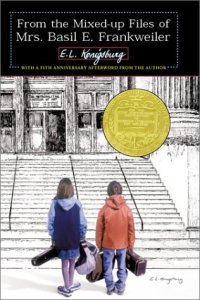 Earlier this fall, JP and I embarked on our annual trip to New York City, where I grew up and where my Mom still lives. Normally on these visits, we are content to plot and rehash the day’s adventures by pouring over the vibrant illustrations in Kathy Jakobsen’s My New York, which my Mom brings down from a closet upon our arrival.
This time, I decided that some advance reading was in order. So, in the weeks leading up to our departure, I read to JP one of the novels I most remember from my childhood: E.L. Konigsburg’s From the Mixed-Up Files of Mrs. Basil E. Frankweiler (Ages 9-12; younger if reading aloud), which won the Newberry Medal in 1968. Through the eyes of two runaway siblings from Greenwich, Connecticut, who secretly live (and sleep) in The Metropolitan Museum of Art for an entire week, we are introduced to this incredible museum with drama and intrigue. The last time I took JP to the Met—albeit he was only five—was a disheartening disaster; he was bored within minutes of my ramblings about Impressionist painters. This time was different. This time, we had purpose: we were following in the steps of Claudia and Jamie Kincaid. « Read the rest of this entry »
Holiday Gift Guide 2013: Illustrated Chapter Books for the Adventure Seeker
December 19, 2013 § 5 Comments
 Many of us remember the first novels we read, the ones that instilled in us a love of reading (off the top of my head: A Secret Garden, A Wrinkle in Time, anything written by Ruth Chew…). Earlier this year, the prolific writer, Neil Gaiman, wrote a beautiful defense of fiction, which I absolutely love. Fiction, he claims, is not only our best entry into literacy (the what-will-happen-next phenomenon being utterly addictive), but it teaches, above all, the power of empathy:
“When you watch TV or see a film, you are looking at things happening to other people. Prose fiction is something you build up from 26 letters and a handful of punctuation marks, and you, and you alone, using your imagination, create a world and people in it and look out through other eyes. You get to feel things, visit places and worlds you would never otherwise know. You learn that everyone else out there is a me, as well. You’re being someone else, and when you return to your own world, you’re going to be slightly changed.”
I’ve thought a lot about Gaiman’s words, as my six year old and I have been devouring some of the year’s newest chapter books. I’m hoping some of our favorites will find a way into your bedtime routines as well, beginning with Gaiman’s newest novel, Fortunately, the Milk (Ages 7-10, younger if reading aloud). This fantastically over-the-top book begs to be read aloud and is itself a kind of commentary on the power of storytelling. In an attempt to entertain his rambunctious children during their mother’s business trip, a father spins a fantastical tall tale (think pirates, piranhas, aliens, and singing dinosaurs all in the same breathlessly-paced story) about what happens when he goes to the store for a simple carton of milk. « Read the rest of this entry »
The Best Chapter Books Talk to the Heart
May 17, 2013 § 3 Comments
 I’m often asked to recommend chapter books that lend themselves to reading aloud, either for a classroom setting or for a parent reading to an elementary-aged child. This is no small order: you need something where the subject matter isn’t too frightening or mature for the 5-8 year old set; you need something that’s going to engage the adult reader as much as the child (there’s no law that says this can’t be enjoyable for us!); and you need something that transcends the plot-driven, early-reader books that kids are reading on their own and helps them develop a taste for the kind of diverse language and emotionally-rich storytelling that will hopefully influence their reading choices in the future. This past winter, we read to my son the classic Little House on the Prairie series, which I adored as a child and whose themes feel just as timeless and important as ever (family values, the rewards of hard work, celebrating the non-material joys in life). But Laura Ingalls Wilder’s writing can also be quite tedious to read aloud, packed with lengthy explanations (twenty pages devoted to smoking a pig?) and repetitive sentence structures. There were moments when I could feel JP’s attention wandering, despite his avid assurance each night that he wanted to read more, more, more.
But then we finished that series and began Marion Dane Bauer’s stand-alone novel Little Dog, Lost (Ages 8-12, younger if reading aloud), published just last year, and it felt like a breath of fresh air. Here’s a book where not a single word is wasted, a book whose text flows off the tongue with such buttery smoothness that most of the time I couldn’t bring myself to stop when I got to the end of a chapter (that’s right, I was actually choosing in those moments to delay bedtime). Bauer achieves this incredible richness of language by breaking with a major narrative tradition: she writes her novel in free verse, creating chapters out of short, staccato poems, which loosely string together and sometimes even repeat words and phrases, all the while telling a very clear and cohesive story. There are 44 of these untitled poem-chapters; and they switch off narrating from the viewpoints of children, adults, and animals—all of whom live in a small contemporary town called Erthly and whose lives are forever touched by an incident involving a lost dog searching for someone to love him.
Freed from the confines of conventional narration, Bauer is able to cut straight to the emotional core of her characters—and the result is a story that children will feel deep in their hearts. Animal stories inherently engender sympathy from children (not coincidentally, some of JP’s favorite moments in the Little House books revolve around the Ingalls’ faithful dog, Jack). At the center of Little Dog, Lost is Buddy, an orphaned dog with “ears like airplane wings,” who “dances” along the sidewalk, longing for a home with “chasing balls,/ ear scratches,/ kisses.” Children will easily relate to Mark, a young boy “who had wanted a dog for as long as he could remember./ He had asked for a dog./ He had begged for a dog./ He had pleaded and prayed and whined for a dog./ Once he’d even tried barking for a dog.” And who wouldn’t be intrigued by a mysterious old man named Charles Larue, who lives alone in a pointy-towered mansion and never speaks to anyone? Throughout the story’s suspenseful twists and turns, even amidst the humorous touches (many coming from a bossy tabby cat who thinks he’s a dog), the story never strays from the hopes and dreams of its relatable, big-hearted characters. It’s fair to say that my son had a full-body experience while listening to this book. He chuckled, gasped, and emitted little exasperated grunts; he covered his eyes and held his breath; he beat his fists on the bed; he cheered; he hugged my arm to pieces; and he shed more than a tear or two (as he says, “I have a little water in my eyes right now because I’m so happy.”). Now that’s a chapter book.
Other Favorite Read-Aloud Chapter Books With Animals & Lots of Heart:
The Cricket in Times Square, by George Selden (Ages 5 & up*)
Charlotte’s Web, by E.B. White (Ages 5 & up)
The Trumpet of the Swan, by E.B. White (Ages 5 & up)
Mr. Popper’s Penguins, by Richard Atwater (Ages 5 & up)
Ginger Pye, by Eleanor Estes (Ages 6 & up)
The One and Only Ivan, by Katherine Applegate & Patricia Castelao (Ages 6 & up)
*Please note that these ages are assuming the reading is being done by an adult. For a child reading independently, the age range would be closer to eight and up.
 What to Read to Your Kids