Elevating the Poop Talk
August 1, 2012 § 1 Comment
 As previously noted, we recently spent a week on the Canadian side of Lake Erie, where the beach isn’t exactly the soft white expanse of the Caribbean. But there’s an as-of-yet-unmentioned benefit to such dark, coarse, and oily sand if you’re an almost five-year-old boy: when wet, it bears a striking resemblance to poop. Cue hours of enjoyment for my son, and lots of averted trying-to-seem-oblivious glances from me. It never mattered how things began (“Mommy, I’m building a series of canals!”), they always ended at poop (“Mommy, now these canals are full of POOP!”)
During the 10 hour drive home at the end of the week, I had a revelation: if you can’t beat ‘em, join ‘em. Or rather, how could I direct this obsession into something educational?
I decided to get my hands on The Truth About Poop, by Susan E. Goodman (Ages 5-10), a mature picture-chapter book packed with biological, zoological, historical, and geographical facts about, yes, poop. There have actually been quite a few expertly executed books on this topic over the past 10 years, and they were always big hits at my shop (“You’re telling me your seven-year-old son isn’t interested in reading? Have you tried giving him a book about poop?”). I figured it was high time to bring one home for JP.
Hoot Hoot
July 24, 2012 Comments Off on Hoot Hoot
 As a city girl who spent her summers in the country, I was easily awed by how pitch black the night could get in the absence of city lights. My kids are similarly fascinated and spooked by the Darkest of Nights, like the ones they recently experienced while vacationing at my grandmother’s lake house in Ontario. Especially on cloudy nights, with the lake on one side and the woods on the other, everything becomes enveloped in pure blackness—and yet the darkness is alive with a chorus of strange and unusual sounds.
I love reading books that infuse nighttime with a dose of friendliness—with delight, if you will—and encourage kids to see the darkness outside their windows as something accessible. I also happen to think that owls in picture books are ridiculously cute (including how my 22-month-old daughter says “hoot hoot” with a perfectly rounded mouth); and, as luck would have it, some of the best books about nighttime happen to star precocious and energetic young owls.
Show Me the Moon
June 28, 2012 § 1 Comment
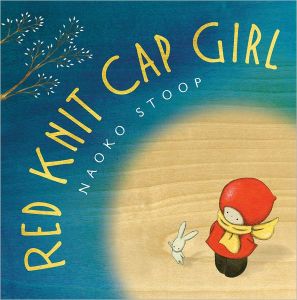 “Moon” was one of the very first words uttered by both of my children. When they’re playing outside at dusk, they will shriek at the top of their lungs—“MOOOOOOON!”—upon catching sight of it emerging in the still-blue sky.
If the sheer volume of children’s storybooks dedicated to this subject is any indication, my children are not alone in their enthrallment with the moon. It’s nearly impossible for me to choose one favorite story to profile here (see my lengthy list below), so I will simply go with the newest addition to this already impressive repertoire: Red Knit Cap Girl (Ages 2-5), written by first-time author Naoko Stoop. I’ve mentioned before my weakness for Japanese-influenced picture books; and, like so many of her predecessors, Stoop (who grew up in Japan and now lives in Brooklyn) has created a work that holds together like a perfectly wrapped present: each word is chosen with the utmost care, each picture serves a clear purpose. In a wholly original move, Stoop’s expressive, whimsical watercolors of a little girl and her woodland friends, on a quest to speak to the moon, are painted on pieces of plywood; children can actually see the grain of the wood shining through the paintings, an effect which is especially fitting for a story set in the forest.
Getting Up the Giggles
May 22, 2012 § 2 Comments
 Let’s face it: being a parent can sometimes feel like a thankless job (does he realize I’m missing precious minutes of “American Idol” while I’m washing his uniform for tomorrow, composing a creative note for his lunchbox, and picking crumbs off the floor so it will stop looking like the inside of a barn—all while he is hollering from upstairs about “one last drink of water”?).
Suffice it to say that we parents will take an Ego Boost where we can get one. And that’s why I love reading books like A Visitor for Bear (Ages 3-6), the first of the delightful Bear and Mouse books by Bonny Becker, with illustrations by Kady MacDonald Denton. Now, I could love this book because of the witty banter between the two strangers-turned-friends, or because Mouse speaks in a decidedly British accent, or because a bear dressed in an apron is just so darn cute. But, on those rare occasions when JP allows me to choose his bedtime book, the reason I run to grab this gem off the shelf, is because it makes him LAUGH OUT LOUD.
A Chomp Through Berryland
May 20, 2012 § 1 Comment
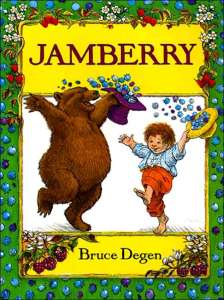 Today’s excursion to pick strawberries at Shlagel Farm in Maryland was the perfect excuse to break out an old favorite: Jamberry (Ages 1-3), by Bruce Degen. Not that we need an excuse to read this rollicking rhyme of a boy and a bear romping through fields and down streams on a quest for every kind of berry. But as the kids and I were filling our buckets with the plumpest, juiciest strawberries I’ve ever tasted, our fingers and shirts and mouths stained red, I couldn’t help but hear in my head: “Three berry/ Four berry/ Hayberry/ Strawberry/ Finger and pawberry/ My berry, your berry/ Strawberry ponies/ Strawberry lambs/ Dancing in meadows/ Of strawberry jam.”
We didn’t encounter any strawberry lambs (although there were goats and some very vocal chickens), and my children are likely to eat all the strawberries before I get a chance to make them into jam, but the spirit of the book was very much alive as we chomped our way through the farm. Our excitement continued to build, as we got deeper into the patch, launching ourselves into uncharted territory wherein (as we imagined it) lay the biggest berries.
How do I get my squirmy-wormy baby to love books?
May 17, 2012 § 1 Comment
 I’ve been fortunate that my kids have loved books from the very beginning. I’ll admit that part of my design was purely selfish: I’d rather read to my children than do almost anything else with them (read: sitting for hours on the floor making train sounds). So they quickly learned that Quality Time With Mom meant listening to stories.
During the years that I worked in retail, I was always surprised when a customer, shopping for a baby gift, would say, “I’m not going to buy a book for someone who can’t even talk! How would they understand it?” Who said anything about understanding?! In the beginning, books are simply stimuli: things to touch, to feel, to explore, to eat. They present an opportunity for little ones to listen uninterrupted to a parent’s voice, a sound babies are born loving. And they make for the best snuggle time EVER.
But don’t be fooled: the past decade of child development research tells us that, even while they’re hanging out of drooling mouths, books are wielding their magic on babies’ brains, laying the groundwork for early language development and, yes, even lifelong intelligence. So how do you get your squirmy-wormy baby to love books?
Send-Off for Sendak
May 8, 2012 Comments Off on Send-Off for Sendak
 Today we remember Maurice Sendak (1928-2012), arguably the most game-changing children’s author and illustrator of the 20th century; he took age-old storytelling conventions and turned them on their head (or, rather, sent them on a wild rumpus through the forest). His beloved Where the Wild Things Are has topped more recommended book lists than any other children’s book in history—as much for its glorious depiction of a boy’s uninhibited reign over his imagination as for its foray into previously shushed subjects like parental abandonment and night terrors. Sendak’s later books took even more risks, got simultaneously darker and more brilliant (and not without their fair share of controversy).
But for me and my family, Sendak’s “sweet spot” lies in his earliest works–no less memorable, even if they didn’t upset the status quo at the time. Before his characters were banished to their rooms without supper or left to wander the streets of New York without clothes, there were the deliciously sweet, make-me-want-to-read-to-my-children-all-day-long moments between a little bear, his parents, and a quirky ensemble of friends. I’m referring, of course, to the Little Bear books (Ages 3-7) by Else Holmelund Minarik, which Sendak illustrated in his 30s.
Curious George: Every Story Has a Beginning (Part 2)
May 7, 2012 Comments Off on Curious George: Every Story Has a Beginning (Part 2)
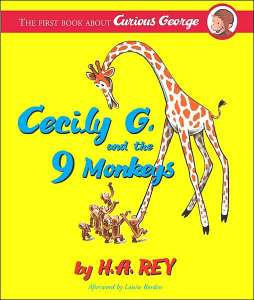 A continuation of yesterday’s post…
H.A. Rey, the German-born creator of Curious George more than 100 years ago, was a master of episodic storytelling, and his original books possess a level of wit, ingenuity, and “meatiness” that the derivative stories published in the last 10 years don’t quite match, even if the illustrations give them a very close look and feel (I’m referring to the stories included in such newer anthologies as A Treasury of Curious George).
Every story has a beginning, and many don’t know that H.A. Rey’s very first book about Curious George was titled Cecily G. and the 9 Monkeys (Ages 2.5-5). It’s a story about how George, still living in Africa with his brothers and sisters, came to live with (and befriend) a lonely giraffe named Cecily G. (who, incidentally, bears a striking similarity to the “Sophie the Giraffe” rattle that’s become something of a fashion accessory to today’s urban baby set). It turns out that when you’re a monkey, playing with a giraffe affords all kinds of unusual delights: you can ski down her neck, parachute off her head with an umbrella, and even sail on her back.
Chapter-a-Night Adventure
May 4, 2012 § 2 Comments
 How do chewing gum, hair ribbons, and six magnifying glasses help a little boy rescue an enslaved baby dragon on a wild island of ferocious talking animals? There are few early chapter books written with as much wit, cleverness, and heart as Ruth Stiles Gannett’s beloved trilogy, first published over 60 years ago: My Father’s Dragon, Elmer and the Dragon, & The Dragons of Blueland (Ages 4-9). With short digestible chapters, about 200 words per page, and enchanting black-and-white sketches peppered throughout, they are perfect for reading aloud.
JP and I started these books on a recent train ride to New York and finished them a few days later, only to start them over again. At the heart of the stories is the relationship between Elmer and his dragon, an evolving friendship that brings out the best in both parties. But the real draw for kids is the adventure (no shortage of “close-calls”) and the magic (who doesn’t love thinking about riding on the back of a flying dragon?).
Your Budding Naturalist
April 28, 2012 Comments Off on Your Budding Naturalist
 Right now in preschools across the country, little eyes are glued to screened containers perched on shelves, waiting to behold one of nature’s most wondrous life cycles: the caterpillar’s transformation into a butterfly. (“Mommy, when the chrysalis shakes, that’s how you know there’s a lot of action going on inside!”)
I grew up reading Eric Carle’s The Very Hungry Caterpillar (and really, who doesn’t love a book with holes for sticking tiny fingers through?); but in my opinion, Ten Little Caterpillars (Ages 2-6), written by Bill Martin Jr. and illustrated by the great collage artist Lois Ehlert, has topped this subject matter.
Apart from its stunning visual feast for the eyes, the book speaks to children on a multitude of levels. First, there’s the simple rhyme, each double-page spread focusing on a single caterpillar’s unique journey: “The first little caterpillar crawled into a bower./ The second little caterpillar wriggled up a flower.” A few of the caterpillars don’t fare so well (it’s a dog-eat-dog world, after all): one meets with a “hungry wren,” another is “frightened by a hen.” It’s the tenth caterpillar that we get to watch hang patiently among the apple blossoms for three pages, until her chrysalis hatches to reveal a stunning orange-and-black “tiger swallowtail.”
Spring is Here!
April 21, 2012 § 1 Comment
 Perhaps at no other time in our lives than when we are parenting young children are we more attuned to the changing of the seasons. Seen through our children’s eyes, it’s positively magical, nature unfolding in all sorts of surprising ways. Regardless of our “mild” winter, on March 1 our family had a March into Spring around our living room, started giddily discussing planting vegetables and riding bikes to school without jackets–and started reading Spring Books. In my opinion, a picture book about spring should capture the anticipation, the wonder, the thrill, and the hope we feel at the beginning of the season.
Get ready to open your hearts to And Then It’s Spring (Ages 3-6), a 2012 picture book by newcomer poet Julie Fogliano and one of my favorite contemporary illustrators Erin E. Stead (side note: if you don’t already own her zoo-animal masterpiece A Sick Day for Amos McGee, do not delay a second longer). And Then It’s Spring is one of those perfect marriages of words and pictures, where the end result is more than the sum of its parts. Without any illustrations, it’s simply a lovely free verse poem about “first you have brown/ all around you have brown/ then there are seeds/ and a wish for rain” and more waiting and “you worry about those seeds” but it’s still brown—until you wake up one morning and suddenly “it’s green/all around you have green.” Now add to this verse subtly stunning pencil and woodblock illustrations, and suddenly you have a little boy, his dog, a bunny, a bird, and a turtle (sporting a red wool cap)—all moving around a backyard that gets a little less brown every day.
 What to Read to Your Kids