The Stuff That Doesn’t Grow on Trees
October 2, 2014 § 5 Comments
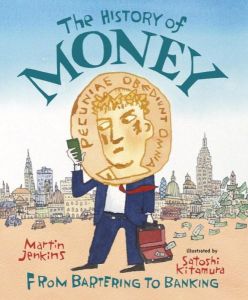 One of the most enjoyable afternoons I spent with my son this past summer had nothing to do with summer. It didn’t involve beaches or roller coasters or ice cream. It didn’t cost a cent, although it was all about money.
JP turned seven last week, and we had been telling him for awhile that we would begin giving him an allowance on his seventh birthday. Then, last June, it occurred to me that the kid had no practical knowledge of money, an inauspicious beginning to forging a lifetime relationship with the stuff that doesn’t grow on trees. I decided to make it my Goal of Summer 2014 to teach him, not only how to count and sort coins and bills, but also about how money came to exist in the first place—and how it has changed over time. Like most of my endeavors in parenting, this one started with a book.
The timing turned out to be perfect, because Candlewick happened to send me a copy of their newly published 52-page chapter book titled The History of Money: From Bartering to Banking (Ages 7-12), with text by Martin Jenkins and cartoonish illustrations by Satoshi Kitamura. From page one, JP was riveted. The book reads as a kind of anthropological, time-travel narrative, beginning in the early age of man when “nobody had any money.” « Read the rest of this entry »
Holiday Gift Guide 2013: Illustrated Chapter Books for the Adventure Seeker
December 19, 2013 § 5 Comments
 Many of us remember the first novels we read, the ones that instilled in us a love of reading (off the top of my head: A Secret Garden, A Wrinkle in Time, anything written by Ruth Chew…). Earlier this year, the prolific writer, Neil Gaiman, wrote a beautiful defense of fiction, which I absolutely love. Fiction, he claims, is not only our best entry into literacy (the what-will-happen-next phenomenon being utterly addictive), but it teaches, above all, the power of empathy:
“When you watch TV or see a film, you are looking at things happening to other people. Prose fiction is something you build up from 26 letters and a handful of punctuation marks, and you, and you alone, using your imagination, create a world and people in it and look out through other eyes. You get to feel things, visit places and worlds you would never otherwise know. You learn that everyone else out there is a me, as well. You’re being someone else, and when you return to your own world, you’re going to be slightly changed.”
I’ve thought a lot about Gaiman’s words, as my six year old and I have been devouring some of the year’s newest chapter books. I’m hoping some of our favorites will find a way into your bedtime routines as well, beginning with Gaiman’s newest novel, Fortunately, the Milk (Ages 7-10, younger if reading aloud). This fantastically over-the-top book begs to be read aloud and is itself a kind of commentary on the power of storytelling. In an attempt to entertain his rambunctious children during their mother’s business trip, a father spins a fantastical tall tale (think pirates, piranhas, aliens, and singing dinosaurs all in the same breathlessly-paced story) about what happens when he goes to the store for a simple carton of milk. « Read the rest of this entry »
The Best Chapter Books Talk to the Heart
May 17, 2013 § 3 Comments
 I’m often asked to recommend chapter books that lend themselves to reading aloud, either for a classroom setting or for a parent reading to an elementary-aged child. This is no small order: you need something where the subject matter isn’t too frightening or mature for the 5-8 year old set; you need something that’s going to engage the adult reader as much as the child (there’s no law that says this can’t be enjoyable for us!); and you need something that transcends the plot-driven, early-reader books that kids are reading on their own and helps them develop a taste for the kind of diverse language and emotionally-rich storytelling that will hopefully influence their reading choices in the future. This past winter, we read to my son the classic Little House on the Prairie series, which I adored as a child and whose themes feel just as timeless and important as ever (family values, the rewards of hard work, celebrating the non-material joys in life). But Laura Ingalls Wilder’s writing can also be quite tedious to read aloud, packed with lengthy explanations (twenty pages devoted to smoking a pig?) and repetitive sentence structures. There were moments when I could feel JP’s attention wandering, despite his avid assurance each night that he wanted to read more, more, more.
But then we finished that series and began Marion Dane Bauer’s stand-alone novel Little Dog, Lost (Ages 8-12, younger if reading aloud), published just last year, and it felt like a breath of fresh air. Here’s a book where not a single word is wasted, a book whose text flows off the tongue with such buttery smoothness that most of the time I couldn’t bring myself to stop when I got to the end of a chapter (that’s right, I was actually choosing in those moments to delay bedtime). Bauer achieves this incredible richness of language by breaking with a major narrative tradition: she writes her novel in free verse, creating chapters out of short, staccato poems, which loosely string together and sometimes even repeat words and phrases, all the while telling a very clear and cohesive story. There are 44 of these untitled poem-chapters; and they switch off narrating from the viewpoints of children, adults, and animals—all of whom live in a small contemporary town called Erthly and whose lives are forever touched by an incident involving a lost dog searching for someone to love him.
Freed from the confines of conventional narration, Bauer is able to cut straight to the emotional core of her characters—and the result is a story that children will feel deep in their hearts. Animal stories inherently engender sympathy from children (not coincidentally, some of JP’s favorite moments in the Little House books revolve around the Ingalls’ faithful dog, Jack). At the center of Little Dog, Lost is Buddy, an orphaned dog with “ears like airplane wings,” who “dances” along the sidewalk, longing for a home with “chasing balls,/ ear scratches,/ kisses.” Children will easily relate to Mark, a young boy “who had wanted a dog for as long as he could remember./ He had asked for a dog./ He had begged for a dog./ He had pleaded and prayed and whined for a dog./ Once he’d even tried barking for a dog.” And who wouldn’t be intrigued by a mysterious old man named Charles Larue, who lives alone in a pointy-towered mansion and never speaks to anyone? Throughout the story’s suspenseful twists and turns, even amidst the humorous touches (many coming from a bossy tabby cat who thinks he’s a dog), the story never strays from the hopes and dreams of its relatable, big-hearted characters. It’s fair to say that my son had a full-body experience while listening to this book. He chuckled, gasped, and emitted little exasperated grunts; he covered his eyes and held his breath; he beat his fists on the bed; he cheered; he hugged my arm to pieces; and he shed more than a tear or two (as he says, “I have a little water in my eyes right now because I’m so happy.”). Now that’s a chapter book.
Other Favorite Read-Aloud Chapter Books With Animals & Lots of Heart:
The Cricket in Times Square, by George Selden (Ages 5 & up*)
Charlotte’s Web, by E.B. White (Ages 5 & up)
The Trumpet of the Swan, by E.B. White (Ages 5 & up)
Mr. Popper’s Penguins, by Richard Atwater (Ages 5 & up)
Ginger Pye, by Eleanor Estes (Ages 6 & up)
The One and Only Ivan, by Katherine Applegate & Patricia Castelao (Ages 6 & up)
*Please note that these ages are assuming the reading is being done by an adult. For a child reading independently, the age range would be closer to eight and up.
Elevating the Poop Talk
August 1, 2012 § 1 Comment
 As previously noted, we recently spent a week on the Canadian side of Lake Erie, where the beach isn’t exactly the soft white expanse of the Caribbean. But there’s an as-of-yet-unmentioned benefit to such dark, coarse, and oily sand if you’re an almost five-year-old boy: when wet, it bears a striking resemblance to poop. Cue hours of enjoyment for my son, and lots of averted trying-to-seem-oblivious glances from me. It never mattered how things began (“Mommy, I’m building a series of canals!”), they always ended at poop (“Mommy, now these canals are full of POOP!”)
During the 10 hour drive home at the end of the week, I had a revelation: if you can’t beat ‘em, join ‘em. Or rather, how could I direct this obsession into something educational?
I decided to get my hands on The Truth About Poop, by Susan E. Goodman (Ages 5-10), a mature picture-chapter book packed with biological, zoological, historical, and geographical facts about, yes, poop. There have actually been quite a few expertly executed books on this topic over the past 10 years, and they were always big hits at my shop (“You’re telling me your seven-year-old son isn’t interested in reading? Have you tried giving him a book about poop?”). I figured it was high time to bring one home for JP.
 What to Read to Your Kids